
Table of Contents
- 1. How many kg does 1 m³ of rubberwood weigh?
- 2. Why do you need to know the density of rubberwood?
- 3. Comparing the weight of rubberwood with other timbers
- 4. Formula for the weight of one rubberwood pallet
- 5. Conclusion
- Frequently asked questions
- How many kg does 1 m³ of green rubberwood weigh?
- How many kg does 1 m³ of dried rubberwood weigh?
- Why do you need the exact weight of rubberwood per m³?
- How many cubic metres is 1 tonne of rubberwood?
- How long does rubberwood take to dry to standard moisture?
- Is rubberwood heavier or lighter than acacia?
- Is rubberwood heavier than pine?
- How many cubic metres of rubberwood can a 40-foot container carry?
- Contact ICD Vietnam for a quote
- References
Reviewed and updated by ICD - Week 43/2026
1 cubic metre (1 m³) of rubberwood dried to 12-15% moisture weighs about 550 - 650 kg; freshly felled green rubberwood weighs about 700 - 800 kg. The Wood Database gives an average of 595 kg/m³ for rubberwood at 12% moisture, while the International Tropical Timber Organization (ITTO) rubberwood processing manual gives an air-dry density of 560 - 640 kg/m³. Taking the middle of both ranges, every cubic metre of green wood loses about 150 kg of water when dried.
The weight of a cubic metre of rubberwood depends first on the moisture content of the wood, then on the age of the tree and the clone. Freshly felled rubberwood weighs about 700 - 800 kg/m³ because it still holds a lot of water and some latex; wood dried to 12-15% moisture falls to about 550 - 650 kg/m³. In pallet consulting this question usually comes with truck load and container loading calculations, so the article goes from sourced figures, through converting tonnes to cubic metres, to the container problem and the weight of a single pallet.
1. How many kg does 1 m³ of rubberwood weigh?
1 m³ of rubberwood weighs 700 - 800 kg when green and 550 - 650 kg after drying; the difference is mostly the water in the wood.
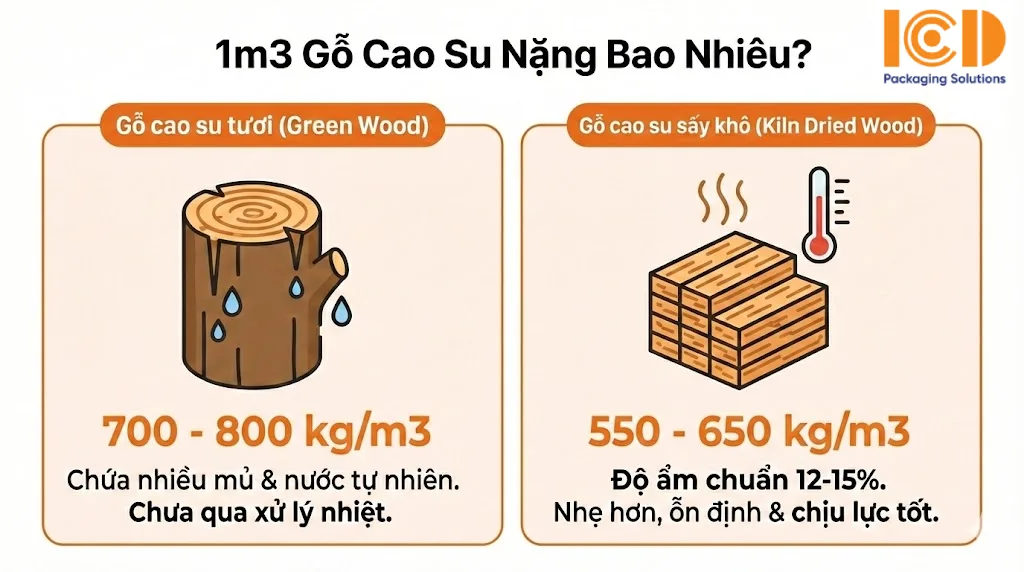
For an accurate calculation we need to look at rubberwood by its processing state: freshly felled wood and wood dried to working moisture.
1.1. Green rubberwood
Green rubberwood weighs about 700 - 800 kg/m³. This is wood just felled from the plantation and not yet dried, with the wood cells still full of water and possibly some latex left; the ITTO manual notes that residual latex in the wood fouls saw blades during sawing. In this state the wood is very heavy and easily attacked by mould and insects if left for long.
According to research published in the journal Maderas (SciELO, 2023), freshly felled rubberwood has a moisture content of about 60%. The green wood weight is the figure plantation owners and traders commonly use to work out the load of trucks carrying raw timber from the plantation to the sawmill.
1.2. Kiln-dried rubberwood
Kiln-dried rubberwood weighs about 550 - 650 kg/m³ at 12-15% moisture. This is the figure purchasing and logistics teams need: after drying the water is drawn out so the weight drops noticeably, the wood is more dimensionally stable and mechanically stronger than when green. Using dried wood reduces the tare weight of a shipment and so saves transport cost.
1.3. Why does each lot of rubberwood weigh differently?
The weight of rubberwood varies with the age of the tree, the clone and the moisture content, so sources give different ranges. The Forest Research Institute Malaysia (FRIM) records rubberwood density at 480 - 650 kg/m³ depending on tree age and clone. A study in the journal Maderas measured an apparent density of 560 - 650 kg/m³ in the rubber clones surveyed. The table below groups the figures by the exact state of the wood each source publishes.
| Source | State of the wood | Density (kg/m³) |
|---|---|---|
| ITTO, Rubberwood Processing Manual | Basic specific gravity (oven-dry weight divided by green volume) | 450 - 550 |
| ITTO, Rubberwood Processing Manual | Air-dry | 560 - 640 |
| FRIM (Malaysia) | Depends on tree age and clone | 480 - 650 |
| Maderas (SciELO, 2023) | Apparent density | 560 - 650 |
| The Wood Database | 12% moisture, average | 595 |
| TCVN 12619-2:2019 | The public version does not state the moisture content | 550 (0.55 g/cm³) |
| Level used in this article (commercial dried wood) | 12-15% moisture | 550 - 650 |
| Level used in this article (green wood) | Freshly felled, about 60% moisture | 700 - 800 |
2. Why do you need to know the density of rubberwood?
Knowing the density lets you convert accurately between tonnes and cubic metres when buying and selling, choose the right truck, and work out whether a container reaches its weight limit or its volume limit first.
Knowing the kg/m³ figure is not only a technical matter but a direct economic problem for a business. When working out freight, knowing the exact weight helps pick the right truck: a wrong calculation can bring an overload fine, or waste money on a truck that is too large for the real load.
For containerised goods, a 40-foot high cube container carries a maximum of about 28.6 tonnes according to the Hapag-Lloyd specification. If pallets are made from green or insufficiently dried wood, the weight of the pallets takes up a significant part of the permitted load and reduces the amount of cargo that can be loaded. Rubberwood pallets built from dried and treated wood keep the tare weight low; when ordering, state the target wood moisture content in the order so both sides agree.

2.1. How many cubic metres is 1 tonne of rubberwood?
Green rubberwood is usually bought by the tonne at the plantation, while dried sawn wood is sold by the cubic metre, so a conversion through density is needed: cubic metres = 1,000 kg divided by the density. For green wood, 1 tonne is about 1.43 m³ if the wood weighs 700 kg/m³, 1.33 m³ at 750 kg/m³ and 1.25 m³ at 800 kg/m³. For dried wood, 1 tonne is about 1.82 m³ at 550 kg/m³, 1.67 m³ at 600 kg/m³ and 1.54 m³ at 650 kg/m³.
Going the other way, 1 m³ of green rubberwood weighs 0.70 - 0.80 tonnes and 1 m³ of dried wood weighs 0.55 - 0.65 tonnes. So for the same tonne, dried wood gives about 25% more cubic metres than green wood; when comparing prices between goods sold by the tonne and goods sold by the cubic metre, bring both to the same unit and the same wood state.
2.2. Does a container reach its weight limit or volume limit first?
With dried rubberwood, a 20-foot standard container usually fills its volume before reaching its weight limit, while a 40-foot high cube container reaches its weight limit before it is full. According to Hapag-Lloyd container specifications (read 17/10/2026), a 20-foot standard container carries a maximum of 28,130 kg with a capacity of 33.2 m³; a 40-foot high cube carries a maximum of 28,600 kg with a capacity of 76.3 m³. Other shipping lines may publish slightly different figures, so check with the carrier for your shipment.
| Container | Maximum payload | Capacity | Dried wood 600 kg/m³ | Green wood 750 kg/m³ |
|---|---|---|---|---|
| 20-foot standard | 28,130 kg | 33.2 m³ | 33.2 m³ weighs about 19.9 tonnes: volume fills first | 33.2 m³ weighs about 24.9 tonnes: still within the payload |
| 40-foot high cube | 28,600 kg | 76.3 m³ | Reaches the payload limit at about 47.7 m³ | Reaches the payload limit at about 38.1 m³ |
The figures above are the container limits; on the road, total load must also respect the permitted load of the truck and the roads and bridges, so in practice less is usually carried. The tare weight of the pallets and dunnage also counts toward the payload.
3. Comparing the weight of rubberwood with other timbers
At the same 12% moisture, rubberwood (595 kg/m³) is heavier than common imported pine species such as radiata pine (515 kg/m³) but lighter than the three-needle pine (610 kg/m³) and resin pine (710 kg/m³) that grow in Vietnam, according to The Wood Database. According to TCVN 12619-2:2019, rubberwood (0.55 g/cm³) is close to acacia (0.57 - 0.59 g/cm³) and lighter than eucalyptus (0.65 - 0.78 g/cm³).
Rankings by species alone are unreliable: imported pine is lighter than rubberwood, but domestic three-needle and resin pine are heavier; and acacia varies a lot with tree age, with FRIM recording Acacia mangium at 290 - 675 kg/m³, rising with age.
For pallets, the main difference between timbers lies in natural durability and treatment more than weight. The Wood Database rates rubberwood as non-durable, so rubberwood for pallets must be treated with preservative and dried soon after the tree is felled. Rubberwood has a volumetric shrinkage from green to oven-dry of about 7.5% and a Janka hardness of about 4,280 N, suitable for warehouse pallets and sea-freight export goods when properly treated.
4. Formula for the weight of one rubberwood pallet
The weight of a rubberwood pallet is the total wood volume of the pallet times the density at the exact moisture content of the wood: Weight = Total wood volume (m³) x Density (kg/m³). This lets warehouse staff or buyers quickly check goods on receipt; a pallet that is unusually heavy against the calculation is usually a sign the wood has not been dried enough.
With dried wood at about 600 kg/m³, a pallet using 0.03 m³ of wood weighs about 18 kg, 0.04 m³ about 24 kg and 0.05 m³ about 30 kg. If the same amount of wood is green (about 750 kg/m³), the pallets weigh about 22.5 kg, 30 kg and 37.5 kg respectively, that is 4.5 - 7.5 kg heavier each. Pallets built for heavy loads use more wood: for example the Asian standard wooden pallet 1200 x 1000 x 156 mm on the ICD Vietnam product page weighs about 30 kg ±5%, equivalent to about 0.05 m³ of dried wood.
For 20 pallets of this kind, the difference between green and dried wood is about 150 kg, enough to affect load calculations when packing heavy goods. You can use the tool below to quickly convert between cubic metres and tonnes for your lot of wood.
Tip: the lighter a pallet is while still stiff enough and rated for the load, the more it saves on transport cost, especially for long-distance export orders.
5. Conclusion
To calculate load correctly, use 550 - 650 kg/m³ for dried rubberwood and 700 - 800 kg/m³ for green wood, then adjust to the actual weighing of the lot.
Rubberwood is only dimensionally stable, resistant to warping and protected from termites and borers when treated with preservative and dried to a suitable moisture content. If you are looking for a rubberwood pallet solution for your warehouse or export goods, contact ICD Vietnam for advice on specification, load rating and ISPM 15 treatment requirements; export pallets are treated and stamped with the IPPC mark through a licensed treatment provider.
Frequently asked questions
How many kg does 1 m³ of green rubberwood weigh?
About 700 - 800 kg/m³, because freshly felled wood still holds a lot of water, with a moisture content of about 60%. This figure is consistent with the estimate from the ITTO basic specific gravity of 450 - 550 kg/m³.
How many kg does 1 m³ of dried rubberwood weigh?
About 550 - 650 kg/m³ at 12-15% moisture. The Wood Database gives an average of 595 kg/m³ at 12% moisture and ITTO gives 560 - 640 kg/m³ air-dry.
Why do you need the exact weight of rubberwood per m³?
To convert between tonnes and cubic metres when trading, choose the right truck, work out transport costs and know whether a container reaches its weight limit or volume limit first.
How many cubic metres is 1 tonne of rubberwood?
1 tonne of green rubberwood (700 - 800 kg/m³) is about 1.25 - 1.43 m³; 1 tonne of dried rubberwood (550 - 650 kg/m³) is about 1.54 - 1.82 m³. Formula: cubic metres = 1,000 divided by the density of the lot.
How long does rubberwood take to dry to standard moisture?
It depends on board thickness and drying method. A study in the journal Maderas dried rubberwood boards naturally to about 15% moisture in a minimum of 10 days; kiln drying is usually faster. FRIM advises not leaving wood more than 2-3 days after felling before sawing, or it needs anti-fungal treatment.
Is rubberwood heavier or lighter than acacia?
The two are close. According to TCVN 12619-2:2019, rubberwood is 0.55 g/cm³, hybrid acacia 0.57 and earleaf acacia 0.59 g/cm³. Acacia varies a lot with tree age: FRIM records Acacia mangium at 290 - 675 kg/m³, rising with age, so young acacia can be lighter than rubberwood.
Is rubberwood heavier than pine?
Heavier than imported pine but lighter than domestic pine. At 12% moisture, The Wood Database gives rubberwood 595 kg/m³, radiata pine 515 kg/m³, three-needle pine 610 kg/m³ and resin pine 710 kg/m³.
How many cubic metres of rubberwood can a 40-foot container carry?
A 40-foot high cube container has a capacity of 76.3 m³ but a maximum payload of about 28.6 tonnes according to Hapag-Lloyd, so it carries only about 47.7 m³ of dried wood at 600 kg/m³ or 38.1 m³ of green wood at 750 kg/m³ before reaching the payload limit.
Contact ICD Vietnam for a quote
- Hotline 1: 0983 797 186
- Hotline 2: 0903 459 186
- Hotline 3: 0905 859 186
South Vietnam: 098 6784 186. Hanoi warehouse: 3rd Floor, Thang Long A1 Building, Bau Hamlet, Thien Loc Commune. Southern workshop: 551/212 Le Van Khuong Street, Tan Thoi Hiep Ward, District 12, Ho Chi Minh City. Price: contact for a quote, with volume discounts.
References
- Basic specific gravity, air-dry density, harvesting cycle, residual latex when sawing: ITTO, Rubberwood Processing Manual.
- Density of rubberwood and Acacia mangium, time from felling to sawing: FRIM, Timber Technology Bulletin No. 26.
- Average weight at 12% moisture, shrinkage, hardness, natural durability: The Wood Database, Rubberwood (Hevea brasiliensis); radiata, three-needle and resin pine from the same source.
- Moisture of freshly felled wood, apparent density, drying time: Maderas Ciencia y tecnologia (SciELO, 2023).
- Density of rubberwood, acacia, pine, eucalyptus: TCVN 12619-2:2019 Timber - Classification - Part 2: By physical and mechanical properties.
- Payload and capacity of 20-foot standard and 40-foot high cube containers: Hapag-Lloyd, Container specifications (read 17/10/2026).
- ICD Vietnam, specifications of the Asian standard wooden pallet 1200 x 1000 x 156 mm on the product page (October 2026).