Table of Contents
- What is the GMA standard and what exactly does it specify?
- Applying the standard in the wooden pallet industry, and its scope
- Why does the GMA standard matter to the wooden pallet industry?
- Challenges and points to note when applying the GMA standard
- How do you know whether a supplier complies with the GMA standard?
- Conclusion
- Frequently asked questions
- What are the dimensions of a pallet under the GMA standard?
- Is GMA an official standard issued by an international body?
- How many boards does a GMA pallet usually have?
- What is the maximum load of a GMA pallet in kg?
- How do GMA pallet grade A and grade B differ?
- How high is a GMA pallet?
- Can wooden pallets exported to the US be fumigated with methyl bromide?
- Do pressed wood pallets need ISPM 15 treatment when going to the US?
- Contact us for advice on GMA-standard wooden pallets
- References
Reviewed and updated by ICD - Week 43/2026
The GMA standard is the 48 x 40 inch (1219 x 1016 mm) stringer pallet specification used across the North American consumer goods industry: 3 notched stringers, 7 top deckboards, 5 bottom deckboards, about 121 mm high, using about 0.032 m³ of timber. A wooden pallet shipped to the US or Canada must also be treated and marked under ISPM 15.
In the North American supply chain, the wooden pallet is the main load carrier, and the GMA standard (Grocery Manufacturers Association) is the specification almost every warehouse, truck and line there is designed around. This article brings together the dimensions, construction, weight, load capacity and quarantine requirements of the GMA pallet, plus how to inspect a sample when you order pallets made in Vietnam.
What is the GMA standard and what exactly does it specify?
GMA is an industry standard for pallet dimensions and layout shaped by the Grocery Manufacturers Association of the United States; in 2020 the association was renamed the Consumer Brands Association, but the name GMA pallet is still used in trade.
The GMA standard is not an official standard issued by a standards body such as ISO, but a de facto standard formed and widely applied by the North American grocery and consumer goods industry. It exists so that pallets used in the warehouses, transport and supply chains of grocery producers and distributors share one specification. The main dimension is 48 inches x 40 inches (1219 mm x 1016 mm), which is also the most common pallet size in North America.
In design terms, the GMA pallet belongs to the partial 4-way entry group: a forklift enters from all four sides thanks to the notches cut in the stringers, while a hand pallet truck enters only from the two 40 inch edges. A 48 x 40 inch pallet can be built as a stringer (longitudinal beam) or block pallet (stringer vs block construction), but the standard GMA layout is the stringer type with 3 notched stringers.
The top deck usually has 7 boards and the bottom deck 5; board spacing and thickness are chosen so the pallet is strong enough and rated for its load. The pallet is designed to carry and store heavy food and consumer goods, but the specific load depends on the design and how it is stored, as covered in the load section below.
The description above is general. When you order pallets from a workshop, you need to convert it to the dimensions of each component in millimetres, as in the next two sections.
What components does a wooden GMA pallet have?
A wooden GMA pallet has 15 components: 3 stringers 1219 mm long, and 7 top deckboards and 5 bottom deckboards 1016 mm long, joined with 84 nails. There is no single licensed GMA drawing; workshops keep the common layout and adjust board thickness and wood species to the required load. The table below is the reference layout from an analysis in the Pallet Design System software of the US National Wood Pallet and Container Association (NWPCA, now renamed Woodpack Global):
| Component | Quantity | Size (mm) | Size (inch) | Nails |
|---|---|---|---|---|
| Top lead boards | 2 | 16 x 140 x 1016 | 5/8 x 5-1/2 x 40 | 3 nails per joint, 18 nails |
| Top middle boards | 5 | 16 x 89 x 1016 | 5/8 x 3-1/2 x 40 | 2 nails per joint, 30 nails |
| Notched stringers | 3 | 35 x 89 x 1219 | 1-3/8 x 3-1/2 x 48 | - |
| Bottom lead boards | 2 | 16 x 140 x 1016 | 5/8 x 5-1/2 x 40 | 3 nails per joint, 18 nails |
| Bottom middle boards | 3 | 16 x 89 x 1016 | 5/8 x 3-1/2 x 40 | 2 nails per joint, 18 nails |
The nails used in a GMA pallet are usually helically threaded nails about 57 mm (2-1/4 inch) long, with a shank of about 2.8 mm, driven at least about 32 mm into the stringer. Each stringer has 2 notches 229 mm long and about 32 mm deep, starting 152 mm from the end of the stringer; the 3 middle bottom boards are pushed into the space between the two notches so they do not block the path of the forks. Total height is 16 + 89 + 16 = 121 mm; with thicker boards the pallet reaches about 152 mm.
For the stringer notches, the Uniform Standard for Wood Pallets (the common rulebook of the US wood pallet industry, cited by pallet.design) recommends a notch opening about 51 mm (2 inches) high and about 229 mm (9 inches) long, rounded notch corners, and a flat section of at least about 178 mm (7 inches) between the two notches. A notch cut at a right angle is not accepted because the sharp corner is where a stringer tends to crack under load. With a 1219 mm stringer and notches starting 152 mm from the end, the flat section in the middle is about 457 mm, well above the minimum.

How many kg does a wooden GMA pallet weigh?
A wooden GMA pallet usually weighs 14 - 32 kg; with the standard layout using about 0.032 m³ of timber, the weight depends mainly on the wood species and its moisture. According to the PDS design analysis published by pallet.design, a mixed hardwood GMA pallet weighs about 27 kg (59 lb) when built from green wood and about 18 kg (39 lb) with kiln-dried wood.
Converted to the wood species commonly used for pallets in Vietnam, with the same 0.032 m³ of timber: kiln-dried radiata pine (density about 515 kg/m³) gives a pallet of about 16.5 kg; kiln-dried rubberwood (about 595 kg/m³) about 19 kg; acacia mangium at 15% moisture (467 - 675 kg/m³) about 15 - 22 kg; and green rubberwood (700 - 800 kg/m³) pushes the pallet up to about 22 - 26 kg. Densities for rubberwood and radiata pine are taken from The Wood Database; the figures for acacia mangium are from the Forest Research Institute Malaysia (FRIM). Actual weight also adds about 0.3 - 0.5 kg of nails and varies with the timber removed by the notches.
How much load does a GMA pallet carry, and what are grade A and grade B?
A GMA pallet has no single standard load rating; the load depends on the design and on how the pallet is supported. For the same reference design, the PDS analysis on pallet.design shows the pallet carrying about 2,369 kg on the floor and 1,136 kg when lifted by forklift, but only about 707 - 739 kg when placed on racking (depending on orientation). That makes racking the case that needs the most careful calculation.
Ratings such as "2,500 lb" (about 1,134 kg) often seen on sellers’ pages are self-declared figures, inconsistent between parties and not a load rating of the standard. Likewise, "grade A" and "grade B" are trading conventions: grade A usually means a pallet in good condition needing little or no repair; grade B is a repaired pallet, which may have had boards replaced or an extra stringer nailed on. Each buyer and seller may define them differently, so when ordering, state the load, the storage method (floor, racking, forklift) and the pallet condition in words instead of only giving a grade.
Applying the standard in the wooden pallet industry, and its scope
GMA applies mainly to stringer wooden pallets circulating in the consumer goods chain of the US, Canada and Mexico, and to cargo exported into that region; outside North America the common sizes are 1200 x 1000 mm or 1200 x 800 mm.
On the production side, pallet workshops supplying the North American market (the US, Canada, Mexico) and businesses exporting to that region design and build pallets to GMA dimensions and construction so they fit the existing logistics systems. GMA pallets are widely used in food and beverage, fast-moving consumer goods (FMCG), retail, pharmaceuticals and many other manufacturing sectors. Uniform dimensions matter even more for automated warehouses, conveyors and robots in large distribution centres, where an error of a few millimetres can stop a line.
GMA is concentrated in North America, but because this is a large market, GMA pallets are also used and accepted to a degree in international trade with the region. According to the summary on Wikipedia, 48 x 40 inches is the most common pallet size in North America, and 1219 x 1016 mm is also one of the 6 flat pallet sizes that ISO 6780:2003 (equivalent to Vietnam standard TCVN 9022:2011) specifies for intercontinental transport. The table below shows how many millimetres GMA differs from the other sizes, to help businesses avoid mix-ups when packing for several markets:
| Size (mm) | Where mostly used | Compared with GMA 1219 x 1016 |
|---|---|---|
| 1219 x 1016 (GMA) | North America | Reference standard |
| 1200 x 1000 | Europe, Asia | 19 mm shorter and 16 mm narrower |
| 1200 x 800 (EUR) | Europe | 19 mm shorter, 216 mm narrower |
| 1100 x 1100 | Asia | 119 mm shorter, 84 mm wider |
| 1067 x 1067 | North America, Europe, Asia | 152 mm shorter, 51 mm wider |
| 1140 x 1140 | Australia | 79 mm shorter, 124 mm wider |
The 16 - 19 mm difference between GMA and a 1200 x 1000 mm pallet looks small but is enough to leave a pallet misaligned on rack beams or jammed on an automated conveyor set for 48 x 40 inches. In Australia, the pallet common on the market is 1165 x 1165 mm, but the size listed in ISO 6780:2003 (TCVN 9022:2011) is 1140 x 1140 mm.

Why does the GMA standard matter to the wooden pallet industry?
The GMA standard matters because warehouses, racking, forklifts and automated lines in North America are all designed around the 48 x 40 inch size; a pallet that departs from it is likely to be refused or to be repacked at the destination port.
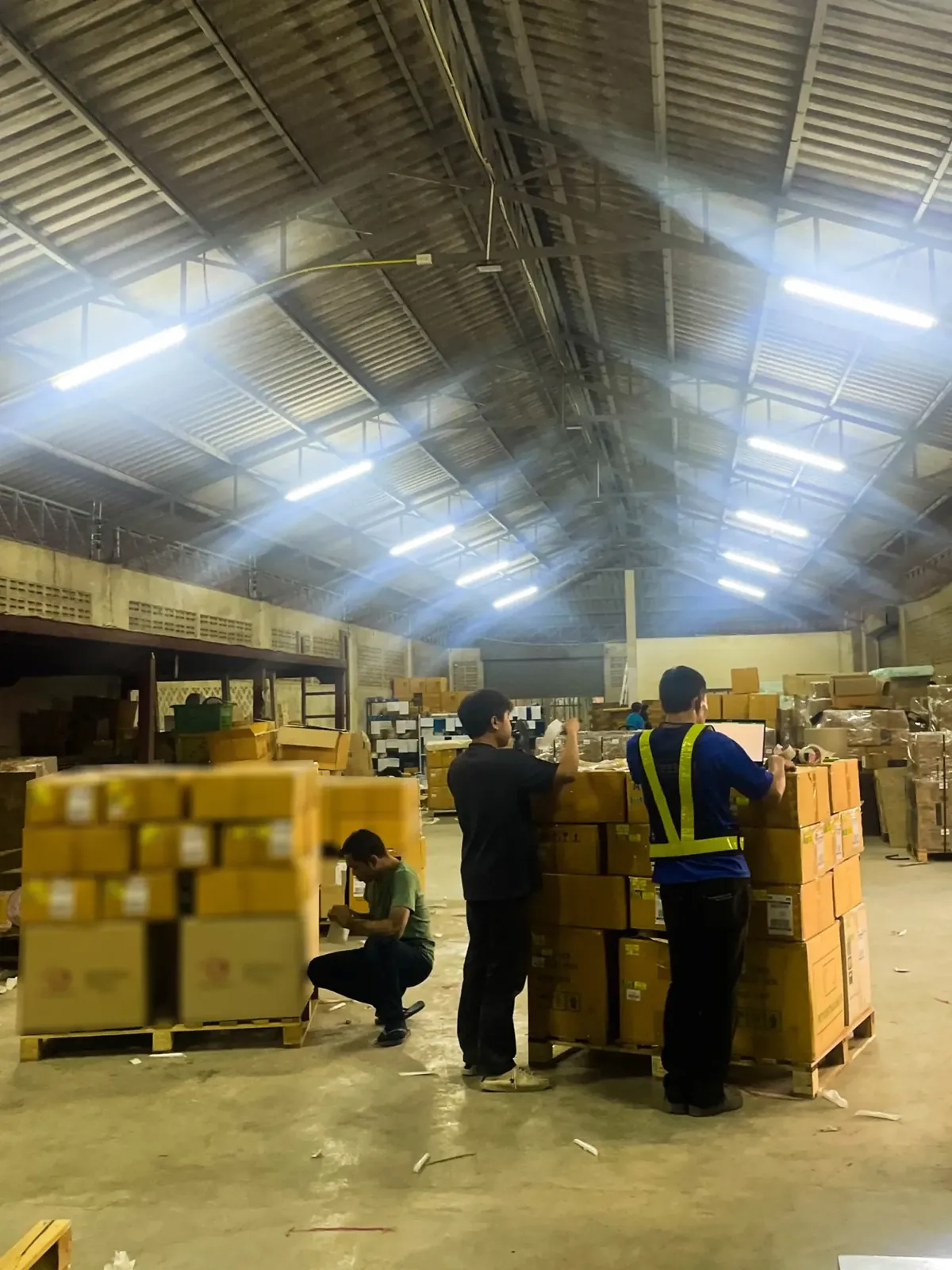
The first benefit is logistics: uniform dimensions let you fill trucks, containers and warehouses fully, cutting transport and storage cost, especially for high-volume distribution cargo. The second is equipment compatibility, because a GMA pallet runs on most forklifts, automated conveyors and standard racking in North American warehouses. Third, the standard dimensions and construction help hold cargo firmly on the pallet, reducing damage in transport and handling.
Because the GMA pallet is common, it is also easy to exchange, trade, repair and place in pallet reuse programmes, creating a closed loop in the supply chain. For a Vietnamese exporter, building to GMA exactly also shows partners that you understand the requirements of their market, a plus when building a long-term relationship.
Challenges and points to note when applying the GMA standard
The biggest challenge is that GMA has no certifying body, so quality depends entirely on the producing workshop, while wooden pallets going to North America must also meet ISPM 15 to clear customs.
Because it is a de facto standard, no single body issues a GMA certificate, so pallet quality may differ between suppliers and is hard to control uniformly. Businesses need to test strength and load on a sample themselves. For wooden pallets used for export to North America, beyond GMA dimensions the pallet must be treated for plant quarantine under the ISPM 15 standard by Heat Treatment (HT) or Methyl Bromide (MB). On cost, a good GMA pallet saves money in the long run, but it still needs wood of the right quality and a correct build process, so the price cannot be compared with a pallet built any way at all.
How must GMA wooden pallets shipped to the US and Canada meet ISPM 15?
A wooden GMA pallet entering the US must be heat treated (HT, wood core at least 56 degrees C for 30 minutes) or fumigated with methyl bromide (MB), and carry the IPPC mark on at least two opposite sides. According to the US Animal and Plant Health Inspection Service (USDA APHIS), a shipment with non-compliant wood packaging will not be admitted.
The US has applied this rule since 16 September 2005 and applied it fully to all wood packaging from 5 July 2006, in coordination with Canada and Mexico, so every raw wood pallet going to North America is subject to inspection. The IPPC mark contains the country code (for example VN-xxx), the treatment facility code and the symbol HT or MB; a treatment certificate cannot replace the mark on the pallet. Non-compliant wood packaging, or packaging with live wood-boring insects, will be re-exported at the importer’s cost, causing delay and storage charges.
Exempt are packaging made entirely of wood processed with glue, heat or pressure such as plywood, particleboard and OSB, and wood no thicker than 6 mm; a composite pallet with natural wood legs or stringers must still have the natural wood treated. The detailed rule is in 7 CFR 319.40-3 of the US Code of Federal Regulations; cargo going to Canada and Mexico follows the same ISPM 15 standard under the trilateral agreement of the North American Plant Protection Organization.
How do you know whether a supplier complies with the GMA standard?
The surest way is to inspect a sample pallet against specific measurements: dimensions, height, number of boards, notch position, wood moisture and the ISPM 15 mark, instead of relying on a promise.
When choosing a supplier, I suggest checking five things: whether the dimensions are exactly 48 x 40 inches (1219 x 1016 mm); whether the design has 4-way entry and the board count and spacing of the GMA layout; whether export pallets carry a clear ISPM 15 mark; whether the supplier has built pallets for cargo going to North America before; and whether they can advise on GMA requirements and related standards. Those criteria turn into an acceptance checklist when you receive a sample pallet or inspect a batch:
- Dimensions 1219 x 1016 mm: measure both directions and both diagonals with a tape.
- Height about 121 mm or the level the customer requires: measure at all 4 corners.
- 7 top boards and 5 bottom boards: count them and check the gaps between boards.
- Stringer notch 229 mm long, about 32 mm deep, 152 mm from the end, rounded corners: try sliding forks in from the 48 inch edge.
- Wood moisture to the level stated in the order: measure with a handheld wood moisture meter.
- IPPC mark clear on 2 opposite sides: check the treatment facility code on the mark.
A wooden pallet that fails quarantine can get a shipment refused entry and cause re-export costs, so the mark check should be done before container loading.

Conclusion
The GMA standard is the common specification of the North American wooden pallet industry, letting cargo pass through warehouses, trucks and lines there without repacking. For a Vietnamese business, knowing GMA together with ISPM 15 is the condition for cargo to clear customs in this market and be received on time.
From our experience, we advise businesses to work with a supplier that is willing to write the specifications into the order and let you measure a sample before a large quantity is built.
See also: ISO 6780:2003 | exporting wooden pallets to the US

Frequently asked questions
What are the dimensions of a pallet under the GMA standard?
A GMA pallet is 48 inches x 40 inches (1219 mm x 1016 mm), the most common size in North America.
Is GMA an official standard issued by an international body?
No. GMA (Grocery Manufacturers Association, now the Consumer Brands Association) is a de facto standard formed by the North American grocery and consumer goods industry, not an ISO standard, and there is no separate certificate.
How many boards does a GMA pallet usually have?
A GMA pallet usually has 7 top boards and 5 bottom boards, stringer type with 3 notched stringers and partial 4-way entry: a forklift enters from four sides, a hand pallet truck only from the two 40 inch edges.
What is the maximum load of a GMA pallet in kg?
There is no single standard load rating for every GMA pallet. For one reference design analysed with the Pallet Design System, the pallet carries about 2,369 kg on the floor, 1,136 kg when lifted by forklift, but only about 707 - 739 kg on racking. When ordering, state the load and the storage method so the workshop can choose a suitable board thickness.
How do GMA pallet grade A and grade B differ?
This is a trading convention, not part of the standard. Grade A usually means a pallet in good condition needing little or no repair; grade B is a repaired pallet, which may have had boards replaced or an extra stringer nailed on. State the specific pallet condition in the order, because each party may define it differently.
How high is a GMA pallet?
A GMA pallet of standard layout is about 121 mm (4-3/4 inches) high, made up of 16 mm top boards, 89 mm stringers and 16 mm bottom boards. A design using thicker boards can reach about 152 mm (6 inches).
Can wooden pallets exported to the US be fumigated with methyl bromide?
Yes. The US accepts both heat treatment (HT) and methyl bromide fumigation (MB) under ISPM 15. If the pallet may be reused for cargo going to Europe, choose heat treatment: the EU has banned methyl bromide within the bloc since 18 March 2010 (it still accepts imported pallets correctly treated by HT or MB under ISPM 15), and EPAL pallets may only be heat treated.
Do pressed wood pallets need ISPM 15 treatment when going to the US?
No, if the pallet is made entirely of wood processed with glue, heat or pressure such as plywood, particleboard or OSB, or of wood no thicker than 6 mm. A composite pallet with natural wood legs or stringers must still have the natural wood treated and marked.
Contact us for advice on GMA-standard wooden pallets
For advice on building 48 x 40 inch wooden pallets for cargo going to North America, send ICD Vietnam your cargo weight, how you store it (floor or racking), the quantity and your ISPM 15 treatment requirements. ICD Vietnam has a Hanoi warehouse and a southern workshop (551/212 Le Van Khuong Street, Tan Thoi Hiep Ward, District 12, Ho Chi Minh City). Wooden pallet price: contact for a quote by size, load and quantity.
For advice on building 48 x 40 inch wooden pallets for cargo going to North America, send ICD Vietnam your cargo weight, how you store it (floor or racking), the quantity and your ISPM 15 treatment requirements.
ICD Vietnam Industrial Production Co., Ltd
North Vietnam: 3rd Floor, Thang Long A1 Building, Bau Hamlet, Thien Loc Commune, Hanoi - 0983 797 186 / 090 345 9186 / 090 5859 186
South Vietnam: 551/212 Le Van Khuong Street, Tan Thoi Hiep Ward, District 12, Ho Chi Minh City - 098 6784 186
Email: sales@icdvietnam.com.vn
Zalo: Chat with ICD Vietnam on Zalo
References
- Construction, weight, load capacity and grades of the GMA pallet - pallet.design (GMA Pallet; Stringer Pallet, citing the Uniform Standard for Wood Pallets).
- Pallet design analysis software - Pallet Design System, Woodpack Global (formerly NWPCA).
- North American pallet dimensions - Wikipedia, Pallet article; the 6 sizes of ISO 6780:2003 - TCVN 9022:2011.
- Requirements for wood packaging imported into the US - US Animal and Plant Health Inspection Service (USDA APHIS) and 7 CFR 319.40-3.
- ISPM 15 Regulation of wood packaging material in international trade, section 2.1 Exemptions - IPPC.
- EU rules on methyl bromide and imported wood packaging - European Commission.
- Density of rubberwood and radiata pine - The Wood Database.
- Density of acacia mangium - Timber Technology Bulletin No. 26, Forest Research Institute Malaysia (FRIM).