Table of Contents
- Are pressed wood (plywood) pallets really the best choice for export?
- What are pressed wood (plywood) pallets? The types on the market
- Construction and manufacturing process of pressed wood pallets
- Real advantages and drawbacks of pressed wood pallets
- Pressed wood compared with natural wood and plastic pallets
- Applications of pressed wood pallets across industries
- Common sizes and pressed wood pallet price list 2026
- How to choose and store pressed wood pallets correctly
- When should you not use a pressed wood pallet?
- Conclusion
- Frequently asked questions
- Are pressed wood pallets and plywood pallets the same thing?
- Do pressed wood pallets really need no fumigation for export?
- How many kg can a pressed wood pallet carry?
- How many times can a pressed wood pallet be reused?
- Does ICD Vietnam make pressed wood pallets to custom sizes?
- Do plywood crates need fumigation?
- Where is the IPPC mark placed on a pallet with a plywood deck and sawn timber legs?
- Is there a double-deck pressed wood pallet?
- How should used pressed wood pallets be handled?
- Contact ICD Vietnam
- References
Reviewed and updated by ICD - Week 43/2026
Pressed wood pallets are popular mainly because, when they are made entirely of processed wood (plywood, particleboard, OSB, pressed sawdust), they fall outside the scope of ISPM 15: no fumigation and no IPPC mark for export. The two pressed sawdust pallet models ICD Vietnam sells carry a 2,000 kg dynamic load and a 6,000 kg static load, and the 1000 x 1000 x 90 mm model weighs about 15 kg.
Quick summary:
- Pressed wood pallets (also called plywood pallets or board pallets) are made from wood chips, sawdust or thin wood veneers bonded with resin under heat and high pressure.
- The biggest advantage is that no ISPM 15 treatment is needed when the whole pallet is processed wood. They also have a flat deck, no nails (the moulded type) and nest compactly when empty.
- The drawbacks are poor water resistance, few reuse cycles, difficult repair, and the need to ask separately about rack load.
- Price: contact for a quote, based on size, construction and quantity.
Are pressed wood (plywood) pallets really the best choice for export?
Pressed wood pallets are the best choice for one-way export cargo with an evenly spread load within the pallet’s published rating. They are not the right choice for very heavy cargo, damp environments or many round trips. The advantage natural wood pallets cannot offer is that they sit outside the scope of ISPM 15, as long as the whole pallet is made of processed wood.
In practice this means you do not wait for heat treatment or fumigation of the pallet, and you do not pay for treatment and IPPC marking of the pallet itself. A phytosanitary certificate for the goods (where the importing country requires one) is a separate procedure and does not depend on the type of pallet.
This article covers construction, pros and cons, how pressed wood compares with natural wood and plastic pallets, the sawdust pallet models ICD Vietnam currently sells, and how to choose the right pressed wood pallet for each type of cargo.
After making pallets since 2011, we still see many customers confuse "pressed wood" with "plywood". In practice the two names are often used for the same group of products: pallets made from engineered wood instead of solid timber. Understanding how this pallet behaves helps a business cut packaging costs, especially on large export volumes. Even so, pressed wood is not always the best option; in some situations natural wood or plastic is the better fit.
What are pressed wood (plywood) pallets? The types on the market
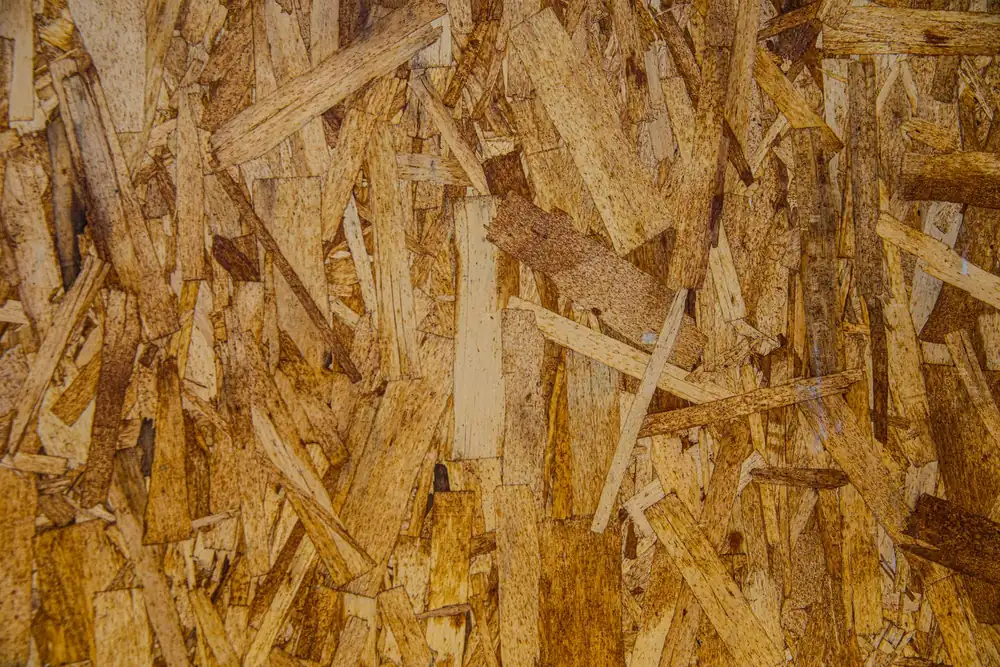
A pressed wood pallet is made from wood waste, sawdust, wood chips or thin layers of wood (veneer), mixed with or coated in resin and pressed under heat and high pressure.
Because the raw material has been processed with resin, heat and pressure, ISPM 15 excludes this kind of pallet from its scope. The condition is that the whole pallet is made of processed wood; if any part is solid sawn timber, that part must still be treated under ISPM 15.
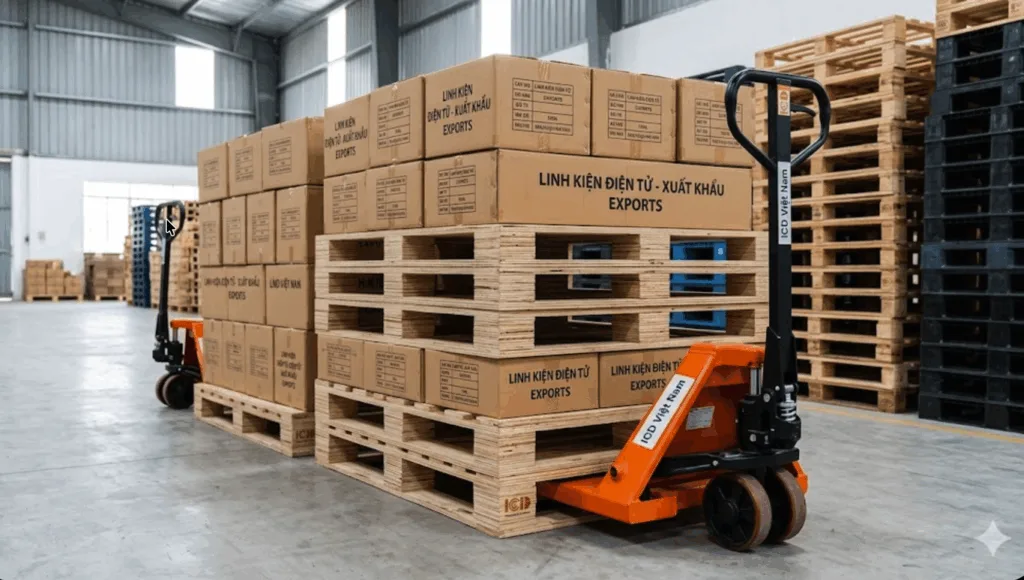
Two main types are often confused. The first is the presswood pallet (in Vietnam usually called a sawdust pallet), made from finely ground sawdust and wood chips mixed with thermosetting resin and pressed in a mould into a single block.
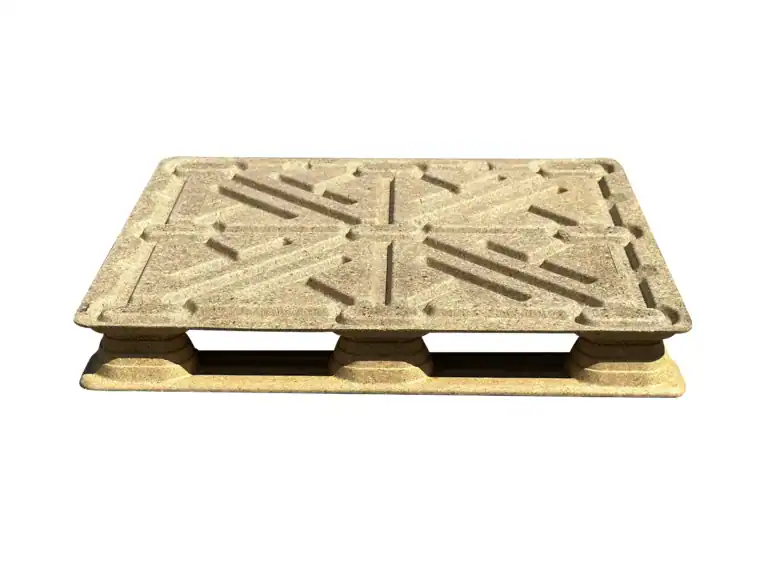
This type is easy to recognise: a smooth, uniform surface with no wood grain, and usually 9 legs moulded as one piece. The second type is the plywood pallet, which uses thin layers of wood laid at right angles and glued into sheets, then assembled with blocks or stringers of plywood or compressed sawdust. A plywood pallet still shows wood grain on its surface and is usually tougher than a presswood pallet under impact.
Both types share the biggest advantage: no treatment is required when used for export cargo. Section 2.1 of ISPM 15 lists the exempt items: packaging made entirely of processed wood such as plywood, particleboard, OSB or veneer produced with glue, heat, pressure or a combination of these; packaging made entirely of thin wood 6 mm thick or less; and sawdust, wood shavings and wood wool. The Canadian Food Inspection Agency (CFIA) adds that processed wood includes fibre board, meaning the MDF group of boards.
Construction and manufacturing process of pressed wood pallets
A pressed wood pallet has two parts: a flat deck that carries the goods and a leg system underneath.
In a presswood pallet the deck and legs are pressed in one mould as a single block. ICD Vietnam’s single-deck line uses hollow cup legs so empty pallets nest into each other when stacked, while the double-deck line adds bottom runners to give a flat underside. In a plywood pallet the deck is a plywood sheet and the legs are assembled plywood blocks or compressed sawdust blocks.
A one-piece presswood pallet uses no nails or metal staples, so there is no risk of a nail working loose, tearing packaging or injuring handlers. A plywood pallet assembled from separate sheets and legs is usually still fastened with nails or staples.
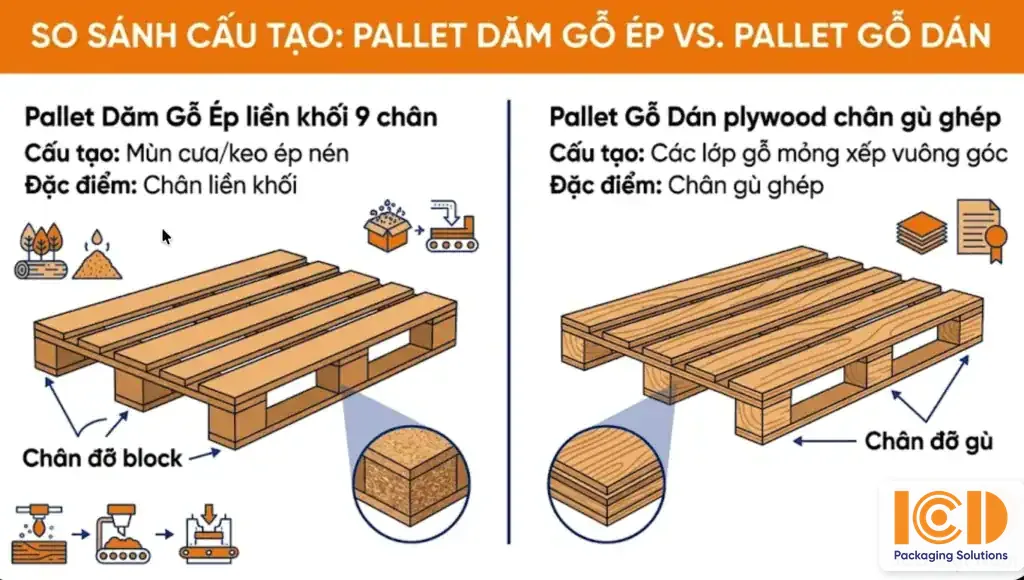
Making a presswood pallet takes four steps. Wood waste, sawdust and chips are ground fine and dried. The dry chips are mixed evenly with thermosetting resin; for particleboard in general, the resins commonly used are urea formaldehyde or phenol formaldehyde. The mixture is spread into a mould and pressed at high temperature and pressure until the resin cures. Finally, the finished pallet is checked for dimensions and load; because it is already processed wood, no fumigation step is added.
For plywood pallets the raw material is thin veneers peeled from round logs. The veneers are stacked with the grain at right angles, usually in an odd number of layers (3, 5, 7 and so on), then glued under heat and pressure. This cross-grain layout is what keeps plywood dimensionally stable and less prone to warping than sawn timber under normal conditions.
Real advantages and drawbacks of pressed wood pallets
Pressed wood pallets have 6 advantages (exempt from ISPM 15, moderate weight, a gentle price, dry, flat, nestable) and 4 limits (poor water resistance, rack load must be asked separately, few reuse cycles, hard to repair). Below is the assessment from a supplier’s point of view, with figures from the models ICD Vietnam actually sells.
The first and biggest advantage is that nothing has to be treated for export, which saves both cost and waiting time. Second, the weight is compact: the 1000 x 1000 mm single-deck model weighs about 15 kg and the 1200 x 1000 mm double-deck model weighs 22 kg, while a natural wood GMA pallet of 1219 x 1016 mm typically weighs 14 - 32 kg depending on the wood and its moisture. So pressed wood is not always much lighter; its clearest benefit is a steady weight from pallet to pallet, because the material is uniform.
Third, the price is usually gentler than a new natural wood pallet of the same size, especially once you count the ISPM 15 treatment that pressed wood does not need.
Fourth, the material has been dried and heat-pressed, so it is dry and less likely to pass mould to the cargo than untreated sawn timber. Fifth, the surface is flat and uniform, with square edges and no splinters or knots. Sixth, the cup-leg line nests when empty, so a stack of empty pallets takes much less room than the same number of natural wood pallets.
As for the drawbacks, there are 4 limits to state plainly. First, poor water resistance: a pressed wood pallet swells and delaminates if soaked or left for long in a damp place. Second, rack load is not in the published specification: the two ICD Vietnam sawdust models state a 2,000 kg dynamic load and a 6,000 kg static load, equal to or higher than ICD’s 1200 x 1000 mm wooden pallets (1,250 - 1,500 kg dynamic), but if the pallet will sit on racking, ask separately for the rack load in the exact orientation it will be placed.
Third, the number of reuse cycles is lower than for natural wood and plastic pallets; pressed wood is designed mainly for one-way cargo. Fourth, repair is hard: when a leg breaks or a corner chips, you usually have to replace the whole pallet, instead of replacing single boards as with a traditional wooden pallet.
Pressed wood compared with natural wood and plastic pallets
Against natural wood and plastic pallets, pressed wood wins on having no ISPM 15 treatment and a gentle price for one-way cargo, but it has the weakest water resistance and the fewest reuse cycles. The table puts the three side by side on the criteria businesses ask about most; the figures belong to specific models, not to the whole category.
| Criterion | Pressed / plywood pallet | Natural wood pallet | Plastic pallet |
|---|---|---|---|
| Price | Contact for a quote | Contact for a quote | Contact for a quote |
| Weight (example) | 15 kg (1000 x 1000 mm, single deck); 22 kg (1200 x 1000 mm, double deck) | 14 - 32 kg (GMA pallet 1219 x 1016 mm) | Depends on model, see each spec sheet |
| Dynamic / static load (example) | 2,000 / 6,000 kg (2 ICD sawdust models) | 1,250 - 1,500 / 4,250 - 6,000 kg (ICD 1200 x 1000 mm models) | Depends on model, see each spec sheet |
| ISPM 15 treatment for export | No, if made entirely of processed wood | Required (HT or MB, IPPC mark) | Outside the scope |
| Water resistance | Poor | Medium | Good |
| Number of reuses | Few, mainly one-way | Many, boards can be replaced | Most |
| Best suited for | One-way export, dry warehouse | Storage, heavy export cargo | Long-term storage, cold and damp rooms |
Natural wood weights per pallet.design (GMA pallet); natural wood loads from ICD Vietnam’s 1200 x 1000 mm wooden pallet product pages; pressed wood load and weight from the product pages for DD-ICD120100-100-04 and SD-ICD100100-60-04. Sizes differ, so use these only for orientation and check against the exact model you plan to buy.
A simple rule follows from the table: pressed wood pallets suit one-way export cargo best (pallets not returned), while natural wood pallets suit long-term storage and heavy cargo that needs many reuses.
If your business exports electronics, components or garments packed in cartons, lean toward pressed wood. If you export industrial machinery or heavy building materials, choose an export-standard wooden pallet made of natural wood treated to ISPM 15. Cargo near or above the published dynamic load of a pressed wood model should move to a double-deck natural wood pallet or a plastic pallet for a larger safety margin.
For cold storage, outdoor use or places where water collects, use plastic pallets because they do not absorb water. For repeated internal handling by forklift many times a day, use plastic or natural wood, because pressed wood is hard to repair and has few reuse cycles. And for cargo going to a country that applies ISPM 15 when you do not want to treat the pallet, choose a pallet made entirely of processed wood or a plastic pallet.
Applications of pressed wood pallets across industries
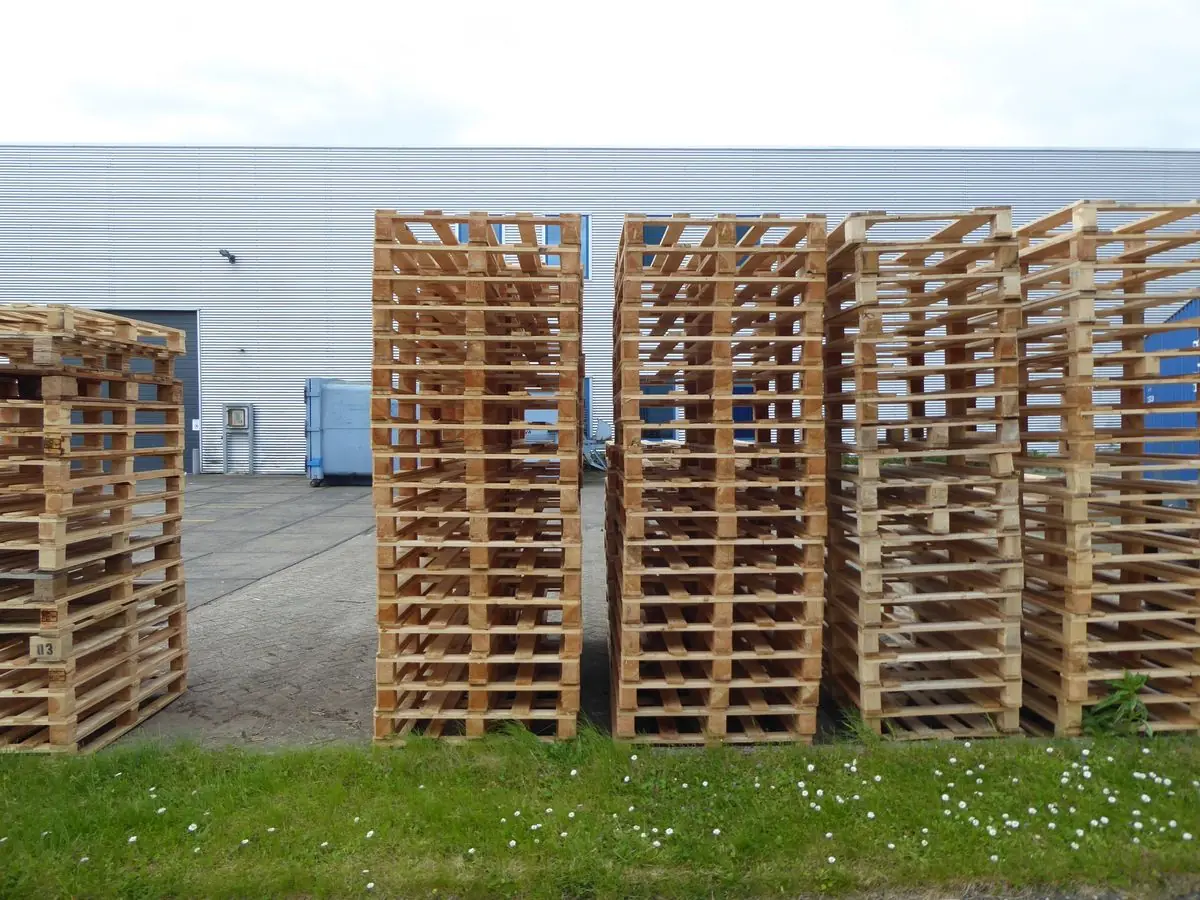
Four industries use pressed wood pallets most: electronics and refrigeration, textiles and footwear, chemicals and pharmaceuticals, and construction. These are sectors with steady export volumes that need clean pallets or cheap single-use pallets.
Electronics and refrigeration is the most common user group. Electronic goods are usually light but high in value, need clean pallets with no splinters sticking to packaging, and ship continuously in large volumes, so the ISPM 15 cost saved adds up noticeably.
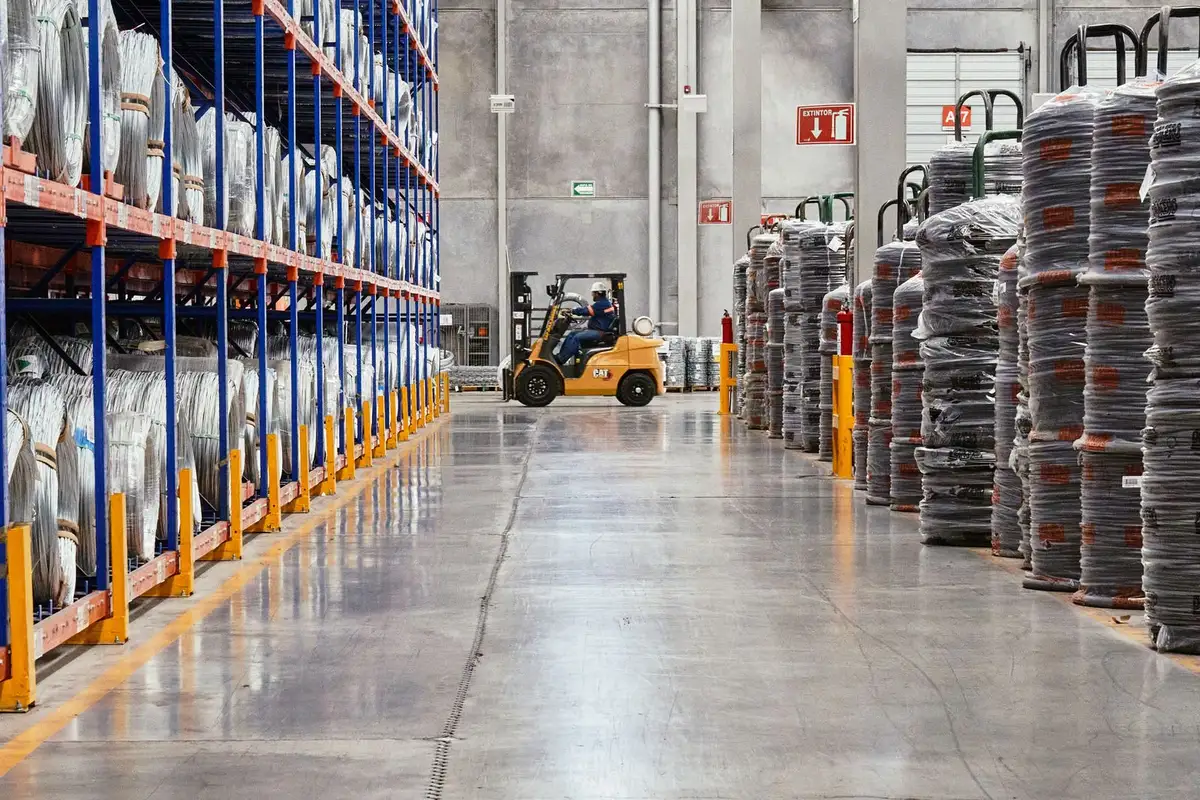
For light cargo in containers, the pallet’s own weight is worth counting. According to the product specifications, 20 single-deck sawdust pallets of 1000 x 1000 mm weigh about 300 kg, 20 double-deck pallets of 1200 x 1000 mm weigh 440 kg, and 20 natural wood GMA pallets can weigh from 280 to 640 kg depending on the wood and its moisture.
Textiles and footwear also use many: light cargo packed in cartons on pressed wood pallets is tidy in both cost and paperwork. Chemicals and pharmaceuticals favour pressed wood for its flat, easy-to-clean surface and absence of wood-boring insects; for heavy bagged chemicals, choose the double-deck line and check the load carefully. Construction uses pressed wood pallets as temporary floor boards on site, thanks to the low price and easy replacement.
Pressed wood pallets that fail after use can be collected and ground into recycling feedstock instead of being burned in the open.
Common sizes and pressed wood pallet price list 2026
ICD Vietnam currently sells pressed sawdust pallets in two lines: single-deck with cup legs (1000 x 1000, 1100 x 1100, 1150 x 1150, 1200 x 1000 and 1300 x 1100 mm) and double-deck (1100 x 1100, 1200 x 1000 and 1300 x 1100 mm). Price: contact for a quote by model, quantity and order date.
Two models have their own specification pages, DD-ICD120100-100-04 and SD-ICD100100-60-04; the table below copies the specifications on the product pages. Other sizes in the same line have different loads depending on size, so ask for the specification sheet of the exact size you plan to buy.
| ICD Vietnam model | Size (mm) | Construction | Weight | Dynamic / static load |
|---|---|---|---|---|
| DD-ICD120100-100-04 | 1200 x 1000 x 150 | Double deck, 4-way entry | 22 kg | 2,000 / 6,000 kg |
| SD-ICD100100-60-04 | 1000 x 1000 x 90 | Single deck, 9 cup legs, 4-way entry | 15 kg | 2,000 / 6,000 kg |
The price of each order varies with quantity, order date and pallet type; large orders receive a volume discount, details when you contact us for a quote.
ICD Vietnam also accepts pallet assembly to your own dimensions if you have special requirements. For moulded sawdust pallets, sizes follow the existing mould sizes above; for custom sizes, especially assembled plywood pallets, please contact us to check feasibility. To compare with the price of natural wood pallets, compare by the same size and include the ISPM 15 treatment cost if the cargo is going for export.
How to choose and store pressed wood pallets correctly
When choosing a pressed wood pallet, check the deck, the legs, the rigidity and the leg construction to be sure the pallet is exempt from ISPM 15. Not every pressed wood pallet on the market is of equal quality; when you receive a sample pallet, you can do a quick check with the steps below:
- Look at and press hard on the middle of the deck: it fails if there is a dent, a bulge, delamination or any give under your hand.
- Check all 9 legs, then put the pallet on flat ground and rock it: it fails if a leg is cracked, a corner is broken or the pallet wobbles.
- Ask what the legs are made of and look at them: solid sawn timber legs without an IPPC mark do not qualify for export.
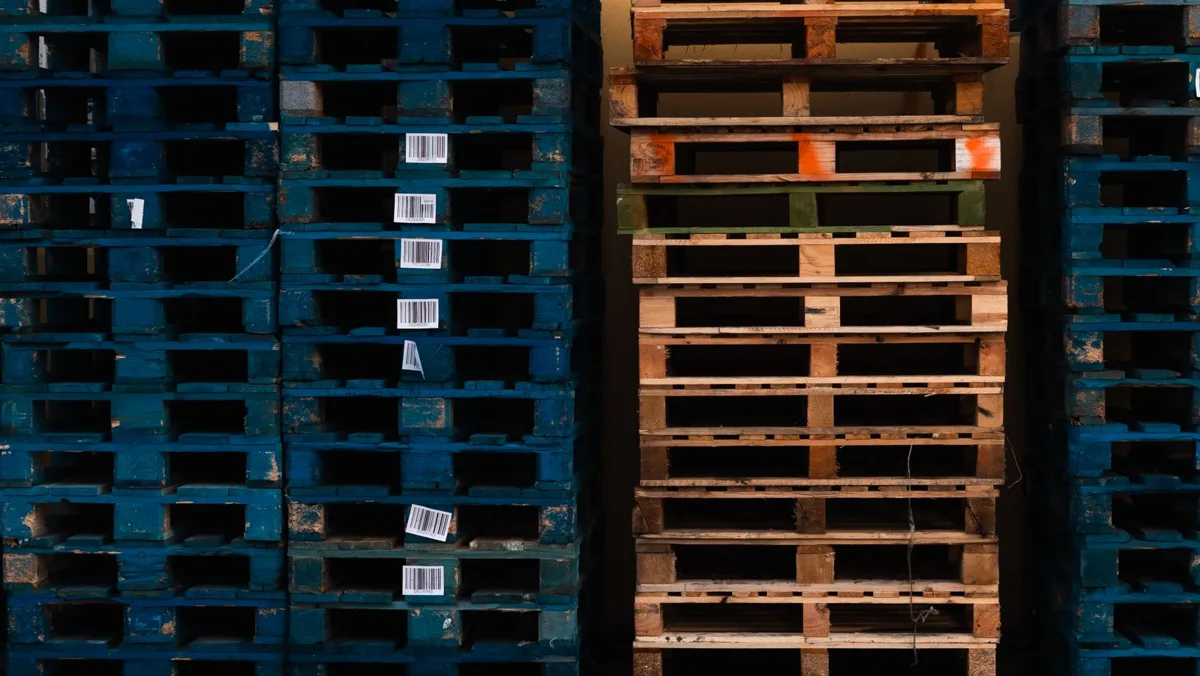
- Look at where the pallets were stored before delivery: pallets sitting on damp ground, or with water marks, show signs of absorbed moisture.
For export use, ask the supplier to confirm that the pallet is made entirely of processed wood. A pressed wood pallet does not come with an "ISPM 15 compliance certificate" in the fumigation sense; only when a pallet has solid sawn parts do those parts need treatment and the IPPC mark.
For storage, keep pressed wood pallets in a dry, airy place, raised off damp ground and away from direct contact with water. When stacking empty pallets, do not stack too high, so the legs of the bottom pallets do not deform; ask for the safe number of tiers for your exact model. If a pallet has absorbed moisture, dry it before reuse; pallets that have swollen or delaminated should be discarded and never used for heavy cargo.
When should you not use a pressed wood pallet?
Do not use pressed wood pallets for cargo above the published dynamic load, in wet environments, or for long-term storage with forklifts running constantly. There are 3 situations where we usually advise customers to switch to another type of pallet.
First, when the weight of cargo on a pallet is near or above the published dynamic load of the model in use (2,000 kg for the two ICD sawdust models), or when cargo concentrates its load on one point; in that case move to a rubber wood pallet or an acacia pallet with reinforced construction. Second, when the pallet is used outdoors or in cold storage where condensation is frequent: pressed wood will swell and fail quickly. Third, when a business needs long-term storage pallets moved by forklift many times a day: replacing pressed wood pallets over and over can cost more than investing in natural wood or plastic pallets from the start.
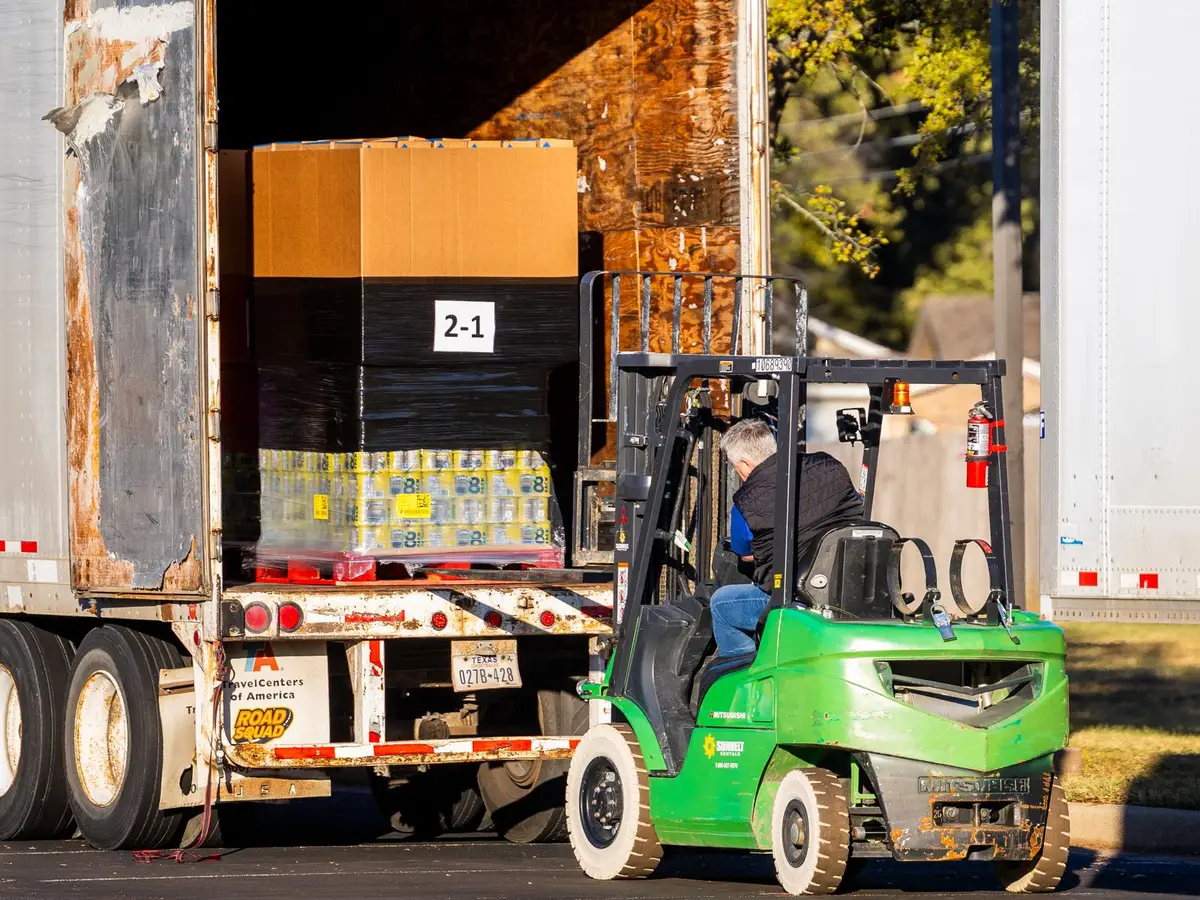
Typical examples are tiles, stone and steel: each pallet weighs a tonne or more and is shuffled by forklift many times a day. For this group, a double-deck acacia wood pallet is usually the better fit; when choosing, compare the pallet load rating across dynamic load, static load and rack load, not just one figure.
Conclusion
Pressed wood (plywood) pallets are an effective solution for businesses exporting light to medium cargo at high frequency, thanks to no ISPM 15 treatment, a gentle price and a clean flat deck. However, heavy concentrated cargo, long-term storage and wet environments call for natural wood or plastic pallets. The simplest rule: cargo within the published load, one-way, in a dry warehouse means pressed wood; cargo near the rated load, needing many reuses or exposed to water means natural wood or plastic.
Frequently asked questions
Are pressed wood pallets and plywood pallets the same thing?
In essence, both are pallets made of engineered wood and neither needs ISPM 15 treatment when made entirely of processed wood. However, "pressed wood" usually means a presswood pallet (sawdust pallet) made from finely ground sawdust moulded under pressure, while "plywood" is board assembled from thin layers of wood laid at right angles and then built into a pallet. Plywood pallets usually take impact better, while moulded sawdust pallets have no nails and nest together.
Do pressed wood pallets really need no fumigation for export?
Yes, if the whole pallet is made of processed wood. The IPPC ISPM 15 standard excludes from its scope packaging made entirely of plywood, particleboard, OSB or veneer produced with glue, heat or pressure; Canada (CFIA) states that this group also includes fibre boards such as MDF. Most countries apply ISPM 15, but you should still check the importing country’s rules before shipping.
How many kg can a pressed wood pallet carry?
It depends on the model. The two ICD Vietnam sawdust pallet models (DD-ICD120100-100-04 and SD-ICD100100-60-04) state a 2,000 kg dynamic load (while a forklift moves it) and a 6,000 kg static load (while it rests on the floor). Rack load is not in the published specification and must be asked separately if you plan to put the pallet on racking.
How many times can a pressed wood pallet be reused?
There is no general figure; reuse depends on load, handling and warehouse humidity. Pressed wood pallets are designed mainly for one-way export cargo (pallets not returned), so they give fewer reuse cycles than natural wood and plastic pallets. Multi-layer plywood pallets are usually tougher than presswood pallets under impact.
Does ICD Vietnam make pressed wood pallets to custom sizes?
Moulded sawdust pallets follow the existing mould sizes: the single-deck line from 1000 x 1000 to 1300 x 1100 mm and the double-deck line from 1100 x 1100 to 1300 x 1100 mm. For custom sizes, especially assembled plywood pallets, please contact ICD Vietnam to check feasibility and the minimum quantity.
Do plywood crates need fumigation?
No, if the crate is made entirely of plywood, particleboard or OSB. If the crate has a base, battens or a frame of solid sawn timber, those parts must be heat treated (HT) or fumigated with methyl bromide (MB) and carry the IPPC mark under ISPM 15, just like a pallet.
Where is the IPPC mark placed on a pallet with a plywood deck and sawn timber legs?
The sawn timber must be treated, and the whole pallet is treated as one unit for marking. ISPM 15 allows the IPPC mark to be placed on the processed wood part where needed so the mark sits in a visible position and is large enough, provided the sawn timber has been properly treated.
Is there a double-deck pressed wood pallet?
Yes. ICD Vietnam model DD-ICD120100-100-04, sized 1200 x 1000 x 150 mm, is a double-deck pressed sawdust pallet with 4-way entry, weighing 22 kg, with a 2,000 kg dynamic load and a 6,000 kg static load. A double-deck pallet has a flat bottom deck, so it spreads load more evenly when cargo is stacked.

How should used pressed wood pallets be handled?
Intact pallets can be reused for light shipments within the load limit. Broken or swollen pallets should be collected as feedstock for grinding and recycling, and should not be burned in the open because pressed wood contains thermosetting resin.
Contact ICD Vietnam
For advice on choosing a pressed wood pallet by load, size and importing country, contact ICD Vietnam:
- North Vietnam: 0983 797 186 / 090 345 9186 / 090 5859 186
- South Vietnam: 098 6784 186
- Email: sales@icdvietnam.com.vn
- Zalo: 090 345 9186
ICD Vietnam has a production workshop, a Hanoi warehouse and a southern workshop (551/212 Le Van Khuong Street, Tan Thoi Hiep Ward, District 12, Ho Chi Minh City). Pressed wood pallet price: contact for a quote by model, quantity and order date.
References
- ISPM 15 Regulation of wood packaging material in international trade, section 2.1 Exemptions and the marking of composite packaging - IPPC.
- Wood packaging questions and answers, definition of processed wood - Canadian Food Inspection Agency (CFIA).
- GMA pallet: 48 x 40 dimensions, weight and specs, weight of wooden GMA pallets - pallet.design.
- Specifications of sawdust pallets DD-ICD120100-100-04 and SD-ICD100100-60-04, specifications of 1200 x 1000 mm wooden pallets - ICD Vietnam product pages.