
Table of Contents
- Overview of the 6 steps in making a wooden pallet
- Step 1: Receive and select raw timber
- Step 2: Saw and rough-process the timber
- Step 3: Dry and quarantine-treat (ISPM 15)
- Step 4: Plane smooth and cut to size
- Step 5: Assemble the finished pallet
- Step 6: Finish and inspect quality (QC)
- Frequently asked questions
- 1. Are heat treatment (HT) and drying the same thing?
- 2. Why use spiral nails to assemble pallets?
- 3. How long does it take to make a batch of wooden pallets?
- 4. What moisture level is acceptable for pallet wood?
- 5. How many nails does an EPAL pallet have?
- 6. What machines does a wooden pallet workshop need?
- 7. Does ICD Vietnam fumigate or heat-treat pallets itself?
- Contact us to order wooden pallets
- References
Reviewed and updated by ICD - Week 43/2026
Making a wooden pallet takes 6 steps: selecting timber, sawing slats, drying and ISPM 15 quarantine treatment, planing and cutting, nailing on a jig, and quality inspection. Slats are usually dried to under 20% moisture; export pallets must be treated to ISPM 15, most commonly by heating the wood core to 56 °C for 30 continuous minutes. An EPAL 800 x 1200 mm pallet has 11 boards, 9 blocks and 78 nails.
Many people think building a wooden pallet is just joining pieces of wood together. In practice, for a pallet to carry loads of a tonne or more and pass through the border crossings of many countries, every step must be done correctly, because each one directly affects strength, safety and long-term cost of use.
This article goes through each step in turn, naming the equipment, the control points and the technical figures with sources, then pulls them together in an acceptance checklist a buyer can use when receiving a pallet batch. I also state clearly which steps ICD Vietnam does directly in its workshop and which must be done by a specialised provider.
Overview of the 6 steps in making a wooden pallet
The six steps can happen inside one integrated factory or be split among several parties: a sawmill, a drying and quarantine-treatment provider, and a pallet workshop. However it is split, the order of steps and the control points stay the same, and understanding them helps you judge the quality of a pallet and choose a suitable supplier.
| Step | Stage | Main equipment | Control points |
|---|---|---|---|
| 1 | Receive and select raw timber | Yard, measuring tape, moisture meter | Species, diameter, dead knots, rot or hollow centres, origin documents |
| 2 | Saw and rough-process the timber | CD saw, multi-blade saw | Slat thickness and width as drawn |
| 3 | Dry and treat to ISPM 15 | Drying kiln, heat-treatment chamber with core sensors (at a provider holding a facility code) | Slat moisture; wood core at 56 °C for 30 minutes if HT-treated |
| 4 | Plane smooth, cut to size | 4-side planer, cross-cut saw | Even thickness, length of each slat type |
| 5 | Assemble the finished pallet | Assembly jig, pneumatic nail gun | Part positions, nails per joint, nail distance from the edge |
| 6 | Finish and inspect quality | Tape measure, moisture meter | Dimensions, diagonals, protruding nails, IPPC mark |
Step 1: Receive and select raw timber
The first step is choosing round logs of adequate diameter with straight trunks, few dead knots, no rot or hollow centres and legal origin documents; pallet quality starts with timber quality. The usual raw materials are pine and acacia logs, brought to the yard and inspected before sawing. Legal origin of the timber is the requirement we always put first when working with timber suppliers.
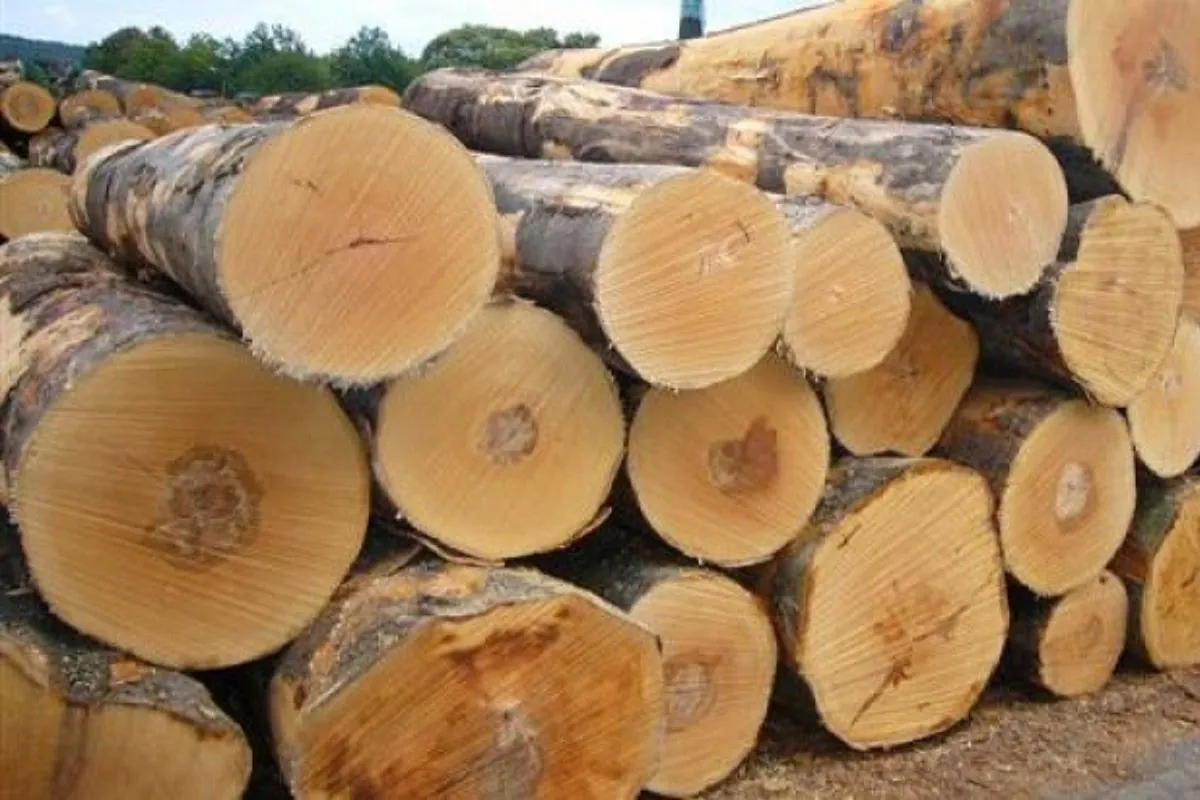
Each species gives a pallet a different weight and different properties, so choose by the load and the destination market. According to The Wood Database, imported radiata pine has a dry density of about 515 kg/m³: light, straight-grained and with few knots, suited to light goods and air freight. Rubberwood is about 595 kg/m³, denser and harder than pine, but prone to stain fungi and borers, so it must be treated and dried right after sawing. Plantation acacias such as Acacia auriculiformis, Acacia hybrid and Acacia mangium have a density of 0.57 - 0.59 g/cm³ according to TCVN 12619-2:2019, with plentiful domestic plantation supply; the two sources were measured at different moisture bases, so use them only for a relative comparison.
Step 2: Saw and rough-process the timber
In this step, logs are sawn into blanks and then sawn again into pallet slats at the thickness and width shown on the technical drawing. A sawing machine (usually a CD saw) makes square or rectangular blocks called blanks; the blanks go into a multi-blade saw that cuts them all at once into strips, called pallet slats.
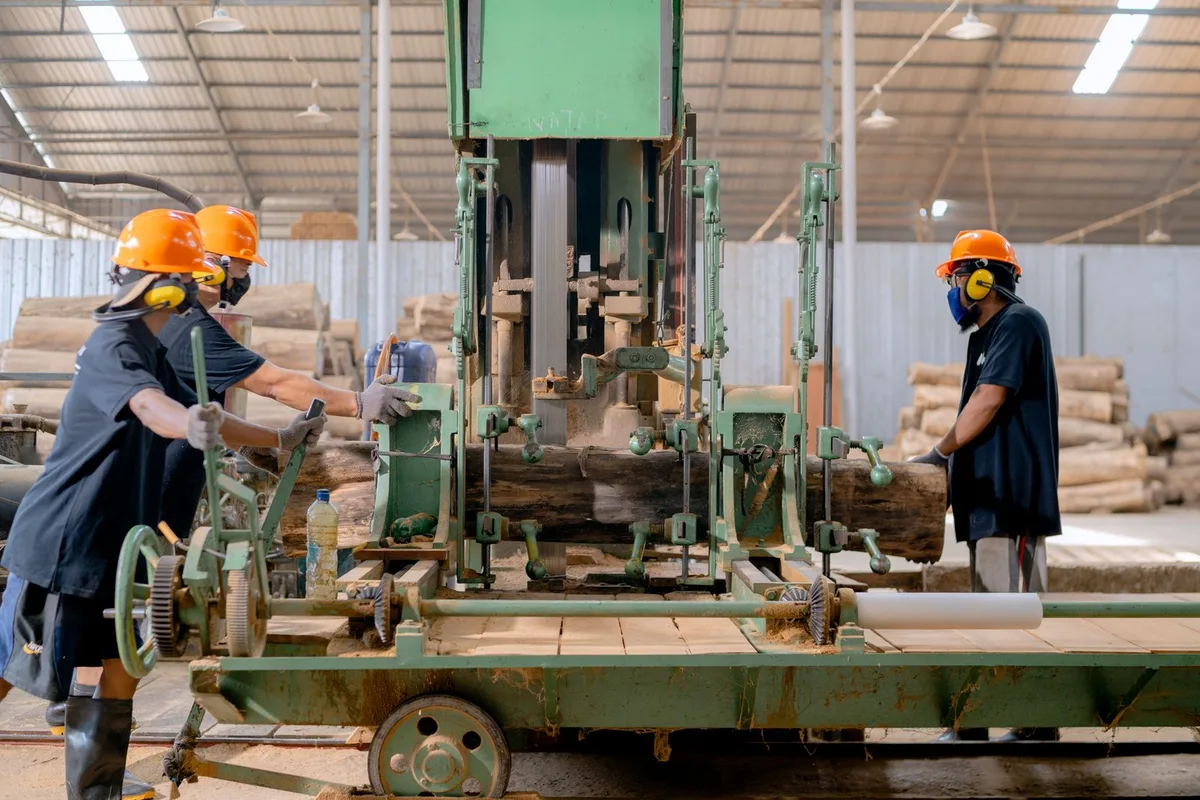
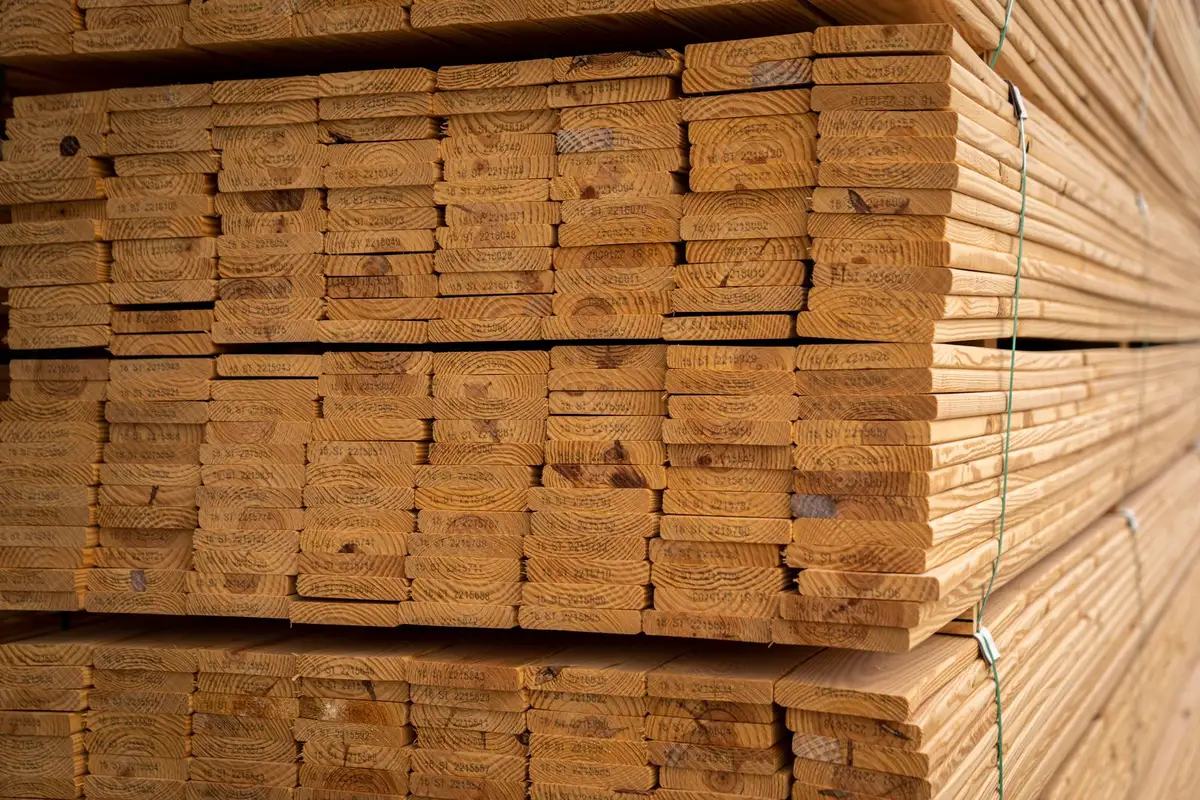
Slat thickness is cut to the design load, not to workshop habit. For example, under the technical specification of the European Pallet Association (EPAL), the boards of a EUR pallet are 22 - 24 mm thick (up to 25 mm for the lead boards), the lead boards must have no bark edges and poplar is not used. Sawn slats are sorted by where they are used: top slats, connecting slats and bottom boards, and blocks.
Step 3: Dry and quarantine-treat (ISPM 15)
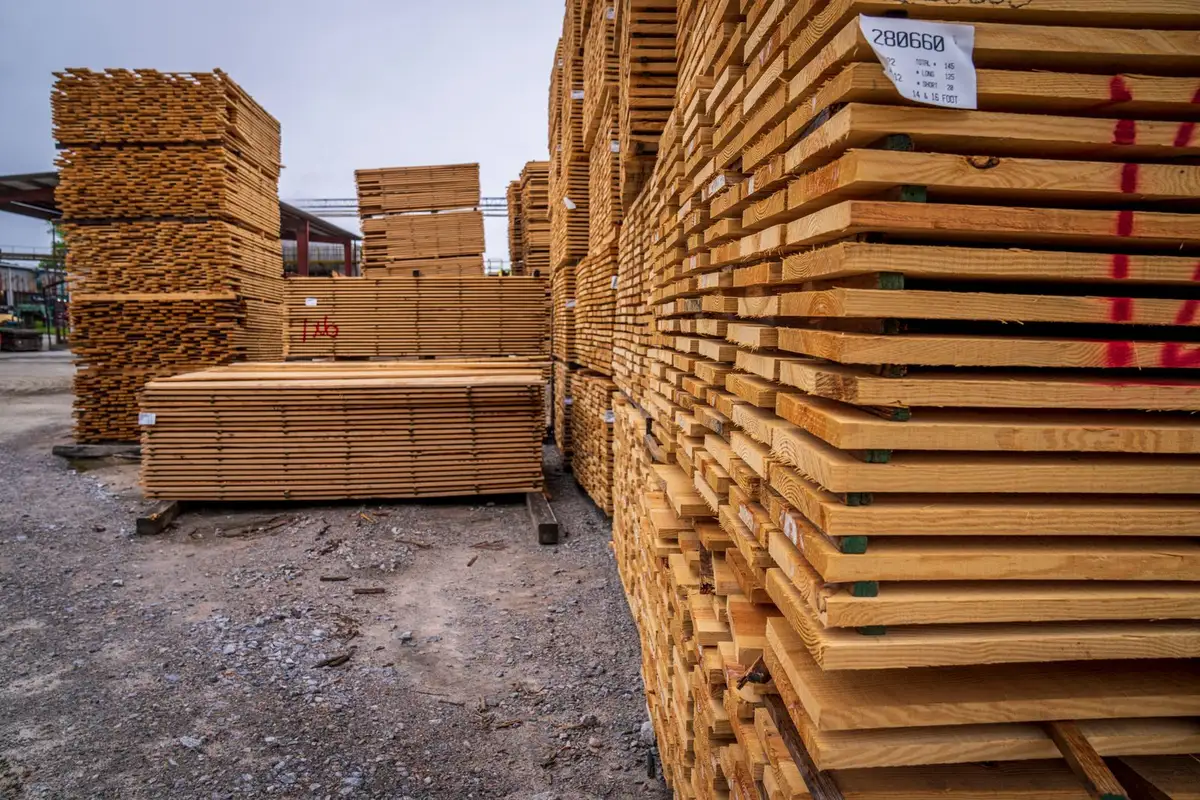
In this step, slats are dried to under 20% moisture and, for export pallets, treated to ISPM 15, most commonly by heat treatment so the wood core reaches at least 56 °C continuously for 30 minutes. This step decides a pallet’s durability and exportability, and it needs a kiln and a separate licence.
Drying means stacking slats in an industrial kiln to bring wood moisture below about 20%, so the pallet has less mould, less warping and shrinkage in use and the wood is stiffer. Heat treatment (HT) is a phytosanitary measure: the pallet or slats are heated until the centre of the wood reaches at least 56 °C and held for at least 30 minutes, to kill insects and pests hidden in the wood. Wooden pallets accompanying export goods must go through one of the treatment methods recognised by ISPM 15.
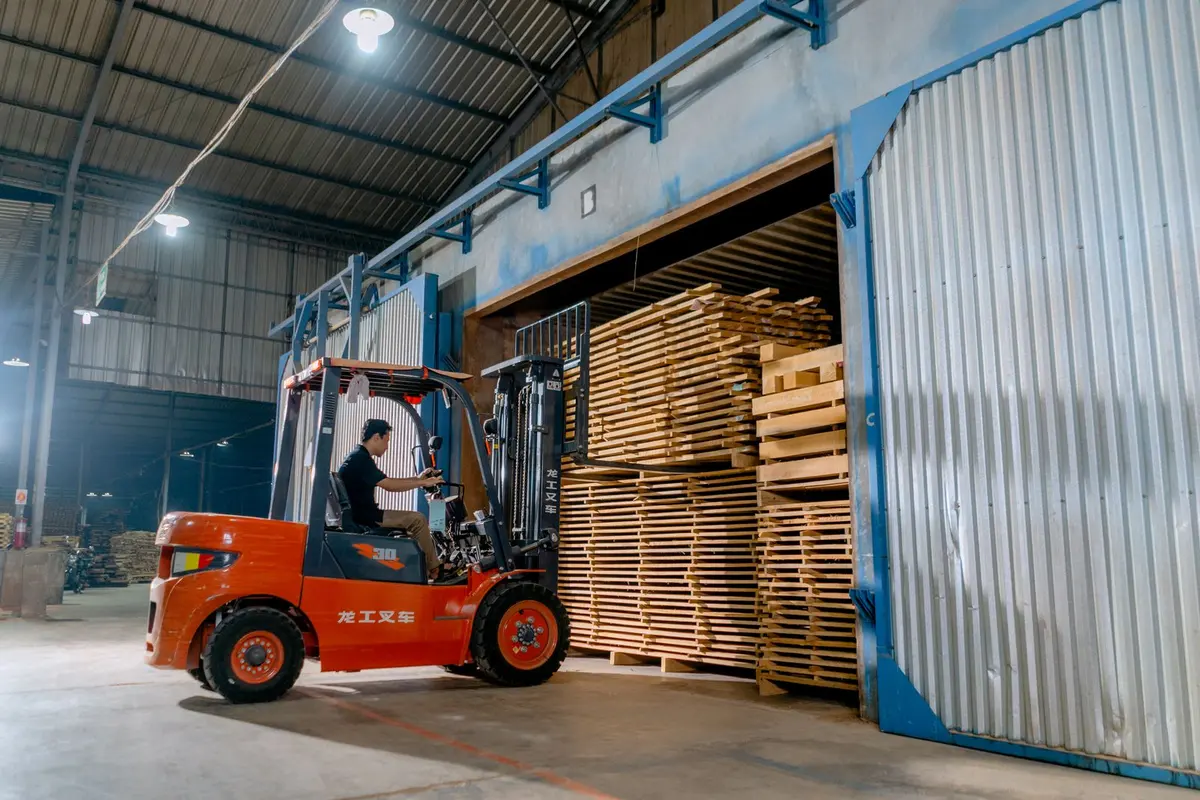
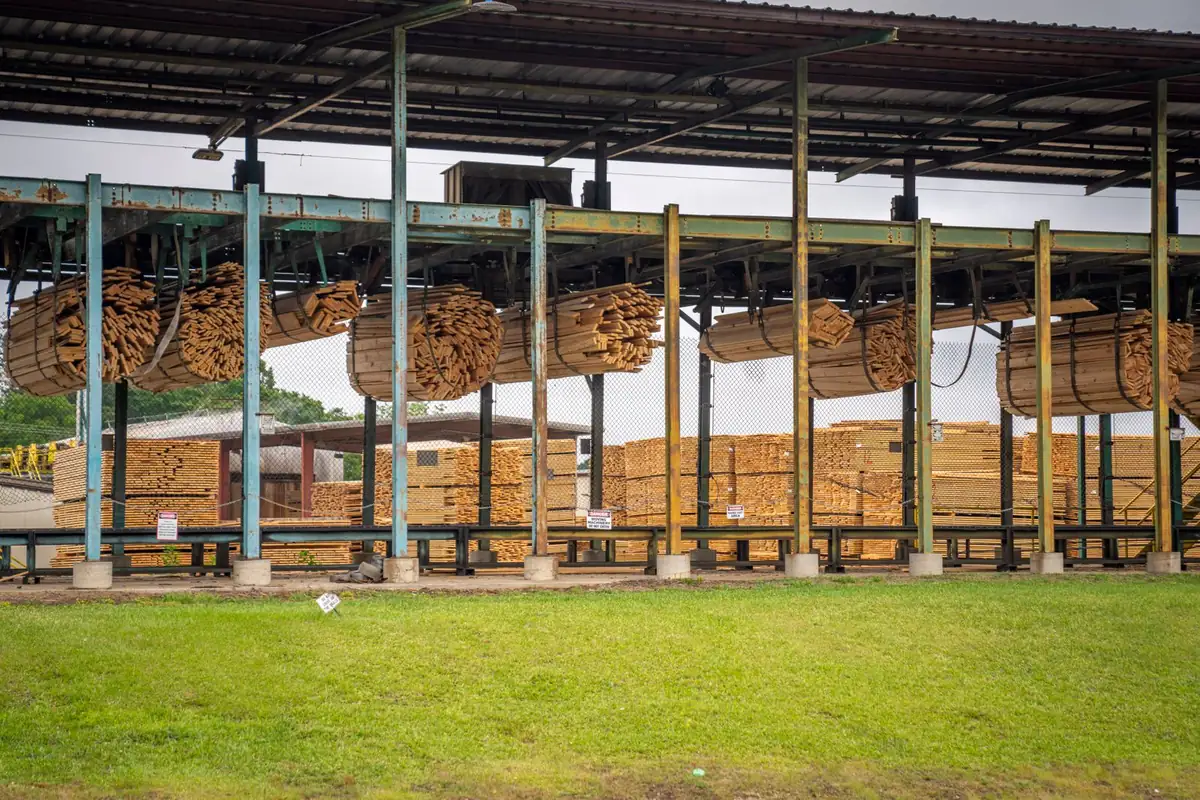
Before going into the kiln, slats are stacked in layers with spacer sticks that leave gaps so hot air flows evenly over every face. Fresh wood can hold from about 30% to over 200% water by dry weight depending on species (USDA Wood Handbook), so drying times vary widely: according to the Forest Research Institute Malaysia (FRIM), 30 mm rubberwood boards kiln-dried to 8 - 10% moisture take about 7 - 9 days.
ISPM 15 recognises 4 treatment methods, each with its own code on the mark. Ordinary kiln drying (KD) is not a treatment code: it counts as HT only when it reaches the exact temperature and time parameters of HT.
| Method | Purpose | Main parameter | Code on the mark |
|---|---|---|---|
| Kiln drying (KD) | Reduce moisture, prevent mould and warping | Slat moisture usually under 20% | No code of its own; counts as HT if it meets HT parameters |
| Heat treatment | Kill pests under ISPM 15 | Wood core at least 56 °C for 30 continuous minutes | HT |
| Dielectric heating (microwave, radio frequency) | Kill pests under ISPM 15 | 60 °C for 1 continuous minute across the whole wood cross-section | DH |
| Methyl bromide fumigation | Kill pests chemically | Per the dosage schedule in Annex 1 of ISPM 15 | MB |
| Sulfuryl fluoride fumigation | Kill pests chemically | Per the dosage schedule; wood with a smallest cross-section of no more than 20 cm | SF |
Newly made EPAL pallets have been heat-treated to ISPM 15 within the production process since January 2010, according to the European Pallet Association (EPAL). For ordinary pallets, you can heat-treat the slats before assembly or treat the finished pallet; the IPPC mark is applied only after the batch has met the treatment parameters. For ICD Vietnam pallets that need ISPM 15 treatment, this step is done through a licensed treatment provider, and the facility code on the mark is that provider’s code.
Step 4: Plane smooth and cut to size
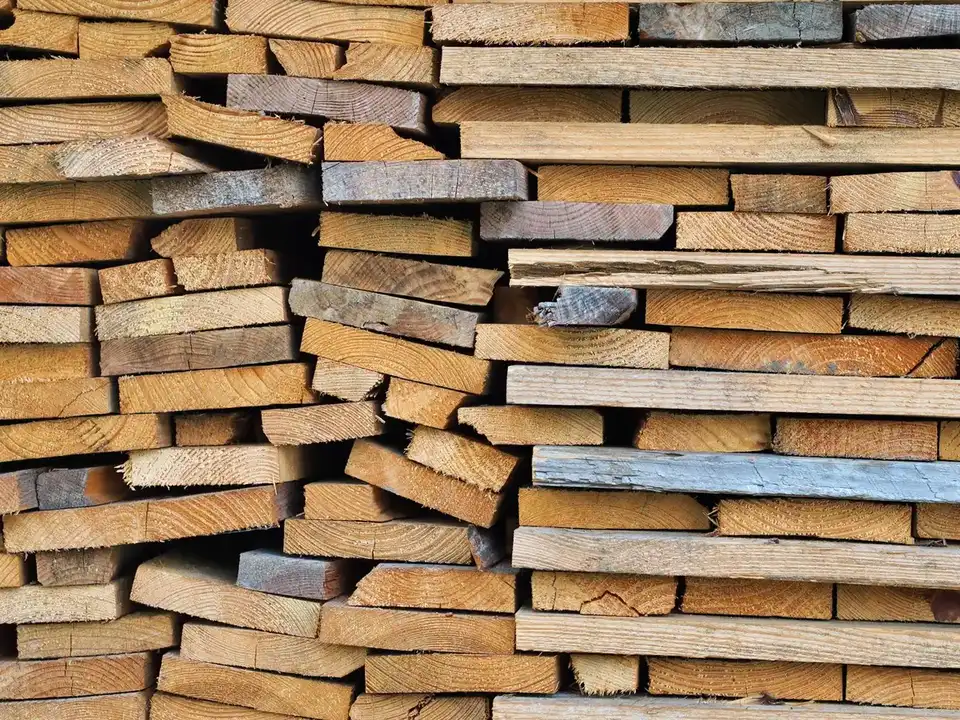
Planing and cutting determine how even the pallet is: slats of uneven thickness make a rough deck, and blocks of uneven height make the pallet rock on the floor and on racking. After drying, slats go through a 4-side planer to smooth the surface, remove splinters and even out thickness, then move to a cross-cut saw to cut each part type (top slats, connecting slats, blocks) to exact length.
Step 5: Assemble the finished pallet
Assembly means laying out slats and blocks on a jig, then nailing them with the number and positions specified for that pallet model. This step gives the product its shape: workers place parts in the jig so they sit at the right positions and spacing, then use an industrial pneumatic nail gun to join them. This is also a step ICD Vietnam does directly in its workshop.
From my experience, nail quality and nailing technique matter as much as wood quality. Spiral (twisted-shank) nails hold in wood better than smooth-shank nails, so joints are less likely to loosen or back out when the pallet shakes on a truck and knocks against forks; it is a small detail that makes a clear difference in durability.
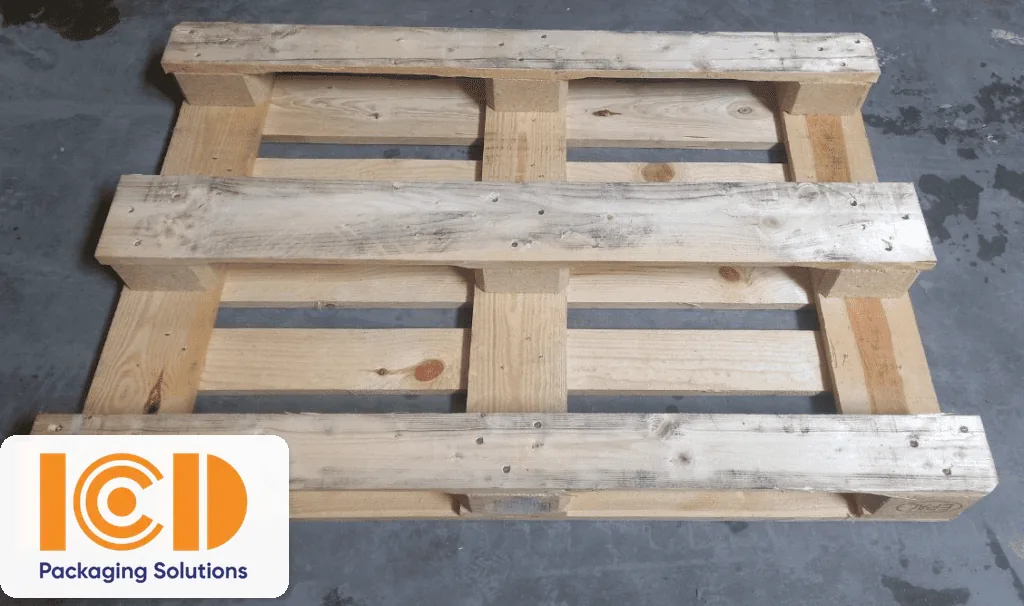
The number and position of nails are set for each pallet model, not nailed at will. The two most common pallets in the world are a concrete example:
| Pallet model | Construction | Number of nails | Nailing rules |
|---|---|---|---|
| EPAL (EUR) 800 x 1200 x 144 mm | 11 boards, 9 blocks | 78 | Fixed positions to keep diagonal stiffness; nails at least 20 mm from the edge; nails approved by EPAL, with a 2-character mark on the head |
| GMA 48 x 40 inch (1219 x 1016 mm) | 3 stringers, 7 top boards, 5 bottom boards | 84 | Spiral nails 57 mm (2-1/4 inch) long; 3 nails per joint on the edge boards, 2 nails per joint on the middle boards |
A complete EPAL pallet weighs about 25 kg, has a safe working load of 1,500 kg, and the bottom pallet carries up to 5,500 kg when stacked on a flat floor. These figures are reached only when the right number of nails is driven in the right places; for pallets to a custom drawing, the load rating must be recalculated from the slat cross-section and the actual number of nails.
Step 6: Finish and inspect quality (QC)
The last step is rounding off sharp edges, applying the IPPC mark to treated export pallets, then spot-checking the batch for dimensions, nails and wood before it leaves the workshop. The IPPC mark is applied only by a treatment provider holding a facility code, on at least two opposite faces of the pallet.
The checks below are the points commonly used; a buyer can also use them to accept a pallet batch on receipt:
- Dimensions: measure length, width, height and both diagonals; a clear difference between the two diagonals means the pallet is skewed.
- Moisture: measure with a handheld wood moisture meter at several slats; above 20% or any green or black mould fails.
- Nailing: check nails per joint and run a hand over the surface; missing nails, raised heads and nails that split a board are defects.
- Wood: inspect slats and blocks; remaining bark, large dead knots, long cracks or rot fail.
- ISPM 15 mark: check the mark on two opposite faces; a missing, faded or wrong method code fails.
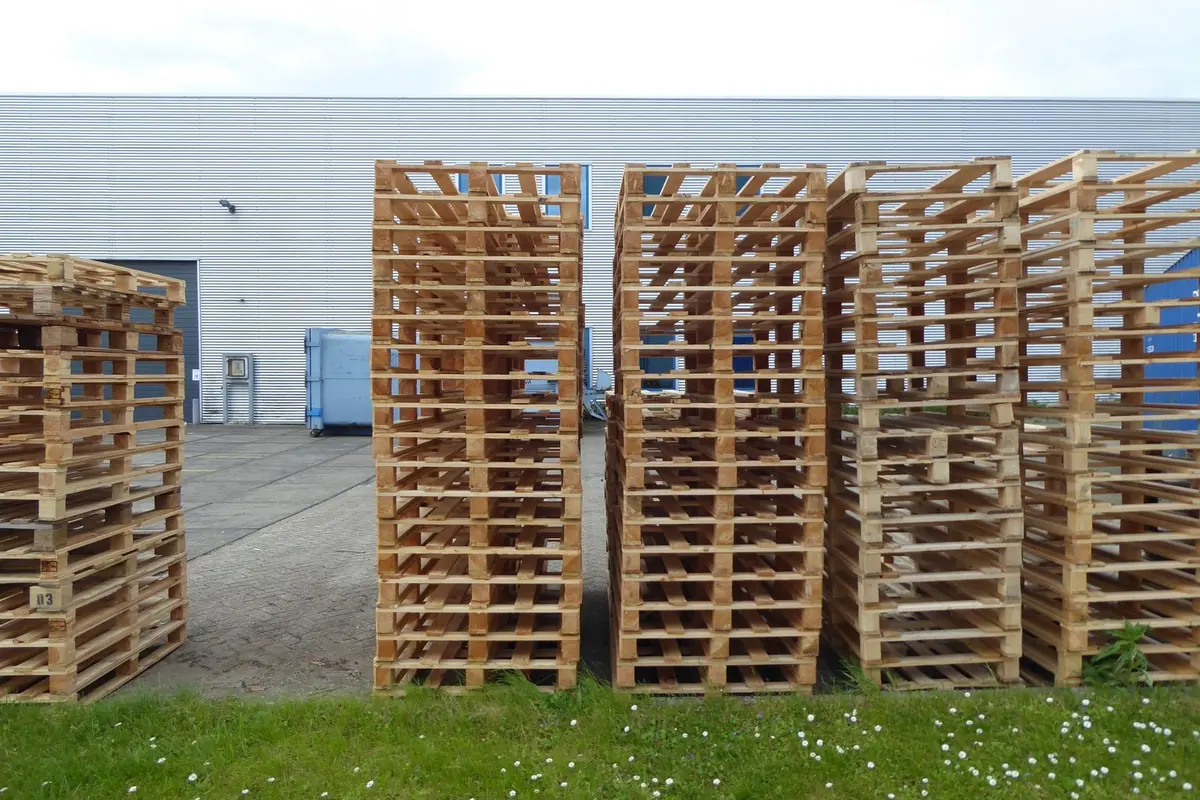
After inspection, finished pallets should be stored in a dry warehouse, raised off the ground and kept from rain. A pallet that has been dried or heat-treated can still reabsorb moisture and mould if left outside, because ISPM 15 kills pests only at the time of treatment; it does not keep wood dry in the long term and does not stop organisms from re-entering afterwards.
See also: wooden pallet price list.
Frequently asked questions
1. Are heat treatment (HT) and drying the same thing?
No. Drying lowers wood moisture to improve durability; heat treatment (HT) is a phytosanitary measure to kill pests under ISPM 15. A pallet can be dried without reaching HT, and a pallet that has had HT is not necessarily dry: ISPM 15 specifies only the wood core temperature and the holding time, not the moisture after treatment. Kiln drying that meets the exact ISPM 15 temperature and time parameters is recognised as HT.
2. Why use spiral nails to assemble pallets?
Spiral nails have a twisted groove on the shank, so they hold in the wood grain better than smooth nails, making the pallet’s joints firmer and able to withstand shaking and impact in transit. GMA pallets use spiral nails 57 mm long; EPAL pallets use nails approved by EPAL.
3. How long does it take to make a batch of wooden pallets?
Time depends on quantity, the complexity of the drawing and whether the batch needs drying or ISPM 15 treatment, because the kiln-drying step alone can take several days. ICD Vietnam gives a specific lead time once it receives the drawing, quantity and delivery location.
4. What moisture level is acceptable for pallet wood?
Pallet slats are usually dried to under 20% moisture. In the pallet design analysis of the American pallet industry, a dry environment is taken to have an equilibrium moisture content of no more than 19%; wetter wood is prone to mould, shrinkage and loosened nails.
5. How many nails does an EPAL pallet have?
An EPAL (EUR) 800 x 1200 x 144 mm pallet has 78 nails, 11 boards and 9 blocks, according to the technical specification of the European Pallet Association. The position of each nail is specified to keep the pallet’s diagonal stiffness.
6. What machines does a wooden pallet workshop need?
A full process needs a log saw, a multi-blade saw, a drying kiln, a heat-treatment chamber with sensors that measure core temperature, a 4-side planer, a cross-cut saw, pallet assembly jigs and pneumatic nail guns; a high-volume workshop may use an automatic pallet assembly line. A heat-treatment chamber may be used to apply the IPPC mark only when the facility has been issued a code by the plant protection authority, so many pallet workshops hire a specialised provider for this step.
7. Does ICD Vietnam fumigate or heat-treat pallets itself?
No. ICD Vietnam assembles wooden pallets in its workshop; we have no drying kiln, do not fumigate ourselves and do not issue certificates ourselves. Pallets that need ISPM 15 treatment are treated and marked with the IPPC mark through a licensed provider, and the facility code on the mark is that provider’s code.
Contact us to order wooden pallets
For advice on wooden pallet models, send ICD Vietnam the size, the load, the quantity and the export market. We have a production workshop, a Hanoi warehouse and a southern workshop; price: contact for a quote, with volume discounts. Wooden pallets carry no warranty and can be returned within 7 days.
ICD Viet Nam Industrial Production Company Limited
- North (Hanoi warehouse): 3rd Floor, Thang Long A1 Building, Bau Hamlet, Thien Loc Commune, Hanoi - 0983 797 186 / 090 345 9186 / 090 5859 186.
- Southern workshop: 551/212 Le Van Khuong, Tan Thoi Hiep, District 12, Ho Chi Minh City - 098 6784 186.
- Email: sales@icdvietnam.com.vn. Zalo: Chat with ICD Vietnam on Zalo.
References
- National Wooden Pallet and Container Association (NWPCA), Uniform Standard for Wood Pallets.
- International Plant Protection Convention (IPPC), ISPM 15 Regulation of wood packaging material in international trade, Annex 1 (4 treatment methods) and Annex 2 (mark).
- European Commission, Requirements for wood packaging material and dunnage.
- EPAL Euro pallet technical specification (dimensions, boards, blocks, nails, load, heat treatment): European Pallet Association (EPAL).
- Standard dimensions and construction of wooden pallets: Material Handling Industry (MHI) - Pallets.
- Analysis of GMA pallet construction, nail counts and design moisture - Pallet Design System software, NWPCA.
- Moisture of fresh wood - Wood Handbook: Wood as an Engineering Material, Forest Products Laboratory, US Department of Agriculture (USDA).
- Rubberwood drying - Timber Technology Bulletin No. 26, Forest Research Institute Malaysia (FRIM).
- Density of rubberwood and radiata pine - The Wood Database.
- Density of Acacia auriculiformis, Acacia hybrid and Acacia mangium - TCVN 12619-2:2019 Timber - Classification - Part 2: By physical and mechanical properties.
Read more: Pros and cons of shrink-wrapping machines.