Table of Contents
- Liquidated rubber plantation prices in 2026 from auctions
- Why rubber wood prices are hard to bring down: supply is shrinking
- Which way are sawn rubber wood and finger-jointed board prices heading?
- How do ster, tonne and m³ differ when buying rubber wood?
- What should you note about rubber wood for export pallets?
- What should you check before buying rubber wood?
- Frequently asked questions
- How much is rubber wood per cubic meter now?
- Why do rubber wood prices differ so much between sources?
- Is rubber wood suitable for export pallets?
- How many 18 mm finger-jointed rubber wood sheets are in 1 cubic meter?
- How does rubber wood priced per ster differ from per cubic meter?
- How much does a liquidated rubber tree sell for?
- Why will rubber wood prices be hard to bring down in the next few years?
- Does ICD Vietnam sell rubber wood pallets?
- Contact ICD Vietnam
- References
In 2026, liquidated rubber plantations were offered at public auction with starting prices of about VND 75 - 315 million per hectare, or roughly VND 130,000 - 420,000 per tree, depending on stand age and timber volume. Sawn rubber wood and finger-jointed boards have no official public price list; prices are quoted per lot, specification and moisture level.
These figures come from public asset auction notices with clear dates and sellers, so I use them as benchmarks in place of price lists that give no source. Rubber wood prices are quoted at three stages: trees or round timber at the plantation, treated and dried sawn timber priced per m³, and finger-jointed board priced per sheet. The article takes each stage in turn, with conversions so you can check the quotes you receive. I follow these numbers because rubber wood is one of the timbers ICD Vietnam uses to build pallets.
Liquidated rubber plantation prices in 2026 from auctions
The clearest public benchmark for rubber wood at the plantation in 2026 is the starting price of auctions of liquidated plantations owned by state enterprises: about VND 75 - 315 million per hectare. The gap is wide because each plantation differs in tree density, tree age and timber volume. The table below gathers the four auctions that had public notices this year:
| Plantation, notice date | Scale | Starting price (excl. VAT) | Per hectare / per tree |
|---|---|---|---|
| 16 Co., Ltd. (one-member), Dong Nai, 1/2026 | 2,229.22 ha; 950,246 trees; 368,134.69 ster of timber and 95,442.36 ster of firewood | VND 396.767 billion | ~VND 178 million/ha; ~VND 417,500/tree |
| Phu Rieng Rubber, Da Kia commune (Dong Nai), 1/2026 | 229.35 ha; 122,264 trees; 17,623 ster of timber and 6,994 ster of firewood | VND 25.311 billion | ~VND 110 million/ha; ~VND 207,000/tree |
| Chu Pah, Gia Lai, 1 - 2/2026 | 230.89 ha; 51,906 m³ of timber (74,226 ster) and 18,496 ster of firewood | VND 72.634 billion | ~VND 315 million/ha |
| Tay Ninh Rubber, Go Dau - Xa Mat expressway project, 9/2026 | 40.52 ha; 23,087 trees | VND 3.037 billion | ~VND 75 million/ha; ~VND 131,500/tree |
Data sources: Vietnam Bidding Newspaper (26 Jan and 28 Sep 2026), Dong Nai Provincial Asset Auction Service Center (14 Jan 2026) and Nam Binh Duong Partnership Auction Company (deposits accepted 20 Jan - 10 Feb 2026). The last column is my own calculation, dividing the starting price by area and tree count, rounded; these are starting prices, and actual winning prices are usually higher. Under these notices the buyer bears the cost of felling, hauling and clearing the plantation, so the per-tree price is not yet the price of timber delivered to a mill.
Another benchmark shows the general price level of the industry: according to 24hmoney (2 June 2026) citing the plan of the Vietnam Rubber Industry Group (GVR), the group planned to liquidate about 7,400 ha of rubber in 2026 at an average of about VND 200 million per hectare; in the first quarter alone it liquidated 2,800 ha, collecting about VND 700 billion. An analysis report by Viet Dragon Securities (April 2026) on Dong Phu Rubber estimates a liquidation price of about VND 350 million per hectare for about 260 ha. These figures are higher than most starting prices in the table above because they are expected liquidation prices, not opening bids.
How do buying standing trees and buying round timber differ?
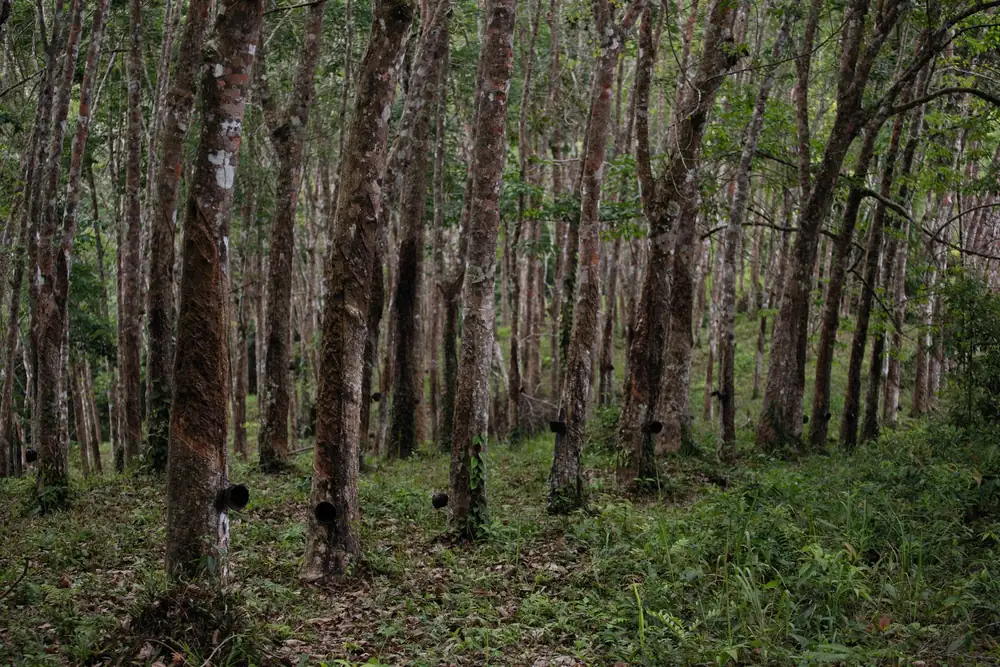
Rubber wood at the plantation is bought in two ways: standing trees priced per tree or per whole lot, or round timber delivered to the mill priced per ster or per tonne. For standing trees, a plantation with large girth, straight trunks and no borers yields more merchantable timber and fetches a higher price; a plantation on steep hills where machines are hard to bring in costs the buyer more in transport and so gets a lower price. For round timber, the buyer should watch the share of heartwood and freshness; for wood from an old plantation, fell a few trees as a test to check for hollow cores before signing the contract.
The gap between stages lies mostly in the costs added to the price. Standing trees are green wood, and the buyer bears harvesting and hauling; round timber at the mill already includes harvesting and hauling to the mill; finished sawn timber priced per m³ has been sawn, treated and dried; finger-jointed board of 1220 x 2440 mm is priced per sheet, adding strip sorting, jointing, pressing, sanding and face grading. So the price per m³ of finger-jointed board is always many times the price per m³ of round timber at the plantation.
Why rubber wood prices are hard to bring down: supply is shrinking
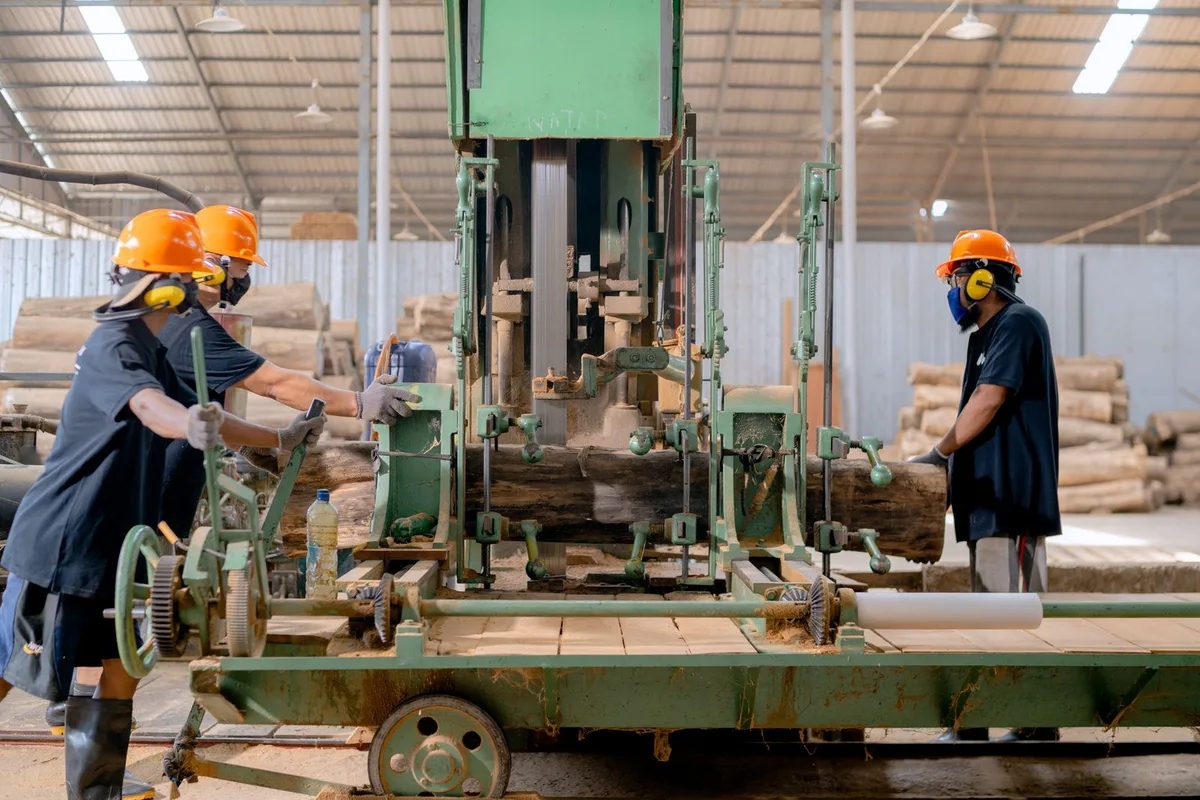
Rubber wood prices are driven mainly by supply: the national rubber area is being directed to shrink, plantations are aging and part of the rubber land is moving to industrial parks. The rubber wood market is therefore no longer just a salvage source after the latex cycle, but the main raw material for export furniture, finger-jointed boards and pallets.
According to Nhan Dan newspaper (May 2024), the country has about 918,000 ha of rubber; over 200,000 ha are certified under VFCS/PEFC sustainable forest management and about 6,000 ha under FSC. Decision 431/QD-BNN-TT of 26 January 2024 sets a direction of 800,000 - 850,000 ha by 2030, a reduction of about 6 - 12%. VietnamBiz (23 September 2026), citing a Kafi Securities report, says more than 55% of the area being tapped is over 22 years old, while the latex cycle is usually 20 - 25 years, after which the plantation is liquidated for timber.
These numbers explain why prices are hard to push down sharply: the volume of old plantations reaching liquidation age is rising, but the total area is shrinking and part of the land is moving to other uses. For export orders that require FSC-certified wood, supply is far narrower than the total area, so prices are usually quoted separately. The market now splits into two kinds of demand: sawmills and drying plants buy round timber at the plantation, while woodworkers and retail buyers look for finished finger-jointed boards.
Which way are sawn rubber wood and finger-jointed board prices heading?
Sawn rubber wood and finger-jointed boards have no public price list from a state agency or association; price trends are followed through market reports. According to Thi Truong Go (Industry News Agency), the price of sawn rubber wood in the south rose by about VND 10 thousand/m³ in February 2026 and by another VND 10 thousand/m³ in March 2026; in April 2026 sawn timber prices kept rising in the central and southern regions.
In the second half of the year the direction is no longer one-way. The week 34 bulletin (17 - 21 August 2026) recorded a slight fall in rubber board prices and an expected rise in August inventory, while the bulletin of 15 October 2026 said southern rubber blank prices edged up because supply is still limited. In other words, raw timber prices stay high while finished board prices move with export furniture demand.
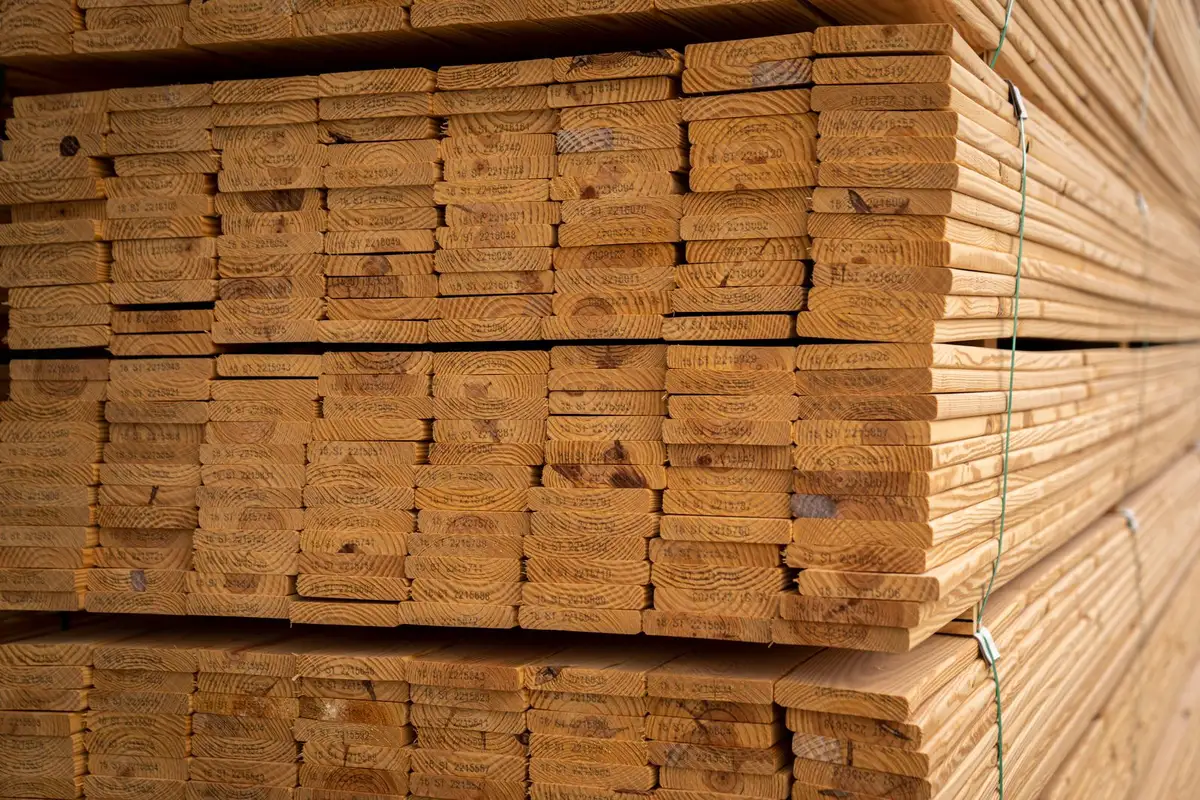
Finger-jointed board is a product treated against termites and borers and dried to a moisture content usually around 8 - 12%, the specification that decides durability and limits warping and cracking in use. The price of a 1220 x 2440 mm board rises with thickness and face grade: at the same thickness, AA board (two good faces) costs more than AC (one good face) and CC (core board). AA board is for exposed surfaces such as tabletops and cabinet doors; AC board has one face with dead knots or black streaks and is used in hidden places to cut cost while still carrying load. Project orders or dealers taking large quantities usually get volume discounts.
Converting board prices per sheet, per m² and per m³
Each 1220 x 2440 mm sheet has an area of 2.977 m²; the volume and the number of sheets per m³ depend only on thickness. For 18 mm board, each sheet is about 0.0536 m³, so 1 m³ equals about 18.7 sheets, in practice 18 - 19 sheets depending on the mill’s tolerance. The conversion table below helps compare quotes per sheet with quotes per cubic meter:
| Thickness | Volume of 1 sheet | Sheets per 1 m³ | Price per m³ |
|---|---|---|---|
| 10 mm | 0,0298 m³ | About 33.6 sheets | Sheet price x 33.6 |
| 12 mm | 0,0357 m³ | About 28.0 sheets | Sheet price x 28.0 |
| 15 mm | 0,0447 m³ | About 22.4 sheets | Sheet price x 22.4 |
| 18 mm | 0,0536 m³ | About 18.7 sheets | Sheet price x 18.7 |
How do ster, tonne and m³ differ when buying rubber wood?
Ster, tonne and m³ measure three different things, so prices cannot be compared directly until converted to one unit.
| Unit | What it measures | Note when comparing prices |
|---|---|---|
| Ster | 1 m³ of stacked wood, including the gaps between logs | The actual solid wood is always less than 1 m³; by the definition of the stere, the shorter and more curved the logs, the more the solid share changes |
| Tonne | Weight of the wood at the time of weighing | Green wood holds a lot of water so it weighs more than air-dried or kiln-dried wood; state clearly when it was weighed |
| m³ (cubic meter) | Volume of solid wood, sawn timber or board | Unit used for finished sawn timber and for converting finger-jointed board |
The Chu Pah plantation auction file (Gia Lai, January 2026) gives one specific conversion factor: 51,906 m³ of timber is recorded as equal to 74,226 ster, so 1 m³ of solid wood is about 1.43 ster, or 1 ster is about 0.70 m³. This factor varies with log diameter and curvature, so when buying round timber per ster or per tonne, agree the conversion factor to m³ of solid wood in the contract beforehand, along with how log diameter and length are measured. This is a place where disputes arise more often than over the unit price.
For the tonne, weight depends on moisture at weighing. According to The Wood Database, dry rubber wood has an average density of about 595 kg/m³ at 12% moisture; freshly felled green wood holds a lot of water and weighs considerably more. So two quotes per tonne can only be compared when both state clearly whether the wood was weighed green or after drying.
What should you note about rubber wood for export pallets?
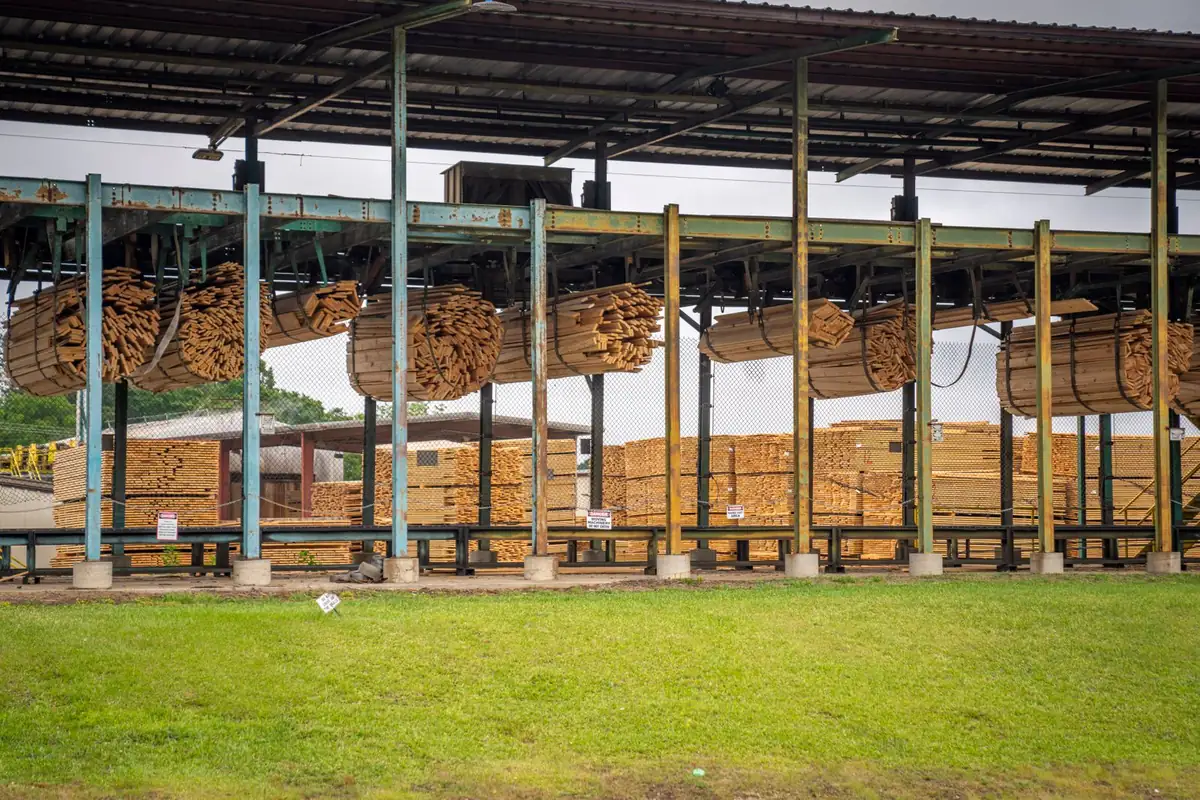
Rubber wood can be used for export pallets, provided it has been treated under ISPM 15 and stamped with the IPPC mark. Raw rubber wood is rich in sugar and resin, so beetles and mold attack it easily if left green for long after harvest; only after preservative treatment and drying to a suitable moisture does the wood qualify for furniture or durable pallets.
ISPM 15 of the International Plant Protection Convention (IPPC) currently recognizes four treatments for wood packaging material: heat treatment (HT), dielectric heating (DH), methyl bromide fumigation (MB) and sulphuryl fluoride fumigation (SF). The European Union banned the use of methyl bromide inside the bloc from 18 March 2010, but still accepts imported pallets treated with MB in line with ISPM 15. ICD Vietnam does not treat, dry or fumigate wood itself; our export pallets are treated and IPPC-stamped through a licensed provider.
The ISPM 15 mark on a wooden pallet: IPPC symbol on the left, country code VN, facility code (xxx is an illustrative placeholder) and treatment code HT (heat treatment).
What should you check before buying rubber wood?
Whether you buy finger-jointed board or timber at the plantation, check the goods and papers against the list below before closing the order:
- Finger-jointed board: measure 8 - 12% moisture with a meter, view the board face under strong light to spot open joints or uneven-colored sawdust patches, and measure the actual size and thickness.
- Finger-jointed board: ask clearly whether the quote includes VAT, delivery and gloss coating, because these three items make two quotes of the same specification differ considerably.
- Timber at the plantation: measure girth at random and fell a few trees as a test to check for hollow cores, since this decides the share of merchantable timber.
- Timber at the plantation: check the papers for land-use rights and the right to harvest the plantation.
The paperwork item matters more and more as timber goes to the EU market. A report by the Vietnam Rubber Association and Forest Trends (June 2025) on readiness for the EU Deforestation Regulation (EUDR) says many smallholder plantation deals are still mostly agreed verbally, with few documents; timber whose origin cannot be traced will be hard to sell to mills making export goods.
Frequently asked questions
How much is rubber wood per cubic meter now?
Sawn rubber wood and finger-jointed boards have no official public price list; prices are quoted by lot, specification and moisture. The latest public benchmark is the starting price of liquidated plantation auctions in 2026: about VND 1 - 1.4 million per ster of round timber at the plantation (including firewood), excluding felling and hauling.
Why do rubber wood prices differ so much between sources?
Price depends on the stage bought (standing tree, round timber, sawn timber or finger-jointed board), the age and volume of the plantation, whether the wood has been treated and dried, specification and grade, and VAT and delivery terms. Compare two quotes only after converting them to the same stage and the same unit.
Is rubber wood suitable for export pallets?
Yes, when the pallet has been treated under ISPM 15 by one of the four recognized methods (HT, DH, MB, SF) and stamped with the IPPC mark. For cargo to the EU, heat-treated pallets are the most common; pallets treated with MB in line with ISPM 15 are still accepted by the EU on import.
How many 18 mm finger-jointed rubber wood sheets are in 1 cubic meter?
A 1220 x 2440 x 18 mm sheet has a volume of about 0.0536 m³, so 1 m³ equals about 18.7 sheets. For 15 mm board it is about 22.4 sheets, for 12 mm about 28 sheets and for 10 mm about 33.6 sheets.
How does rubber wood priced per ster differ from per cubic meter?
A ster is 1 m³ of stacked wood, including the gaps between logs, so the solid wood is less than 1 m³. According to the Chu Pah plantation auction file (January 2026), 1 m³ of round rubber wood equals about 1.43 ster; write the conversion factor into the contract.
How much does a liquidated rubber tree sell for?
According to the 2026 auctions, starting prices work out to about VND 130,000 - 420,000 per tree, depending on the plantation; the buyer bears felling, hauling and clearing. The actual winning price is usually higher than the starting price.
Why will rubber wood prices be hard to bring down in the next few years?
The national rubber area is directed to fall to 800,000 - 850,000 ha by 2030 under Decision 431/QD-BNN-TT, with some land moving to industrial parks. The volume of old plantations reaching liquidation age is rising but does not offset the shrinking area.
Does ICD Vietnam sell rubber wood pallets?
Yes. ICD Vietnam makes rubber wood pallets to your dimensions, load rating and ISPM 15 requirement (treated through a licensed provider); price: contact for a quote, with volume discounts, returns within 7 days (wooden pallets carry no warranty).
Contact ICD Vietnam
For a wooden pallet price for rubber wood pallets by dimensions, load rating and ISPM 15 requirement, contact ICD Vietnam (ICD Vietnam Industrial Manufacturing Co., Ltd.). We have a production workshop, a Hanoi warehouse and a southern workshop; price: contact for a quote. Orders are processed in 1 - 2 days, with delivery in 1 - 3 days within Hanoi and Ho Chi Minh City, 2 - 5 days between regions and 3 - 7 days to other provinces.
- North: 0983 797 186 / 090 345 9186 / 090 5859 186.
- South: 098 6784 186; southern workshop: 551/212 Le Van Khuong, Tan Thoi Hiep, District 12.
- Zalo: Chat on Zalo. Email: sales@icdvietnam.com.vn.
References
- Auction of nearly 2,230 ha of rubber plantation in Dong Nai, starting price nearly VND 400 billion, Vietnam Bidding Newspaper, 26 Jan 2026; same newspaper: auction notice for the rubber plantation of the Go Dau - Xa Mat expressway project, 28 Sep 2026.
- Auction notice for 229.35 ha of liquidated rubber trees of Phu Rieng Rubber One-Member Co., Ltd., Dong Nai Provincial Asset Auction Service Center, 14 Jan 2026.
- Auction notice for 230.89 ha of liquidated rubber trees, Nam Binh Duong Partnership Auction Company, Jan 2026.
- GVR 2026 plantation liquidation plan, 24hmoney, 2 Jun 2026; Dong Phu Rubber (DPR) analysis report, Viet Dragon Securities, Apr 2026.
- Timber market report for March 2026 and outlook, Thi Truong Go; same source: bulletins of February, April 2026 and 15 Oct 2026.
- Vietnam timber market overview, week 34/2026: rubber board prices dip slightly, Industry News Agency.
- Vietnam’s rubber sector prepares to meet the EU Deforestation Regulation, Nhan Dan, 17 May 2024.
- Latex supply grows slowly, rubber companies look to industrial park land, VietnamBiz, 23 Sep 2026 (citing Decision 431/QD-BNN-TT and the Kafi Securities report).
- Smallholder rubber supply chain: status and readiness for the EUDR, Vietnam Rubber Association and Forest Trends, Jun 2025.
- Rubberwood (Hevea brasiliensis), The Wood Database.
- Stere (unit for measuring stacked wood), Wikipedia.
- ISPM 15, regulation of wood packaging material, IPPC.