Table of Contents
- 1. What is finger-jointed rubber wood board?
- 2. Face grades AA, AB and AC of finger-jointed rubber wood
- 3. Sizes and thicknesses of finger-jointed rubber wood board
- 4. Reference prices of finger-jointed rubber wood board in 2026
- 5. Finger-jointed rubber wood compared with MDF and MFC engineered boards
- 6. What to check when buying finger-jointed rubber wood board
- Frequently asked questions
- Which group does finger-jointed rubber wood belong to?
- Why is finger-jointed rubber wood so widely used even though it is a light wood?
- Is there a classification standard for finger-jointed rubber wood?
- Is finger-jointed rubber wood any good?
- How does veneered or melamine-faced rubber wood board differ from bare board?
- How much does an 18 mm finger-jointed rubber wood sheet weigh?
- How much does a finger-jointed rubber wood sheet cost?
- Can finger-jointed rubber wood be used outdoors?
- Does ICD Vietnam sell finger-jointed rubber wood board?
- Contact ICD Vietnam about wooden pallets
- References
Finger-jointed rubber wood board is panel made from rubber wood strips that have been treated, dried to about 8-12% moisture, glued and pressed into sheets, in the usual size of 1220 x 2440 mm, commonly 8-18 mm thick, and graded AA, AB or AC by the quality of its two faces. According to a seller’s public price list of June 2026, a 17 mm grade AA sheet is listed at about 695,000 VND.
ICD Vietnam makes pallets and does not sell finger-jointed boards. This article pulls together the structure, production process, how to read face grades, sizes, weights and the public price level of this board, with sources, so you can compare for yourself when dealing with a board seller.
1. What is finger-jointed rubber wood board?
Rubber wood board, also called glued-up rubber wood panel, is a sheet made by joining many small rubber wood strips with glue and finger joints, then pressing them into a large panel.

The strips are sawn from rubber tree trunks after the latex-tapping cycle ends, treated with preservative and then dried to about 8-12% moisture before joining. The European standard EN 13353 for solid wood panels requires a delivery moisture of 8 ± 2% for panels used in dry conditions, so the closer the drying gets to 8%, the less the board shrinks once installed in an air-conditioned home.
The most common glue for furniture is PVAc, graded for water resistance from D1 to D4 under EN 204; some workshops use urea-formaldehyde (UF) or melamine-urea-formaldehyde (MUF) glues. The glue decides two things buyers care about: how well the joint tolerates moisture, and how much formaldehyde the board emits.
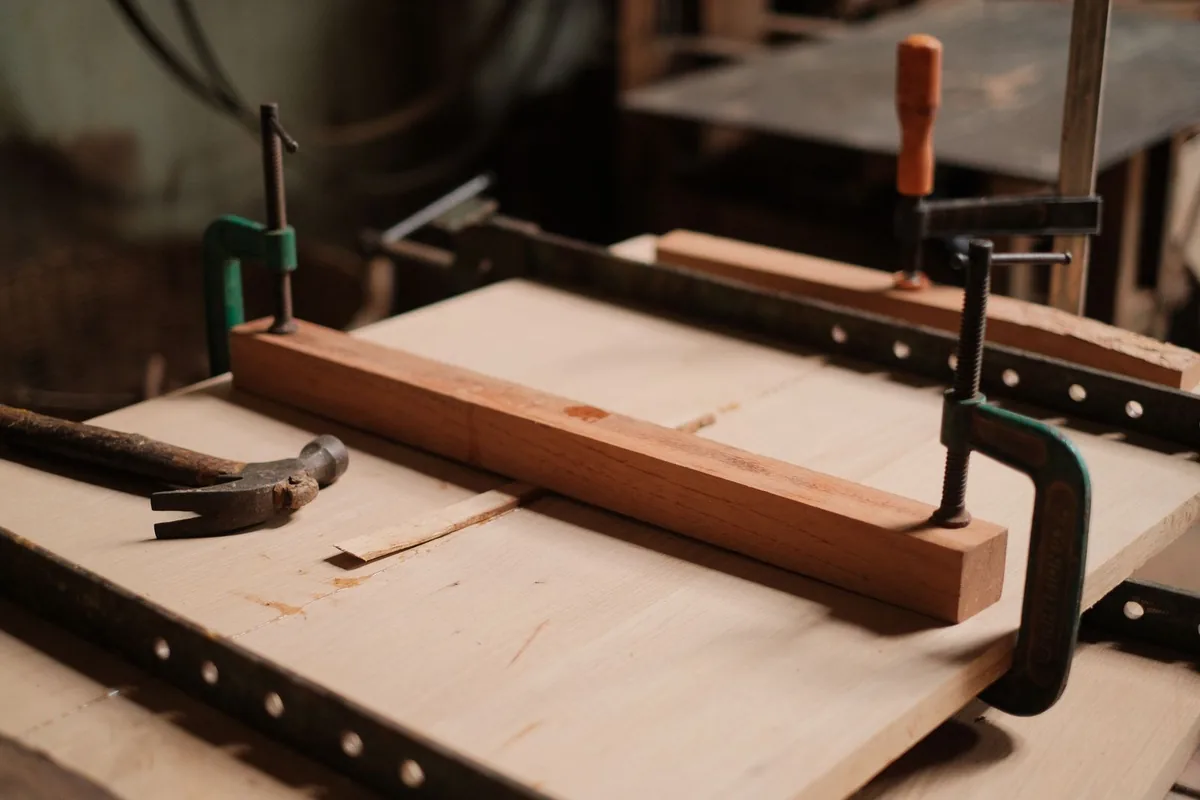
Joining many small strips with the grain direction alternated makes the sheet warp and shrink less than a solid timber panel of the same size, and makes use of rubber tree trunks, which are small in diameter.
There are two main kinds of finger joint today:
- Horizontal finger joint: the comb teeth are hidden inside, and only a thin joint line shows on the surface; often used for exposed surfaces such as table tops and cabinet doors.
- Vertical finger joint: the comb teeth show clearly on the surface like two combs interlocked; the joint is strong but less refined to look at.
What steps are involved in making finger-jointed rubber wood board?
The board goes through eight main stages; its quality depends most on drying and on removing defects before joining.
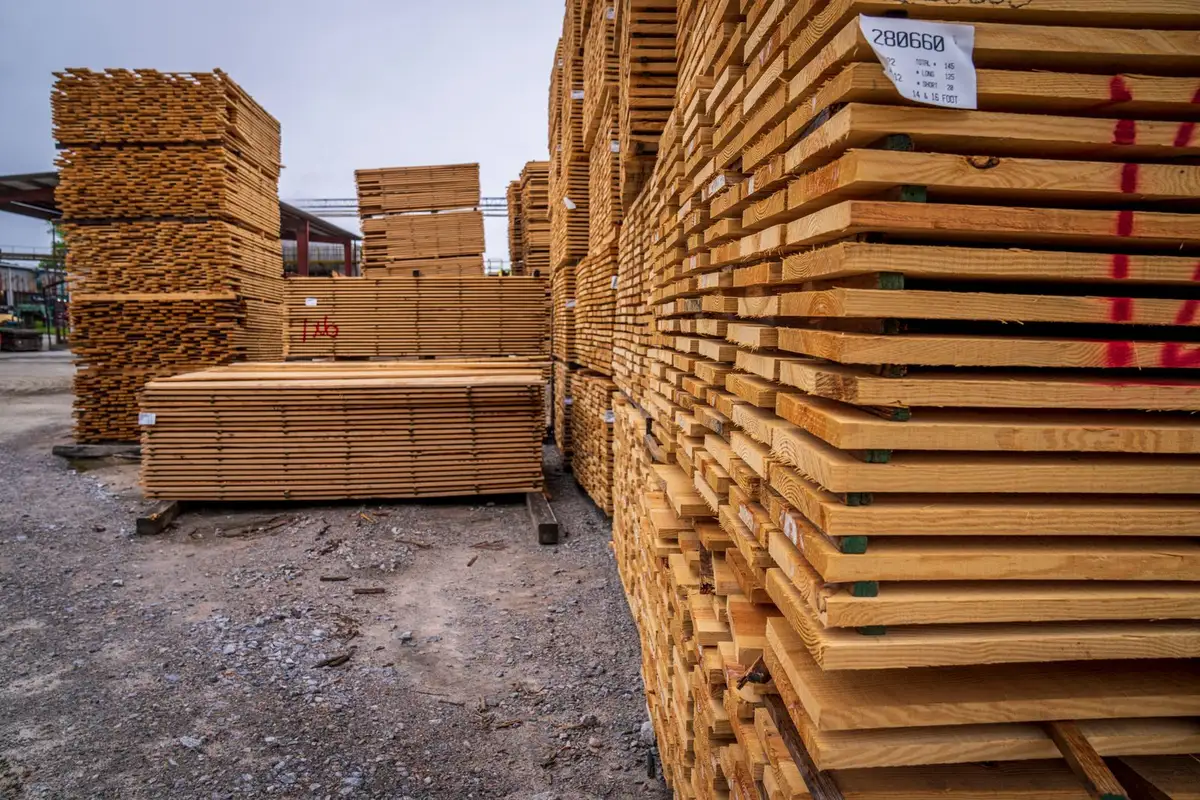
- Saw blanks from rubber trunks at the end of the latex cycle; this stage decides the usable yield and the straightness of the grain.
- Treat with preservative against stain fungi and borers; rubber wood has poor natural durability, so this cannot be skipped.
- Dry the strips to about 8-12% moisture; under-drying is the main cause of warping and cracked joints after installation.
- Plane and cut out dead knots and cracks; the more carefully this is done, the higher the share of AA and AB board.
- Mill the finger joints and join short pieces end to end into long strips; the joint style decides whether the joint line shows or is hidden.
- Edge-glue and press; the glue and pressing force decide joint strength and formaldehyde emission.
- Sand and cut to the 1220 x 2440 mm size; this decides flatness and dimensional tolerance.
- Grade the faces as AA, AB, AC, BC or CC according to the defects on the two faces.
2. Face grades AA, AB and AC of finger-jointed rubber wood
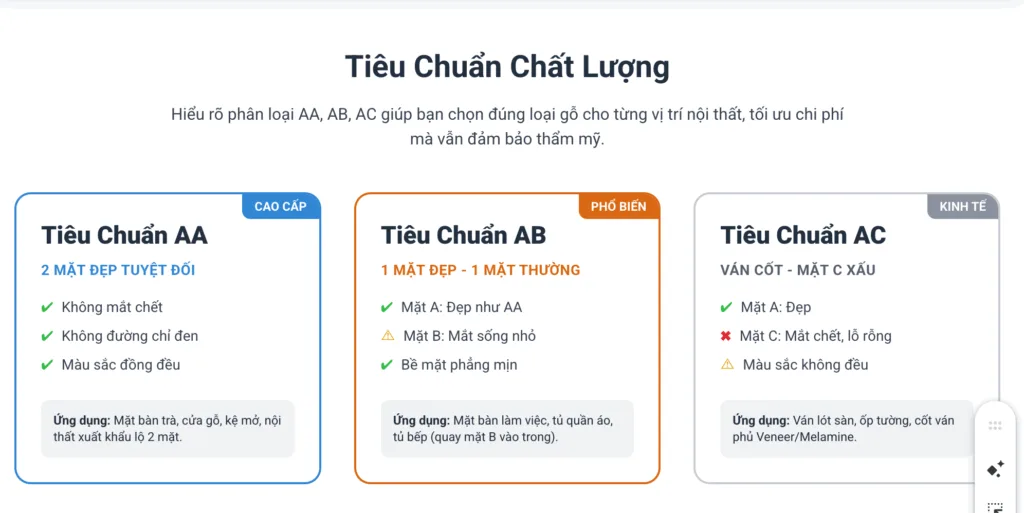
Rubber wood board is graded by the quality of its two faces: AA is good on both faces, AB has one good face and one face that allows minor flaws, AC has one good face and one face with many flaws; BC and CC are used as core board.
This is a trade convention of the board market, not a national standard. In Europe, the surface appearance of solid wood panels is classified in the EN 13017 series, while in the United States the letters AA in the ANSI/HPVA HP-1 hardwood plywood standard grade only the front face and do not mean two grade-A faces. Reading the code correctly helps you choose the right grade for each part and avoid paying for a face nobody sees.
AA board: two good faces for parts visible on both sides
AA board requires both faces to be good: no dead knots (black, rotten knots), no black lines or small cracks, and colour between strips selected to be even. This board is for parts that show both faces, such as room doors, coffee table tops and open bookshelves with no back panel.
AB board: a balance between looks and cost
Face A of an AB board is as good as AA, while face B allows some minor flaws such as live knots (sound, not rotten), short black lines or slight colour differences between strips, but is still smooth and flat. AB board is very common in wardrobes and kitchen cabinets: the carpenter turns face A outward and face B inward, saving cost without affecting product quality.
AC and BC board: an economical choice for core board
AC board has a good face A but a face C with many flaws such as large dead knots, small voids or uneven colour, so it is not used for exposed surfaces. It is often used for loft flooring, hidden sofa frames, or as core for another layer of material on top.
BC board has a grade B main face and a grade C back, usually used as core for veneer, melamine overlay or opaque paint that hides the grain, where the natural flaws of the wood no longer show.
3. Sizes and thicknesses of finger-jointed rubber wood board
Finger-jointed rubber wood board comes in the common size of 1220 x 2440 mm; common thicknesses run from 8 to 18 mm, and 20-35 mm board is usually made to order.
The 1220 x 2440 mm size matches MDF and plywood sheets, so carpenters can easily work out quantities and cut on a CNC machine. The market also has 1200 x 2400 mm and 1000 x 2000 mm; when comparing prices, state the size clearly because the areas differ quite a lot.
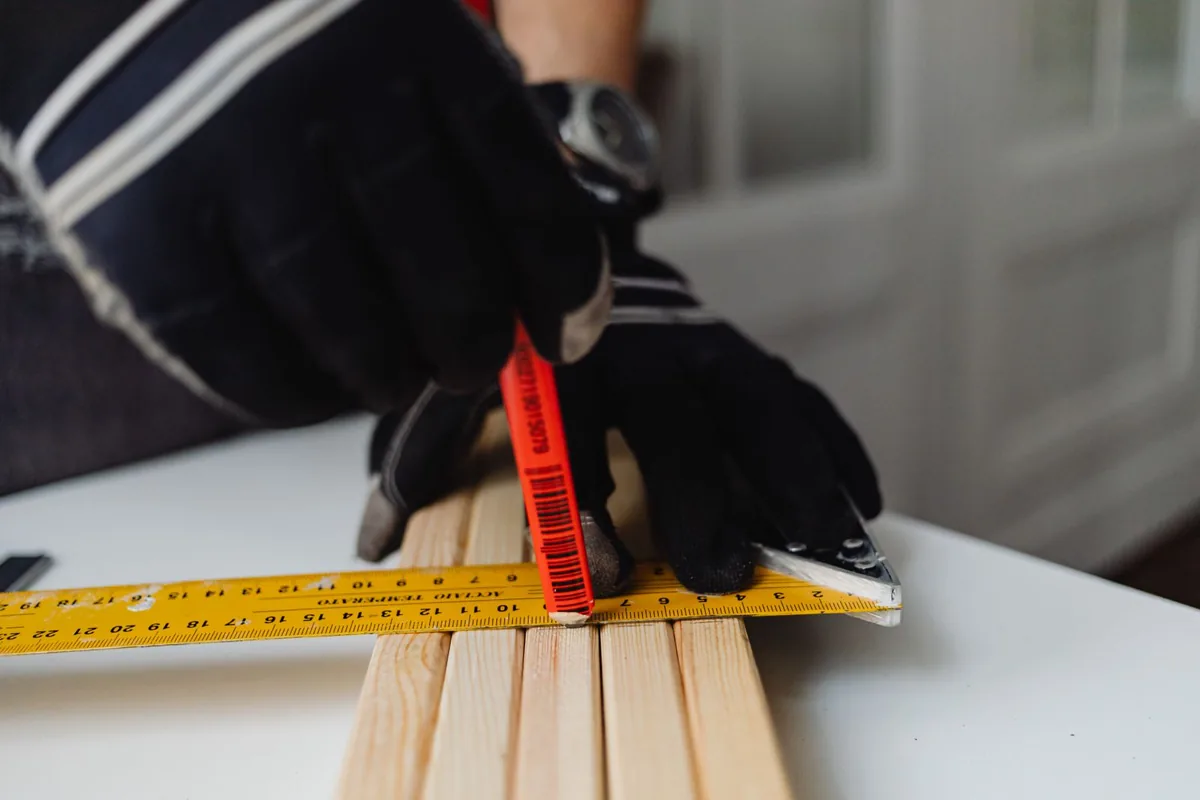
On thickness, the choice by use is fairly clear. Board of 8-10 mm is usually used for cabinet backs, drawer bottoms or thin wall cladding. Board of 12-15 mm suits internal cabinet dividers, small bookshelves and kitchen cabinet carcasses. Board of 17-18 mm is the most common, used for work desk tops, wardrobe doors, beds and stair treads. Thicknesses of 20-35 mm serve heavily loaded parts such as large dining table tops.
The table below summarises thickness, use and estimated weight of one sheet, useful when working out shelf loads, handling crews and transport costs:
| Thickness | Used for | Weight of 1 sheet (estimated at 595 kg/m³) |
|---|---|---|
| 8 mm | Cabinet backs, drawer bottoms, thin wall cladding | About 14 kg |
| 10 mm | Cabinet backs, drawer bottoms | About 18 kg |
| 12 mm | Internal cabinet dividers, small bookshelves | About 21 kg |
| 15 mm | Kitchen cabinet carcasses, dividers | About 27 kg |
| 17 mm | Table tops, cabinet doors, beds | About 30 kg |
| 18 mm | Table tops, cabinet doors, stair treads | About 32 kg |
The weights in the table are calculated from the sheet area of 2.977 m² times the thickness and the average density of dry rubber wood, 595 kg/m³ according to The Wood Database, the same method as ICD Vietnam’s other articles. If you use the 0.55 g/cm³ value in TCVN 12619-2:2019, each sheet is about 8% lighter, for example about 29.5 kg for an 18 mm sheet. Actual weight also varies with moisture, the amount of glue and thickness tolerance.
4. Reference prices of finger-jointed rubber wood board in 2026
According to public list prices from April and June 2026, an uncoated rubber wood sheet of 1220 x 2440 mm costs about 500,000-700,000 VND depending on thickness from 12 to 18 mm and face grade; there is no price source published by a government agency for this product.
I checked the construction-materials price announcement for October 2026 from the An Giang Department of Construction, the kind of document provinces issue every month; its list includes formwork plywood and film-faced board but no finger-jointed rubber wood board. So the figures below come from sellers’ own price lists.
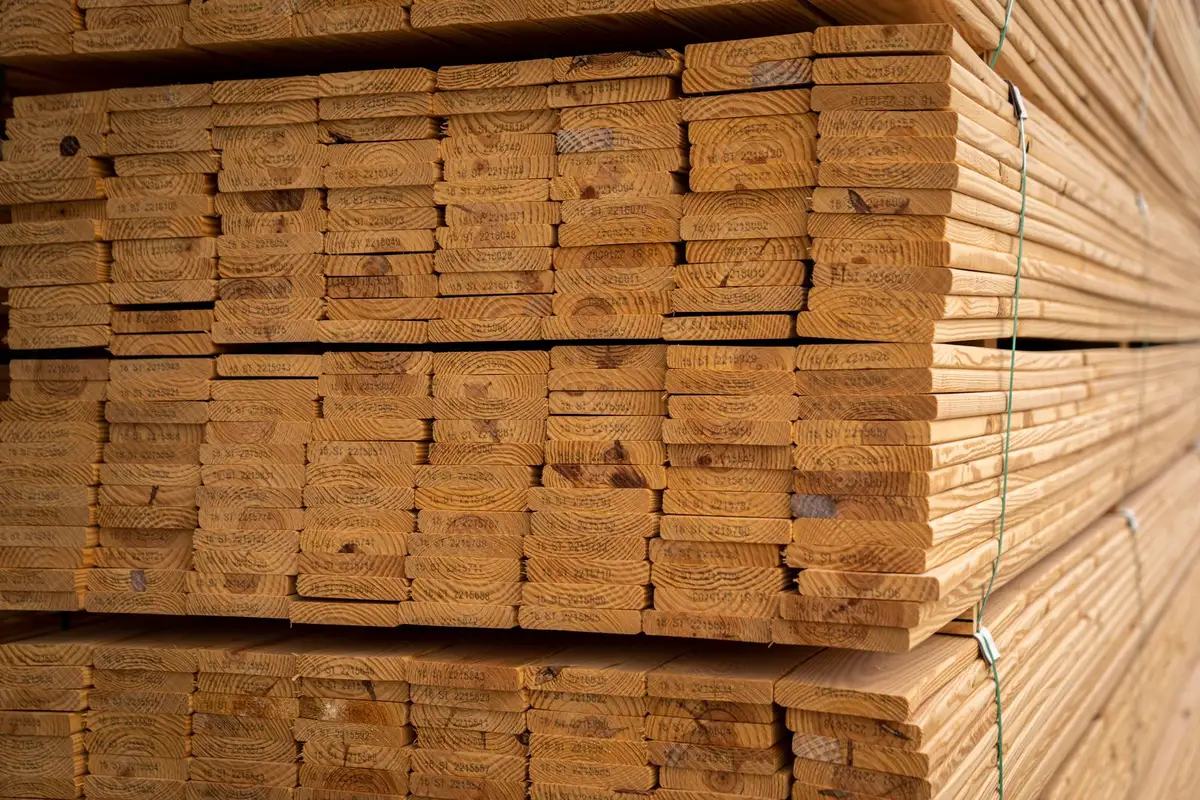
The price list posted on 20 June 2026 by Go An Thanh, a board seller in Binh Duong, shows a 12 mm sheet at 530,000 VND for grade AA and 500,000 VND for grade AC, a 15 mm sheet at 625,000 VND for grade AA, and a 17 mm sheet at 695,000 VND for grade AA and 630,000 VND for grade AC. In Hanoi, the list posted on 24 April 2026 by Tan Dai An shows an 18 mm sheet at about 680,000 VND for grade AA and about 555,000 VND for grade AC.
The difference between AA and AC of the same thickness is about 30,000-125,000 VND a sheet, so choosing the right face grade for each part is the easiest way to save. Gloss-coated board costs more than plain board, usually adding about 40,000 VND per coated side.
The figures above are sellers’ asking prices, before discounts and possibly excluding VAT and delivery; they are not ICD Vietnam quotes. When comparing quotes, ask each seller to state the size, actual thickness, face grade, glue type and delivery terms.
5. Finger-jointed rubber wood compared with MDF and MFC engineered boards
Compared with MDF, finger-jointed rubber wood holds screws better, swells less when it meets moisture and can be worked like natural wood; in return it shows the joint lines on the surface and needs careful drying to avoid warping.
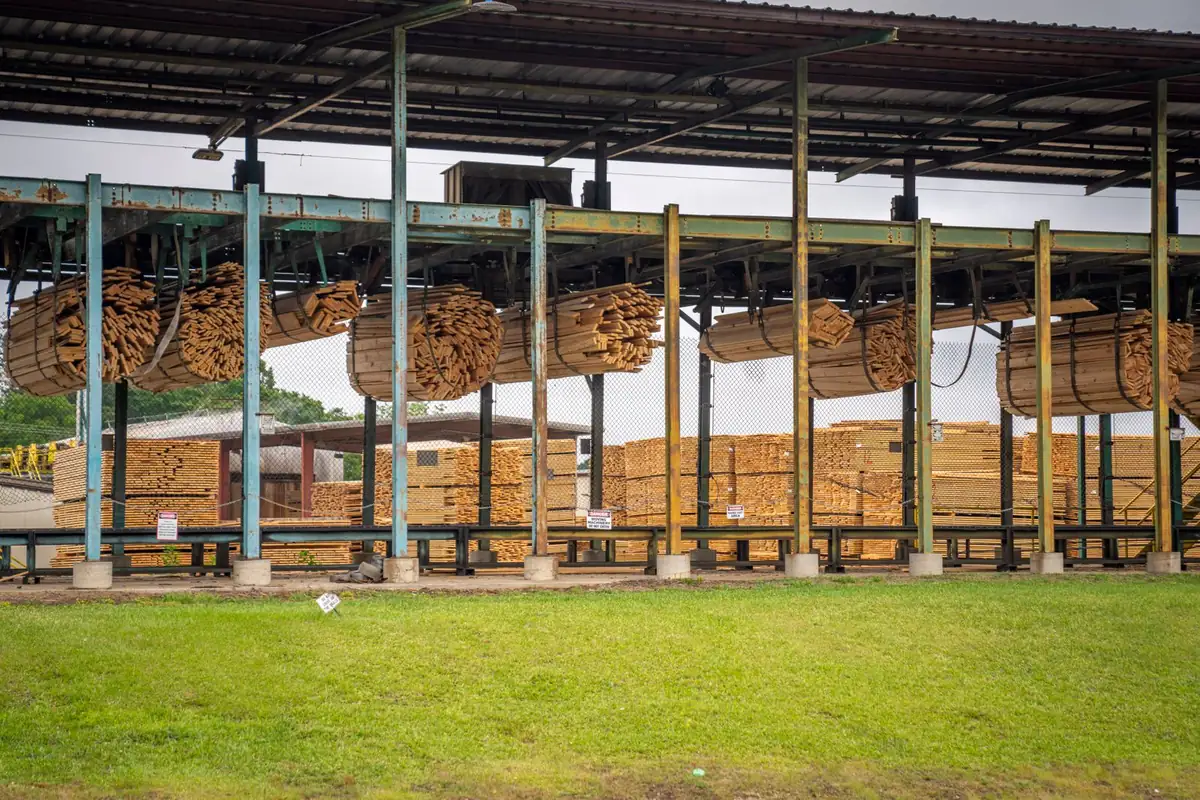
Many people hesitate between finger-jointed rubber wood and engineered boards such as MDF or MFC. The difference lies in the structure: finger-jointed board is natural wood strips joined together, while MDF and MFC are wood fibre or particles pressed with glue.
On strength, the continuous wood fibre in each strip helps finger-jointed rubber wood resist bending and hold screws better than MDF. In damp places such as kitchens, it also swells or crumbles less than particle-based engineered board, provided the joints use a suitable water-resistant glue.
On machining, MDF is mostly cut straight and edge-banded with plastic strip, while finger-jointed rubber wood can be planed, tenoned, profile-milled or carved directly like solid timber.
On emissions, MDF belongs to the group of boards controlled for formaldehyde emission under TSCA Title VI when sold in the United States, while solid-strip finger-jointed board is not, because the amount of glue in the sheet is much smaller. A summary comparison by criterion:
| Criterion | Finger-jointed rubber wood | MDF, MFC board |
|---|---|---|
| Structure | Natural wood strips joined with glue | Wood fibre or particles pressed with glue; MFC comes pre-coated with melamine |
| Bending strength, screw holding | Better thanks to continuous wood fibre | Weaker than finger-jointed rubber wood |
| Damp environments | Swells and crumbles less | Swells and crumbles more easily |
| Machining | Plane, tenon, profile-mill, carve like solid wood | Mostly straight cuts and edge banding |
| Formaldehyde emission | Depends on the joint glue; little glue relative to the volume of the sheet | Glue is the main component; MDF sold in the US must meet TSCA Title VI limits |
6. What to check when buying finger-jointed rubber wood board
Choose a seller with a dry warehouse, a stated board moisture and the willingness to let you inspect the joints, who can also supply the glue type and formaldehyde emission test results.
Moisture is the first thing to ask about: board kept in a damp warehouse or dried insufficiently will keep shrinking after it is installed, opening the joints and bowing cabinet doors. If you have a handheld moisture meter, measure a few points on the sheet before accepting delivery.
Next, look at the joint lines. A good sheet has tight joints with no visible gaps, no glue squeeze-out and no strong chemical smell. For a large construction order, ask the supplier which glue was used and for the emission test certificate. See more wooden pallets at ICD Vietnam.
Which formaldehyde emission certificate should you ask for when buying board?
The most common certificate is emission class E1 under the European standard EN 13986, measured in a test chamber under EN 717-1. According to the TUV Rheinland guidance on wood-based panels, the main levels are as follows:
| Label, regulation | Formaldehyde emission limit | Note |
|---|---|---|
| E1 (EN 13986, Europe) | No more than 0.124 mg/m³, about 0.1 ppm, measured under EN 717-1 | The minimum level to ask for in indoor furniture |
| E2 (EN 13986, Europe) | Above 0.124 mg/m³ | Not suitable for items used in living rooms |
| Germany, from 1 January 2020 | Maximum 0.1 ppm by the EN 16516 method, equal to about 0.05 ppm when measured under EN 717-1 | Board produced from 2020 and sold in Germany must meet this level |
| Board using formaldehyde-free glue | Classed as E1 without testing | Needs the manufacturer to confirm the glue used |
Other codes such as E0 are not part of the EN 13986 classification; when a supplier writes E0, ask which standard it refers to and ask for the laboratory test certificate.
Frequently asked questions
Which group does finger-jointed rubber wood belong to?
Rubber wood belongs to group VII in the timber classification issued with Decision 2198-CNR (1977), the group of light woods with low strength. Rubber wood has poor natural durability and is prone to stain fungi and borers, so it must be treated and dried before joining.
Why is finger-jointed rubber wood so widely used even though it is a light wood?
The timber comes from rubber trees at the end of their latex-tapping cycle, so supply is plentiful; the wood is light-coloured, easy to work and takes glue and paint well. Once treated, dried properly and joined into panels, the board warps less than solid timber and is durable enough for indoor furniture.
Is there a classification standard for finger-jointed rubber wood?
The market uses the face grades AA, AB, AC, BC and CC by the quality of the two faces; this is a trade convention, not a national standard. In Europe, solid wood panels have technical requirements in EN 13353 and appearance classes in the EN 13017 series.

Is finger-jointed rubber wood any good?
It is good for indoor furniture if the board is dried to the right moisture and uses glue that meets emission standards: it holds screws and machines better than MDF. The drawbacks are that it can still warp if under-dried, it shows joint lines on the surface and it is not suited to uncovered outdoor use.
How does veneered or melamine-faced rubber wood board differ from bare board?
Bare board shows the rubber wood grain, usually in grade AA or AB and then finished with a coating. Veneered or melamine-faced board uses lower grades such as BC or CC as core, with a thin sliced veneer or melamine paper on the outside, so it hides surface flaws and can change colour and grain.
How much does an 18 mm finger-jointed rubber wood sheet weigh?
About 32 kg for the 1220 x 2440 mm size at the 595 kg/m³ density of The Wood Database; at the 0.55 g/cm³ of TCVN 12619-2:2019 it is about 29.5 kg. A 15 mm sheet is about 27 kg and a 12 mm sheet about 21 kg; the real weight depends on moisture and the amount of glue.
How much does a finger-jointed rubber wood sheet cost?
According to public list prices of April and June 2026, an uncoated 1220 x 2440 mm sheet is about 500,000-700,000 VND depending on thickness from 12 to 18 mm and face grade, for example a 17 mm grade AA sheet at 695,000 VND. This is the seller’s asking price and changes with timing and quantity.
Can finger-jointed rubber wood be used outdoors?
Ordinary finger-jointed board uses furniture glue and so is not suited to uncovered outdoor use. EN 13353 separates board for dry (SWP/1), humid (SWP/2) and exterior (SWP/3) conditions; if you need it in damp places or outdoors, order board with a matching water-resistant glue and seal both faces and edges.
Does ICD Vietnam sell finger-jointed rubber wood board?
No. ICD Vietnam makes and supplies pallets and does not trade in finger-jointed boards. The board prices in this article are public list prices of board sellers, with source and date.
Contact ICD Vietnam about wooden pallets
- Hotline 1: 0983 797 186
- Hotline 2: 0903 459 186
- Hotline 3: 0905 859 186
South Vietnam: 098 6784 186. Hanoi warehouse: 3rd Floor, Thang Long A1 Building, Bau Hamlet, Thien Loc Commune. Southern workshop: 551/212 Le Van Khuong Street, Tan Thoi Hiep Ward, District 12. Wooden pallets: contact for a quote, volume discounts.
References
- List prices of finger-jointed rubber wood board: the article “How much is finger-jointed rubber wood board? Price list updated 2026”, Go An Thanh, posted 20 June 2026; the rubber wood board price list, Tan Dai An (Hanoi), posted 24 April 2026. Read on 17 October 2026.
- TCVN 12619-2:2019 Wood - Classification - Part 2: By physical and mechanical properties.
- The Wood Database, Rubberwood (Hevea brasiliensis): density and natural durability of rubber wood.
- Decision 2198-CNR (1977) of the Ministry of Forestry promulgating the provisional classification table of timbers used uniformly nationwide.
- BSI Knowledge, EN 13353:2022 Solid wood panels (SWP) - Requirements.
- US Environmental Protection Agency (EPA), frequently asked questions on the TSCA Title VI formaldehyde emission standards.
- Construction materials price announcement for October 2026, An Giang Department of Construction.
- EN 204 Classification of thermoplastic wood adhesives for non-structural applications (classes D1-D4).
- TUV Rheinland, Guideline Information: Formaldehyde Release from Wood-Based Panels (EN 13986, EN 717-1, German regulation).
- EUR-Lex, Regulation (EU) 2023/1464 on limits for formaldehyde emissions from products.