Table of Contents
- 1. How many kg does 1 cubic meter of acacia wood weigh?
- 2. Density of Acacia mangium, Acacia auriculiformis and hybrid acacia
- 3. Three factors that decide the weight of acacia wood
- 4. How to estimate acacia wood weight: a worked example
- 5. How many cubic meters is 1 tonne of acacia wood?
- 6. Conclusion
- Frequently asked questions
- 1. How many kg does 1 cubic meter of acacia weigh?
- 2. Which factor affects acacia weight the most?
- 3. How many cubic meters is 1 tonne of acacia?
- 4. What is the moisture of green acacia?
- 5. How many m³ is 1 tonne of green acacia?
- 6. How much does an acacia pallet weigh?
- 7. Which is heavier, Acacia auriculiformis or Acacia mangium?
- Contact ICD Vietnam
- References
Reviewed and updated by ICD - Week 43/2026
One cubic meter (1 m³) of acacia wood dried to 12 - 15% moisture weighs about 570 - 650 kg; freshly cut green acacia weighs about 930 - 980 kg, nearly a tonne. Under TCVN 12619-2:2019, hybrid acacia has a density of 0.57 g/cm³, Acacia mangium 0.58 g/cm³ and Acacia auriculiformis 0.59 g/cm³. The gap between green and dry wood is almost entirely water in the grain, so whenever someone asks how much a cubic meter of acacia weighs, always ask what moisture the wood is at.
I have made pallets at ICD Vietnam since 2011, and the question of acacia wood weight comes up on almost every order: buyers need it to work out truck load and sea freight, while sellers of round logs price by the tonne. The 570 kg/m³ figure many sites quote is correct only for dry wood; using it to convert green wood bought by the tonne can be off by up to 40%. This article gathers sourced figures, states the moisture that goes with each, and shows how to calculate for your own lot.
1. How many kg does 1 cubic meter of acacia wood weigh?
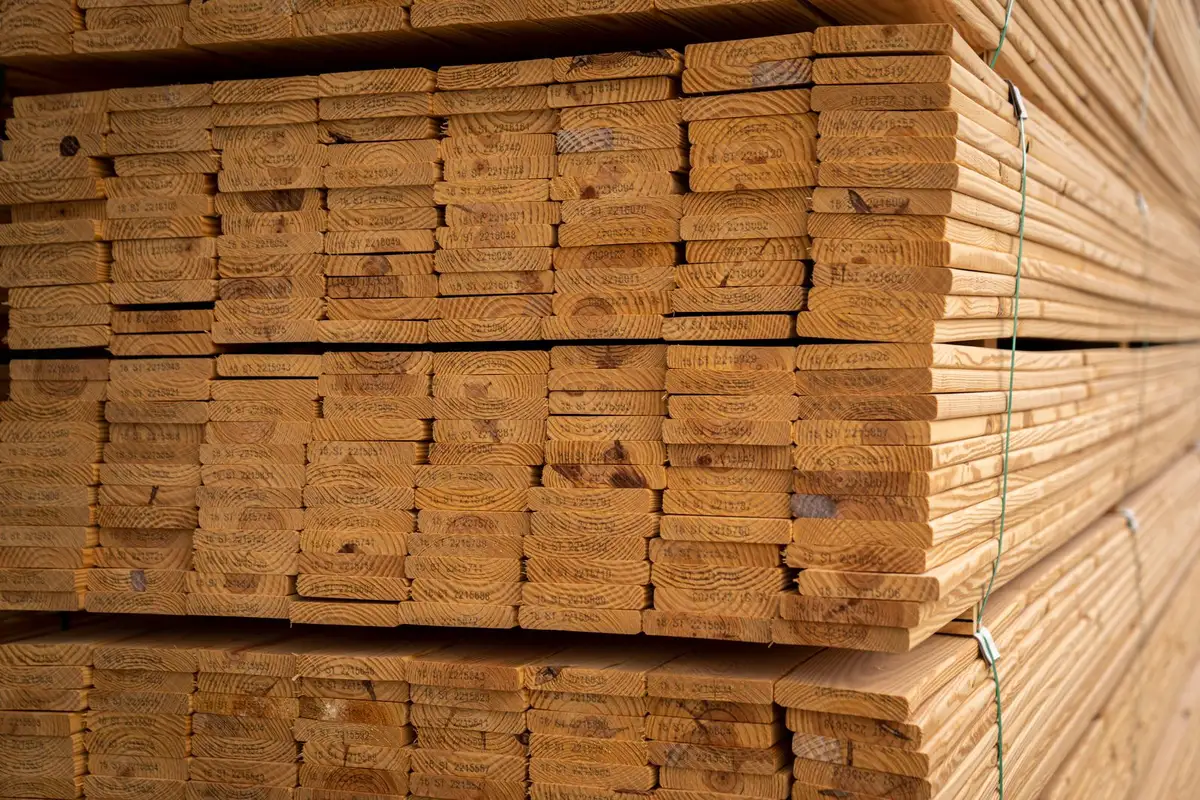
The weight of 1 m³ of acacia is simply the density of the wood at a stated moisture: about 570 - 650 kg for wood dried to 12 - 15%, and 930 - 980 kg for freshly cut wood. The 570 - 650 kg range is where measurements of plantation acacia overlap: TCVN 12619-2:2019 gives 570 - 590 kg/m³ for the three main acacia species, and The Wood Database gives Acacia mangium an average of 585 kg/m³ at 12% moisture. The public version of the TCVN does not state the moisture at which its table was measured, so I use it to compare species and take the whole 570 - 650 kg range when calculating loads.
The chart shows what surprises many people: 1 m³ of green acacia weighs almost the same as 1 m³ of water. Wood left to air-dry in a yard for a few months gradually drops to about 600 kg/m³, depending on weather and the thickness of the pieces. So the right answer to how much a cubic meter of acacia weighs is not one number, but a number tied to the condition of the wood.
2. Density of Acacia mangium, Acacia auriculiformis and hybrid acacia
The three main plantation acacias in Vietnam differ by only about 20 kg per m³ under TCVN 12619-2:2019: hybrid acacia 0.57 g/cm³, Acacia mangium 0.58 g/cm³, Acacia auriculiformis (golden-flowered tram) 0.59 g/cm³. International sources give a much wider range because they measure trees of many ages and growing regions. The table below sets these figures side by side with the moisture at measurement.
| Acacia species | Scientific name | TCVN 12619-2:2019 | Range in international sources |
|---|---|---|---|
| Hybrid acacia | Acacia mangium x A. auriculiformis | 570 kg/m³ (0.57 g/cm³) | No separate figure in PROSEA or The Wood Database |
| Acacia mangium | Acacia mangium | 580 kg/m³ (0.58 g/cm³) | 530 - 690 kg/m³, with a sample at 450 kg/m³ at 15% moisture (PROSEA); 467 - 675 kg/m³ at 15% moisture, 14-year-old trees (FRIM); average 585 kg/m³ at 12% moisture (The Wood Database) |
| Acacia auriculiformis (golden-flowered tram) | Acacia auriculiformis | 590 kg/m³ (0.59 g/cm³) | 490 - 840 kg/m³ at 15% moisture (PROSEA) |
The wide PROSEA and FRIM ranges come from tree age and sampling position. The Forest Research Institute Malaysia (FRIM) found that the density of Acacia mangium wood rises with tree age and from the pith outward, so young 5 - 6 year trees are usually lighter than trees over 10 years old. Data from the Vietnamese Academy of Forest Sciences show the same: at age 7, the wood basic density (dry mass divided by green volume) is 0.469 t/m³ for Acacia auriculiformis, 0.455 t/m³ for hybrid acacia and 0.414 t/m³ for Acacia mangium.
Why do some sites say acacia weighs 770 kg/m³?
The figure of 770 kg/m³ (48 lbs/ft³) common on foreign sites is used for the trade name ‘acacia’ in general and does not represent plantation acacia in Vietnam. The Wood Database notes that the genus Acacia has nearly 1,000 species, from woods lighter than black cherry such as Acacia mangium to some among the heaviest and hardest in the world, so it is almost impossible to pick one figure for the whole genus. When calculating loads for domestically grown acacia, use the figure for the exact species above instead of this generic number.
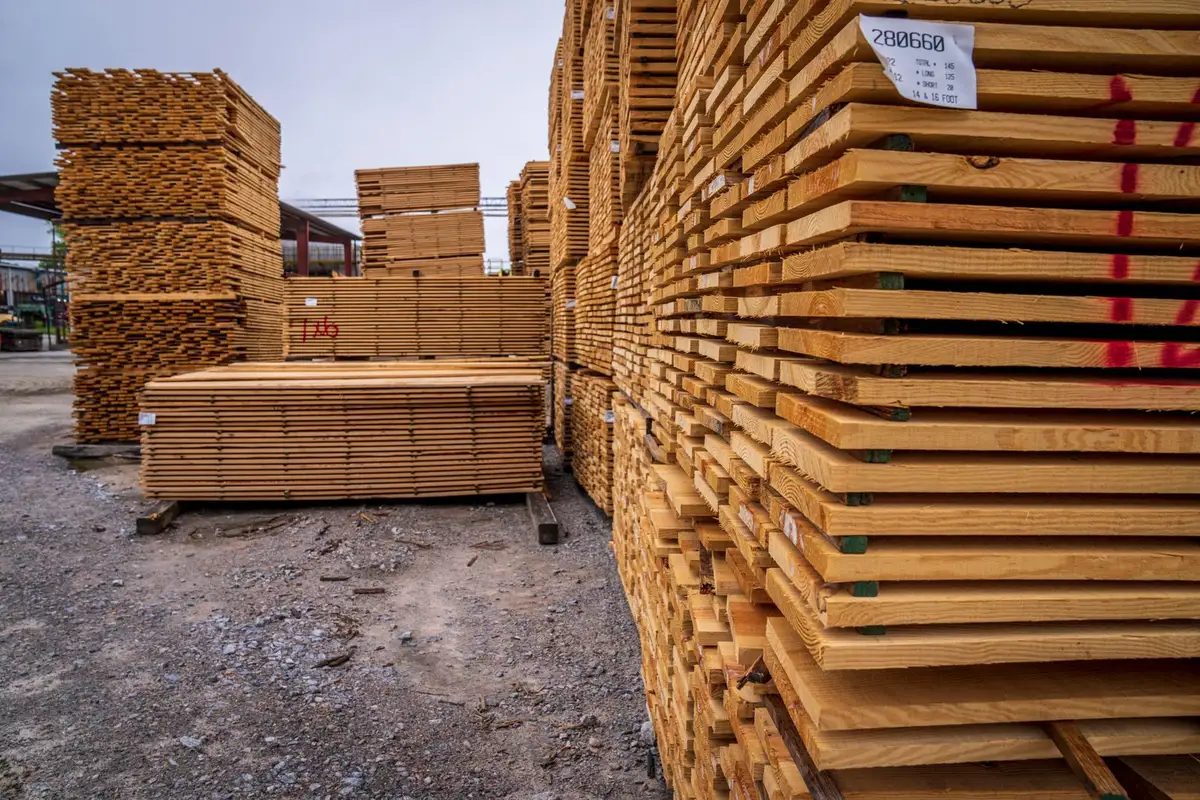
Another mix-up is the leucaena tree (Leucaena leucocephala): although its Vietnamese name includes ‘keo’, it belongs to the genus Leucaena, not Acacia, so its figures should not be used for the acacia wood used in pallets.
3. Three factors that decide the weight of acacia wood
Three factors decide the weight of acacia wood: moisture, species and the volume of the block, of which moisture alone can make the same cubic meter differ by 300 - 400 kg. Species creates a difference of only about 20 kg/m³ as in section 2, and volume is a simple multiplication. In the lots I have handled for transport and pallet production projects, the biggest error almost always comes from not knowing how wet the wood is.

Moisture: the most important factor
Freshly cut acacia holds a great deal of water. Studies on Acacia mangium show that newly felled wood has an average moisture of about 73% on an oven-dry basis (Chowdhury et al., 2005; Ismaili et al., 2011), and some 8-year-old lots reach 118%. The mass of 1 m³ of green wood equals the basic density multiplied by (1 + moisture): with 0.54 - 0.56 g/cm³ and 73% moisture, each m³ weighs about 930 - 970 kg; with 0.45 g/cm³ and 118% moisture, about 980 kg.
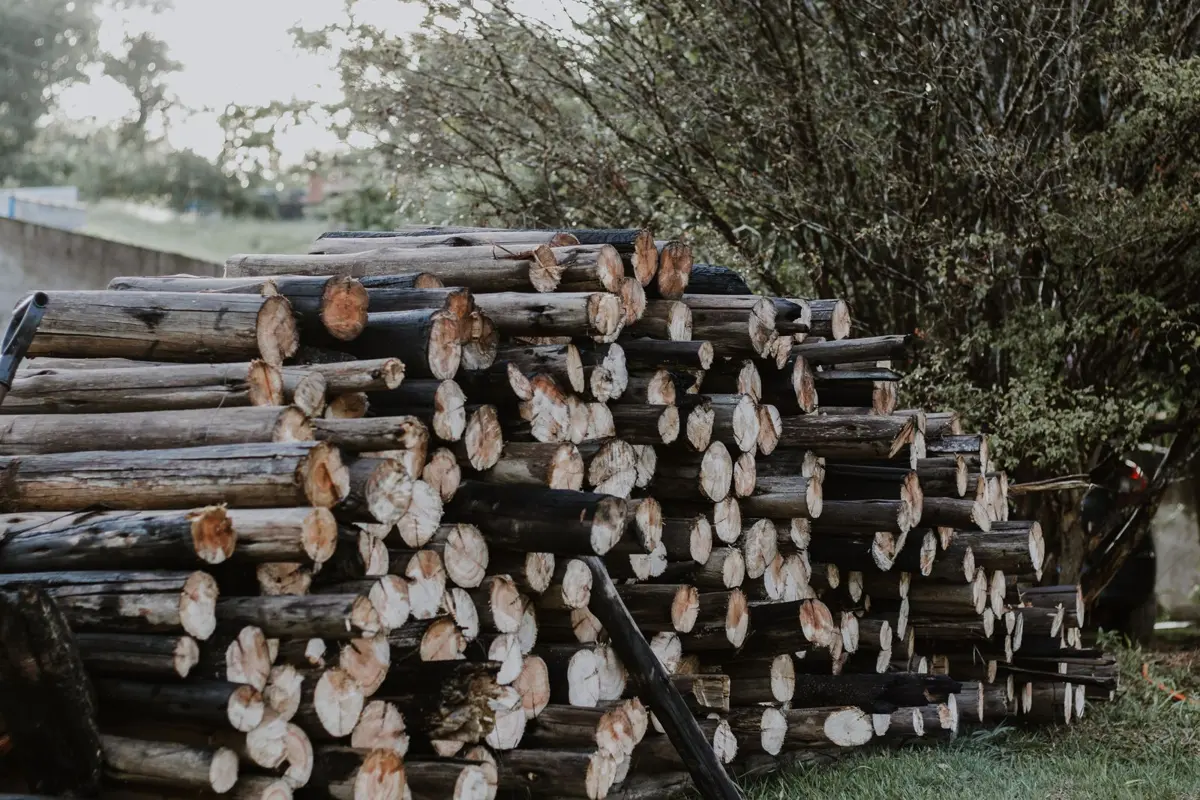
For export wooden pallets charged by weight, moisture also decides how stable the load is: wet wood is heavy, molds easily, and shrinkage loosens the nails. So when taking orders I always advise customers to state a target wood moisture in the order, usually under 20% as recommended by the Wood Handbook (US Forest Products Laboratory, Department of Agriculture), so both sides use the same way of calculating weight.
Species
The acacias grown for timber in Vietnam all belong to the genus Acacia, such as hybrid acacia, Acacia mangium and Acacia auriculiformis, and have slightly different wood densities. Under TCVN 12619-2:2019, the three differ by only 0.02 g/cm³, about 20 kg per m³, far smaller than the difference caused by moisture or tree age.
Volume of the block
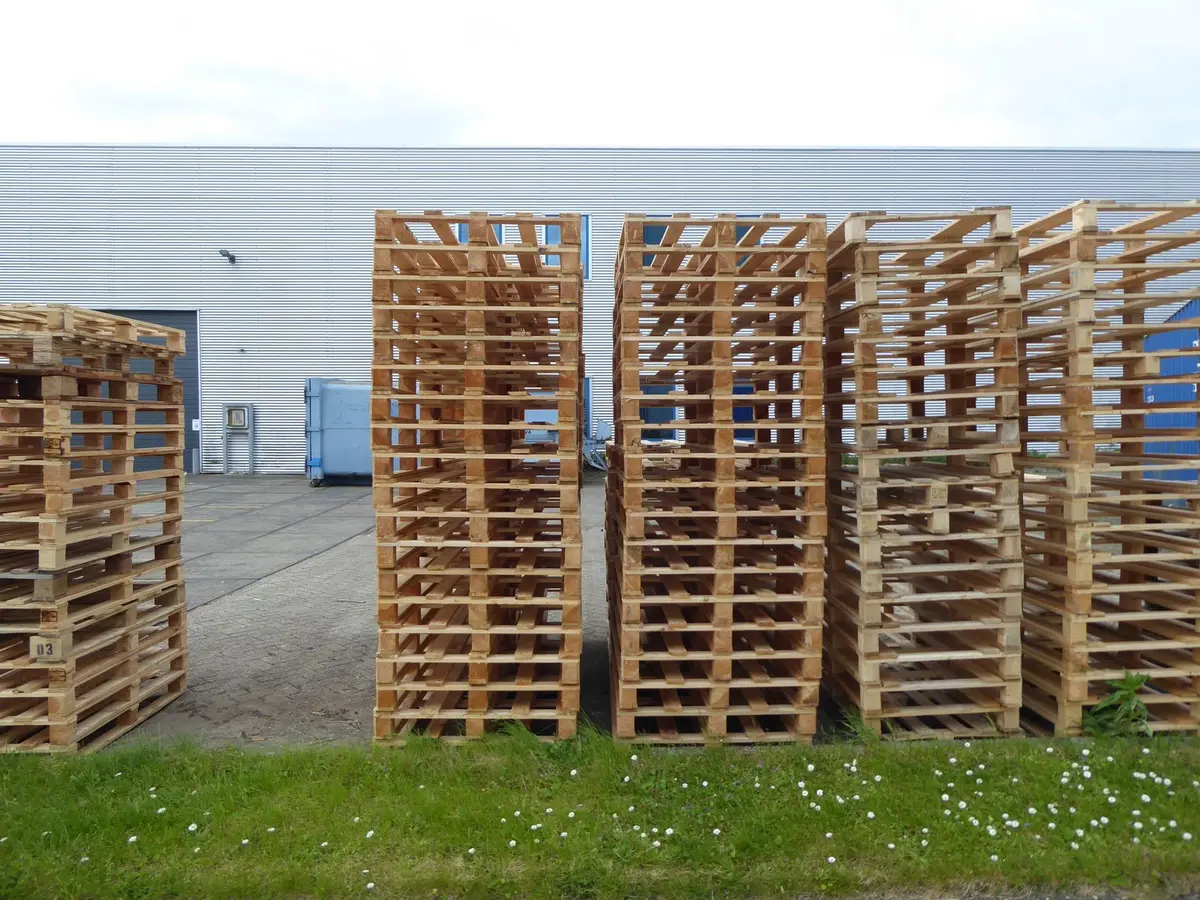
The weight of a block of wood equals its volume times its density, so to know how much a lot weighs you only need to get the volume right. Two blocks of the same species and moisture weigh in exact proportion to their volume. The table below applies this formula to some common pallet-making sizes, using dried acacia at 570 - 650 kg/m³ and green acacia at about 950 kg/m³ (the middle of the 930 - 980 kg range).
| Size | Volume | Dry acacia | Green acacia |
|---|---|---|---|
| Board 20 x 100 x 1200 mm | 0.0024 m³ | 1.4 - 1.6 kg | About 2.3 kg |
| Board 30 x 90 x 1200 mm | 0.00324 m³ | 1.8 - 2.1 kg | About 3.1 kg |
| Wood for one pallet using 0.05 m³ | 0.05 m³ | 28.5 - 32.5 kg | About 47.5 kg |
| 1 tonne of wood (converted to volume) | 1.54 - 1.75 m³ (dry); about 1.05 m³ (green) | 1,000 kg | 1,000 kg |
4. How to estimate acacia wood weight: a worked example
The general formula is mass (kg) = volume (m³) x density (kg/m³), with the density chosen for the right species and moisture. A block of acacia 1 m x 1 m x 1 m weighs 570 - 650 kg if dried to 12 - 15%, and about 930 - 980 kg if freshly cut; the more thoroughly it is dried, the lighter the block gets, not heavier.
Example: a glued acacia tabletop calculated in US units
Many acacia butcher block countertop catalogs give sizes in US units, for example 8 ft x 25.5 in x 1.5 in. Converted to feet: width 25.5 / 12 = 2.125 ft, thickness 1.5 / 12 = 0.125 ft, so the volume is 8 x 2.125 x 0.125 = 2.125 ft³. Multiplied by the 48 lbs/ft³ density commonly used for ‘acacia’, the countertop weighs about 102 lbs, or 46 kg.
In metric units, 2.125 ft³ is about 0.060 m³. Using the density of Vietnamese plantation acacia (570 - 650 kg/m³), this countertop weighs only about 34 - 39 kg (75 - 86 lbs), clearly lighter than 102 lbs. In practice, a similar product on the market may weigh only about 50 lbs.
The gap may be because the countertop is not fully solid wood, has a hollow structure inside, or the real density of the product differs from the average figure. This is a point I often raise when advising on engineered wood products: weighing the finished product is always more accurate than multiplying volume by a factor read online.
To calculate quickly for your own lot, enter the volume or the mass in the tool below and choose the matching wood condition.
5. How many cubic meters is 1 tonne of acacia wood?
1 tonne of green acacia is about 1.02 - 1.08 m³ of solid wood, while 1 tonne of acacia dried to 12 - 15% is about 1.54 - 1.75 m³. The calculation is 1,000 kg divided by the weight of 1 m³ in the right condition: 1,000 / 980 to 1,000 / 930 for green wood, 1,000 / 650 to 1,000 / 570 for dry wood.
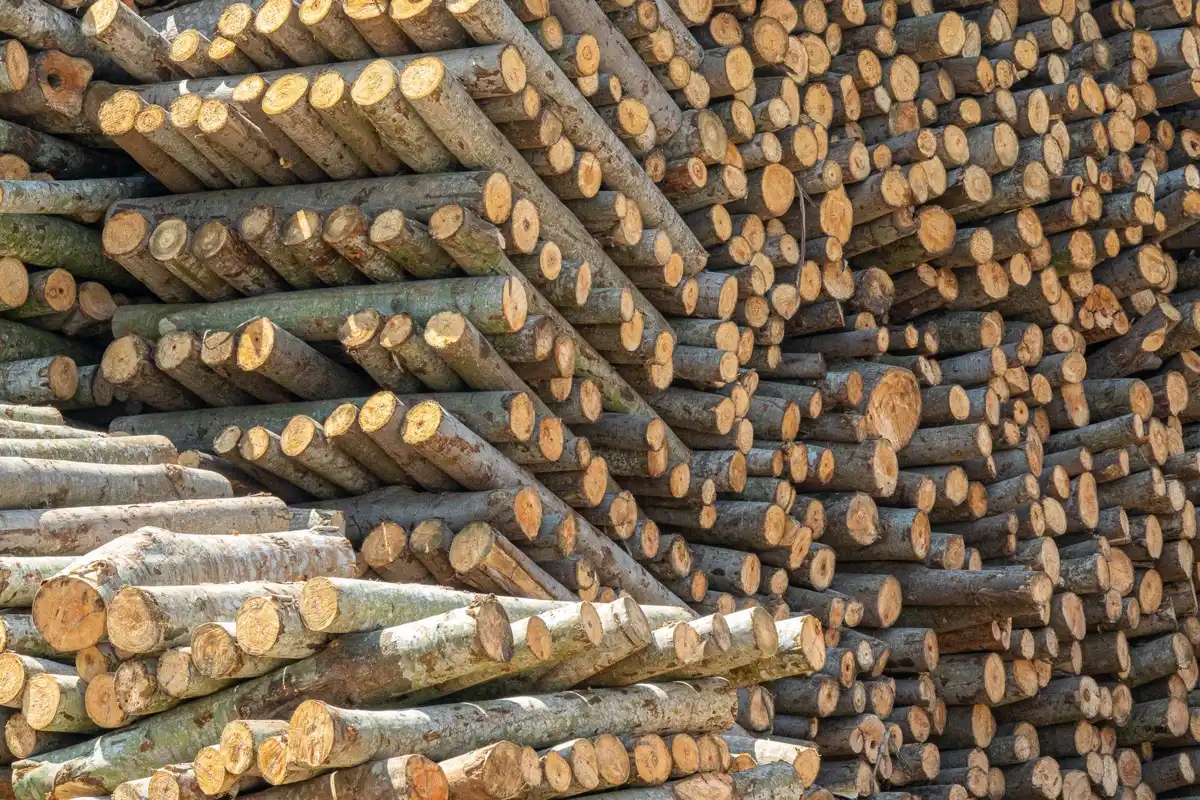
Round acacia on the market is mostly traded by the tonne, while sawn timber and veneer are priced per m³, so this conversion decides price comparisons. But there is no fixed factor for green wood, because the amount of water varies with species, tree age and time since harvest; the surest way is to weigh a sample lot of known volume. Round logs with bark stacked in a pile also take up far more volume than the solid wood, because of the gaps between the logs.
6. Conclusion
1 m³ of acacia weighs 570 - 650 kg when dried to 12 - 15% moisture, and 930 - 980 kg when green. Hybrid acacia, Acacia mangium and Acacia auriculiformis differ by only about 20 kg/m³ under TCVN 12619-2:2019, while moisture makes the same block differ by 300 - 400 kg. To estimate transport cost, load capacity and safety correctly, always tie a weight figure to the moisture of the lot, and weigh a sample lot when buying green wood by the tonne.
Frequently asked questions
1. How many kg does 1 cubic meter of acacia weigh?
About 570 - 650 kg/m³ for wood dried to 12 - 15% moisture; freshly cut acacia weighs about 930 - 980 kg/m³ because it still holds a lot of water. The 770 kg/m³ figure on some foreign sites is for ‘acacia’ in general and does not represent plantation acacia in Vietnam.
2. Which factor affects acacia weight the most?
Moisture is the most important factor: green wood weighs about 300 - 400 kg per m³ more than dried wood. Species creates a difference of only about 20 kg/m³, and the size of the block decides weight in exact proportion to volume.
3. How many cubic meters is 1 tonne of acacia?
About 1.02 - 1.08 m³ for green acacia and about 1.54 - 1.75 m³ for wood dried to 12 - 15% moisture. Green wood has no fixed factor because water content differs by lot, so the accurate way is to weigh a sample lot of known volume.
4. What is the moisture of green acacia?
Freshly cut Acacia mangium has an average moisture of about 73% (on an oven-dry mass basis), according to studies in Bangladesh in 2005 and Malaysia in 2011; some lots exceed 100%. For making pallets, wood is usually dried to below 20%.
5. How many m³ is 1 tonne of green acacia?
About 1.0 - 1.1 m³ of solid wood, because 1 m³ of green acacia weighs 930 - 980 kg. For round logs with bark stacked in a pile, the space occupied is larger because of the gaps between the logs.
6. How much does an acacia pallet weigh?
It depends on the construction. A pallet using about 0.05 m³ of dried acacia weighs about 28 - 33 kg; built from green wood, the same pallet weighs about 47 kg. So export cargo charged by weight should use dried wood.
7. Which is heavier, Acacia auriculiformis or Acacia mangium?
Under TCVN 12619-2:2019, Acacia auriculiformis is slightly heavier: 0.59 g/cm³ against 0.58 g/cm³ for Acacia mangium and 0.57 g/cm³ for hybrid acacia. At age 7, the Vietnamese Academy of Forest Sciences also records Acacia auriculiformis as having the highest basic density of the three.
Contact ICD Vietnam
For advice on choosing dried acacia pallets by load and shipping route, send us the dimensions, load, quantity and target wood moisture. ICD Vietnam has a production workshop, a Hanoi warehouse and a southern workshop; price: contact for a quote, with volume discounts. Wooden pallets carry no warranty and can be returned or exchanged within 7 days.
ICD Vietnam Industrial Manufacturing Co., Ltd
- North (Hanoi warehouse): 3rd Floor, Thang Long A1 Building, Bau Hamlet, Thien Loc Commune, Hanoi - 0983 797 186 / 090 345 9186 / 090 5859 186.
- Southern workshop: 551/212 Le Van Khuong, Tan Thoi Hiep, District 12, Ho Chi Minh City - 098 6784 186.
- Email: sales@icdvietnam.com.vn. Zalo: Chat on Zalo.
References
- TCVN 12619-2:2019 Wood - Classification - Part 2: By physical and mechanical properties, published by the Ministry of Science and Technology.
- Timber Technology Bulletin No. 26: Rubberwood and Acacia mangium, Forest Research Institute Malaysia (FRIM).
- Acacia mangium and Acacia auriculiformis, PROSEA (Plant Resources of South-East Asia), Pl@ntUse.
- Mangium (Acacia mangium) and the Acacia genus page, The Wood Database.
- Potential uses of hybrid acacia wood and points to note in forest planting, Vietnamese Academy of Forest Sciences.
- Leucaena leucocephala, Vietnamese Wikipedia.
- Chowdhury M.Q., Shams I., Alam M. (2005). Effects of age and height variation on physical properties of mangium (Acacia mangium Willd.) wood.
- Ismaili G., Abu Bakar B.H., Abdul Rahim K.K. (2011). Evaluation of Acacia mangium in structural size at green condition.
- Siarudin M., Marsoem S.N. (2007). Characteristic and variation of Acacia mangium Willd. wood physical properties in many plantation spacings and axial-radial position.
- Wood Handbook: Wood as an Engineering Material, US Forest Products Laboratory, Department of Agriculture (USDA).