
Mục lục
Rubberwood is the most widely used English name for wood harvested from rubber trees after their latex-producing life ends. In international trade you will also encounter the names Parawood and the scientific name Hevea brasiliensis. Knowing which term to use, and when, prevents errors in phytosanitary certificates, purchase orders and shipping documents. This article explains each name, lists the key English technical terms for wooden pallets and ISPM-15 phytosanitary treatment, and explains why rubberwood pallets are the preferred choice for export manufacturing in southern Vietnam.
1. What is the English name for rubberwood?
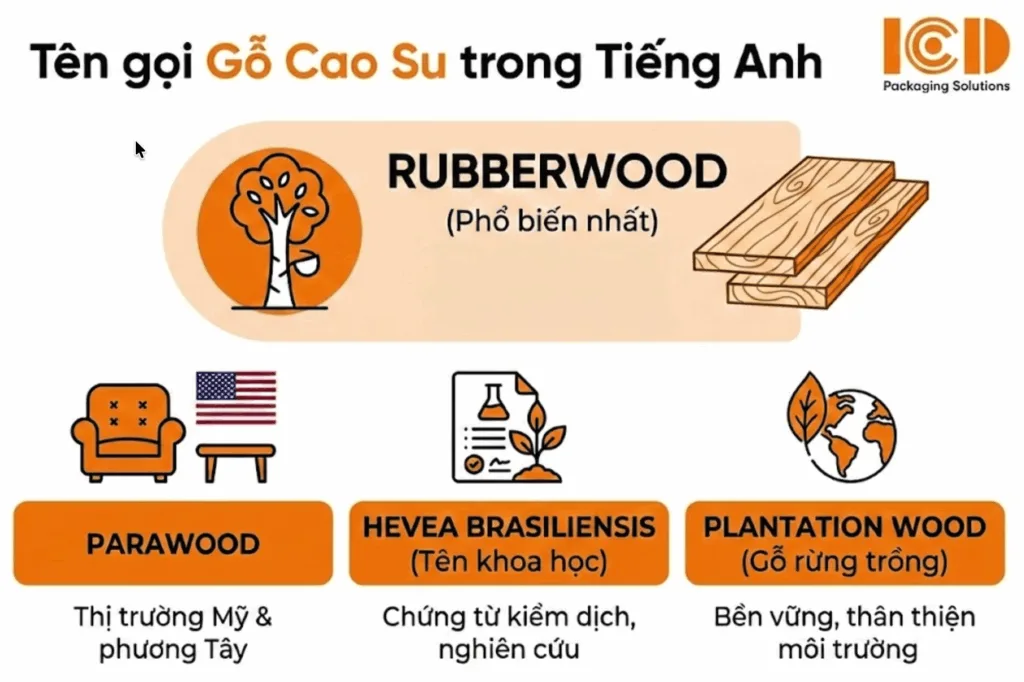
In international trade, the most common name is Rubberwood - a direct compound of Rubber and Wood that accurately reflects the origin of the timber. Depending on the market and purpose, you will also encounter the following names:
- Parawood: Extremely common in the United States and Western markets when referring to furniture products made from rubberwood.
- Hevea brasiliensis: The formal scientific name, appearing in phytosanitary inspection documents and forestry research literature.
- Plantation Wood: A term for farmed timber. Because rubberwood is harvested only after the latex-production cycle ends, it is classified as eco-friendly wood for its sustainability and low environmental impact.
In industrial packaging, rubberwood is regarded as a cost-effective substitute for natural hardwood, with adequate load-bearing capacity for pallets and wooden crates.
2. English terminology for wooden pallets in logistics
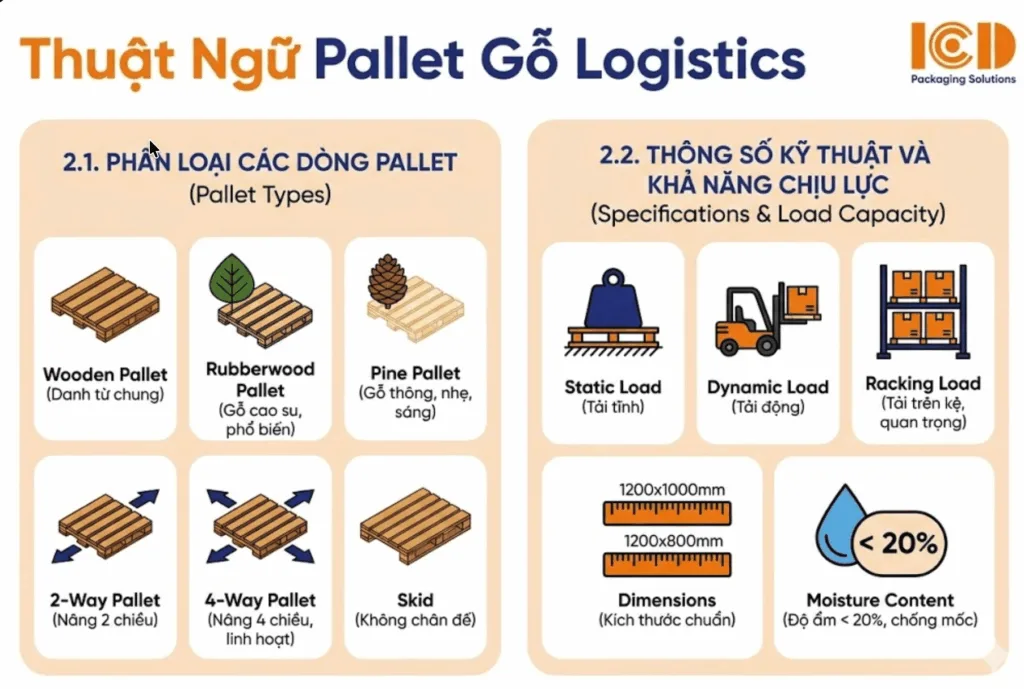
Using precise terminology in contracts and emails helps businesses avoid technical errors when ordering export pallets.
2.1. Pallet types
- Wooden Pallet: The general term for any pallet made of wood.
- Rubberwood Pallet: A pallet made from rubberwood - the flagship product line in southern Vietnam.
- Pine Pallet: A pallet made from pine wood, typically lighter in weight and lighter in colour.
- 2-Way Pallet: A design that allows forklift tines to enter from two opposite sides only.
- 4-Way Pallet: A flexible design that allows forklift entry from all four sides, maximising container space utilisation.
- Skid: Similar to a pallet but without bottom deck boards, commonly used for fixed machinery and equipment.
2.2. Load capacity specifications
| Term | Definition |
|---|---|
| Static Load | Maximum weight the pallet can bear when placed stationary on a warehouse floor. |
| Dynamic Load | Rated load during transport by forklift or other moving equipment. |
| Racking Load | The most critical figure for warehouses using high-bay racking systems - the load the pallet can bear on a rack beam. |
| Dimensions | Overall pallet size. Common international standards are 1200 x 1000 mm and 1200 x 800 mm (Euro Pallet). |
| Moisture Content | Wood moisture level. To meet export standards and prevent mould, moisture content must be kept below 20%. |
2.3. International phytosanitary treatment standards
| Term | Definition |
|---|---|
| ISPM-15 | International Standards for Phytosanitary Measures No. 15 - the mandatory standard for all wood packaging in international exports to prevent the spread of pests and disease. Full reference: ISPM-15 standard. |
| Heat Treatment (HT) | The wood is heated to a prescribed core temperature for a set period to kill pests. Currently the most widely used method. |
| Fumigation (MB) | Chemical treatment using Methyl Bromide. Still accepted but increasingly replaced by Heat Treatment due to environmental regulations. |
| Debarked | Wood from which all bark has been removed before processing - a mandatory requirement under ISPM-15. |
2.4. Packaging and cargo protection
- Wooden Crate: A wood box that can be fully enclosed or slatted, used to protect fragile goods or high-value machinery.
- Industrial Packing: A packaging process conforming to sea-freight or air-freight transport standards.
- Lashing and Chocking: Techniques for securing and blocking cargo inside a container to prevent movement during ocean transit.
3. Why is rubberwood the preferred pallet material in Vietnam?
Rubberwood pallets have become the first choice for manufacturers in southern Vietnam’s industrial zones for three concrete reasons.
| Advantage | Detail |
|---|---|
| Hardness | Rubberwood has higher density and grain hardness than pine or acacia, giving pallets superior load resistance and reduced splitting under impact. |
| Cost-effective | Domestic rubberwood significantly reduces production cost compared to imported pine while still meeting export quality requirements. |
| Availability | Vietnam is one of the world’s major rubber-producing countries. Raw material is consistently available from Binh Phuoc, Binh Duong and Dong Nai, allowing ICD Vietnam to maintain reliable supply schedules. |
4. ICD Vietnam rubberwood pallet export service
ICD Vietnam supplies ISPM-15 certified rubberwood pallets ready for export to the most demanding markets including Europe, the United States and Japan.
- Customised Pallets: ICD’s technical team designs pallets to the specific load diagram and dimensions of each cargo type, optimising container space utilisation.
- Supply capacity: With large-scale production facilities in key zones including VSIP and My Phuoc, ICD fulfils high-volume orders in the shortest lead times.
5. Summary
Mastering English terminology for wood and pallets makes you more professional in the eyes of overseas partners and protects your business interests during contract negotiation. The key terms - Rubberwood, ISPM-15, Heat Treatment, Static Load, Dynamic Load and Racking Load - appear on every export pallet order. If you are sourcing a reliable rubberwood pallet supplier at a competitive price, ICD Vietnam is ready to assist.
Related articles
| Rubberwood: properties, price and applications | ISPM-15 standard for export wood packaging | Wooden pallets: full product range at ICD |
1. What is the English name for go cao su (rubber tree wood)?
The most common English name is Rubberwood. In the furniture market, particularly in the United States, it is also called Parawood. The formal scientific name used in phytosanitary documents is Hevea brasiliensis.
2. What does ISPM-15 mean on a wooden pallet?
ISPM-15 stands for International Standards for Phytosanitary Measures No. 15. It is the mandatory international standard for wood packaging used in exports. Compliant pallets are stamped with the IPPC mark showing the treatment method (HT for heat treatment or MB for methyl bromide fumigation) and country code.
3. What is the difference between Static Load and Dynamic Load?
Static Load is the maximum weight a pallet can bear when standing still on a flat floor. Dynamic Load is the rated capacity during movement by forklift or other equipment. Dynamic Load is always lower than Static Load for the same pallet.
4. What does Racking Load mean?
Racking Load is the maximum load a pallet can carry when placed on rack beams in a high-bay storage system. It is the most critical figure to specify when ordering pallets for warehouse racking, as the pallet spans between beams rather than resting on a flat surface.
5. What is Debarked wood?
Debarked means all bark has been fully removed from the wood before processing. This is a mandatory requirement under ISPM-15 because bark can harbour insects and plant diseases. Pallets made from debarked timber comply with phytosanitary regulations for international export.
6. Why is rubberwood used for export pallets in Vietnam?
Rubberwood is available in large volume from domestic plantations in Binh Phuoc, Binh Duong and Dong Nai, making it cost-effective compared to imported timber. Its density and hardness are suitable for pallet load requirements, and it can be heat-treated to meet ISPM-15 standards for export to Europe, the US and Japan.
7. What is a Wooden Crate and when is it used instead of a pallet?
A Wooden Crate is an enclosed or slatted wood box used to protect fragile goods, heavy machinery or high-value items during sea or air freight. Unlike a pallet, it surrounds the cargo on multiple sides. It is used when the cargo cannot be stabilised on an open pallet alone.
Contact ICD Vietnam
Hotline: 0983 797 186 / 090 345 9186 / 090 5859 186
Email: sales@icdvietnam.com.vn | Zalo: Chat Zalo