
Mục lục
- 1. What is finger joint rubber wood board?
- 2. Quality grades for rubber wood finger joint board
- 3. Standard sizes and thickness of rubber wood finger joint board
- 4. Reference price table for rubber wood finger joint board
- 5. Rubber wood finger joint board versus MDF and MFC engineered boards
- 6. Where to source reliable rubber wood finger joint board
- Related articles
- Frequently asked questions about finger joint rubber wood board
- Contact ICD Vietnam
Finger joint rubber wood board is made by gluing small-dimension strips cut from post-harvest rubber trees into large, stable panels. ICD Vietnam supplies finger joint rubber wood boards in standard size 1220 x 2440 mm, thickness from 8 mm to 35 mm, in grades AA, AB and AC, with dry kilned moisture content of 8-12% to prevent warping after installation. This guide explains how the grades differ, how to choose thickness by application, and what prices to expect per sheet from warehouse stock in Binh Duong and Dong Nai.
1. What is finger joint rubber wood board?
Rubber wood finger joint board - also called rubber wood laminated board - is the finished product of bonding small-dimension natural timber strips together. The strips are sawn from rubber tree trunks after the latex harvest cycle ends, then kiln-dried to a moisture content of 8-12%.
To form a large, rigid panel the mill uses specialised adhesives such as Urea Formaldehyde or Phenol resin combined with high-pressure hydraulic pressing. This bonding method not only makes full use of the timber resource but also eliminates the warping and shrinkage typical of solid timber blocks.

There are two common joint types:
- Horizontal finger joint: The interlocking fingers are hidden inside the grain, and only fine glue lines appear on the face. This is the most aesthetically refined joint, preferred for exposed surfaces such as tabletops and cabinet doors.
- Vertical finger joint: The finger profiles are visible on the face of the panel, resembling interlocked combs. This joint gives maximum mechanical strength but is less refined in appearance.
2. Quality grades for rubber wood finger joint board
Understanding the AA, AB and AC grade codes is the key to optimising cost when ordering furniture. Each grade reflects the surface finish quality of the panel.

2.1. Grade AA: the export-quality standard
This is the premium tier in the laminated board range. Grade AA requires both faces of the panel to be flawless. No dead knots (black or decayed knots), no black glue lines, and no fine cracks are permitted. The colour match between strips is selected to achieve the highest uniformity.
Grade AA is used for high-end furniture or products where both faces are visible, such as room doors, coffee tabletops, and open-back bookshelves.
2.2. Grade AB: the balance between aesthetics and cost
This grade has a differentiated face: the A face is perfectly clean, equivalent to the AA standard, while the B face may have minor defects such as live knots (solid, non-decayed), short black glue lines, or slight colour variation between strips. The B face still meets flatness and structural requirements.
Grade AB is extremely popular for wardrobes and kitchen cabinets. The carpenter places the A face outward for aesthetics and the B face inward to save cost without affecting the overall quality of the product.
2.3. Grades AC and BC: the economical choice for core panels
Grade AC has a clean A face but the C face shows more significant defects such as large dead knots, small voids, or uneven colour. This grade is not used for exposed surfaces. Instead, it is used for subfloor lining, hidden sofa frames, or as a core panel to be overlaid with other materials such as plastic laminate or a veneer layer.
3. Standard sizes and thickness of rubber wood finger joint board
The international standard size for a rubber wood finger joint panel is 1220 x 2440 mm - the same footprint as other engineered boards such as MDF and plywood - making it easy for carpenters to calculate yield and cut on a CNC machine.
Thickness is divided clearly by intended application:
- 8 mm and 10 mm: Used for cabinet backs, drawer bottoms, or thin decorative wall panels.
- 12 mm and 15 mm: The ideal thickness for internal cabinet dividers, small bookshelves, and kitchen cabinet carcasses.
- 17 mm and 18 mm: The most widely used thickness today, used for work surfaces, wardrobe doors, bed frames, and stair treads.
- 20 mm to 35 mm: Produced to order, for components that need high load-bearing capacity such as large dining tabletops and oversized decorative elements.
4. Reference price table for rubber wood finger joint board
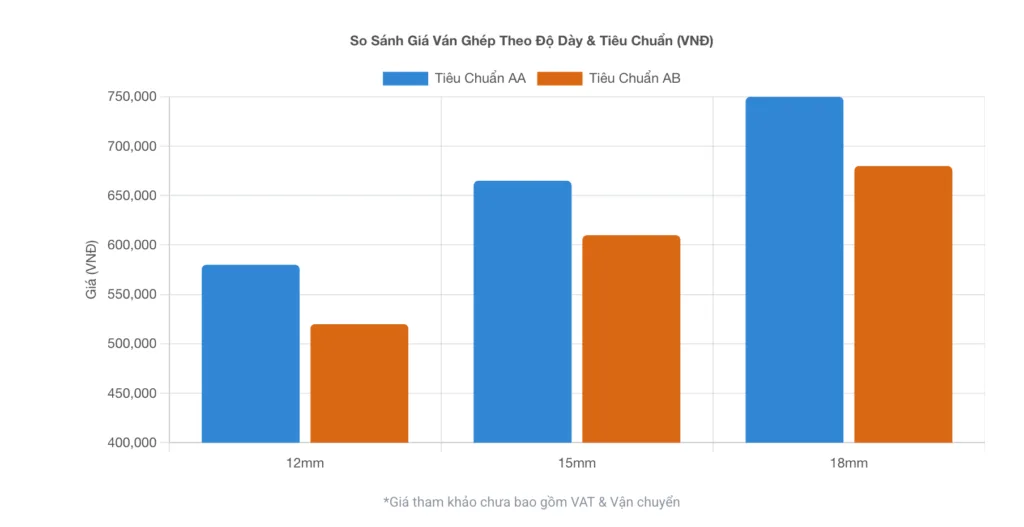
Board prices fluctuate with raw log prices and kiln-drying energy costs. The table below shows reference prices at major warehouses in Binh Duong and Dong Nai for the current year, standard size 1220 x 2440 mm:
| Thickness (mm) | Grade | Reference price (VND/sheet) |
|---|---|---|
| 12 mm | AA | 580,000 |
| 12 mm | AB | 520,000 |
| 15 mm | AA | 665,000 |
| 15 mm | AB | 610,000 |
| 17 mm | AA | 710,000 |
| 18 mm | AA | 750,000 |
| 18 mm | AB | 680,000 |
| 18 mm | AC (Core panel) | 550,000 |
Prices apply to the standard 1220 x 2440 mm format. Custom sizes or pre-lacquered boards are priced separately on request.
5. Rubber wood finger joint board versus MDF and MFC engineered boards
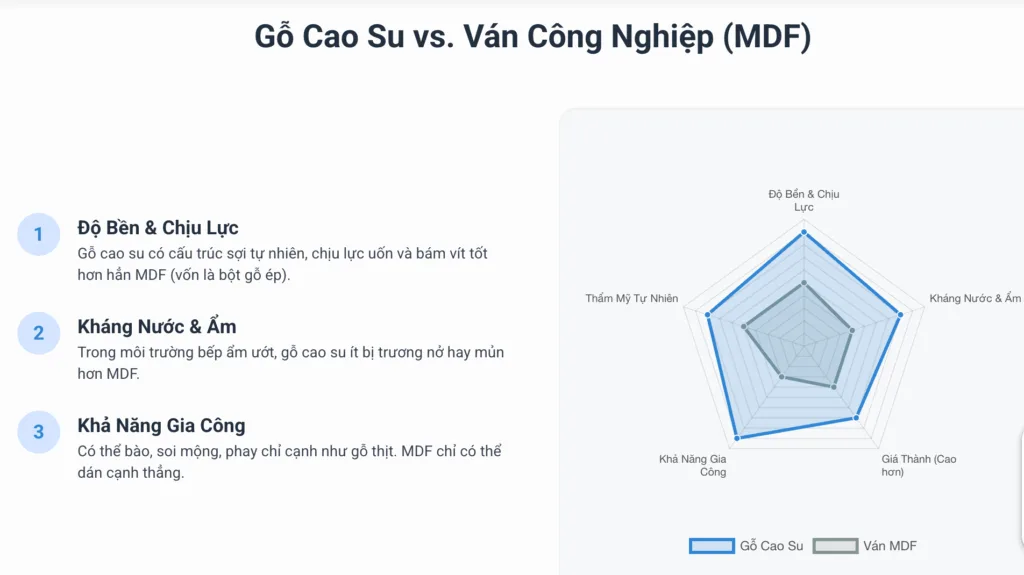
Many buyers weigh up rubber wood finger joint board against engineered panels such as MDF or MFC. In practice, rubber wood retains the natural wood fibre structure and has a number of advantages that matter in use.
Strength and load-bearing: Rubber wood has a natural interlocked fibre structure that gives significantly better bending strength and screw-holding than MDF. In humid environments such as kitchens, rubber wood finger joint board also swells and degrades far less than chip-based engineered boards.
Machinability: Unlike MDF which can only be cut and edge-banded with PVC strip, rubber wood can be planed, mortised, routed along edges, or shaped into complex profiles directly in the wood. This gives furniture a refined, crafted quality.
Price: Rubber wood costs about 20-30% more than engineered boards, but the service life and quality of the finished product fully justify the investment.
6. Where to source reliable rubber wood finger joint board

When looking for a rubber wood finger joint board supplier, prioritise large board yards with dry, well-organised storage and a clear warranty policy. A reliable supplier will guarantee board moisture content (typically under 12%) so the panel does not warp after installation.
Also inspect the glue joint quality by looking closely at the glue lines. A good panel has tight joints with no visible gaps and no overpowering chemical smell. For large project orders, ask the supplier for safety and health compliance certificates. See also wood pallets from ICD Vietnam.
Related articles
Frequently asked questions about finger joint rubber wood board
1. What is finger joint rubber wood board?
It is a panel made by gluing small-dimension strips cut from post-harvest rubber trees using specialised adhesives and high-pressure hydraulic pressing. The result is a large, stable panel that does not warp or shrink the way solid timber does.
2. What is the difference between grade AA and grade AB rubber wood board?
Grade AA requires both faces to be flawless with no dead knots, no black glue lines, and uniform colour throughout. Grade AB has a perfect A face but the B face may have minor live knots, short black lines, or slight colour variation between strips. AB is the most popular choice for wardrobes and kitchen cabinets because it balances appearance and cost.
3. What is the standard size of a rubber wood finger joint panel?
The international standard is 1220 x 2440 mm, matching the footprint of other engineered boards such as MDF and plywood. This size is convenient for CNC cutting and yield calculation on standard furniture production lines.
4. What thickness should I choose?
8-10 mm for cabinet backs and drawer bottoms; 12-15 mm for internal dividers and small shelves; 17-18 mm for tabletops, wardrobe doors and bed frames; 20-35 mm (made to order) for high-load components such as large dining tables.
5. Is rubber wood finger joint board stronger than MDF?
Yes. Rubber wood retains a natural interlocked fibre structure that gives better bending strength and screw-holding than MDF. It is also more resistant to swelling in humid environments such as kitchens than chip-based boards.
6. What moisture content should the board have?
Standard kiln-dried rubber wood finger joint board should have moisture content of 8-12%. This range ensures the panel does not warp or crack after installation in normal indoor conditions.
7. Can I machine or shape rubber wood finger joint board directly?
Yes. Unlike MDF which can only be cut and edge-banded, rubber wood can be planed, mortised, routed along edges, and shaped into complex profiles directly in the wood, making it suitable for crafted furniture detailing.
Contact ICD Vietnam
Hotline: 0983 797 186 / 090 345 9186 / 090 5859 186
Email: sales@icdvietnam.com.vn | Zalo: Chat Zalo