
Mục lục
- What a pallet jack hydraulic seal does and why it matters
- Five warning signs that a seal needs replacing
- 5 seal material types - pick the right one for 3x longer service life
- Seal size and pricing table (2026)
- 7-step hydraulic seal replacement procedure
- 3 installation mistakes that destroy a new seal within a week
- How to identify genuine Xilin seals versus counterfeits
- Related articles
- Contact ICD for seal kits and technical support
A pallet jack hydraulic seal - also called a hydraulic gasket or O-ring kit - is the rubber or synthetic component inside the pump cylinder that keeps hydraulic oil contained and pressure stable enough to lift loads from 2 to 5 tonnes. When a seal fails, the jack leaks oil, drops the load unexpectedly, or the pump handle pumps freely with no lift. This guide covers how seals work, how to diagnose which seal has failed, a complete 7-step replacement procedure you can do on-site, a seal size and pricing table for 2026, and a material comparison so you pick the seal that lasts longest in your conditions.
What a pallet jack hydraulic seal does and why it matters
A pallet jack hydraulic seal is a rubber or synthetic polymer ring fitted inside the pump body and ram cylinder of a Xilin pallet jack. Its job is to create an airtight, oil-tight barrier that prevents hydraulic fluid from escaping and stops air, dust, and grit from entering the cylinder. Without intact seals, the system cannot build or hold the 200-300 bar of pressure needed to lift loaded pallets.
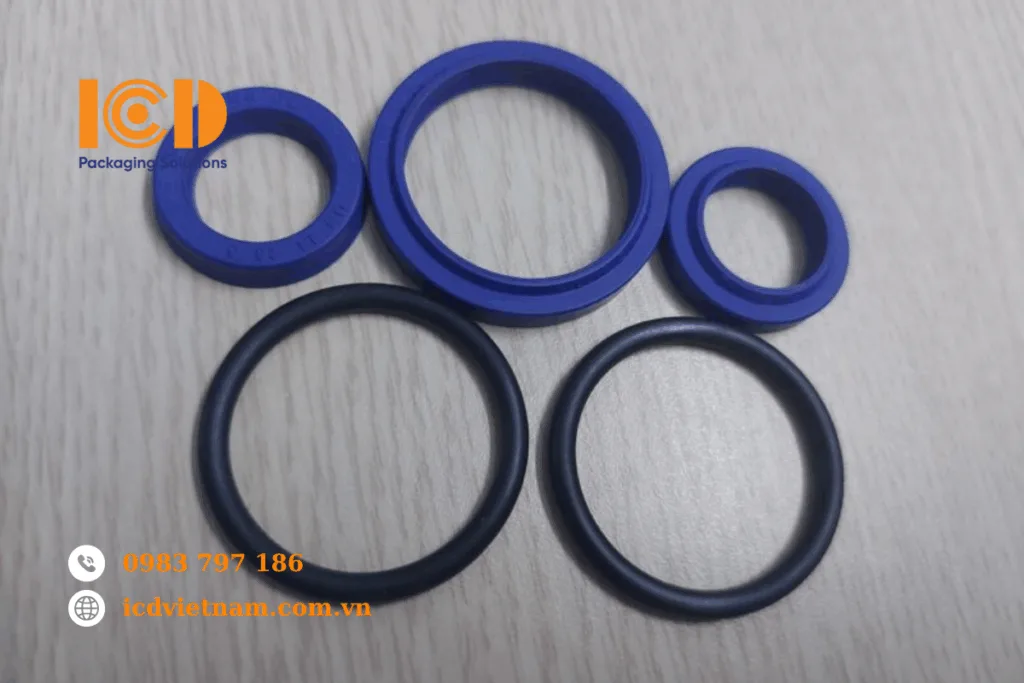
The hydraulic system operates on the principle of fluid pressure transfer. When you push the handle, the piston compresses oil and forces the ram upward. The seals bear that pressure directly. A standard pallet jack seal kit contains several components that work together: a wiper seal (the outermost ring that sweeps dust and grit off the ram before it re-enters the cylinder), a main ram seal that holds full working pressure, and O-rings that seal threaded joints and end caps. Understanding each component helps you buy the right part and install it correctly.
Five warning signs that a seal needs replacing
You do not need a workshop technician to spot a failing seal. The symptoms show up during normal warehouse operation.
Oil seeping around the base of the ram is the clearest sign. Visible oil on the ram shaft or pooling under the pump body means the wiper seal or main ram seal has worn through. Once oil escapes, there is not enough fluid to transmit force, so lifting becomes laboured and the forks gain little height per pump stroke.
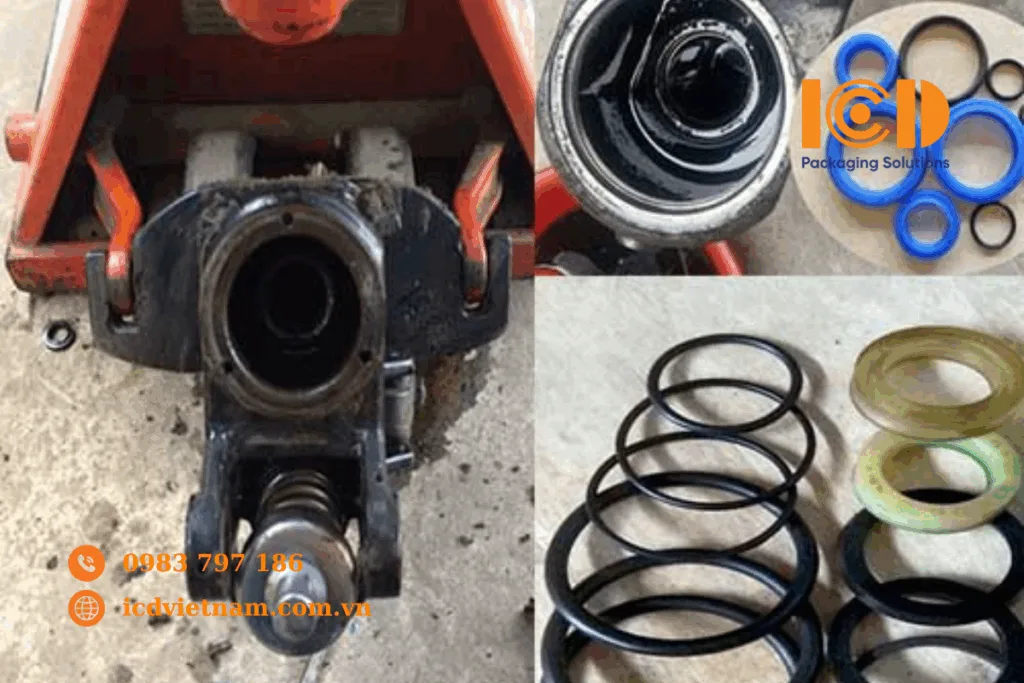
Load drop without operating the release valve is particularly hazardous. If the forks descend on their own after lifting, the O-ring in the relief valve or the main piston seal has lost its seating and oil is bleeding back into the reservoir. Never load personnel under a jack showing this symptom.
Fault diagnosis table for pallet jack hydraulic seals:
| Observed symptom | Likely failed component | Action |
|---|---|---|
| Oil at base of ram | Wiper seal or main ram seal torn | Replace immediately |
| Forks drop without release | Relief valve O-ring or piston seal bypassing | Replace immediately |
| Handle pumps free, no lift | Piston seal fully bypassing or oil depleted | Check oil level then seals |
| Jerky or bouncing lift | Air in system via failed seal | Bleed system and replace seal |
| Handle does not return | Return spring or check-valve O-ring stuck | Clean, then replace O-ring |
5 seal material types - pick the right one for 3x longer service life
| Material | Base | Working temperature | Chemical resistance | Service life | Reference price (VND/kit) |
|---|---|---|---|---|---|
| NBR (Nitrile) - most common | Synthetic rubber | -30 to +100 C | Good with mineral oil | 3-5 years | 180,000-280,000 |
| HNBR (Hydrogenated NBR) | Upgraded NBR | -40 to +150 C | Very good | 5-7 years | 350,000-500,000 |
| FKM/Viton - chemical duty | Fluoroelastomer | -20 to +200 C | Excellent; acids and mineral oil | 7-10 years | 600,000-900,000 |
| EPDM - water and alkali | Ethylene propylene | -50 to +150 C | Very good with water and alkali; POOR with mineral oil | 4-6 years | 250,000-400,000 |
| PTFE/Teflon (hard ring) | Fluoride polymer | -200 to +260 C | Inert to virtually all chemicals | 8-15 years | 800,000-1,500,000 |
Seal size and pricing table (2026)
There is no universal seal kit. The correct size depends on the ram diameter and the pump design of each model. Measure the ram with a vernier caliper before ordering.
| Seal kit type | Ram diameter | Reference price (VND) | Typical application |
|---|---|---|---|
| 2-tonne low-lift kit | 35 mm | 150,000-250,000 | Standard low-lift pallet jack |
| 3-tonne low-lift kit | 40 mm | 250,000-450,000 | Heavy-duty low-lift pallet jack |
| Relief valve O-ring only | Various | 50,000-100,000 | Fix load-drop without full kit |
| High-lift jack seal kit | 45-50 mm | 450,000-800,000 | High-lift stacker (e.g. HS1016) |
| OEM full seal kit | Complete set | 600,000-1,200,000 | Premium replacement for Xilin (Ningbo Ruyi) |
7-step hydraulic seal replacement procedure
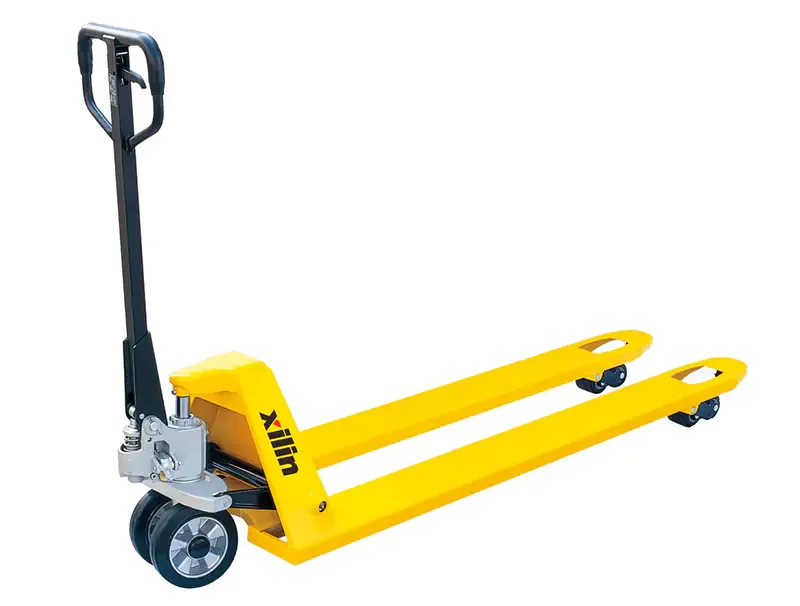
Tools needed: open-end spanners, needle-nose pliers, a thin flat-blade screwdriver, a rubber mallet, and one litre of fresh ISO VG46 hydraulic oil. Allow 45-60 minutes for a first-time replacement; experienced technicians complete it in 20-30 minutes.
Step 1 - Drain the oil and remove the pump assembly
Block the forks on a pallet to prevent the jack from rolling. Squeeze the release lever to lower the forks fully. Remove the retaining bolts and disconnect the release-valve chain. Tilt the jack over a clean drain pan and allow all oil to flow out completely. Never reuse drained oil: it contains metal particles and contamination that will damage the new seals immediately.
Step 2 - Extract the ram and piston
Use pliers or a flat screwdriver to remove the circlips that retain the ram. Slide the main ram and pump piston out of the cylinder. Work slowly and avoid dragging the ram sideways, as scratching the cylinder bore is the most common cause of repeat seal failure.
Step 3 - Inspect the ram surface
Wipe the ram dry with a lint-free cloth. Inspect the full length for deep scratches, scoring, or rust. Even a new seal will leak immediately if installed over a scored ram. Light surface marks can be polished with fine emery paper (600 grit or finer). A bent or deeply grooved ram must be replaced together with the seal kit, or the leak will return within days.
Step 4 - Remove the old seals
Use a thin flat-blade screwdriver to lever each seal out of its groove. After years of service, seals typically harden, flatten, or become brittle. Note the orientation of each seal before removal - specifically which face of the lip points toward the pressure side - so you can install the new seals in the same direction. Lip direction is the single most important detail in seal installation.
Step 5 - Install the new seal kit
Clean each seal groove with mineral spirits or fresh hydraulic oil and a lint-free cloth. Coat each new seal lightly with fresh hydraulic oil or petroleum jelly to ease installation and prevent the rubber from rolling in the groove. Seat each seal carefully with your fingers. For stiff seals, soak in warm water for five minutes to make the rubber more pliable before fitting.
Step 6 - Reassemble the pump body
Slide the piston and ram back into the cylinder. Refit the circlips, return spring, and control handle. Make sure all components seat fully and that no foreign material enters the pump body. Tighten the pump cap to the torque specification for your model - typically 8-12 N.m. Over-tightening distorts the seal and causes an immediate leak.
Step 7 - Fill with oil and bleed air from the system
Open the reservoir filler cap and add fresh ISO VG46 hydraulic oil to the marked level. Bleeding is critical and must not be skipped: squeeze the release lever and pump the handle continuously 10-15 times without load. This purges trapped air from the pump chamber. Air in the system causes the jerky, bouncing lift that feels like a failed seal. Once bled, test by lifting a loaded pallet and checking for leaks and steady hold at full height.
3 installation mistakes that destroy a new seal within a week
- Installing the lip seal backwards: a hydraulic lip seal only seals in one direction - the lip must face the high-pressure side. Reversed installation causes oil bypass the moment load is applied. Always check the lip orientation against the old seal before fitting.
- Not cleaning the ram before installation: old oil residue and metal debris score the new seal within the first few pump strokes. Wipe the ram with a lint-free cloth dampened with fresh hydraulic oil, not a rag that leaves fibres.
- Over-tightening the pump cap: exceeding the torque specification (8-12 N.m) compresses the seal beyond its designed cross-section and causes bypass at the cap face. Use a torque wrench and follow the model specification.
How to identify genuine Xilin seals versus counterfeits
- Genuine seals (NRY/Xilin): the logo, model number, and lot number are moulded (recessed) directly into the seal lip, not printed. The rubber is uniform in colour and texture with no visible mould flash.
- Counterfeit seals: markings are ink-printed and fade when wiped with solvent. The seal edge is uneven and the rubber shows colour variations or surface bubbles, indicating inconsistent compound mixing.
- Quick field test: submerge the seal in ISO VG46 hydraulic oil for 24 hours. A genuine seal changes in diameter by less than 1%. A counterfeit seal swells more than 3%, which means it will not fit or will bypass under load.
Related articles
| Pallet jack hydraulic oil leak: causes and fixes | Pallet jack hydraulic pump components explained | Pallet jack maintenance schedule and checklist |
1. How much does a pallet jack seal kit cost?
A standard low-lift pallet jack seal kit costs 150,000-350,000 VND. High-lift stackers and electric pallet jacks use more complex seal assemblies that can reach 500,000-1,500,000 VND for a full OEM kit.
2. How long does a seal replacement take?
A first-time replacement takes 45-60 minutes following the 7-step procedure. A technician familiar with the model completes the job in 20-30 minutes.
3. Can I use engine oil instead of hydraulic oil?
No. Engine oil has different viscosity and chemical composition. Using the wrong oil causes rubber seals to swell, distort, and fail within days, and may also damage the pump bore. Always use ISO VG46 or VG68 hydraulic oil as specified for the jack.
4. Why does the jack still not lift after a seal replacement?
Two likely causes: the system was not bled of air after filling (pump the handle 10-15 times with the release lever open to purge air), or the check-ball in the one-way valve was left out during reassembly. Check that no parts remain unused after assembly.
5. Does the ram always need polishing when replacing a seal?
Only if the ram surface shows light scratches or rust. A smooth, shiny ram only needs wiping with a clean cloth dampened with hydraulic oil before the new seal is fitted. A deeply scored or bent ram must be replaced, not polished.
6. How often should hydraulic oil be changed to protect seals?
Change the hydraulic oil every six months in normal warehouse use. Contaminated oil carries abrasive metal particles that accelerate seal wear and can cut seal life by half.
7. What is the difference between a wiper seal and a main ram seal?
The wiper seal is the outermost ring; it scrapes dust, grit, and moisture off the ram as it retracts so contaminants do not enter the cylinder. The main ram seal sits deeper inside the cylinder and holds full working pressure. Both must be in good condition for the system to work correctly.
Contact ICD for seal kits and technical support
ICD Viet Nam Industrial Production Company Limited
North: Floor 3, Thang Long A1 Building, Bau Hamlet, Thien Loc Commune, Hanoi - 0983 797 186 / 090 345 9186 / 090 5859 186
South: 551/212 Le Van Khuong, Tan Thoi Hiep, District 12, Ho Chi Minh City - 098 6784 186
Email: sales@icdvietnam.com.vn · Zalo: Chat on Zalo now
Tell us your pallet jack model and ram diameter and ICD will identify the correct seal kit, quote a price, and arrange delivery. Free technical advice on hydraulic faults for all Xilin (Ningbo Ruyi) pallet jacks.