Mục lục
PP plastic (Polypropylene) is a familiar material across many industrial sectors, from food packaging to high-durability products such as plastic pallets.
The question of how many times PP plastic can be reused has no single definitive answer. However, by analyzing the key factors, we can maximize the lifespan and economic value of PP products.
Summary
- The lifespan of PP plastic depends on many factors: product design, environment, and how the product is used.
- Overall, PP plastic has one of the best lifespans among all plastic types. In the absence of extreme conditions (excessive heat, UV exposure, chemical attack), and with correct use, PP products can last up to 15 years.
- PP plastic can be mechanically recycled up to 10 times, though quality declines with each cycle; 4-5 cycles is the practical high-quality limit.
Raw material quality determines reuse count
The most important factor determining PP lifespan is the quality of the raw material. Products made from virgin PP resin have far superior durability, load resistance, and impact resistance compared to recycled PP. Virgin PP pellets maintain a stable molecular structure, allowing products to withstand thousands of use cycles over many years without degradation.
Recycled PP has undergone multiple processing cycles, causing molecular chain degradation that results in lower lifespan and increased tendency toward aging and brittleness. Investing in virgin PP products has a higher initial cost but delivers superior long-term economic value.
Product design and wall thickness
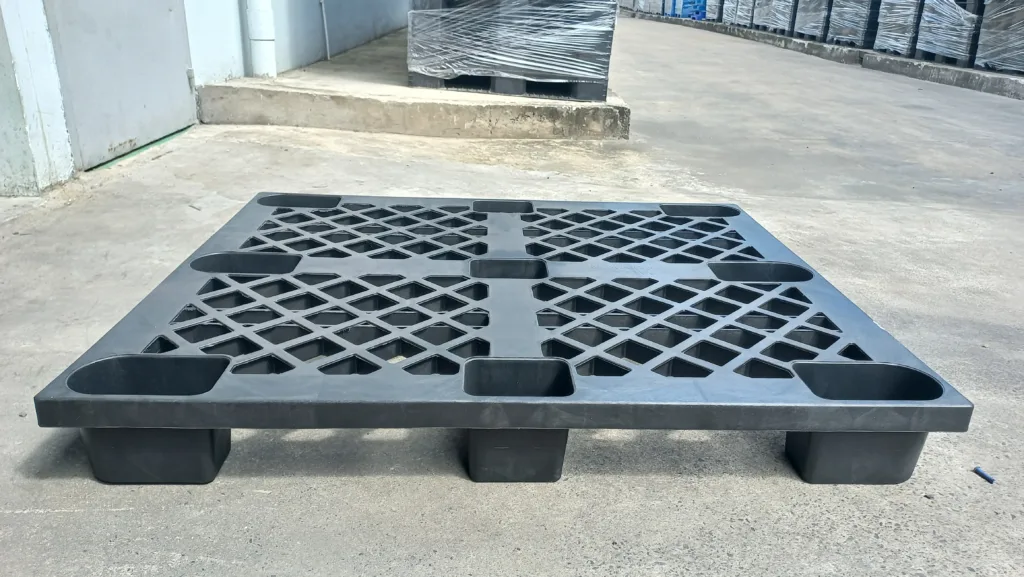
Beyond material quality, the lifespan of PP products is strongly influenced by design and wall thickness. A product designed with a robust structure, reinforcing ribs, and optimized wall thickness will distribute load effectively, minimizing the risk of cracking or breakage.
For example, an ICD Vietnam PP plastic pallet is designed to withstand static loads up to 5,000 kg and dynamic loads of 1,500 kg, handling heavy forklift impacts and transit stress. Optimized design dramatically extends product life and increases reuse cycles.
Environment and usage conditions
Environmental conditions and how products are used are also decisive factors. Even high-quality products will deteriorate quickly if not handled and stored correctly.
- Sunlight (UV): Prolonged UV exposure causes PP to age, become brittle, and crack. UV stabilizer additives are required for outdoor applications.
- Chemicals: Strong chemicals can attack or alter the structure of PP plastic.
- Overloading: Using products beyond their rated load capacity, especially plastic pallets, causes deformation and failure.
- Impact: Rough handling, heavy impacts, or dragging products across abrasive surfaces significantly reduce lifespan.
PP plastic recyclability: how many cycles?
Unlike glass or metals that can be recycled indefinitely, plastics always lose quality with each recycling cycle. However, recyclability varies greatly between plastic types.
| Plastic type | Recycling cycles (practical) | Common applications after recycling |
|---|---|---|
| PET (water/beverage bottles) | 2-3 cycles | Polyester fibre, carpet |
| HDPE (chemical containers, milk jugs) | Up to 10 cycles | Pipes, bins, pallets |
| LDPE (nylon bags) | 2-3 cycles | Bin liners, agricultural film |
| PVC | 1-2 cycles | Limited - chemical hazards |
| PP (pallets, containers) | 4-10 cycles | Automotive parts, pallets, crates |
Among commodity plastics, PP is an excellent material with up to 4 high-quality recycling cycles before noticeable degradation. For virgin PP products that are used and maintained correctly, average service life can reach 10 to 15 years. This makes PP a sustainable and economically efficient investment. Rather than repeatedly replacing wood pallets, businesses can confidently use PP products for an extended period, significantly reducing operating costs and contributing to reduced plastic waste.
Challenges and new directions in PP recycling
- Contamination: PP contaminated with food, oil, or chemicals is difficult to recycle effectively and often ends up in landfill.
- Mixing: Each plastic type has different properties and melting temperatures. Mixing reduces recycled product quality.
- Cost: Recycling costs are often higher than virgin production, particularly when crude oil prices are low.
Advanced recycling technologies such as chemical (feedstock) recycling are being developed to address these issues. Chemical recycling breaks plastic down to base molecules, enabling theoretically infinite reuse. Design-for-recyclability and consumer awareness are also key levers.
Frequently Asked Questions
1. How many times can a PP plastic pallet be reused?
A virgin PP plastic pallet manufactured to industrial standards, used within its rated load capacity, and stored correctly can be reused for 5-10 years in normal warehouse environments. ICD Vietnam pallets come with a 2-year manufacturer warranty and typical service lives of 7-10 years reported by customers.
2. How can I tell if a PP product is near end of life?
Signs include: visible surface cracking, yellowing or whitening (UV degradation), structural warping, cracks at stress points (corner legs, fork entry points on pallets), and reduced load-bearing capacity. Retire products showing these signs before structural failure occurs.
3. Is PP better than PE for long-duration use?
Generally yes. PP has a higher melting point, better chemical resistance to oils and solvents, and superior fatigue resistance under repeated loading - making it the preferred choice for reusable industrial packaging such as pallets and crates.
Contact ICD Vietnam - Virgin PP plastic pallets
Hotline 24/7: 0983 797 186 | 090 345 9186 | 090 5859 186
Zalo: icdvietnam | Email: sales@icdvietnam.com.vn
References
- Treehugger: How Many Times Can Plastic Be Recycled?
- ICD Vietnam technical team - field data from 200+ customer deployments, 2014-2026