
Mục lục
- Quick summary
- 1. Container dimensions and usable floor area
- 2. Calculating pallet count by container size
- 3. Three container loading layouts and when to use each
- 4. Preparing the container before loading - a step that is often skipped
- 5. How to stack cargo on pallets before loading into the container
- 6. Securing cargo after loading into the container
- 7. Export pallet standards - mandatory requirements
- 8. Five mistakes businesses commonly make when loading pallets into a container
- Related articles
- Frequently asked questions
- Contact ICD Vietnam
A container loaded with the wrong layout can waste 20-30% of usable volume - equivalent to extra freight costs of millions of dong per shipment. ICD Vietnam has 15 years of experience advising B2B businesses on pallet and packaging solutions. The core finding: the biggest problem is not how pallets are arranged inside the container but the choice made before loading - selecting a pallet size that does not match the container type in use.
Quick summary
- A 20-foot container holds 10-11 pallets (1200×1000 mm) in a single layer; a 40-foot container holds 20-23 pallets depending on the layout used.
- There are 3 standard pallet loading layouts: Block Loading (parallel rows), Pinwheel Loading (alternating rotation) and Hybrid - each optimised for different pallet sizes and cargo types.
- The most common mistake is not a wrong layout but choosing the wrong pallet size at the outset - which wastes 15-25% of container floor space regardless of how well the loading is done.
- Export pallets must comply with ISPM 15 (wooden pallets) or use plastic pallets, which are exempt from fumigation requirements.
- Wrapping loads with stretch film before placing them into the container is a non-negotiable step - especially for sea freight.
1. Container dimensions and usable floor area
Before calculating pallet counts, one point that is often overlooked must be understood: the container dimensions quoted by freight providers are external dimensions. The actual usable floor area for loading is always significantly smaller due to wall thickness and floor beam structure.
| Container type | Internal length (mm) | Internal width (mm) | Internal height (mm) | Max payload |
|---|---|---|---|---|
| 20 ft (20DC) | 5,895 | 2,352 | 2,395 | ~21,700 kg |
| 40 ft (40DC) | 12,025 | 2,352 | 2,395 | ~26,680 kg |
| 40 ft High Cube (40HC) | 12,025 | 2,352 | 2,698 | ~26,330 kg |
| 45 ft High Cube | 13,556 | 2,352 | 2,698 | ~27,090 kg |
Important note: For a 20DC container, the internal width of 2,352 mm is the parameter that governs how pallets are arranged. This is exactly why 1200×1000 mm and 1100×1100 mm pallets became the two most common sizes for the Vietnamese domestic market - they fit the container width under standard loading layouts. A 1200×1200 mm pallet, by contrast, cannot fit two parallel rows without leaving a significant gap.
2. Calculating pallet count by container size
This is the area where most available guides fall short - they state figures without explaining how to calculate them. The basic formula is straightforward, but the actual result depends on the loading layout chosen.
For a 20-foot container (internal length 5,895 mm, width 2,352 mm):
| Pallet size | Loading layout | Pallets per 20 ft | Pallets per 40 ft | Fill rate |
|---|---|---|---|---|
| 1200×1000 mm | Block (parallel rows) | 10 | 20 | ~85% |
| 1200×1000 mm | Pinwheel (alternating) | 11 | 23 | ~93% |
| 1100×1100 mm | Block | 10 | 20 | ~87% |
| 1100×1100 mm | Pinwheel | 10 | 21 | ~91% |
| 1200×800 mm (Euro) | Block | 11 | 22 | ~89% |
| 1200×800 mm (Euro) | Pinwheel | 15 | 30 | ~97% |
The table above is calculated for a single tier of pallets.
Double stacking - placing one layer of pallets on top of another - applies only to light cargo and pallets with adequate load capacity. It doubles the count but requires checking that the total height does not exceed the container’s internal height.
A standard pallet stands 150 mm tall; add average cargo height of 1,200 mm to get 1,350 mm per tier. Two tiers reach 2,700 mm - right at the limit of a 40HC (2,698 mm) and not usable in a 40DC (2,395 mm).
Cost perspective: Moving from 10 pallets (block loading) to 23 pallets (pinwheel) in a 40-foot container means saving more than one container shipment for every 230-pallet consignment. With current 40DC hire rates of roughly 40-60 million VND per trip on the Hanoi to Hai Phong port route, the difference is highly material.
3. Three container loading layouts and when to use each
No single layout is best for every situation. The choice depends on pallet size, cargo type, unloading equipment at the destination, and the experience of the loading crew.
Layout 1 - Block Loading (parallel rows)
All pallets are placed in the same orientation, parallel to each other. This is the simplest layout, suitable for businesses new to container loading or when the cartons on the pallets are not uniform in size.
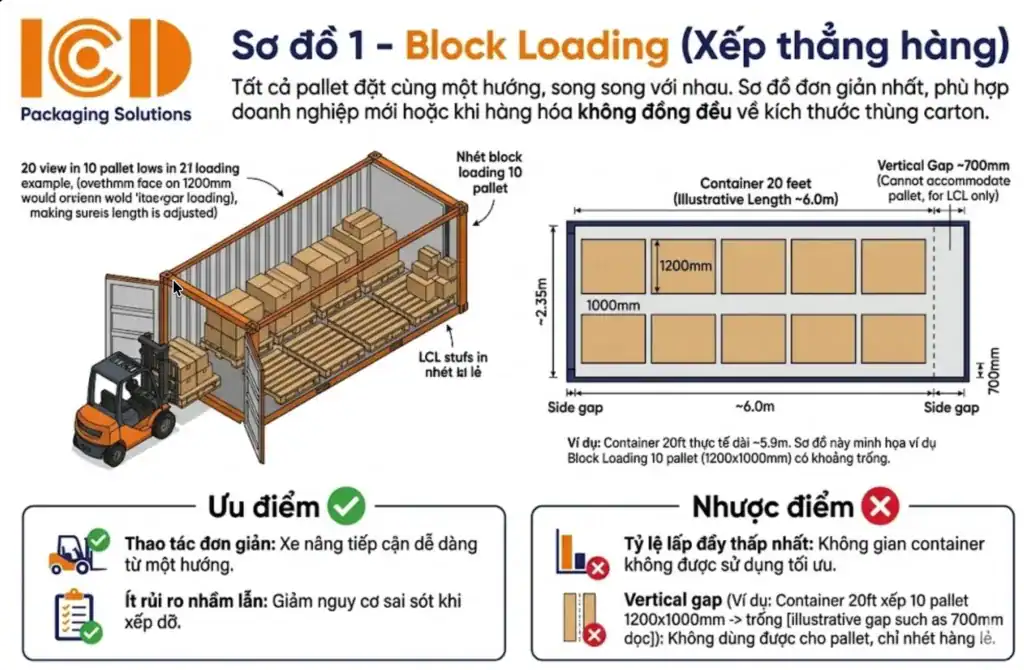
- Advantages: Simple to execute, low risk of error, forklift access from one direction.
- Disadvantages: Lowest fill rate of the three layouts. With 1200×1000 mm pallets in a 20-foot container, only 10 pallets fit, leaving roughly 700 mm of unusable space at the rear that must be filled with loose cargo.
Layout 2 - Pinwheel Loading (alternating rotation)
Some pallets are placed lengthwise and the rest crosswise, creating an alternating pattern that resembles a pinwheel. This is the most widely used layout for exporting consumer goods and electronics because it fills the container considerably better.
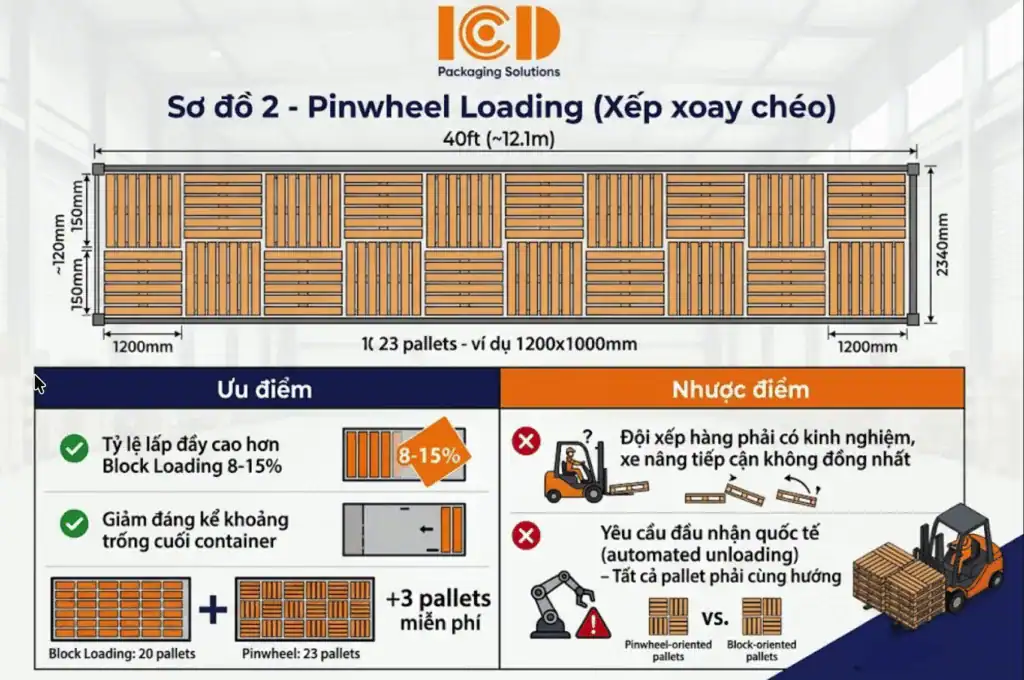
- Advantages: Fill rate 8-15% higher than Block Loading, significantly reducing dead space at the rear. With a 40-foot container and 1200×1000 mm pallets, Pinwheel fits 23 pallets instead of 20 - that is 3 extra pallets at no additional cost in the same container.
- Disadvantages: Requires an experienced loading crew, particularly for forklift operators because the access direction is less consistent. Some overseas consignees require all pallets to face the same direction for automated unloading.
Layout 3 - Hybrid Loading (pallets combined with loose cargo)
Pallets are loaded first to fill the majority of the container, then loose cargo is placed in the remaining gaps - typically at the rear corners or on top of pallets where headroom allows.
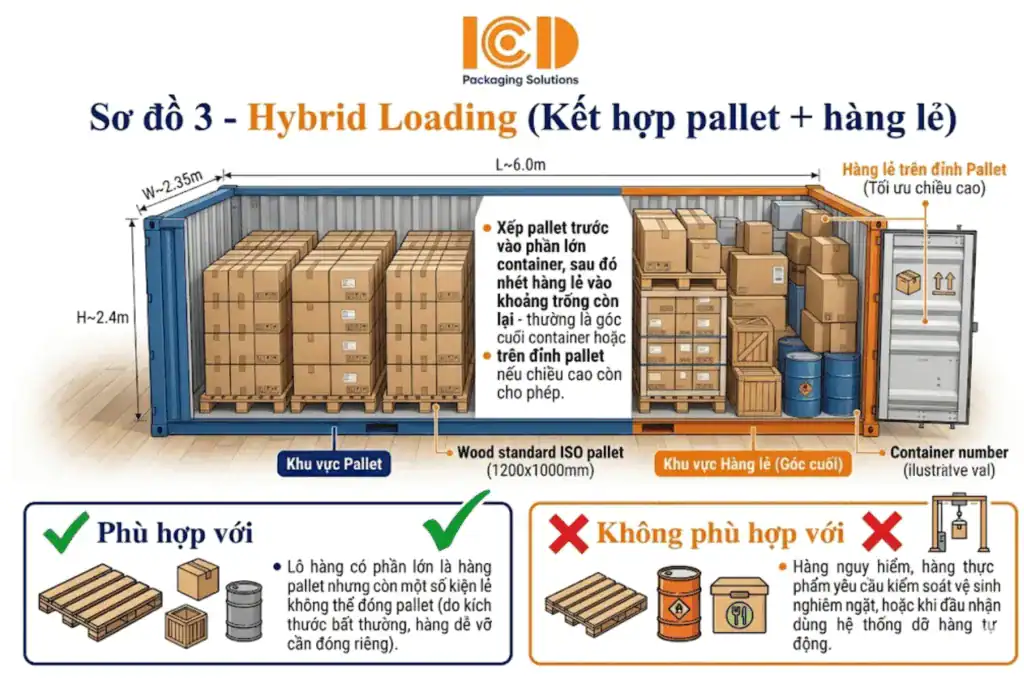
- Suitable for: Shipments that are mostly palletised but include some loose pieces that cannot be palletised (due to unusual dimensions or fragile items requiring separate packaging).
- Not suitable for: Dangerous goods, food cargo subject to strict hygiene controls, or when the consignee uses automated unloading systems.
4. Preparing the container before loading - a step that is often skipped
Many businesses begin loading the moment the container arrives at the warehouse without any inspection. This is a risk that can be costly - especially for food, electronics or temperature-sensitive cargo.
A container with internal mould, residual chemical odours from a previous shipment, or a cracked floor can destroy an entire consignment during weeks at sea.
Container inspection checklist before loading:
- Check for light leaks: Close the container doors and stand inside - if daylight is visible through the walls or roof, the container is punctured.
- Check for odours: Chemical, pesticide or unusual smells indicate the container previously carried hazardous cargo. Food cargo must never use such a container.
- Check the floor: Sagging, rotting or cracked flooring must be rejected immediately as it cannot support the weight of a loaded forklift driving in.
- Lashing rings: Check that the steel rings on the walls are intact. Critical for heavy cargo.
- Check for moisture: Touch the walls - condensation present means the container is prone to container rain.
Moisture control solution: Place silica gel sachets or absorbent panels inside the container before sealing to prevent condensation forming inside during transit.
5. How to stack cargo on pallets before loading into the container
Correct pallet stacking is a prerequisite - however well optimised the container layout is, unstable pallet loads still create risk.
Weight distribution principle:
Heavy items always go on the bottom, lighter items on top. The centre of gravity of the whole load must sit in the lower third to keep the forklift stable when moving across ramp transitions.
Stacking patterns for cartons on a pallet:
- Brick pattern: The recommended pattern for export cargo. Each layer is rotated 90 degrees, interlocking with the layer below for excellent load integrity.
- Column pattern: Cartons stacked vertically. Good compressive strength but the load block is prone to toppling if the vessel rolls.
- Pyramid (Incorrect): Each upper layer is smaller than the one below. Extremely unstable - never use.
Load weight and height: Do NOT exceed the dynamic load rating of the pallet (dynamic rating is typically only 40-60% of static rating). Maximum cargo height is 1,400-1,600 mm so the forklift operator retains a clear line of sight.
6. Securing cargo after loading into the container
A sea container endures continuous vibration in six directions - longitudinal, lateral, torsional, heave, pitch and roll. Securing is critical.
1. Stretch film wrap - mandatory: Start from the base of the pallet and wrap upward, each pass overlapping the previous by 50%. Using a stretch wrap machine saves around 70% of wrapping time for high-volume operations.
2. Filling gaps:
- Dunnage bags (air bags): The most common solution. Inflate to create static pressure that prevents movement. Cost-effective and reusable.
- Thick cardboard sheets: Temporary gap fill for static cargo on short routes.
- Lashing straps: For very heavy loads secured to the container wall lashing rings.
7. Export pallet standards - mandatory requirements
Having a completed shipment held at port due to non-compliant packaging is one of the most expensive risks in export logistics.
| Criterion | Solid wood pallet (ISPM 15) | Plastic pallet for export |
|---|---|---|
| Fumigation | Mandatory (~15,000 VND per pallet) | Fully exempt |
| Risk of port rejection or destruction | Yes (if IPPC mark is faded or incorrect) | Never |
| Purchase cost | 150,000 - 250,000 VND | 500,000 - 900,000 VND |
| Service life | A few months (insects, breakage) | 5-10 years |
Note: Wooden pallets previously treated with methyl bromide (MB) are banned in the EU and USA. Only pallets marked with the heat-treatment (HT) stamp may be used. Alternatively, switching directly to plastic export pallets eliminates all documentation risk, despite the higher upfront cost.
8. Five mistakes businesses commonly make when loading pallets into a container
- Mistake 1: Wrong pallet size. Using 1200×1200 mm pallets in a 20-foot container results in only 8 pallets fitting instead of 10-11, wasting 20% of freight cost.
- Mistake 2: Exceeding dynamic load rating. Seeing floor space remaining and adding more cargo, forgetting that a loaded forklift driving in applies roughly double the static load. The pallet breaks inside the truck.
- Mistake 3: No stretch film or loose wrapping. A tightly packed load seems secure until ocean swells gradually dislodge individual cartons to the floor. Three minutes of proper wrapping prevents this.
- Mistake 4: No dunnage bags. Leaving gaps of up to 300 mm allows cargo to impact each other freely during transit.
- Mistake 5: Wooden pallets with falsified ISPM 15 certification. Cheap to buy but extremely expensive when the shipment is destroyed at the destination port and contractual penalties apply.
Related articles
| Standard pallet sizes: dimensions reference table | Pallet static and dynamic load ratings explained | Plastic pallets for export: full product range |
Frequently asked questions
1. How many pallets fit in a 20-foot container?
A 20-foot container fits 10 pallets (1200×1000 mm) with Block Loading, or 11 pallets with Pinwheel Loading. Euro pallets (1200×800 mm) give 11-15. Double stacking doubles the count but requires checking total height against the container’s internal height.
2. Which pallets are exempt from fumigation for export?
Plastic pallets are fully exempt from fumigation requirements. Engineered wood (LVL) pallets are also exempt because they undergo heat treatment during manufacture.
3. Can pallets be double stacked inside a container?
Yes, provided three conditions are met: the total height must not exceed the container’s internal height; the two-tier load must not exceed the pallet’s rated capacity; and the pallet must be designed with stacking corners. Do not double stack loads heavier than 500 kg per pallet.
4. How much side gap is acceptable in a container?
Gaps under 100 mm can be filled with light padding. Gaps of 100-300 mm should be filled with dunnage bags. Gaps exceeding 300 mm must never be left unfilled.
5. What is the difference between block loading and pinwheel loading?
Block loading places all pallets in the same direction, giving a fill rate of around 85-89%. Pinwheel loading alternates pallet orientation to fill gaps, achieving 91-97% - fitting 3 additional pallets per 40-foot container with 1200×1000 mm pallets.
6. Is stretch film wrapping mandatory before putting pallets in a container?
Yes. Stretch film binds the cartons to the pallet so that ocean vessel motion - rolling, pitching, heave in six directions - does not dislodge individual cartons. Unwrapped or loosely wrapped pallets are the leading cause of cargo damage claims on sea shipments.
Contact ICD Vietnam
Hotline: 0983 797 186 / 090 345 9186 / 090 5859 186
Email: sales@icdvietnam.com.vn | Zalo: Chat Zalo