
Mục lục
- 1. Two extremes of the natural timber spectrum
- 2. Technical specification comparison from an industrial perspective
- 3. Why rubber wood is the top choice for pallets and packaging
- 4. When does investing in oak make sense?
- 5. Related articles
- Frequently asked questions about rubber wood vs oak
- Contact ICD Vietnam
The biggest difference between rubber wood and oak lies in intended use and mechanical properties. Oak is a prestige timber reserved for high-end home furniture, while rubber wood dominates industrial and logistics applications. This article explains why businesses choose rubber wood for heavy-duty pallets - it balances cost, flexibility, and compliance with strict export standards - and when oak actually earns its higher price.
1. Two extremes of the natural timber spectrum
Oak is a hardwood typically imported from temperate regions such as the United States or Russia. Its defining qualities are striking grain patterns, high density, and structural rigidity, making it the go-to choice for furniture that must look impressive.
Rubber wood represents durability and economic sense. It is a plantation timber grown widely in Vietnam, harvested after the trees have completed their latex-producing cycle. Its natural impact resistance and flexibility have made it the first choice for industrial products such as wooden pallets, crates, and warehouse racking boards.
2. Technical specification comparison from an industrial perspective
To understand why rubber wood dominates logistics, consider the criteria below:
| Criterion | Rubber Wood | Oak Wood |
|---|---|---|
| Initial cost | Low - cost-effective for business operations | Very high - typically 3 to 4 times the price of rubber wood |
| Flexibility and resilience | Very high - absorbs direct impact from forklift tines without fracturing | Hard but brittle - prone to cracking and splitting under sudden impact |
| Physical weight | Lighter - reduces total shipment weight and optimises freight cost | Very heavy - difficult to move and stack manually |
| Raw material supply | Abundant from domestic plantations - production schedules are self-determined | Scarce - fully dependent on imports and exchange rates |
| Practical applications | Pallet production, wooden crates, export packaging, truck flooring | Dining sets, kitchen cabinets, executive office furniture |
3. Why rubber wood is the top choice for pallets and packaging
Many businesses in industrial zones initially assume that harder timber makes better pallets. Operational experience consistently proves the opposite.
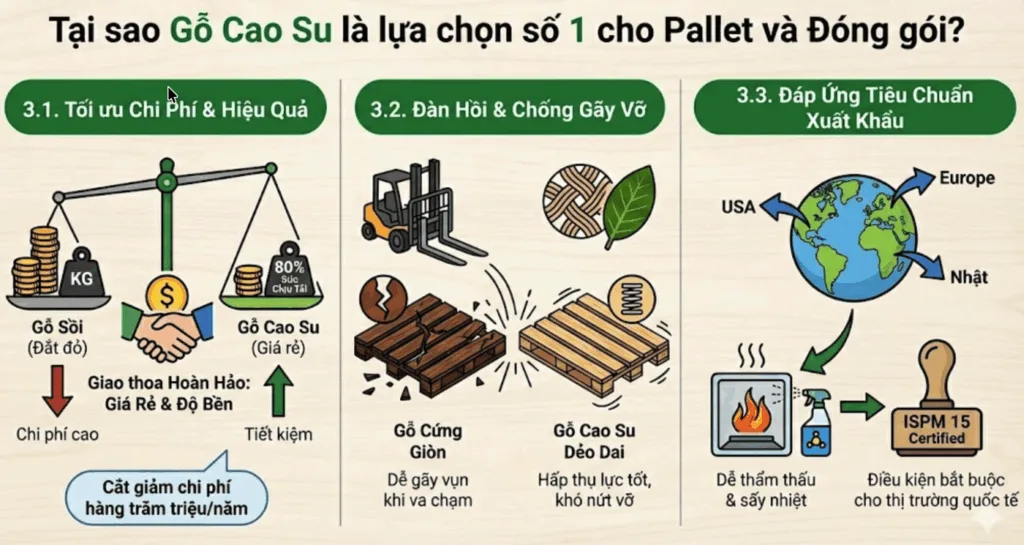
3.1. Cost optimisation and operational efficiency
Using oak to build warehouse pallets is roughly equivalent to throwing money away. Rubber wood costs about one-third as much yet delivers load-bearing capacity reaching 80% of the highest-grade hardwoods. This is the ideal intersection of price and durability, allowing businesses to cut packaging costs by hundreds of millions of dong per year without compromising cargo safety.
3.2. Outstanding resilience and fracture resistance
In warehouse environments, wooden pallets regularly absorb direct hits from forklift tines and drops during loading and unloading. Rubber wood contains naturally flexible wood fibres inherited from the latex-producing tree. This structure gives rubber wood pallets superior impact absorption, resisting the sudden splitting and grain-line fractures common in hard but brittle timber species.
3.3. Meeting international export standards
Once sawn into planks, rubber wood has a relatively stable grain structure that readily absorbs anti-pest treatments and withstands the high temperatures used in kiln drying. This allows ICD Vietnam’s rubber wood pallets to obtain ISPM 15 certification - the mandatory requirement for goods entering demanding markets such as the United States, European Union, and Japan.
4. When does investing in oak make sense?
Oak only delivers its full value when placed in spaces where prestige and aesthetics are paramount. In a business context, oak is typically chosen for VIP office furniture such as boardroom tables, executive desks, and display cabinets in high-end reception rooms. Oak grain carries a gravitas and authority that no engineered board or rubber wood alternative can replicate.
That said, no professional logistics company uses oak as warehouse racking material or export crating timber - the cost is prohibitive and the material properties are misaligned with transport requirements.
5. Related articles
| What is rubber wood? Properties and uses | Rubber wood vs pine wood: pallet comparison | Wooden pallets: specifications and pricing guide |
Frequently asked questions about rubber wood vs oak
1. What is the main difference between rubber wood and oak?
The core difference is application. Oak is a prestige hardwood for high-end furniture; rubber wood is a plantation timber optimised for industrial use - pallets, crates, and export packaging - where cost efficiency, resilience, and ISPM 15 compliance matter most.
2. Why is rubber wood preferred for pallets over oak?
Rubber wood costs about one-third as much as oak, is lighter (reducing freight costs), and has a flexible fibre structure that absorbs forklift impact without fracturing. Oak, while very hard, is brittle under sudden impact and far too expensive for disposable or reusable pallet applications.
3. Can rubber wood pallets meet ISPM 15 export requirements?
Yes. Rubber wood absorbs anti-pest treatments readily and tolerates the high temperatures of kiln drying, making it straightforward to certify under ISPM 15 - the mandatory phytosanitary mark for timber packaging entering the US, EU, Japan, and most other major markets.
4. How much heavier is oak compared to rubber wood?
Oak is significantly denser than rubber wood. The additional weight increases total shipment mass, raises freight costs, and makes manual handling harder - all of which make oak impractical for high-volume warehouse and logistics environments.
5. When should a business choose oak over rubber wood?
Only when aesthetics and prestige are the primary requirement - executive boardroom tables, high-end office cabinets, or reception furniture where the grain pattern and gravitas of oak justify the cost. For any structural or logistics purpose, rubber wood is the rational choice.
6. What is the load capacity of rubber wood pallets?
Rubber wood pallets from ICD Vietnam can bear loads up to 2 tonnes, reaching roughly 80% of the load-bearing capacity of the highest-grade hardwoods - at a fraction of the cost.
Contact ICD Vietnam
Hotline: 0983 797 186 / 090 345 9186 / 090 5859 186
Email: sales@icdvietnam.com.vn | Zalo: Chat Zalo