
Mục lục
- 1. What is rubber wood?
- 2. Is rubber wood good quality? Advantages and disadvantages
- 3. Common questions answered
- 4. Rubber wood board types and grades
- 5. Applications of rubber wood
- 6. Rubber wood price reference - 2026
- 7. Conclusion
- Related articles
- Frequently asked questions about rubber wood
- Contact ICD Vietnam
Rubber wood is harvested from rubber trees at the end of their latex cycle - typically after 20 to 30 years - making it one of the most sustainable commercial timbers available. Classified as Group VII under Vietnamese wood standards, it offers a practical balance of flexibility, moisture resistance and competitive pricing that few other affordable species can match. This guide covers what rubber wood is, how it performs in real use, which board grades to specify, current 2026 fingerjointed panel prices, and its key application in wooden pallets.
1. What is rubber wood?
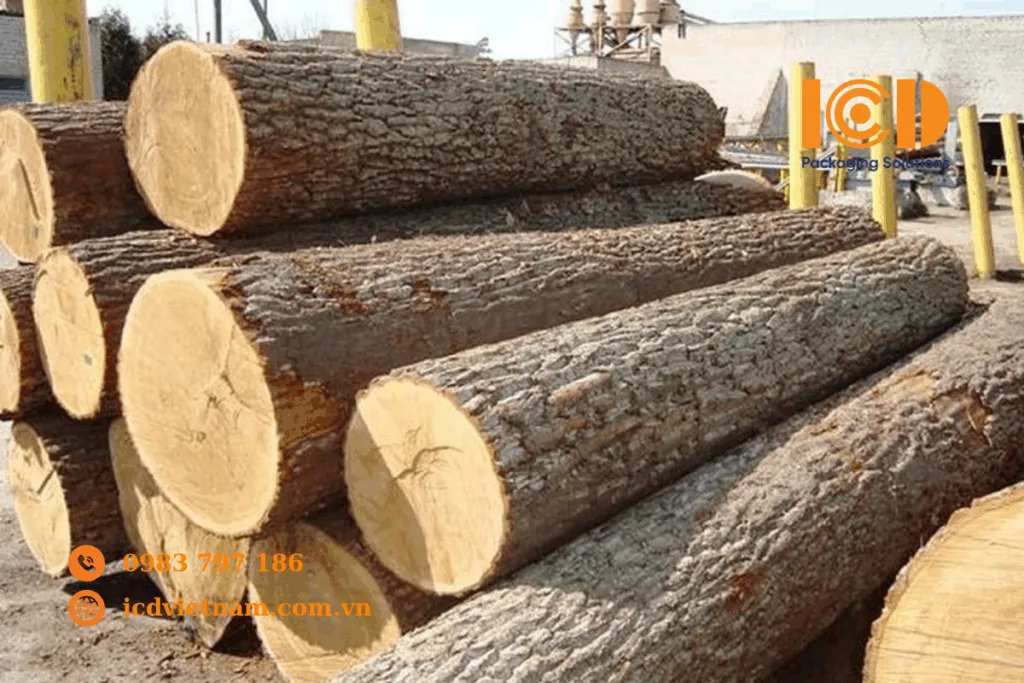
Rubber wood is a natural timber harvested from the trunk of the rubber tree (Hevea brasiliensis) once the tree has completed its latex-producing life. A rubber tree is typically felled for timber at 20 to 30 years of age, when latex yield has fallen to a level that makes replanting more economical than continued tapping. Using the felled tree for timber rather than burning it turns an agricultural by-product into a commercial resource, reducing pressure on natural forests.
Under the Vietnamese timber classification standard, rubber wood is a Group VII timber - a lighter-density species with moderate mechanical strength and distinctive aesthetic properties. The grain is notably wavy, producing an attractive ripple figure, while the tone ranges from pale yellow to pink-brown, suiting both natural and painted finishes.
Because rubber wood comes from plantation trees grown for agricultural purposes rather than from native forest, it carries a strong environmental credential: its use displaces demand for old-growth timber.
2. Is rubber wood good quality? Advantages and disadvantages
Assessing rubber wood honestly requires looking at both its technical properties and its real-world performance across different applications.
2.1. Advantages of rubber wood
The most notable property is flexibility combined with toughness. Because the rubber tree produces a latex with high elasticity, its wood inherits similar characteristics: it bends under load rather than splitting, giving furniture and pallet components good resistance to impact without catastrophic failure.
Moisture resistance is another significant advantage. The natural structure of rubber wood grain limits moisture ingress more effectively than many timbers in the same price bracket. When kiln-dried and pressure-treated to the correct standard, rubber wood panels show minimal warping or shrinkage even as humidity changes seasonally.
Aesthetically, the timber ranges from pale yellow to pink-brown with a wavy grain that photographs well and suits contemporary interiors. It accepts both clear lacquer and painted finishes - including walnut, white and high-gloss PU - without excessive grain raising.
Price is the decisive factor for many buyers. Rubber wood costs significantly less than oak or rosewood while still being a genuine natural timber, making it the default choice for volume furniture production and budget-conscious buyers who want solid wood.
2.2. Disadvantages of rubber wood
As a Group VII species, rubber wood is softer than hardwoods such as teak or merbau and cannot match their resistance to heavy impact. For structural applications demanding high compressive or tensile strength, it is not the right choice.
Untreated rubber wood is susceptible to insect attack and fungal decay because the sapwood contains residual sugars from the latex system. However, modern high-pressure chemical treatment (impregnation) eliminates this weakness in commercial-grade boards, and all reputable suppliers process the timber before sale.
Rubber wood is strictly an indoor material. Prolonged direct exposure to rain and intense sunlight degrades the structure rapidly. It should not be specified for exterior furniture, garden decking, or outdoor pallet storage without additional protective coating.
3. Common questions answered
3.1. Is rubber wood toxic?
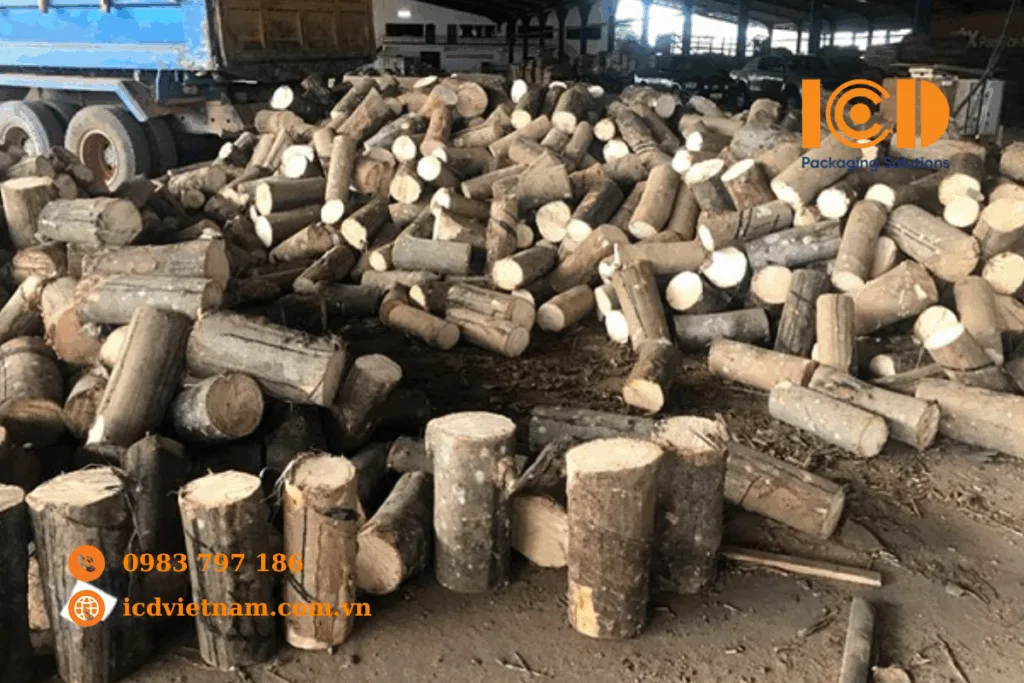
Rubber wood is not toxic. The tree is only felled for timber at the end of its latex cycle, meaning residual latex in the trunk is minimal. During processing, the wood undergoes kiln drying and chemical treatment that removes remaining impurities and excess resin. The adhesives and surface coatings used in standard commercial rubber wood production must meet health-safety certifications. Rubber wood furniture is safe for dining tables, beds and children’s room furniture.
3.2. How durable is rubber wood?
Durability depends heavily on the environment. Used indoors, away from standing water and direct sunlight, rubber wood furniture and pallet components typically last 10 to 20 years - a strong result for a species at this price point. Correct kiln drying before manufacture is the single biggest factor determining long-term stability.
4. Rubber wood board types and grades
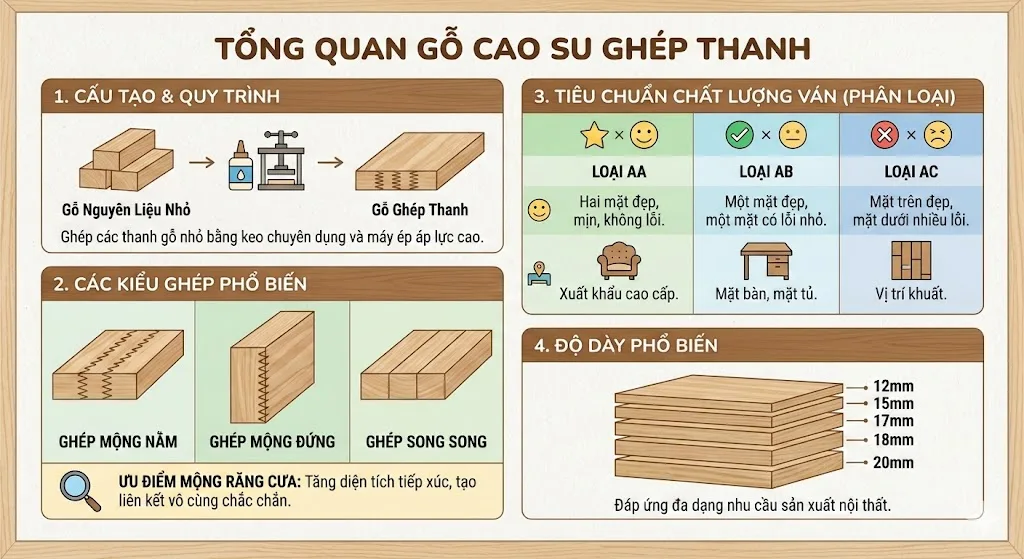
Rubber wood reaches the market almost exclusively as fingerjointed (edge-glued) panels rather than solid wide boards, because the trunk diameter limits the size of clear-cut sections. Fingerjointing bonds short strips edge-to-edge using specialist adhesive and high-pressure presses, producing stable panels in standard furniture sizes.
Common joint configurations include flat-finger, vertical-finger and parallel-grain bonding. The fingerjoint profile maximises glue-line surface area, giving bonded panels bond strength that often exceeds the wood itself.
Commercial rubber wood panels are graded into three quality levels:
- Grade AA: Both faces are clear, smooth and free of black knots or defects. Used for export furniture and high-end interior joinery.
- Grade AB: One clear face; the reverse may show small knots or minor colour variation. Standard for tabletops, cabinet faces and visible interior components.
- Grade AC: One clear face with a reverse showing more defects. Used for concealed applications such as cabinet backs, drawer bottoms and floor underlayment.
Standard panel thicknesses are 12 mm, 15 mm, 17 mm, 18 mm and 20 mm, covering the full range of furniture and joinery requirements.
5. Applications of rubber wood
Rubber wood’s combination of workability, aesthetic appeal and low cost places it across most indoor applications.
- Residential furniture: Dining sets, beds, wardrobes and TV units are the most common uses. The pale tone makes rooms feel larger and suits apartments where space is limited.
- Office furniture: Desks, bookshelves and filing cabinets in rubber wood give a professional look without the premium cost of denser hardwoods.
- Flooring: The moderate moisture resistance makes rubber wood suitable for fingerjointed flooring panels, delivering a warm underfoot feel at a lower price than solid hardwood strips.
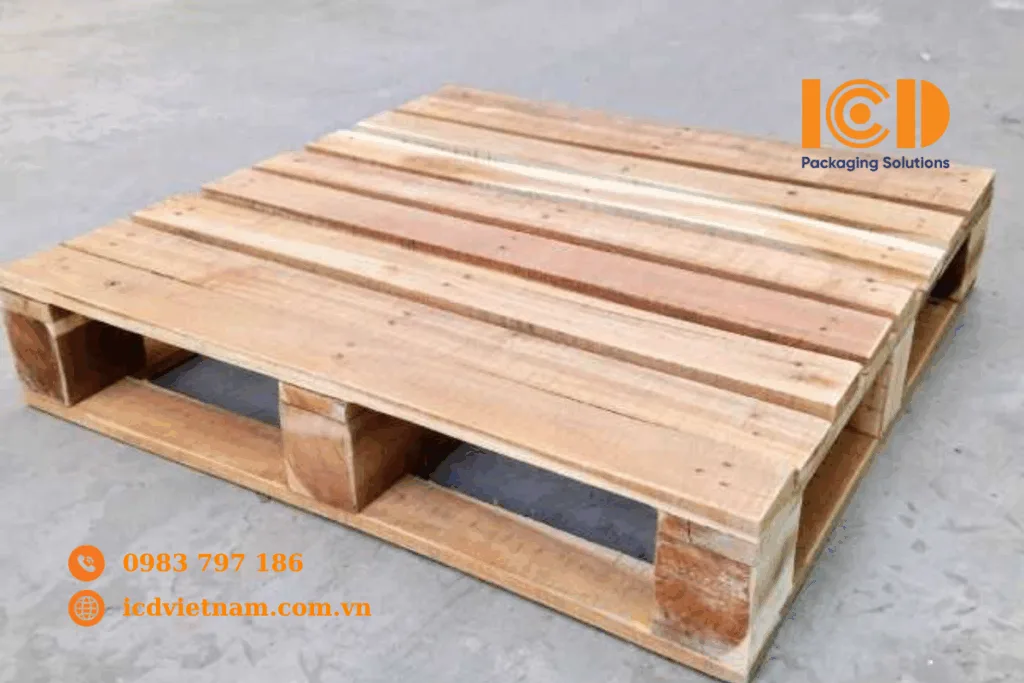
- Wooden pallets: Rubber wood is used to manufacture wooden pallets for domestic distribution and export, offering good structural performance at competitive timber cost.
6. Rubber wood price reference - 2026
Prices below are indicative for 2026 and may vary by supplier and region. Contact ICD for a current quote on volume orders.
| Product | Thickness (mm) | Standard size (mm) | Reference price (VND/sheet) |
|---|---|---|---|
| Rubber wood fingerjointed panel (AA) | 12 | 1200 x 2400 | 450,000 - 520,000 |
| Rubber wood fingerjointed panel (AA) | 15 | 1200 x 2400 | 580,000 - 650,000 |
| Rubber wood fingerjointed panel (AA) | 17 | 1200 x 2400 | 660,000 - 730,000 |
| Rubber wood fingerjointed panel (AA) | 18 | 1200 x 2400 | 700,000 - 780,000 |
| Rubber wood fingerjointed panel (AB) | 18 | 1200 x 2400 | 620,000 - 680,000 |
Unprocessed rough timber is priced per cubic metre and fluctuates with raw-material market conditions. The above prices apply to kiln-dried, glued panel stock.
7. Conclusion
Rubber wood is the practical answer for buyers who need a real natural timber at a price that works for volume production. It delivers genuine flexibility and moisture resistance, accepts a wide range of finishes, and carries a clear environmental advantage over forest-harvested species. Modern kiln drying and pressure treatment have effectively eliminated the insect and decay risks that once limited its use. For indoor furniture, flooring and wooden pallets, rubber wood remains one of the most cost-effective natural timber choices available.
Related articles
| Is rubber wood good? A real-world review | Does rubber wood get termites? | Rubber wood fingerjointed panels: price and standards |
Frequently asked questions about rubber wood
1. What group is rubber wood classified in Vietnam?
Rubber wood is classified as Group VII under Vietnamese timber standards (TCVN 12619-2:2019), placing it in the lighter-density category with moderate mechanical strength.
2. Is rubber wood safe for furniture?
Yes. Rubber wood is non-toxic. The tree is felled after its latex cycle ends, residual latex is minimal, and commercial processing removes remaining impurities. Adhesives and coatings must meet health-safety standards. It is safe for dining and bedroom furniture including children’s rooms.
3. How long does rubber wood furniture last?
Used indoors and kept away from standing water and direct sunlight, rubber wood furniture typically lasts 10 to 20 years - strong value for a budget-priced natural timber.
4. Can rubber wood be used outdoors?
No. Rubber wood is an indoor material. Prolonged exposure to rain and intense sunlight degrades its structure quickly. For outdoor use, specify a naturally durable hardwood or apply a suitable protective coating and shelter the piece from weather.
5. What are the AA, AB and AC grades of rubber wood?
Grade AA has both faces clear and defect-free, used for export furniture. Grade AB has one clear face, used for tabletops and cabinet fronts. Grade AC has one clear face with more defects on the reverse, used for concealed components such as drawer bottoms and cabinet backs.
6. What thicknesses are rubber wood panels available in?
Standard fingerjointed rubber wood panels are produced in 12 mm, 15 mm, 17 mm, 18 mm and 20 mm thicknesses to cover most furniture and joinery requirements.
7. Is rubber wood used for pallets?
Yes. Rubber wood is used to produce wooden pallets for domestic distribution and export. It offers good structural performance relative to its cost and, after heat treatment to ISPM-15, is accepted for international shipments.
Contact ICD Vietnam
Hotline: 0983 797 186 / 090 345 9186 / 090 5859 186
Email: sales@icdvietnam.com.vn | Zalo: Chat Zalo