
Mục lục
Acacia auriculiformis (yellow wattle acacia) is classified as durability class IV under Vietnam’s national wood grading standard - a mid-range class that combines manageable weight, good load-bearing strength, natural resistance to termites and moisture, and a stable domestic supply chain. This article explains what class IV means, how the three acacia species compare, and why acacia auriculiformis supplies roughly 70-80% of all wood pallets made in Vietnam.
1. What is acacia wood?
Acacia wood is a natural hardwood harvested from acacia trees, a genus in the legume family (Fabaceae). The tree grows widely across Vietnam, is fast-growing, and tolerates harsh climatic conditions well. It delivers economic value across manufacturing, construction, and logistics industries.
1.1 Origin and biological characteristics
- Origin: Acacia originates from Australia and Southeast Asia. In Vietnam it is cultivated extensively in the Central and Southern regions - Quang Ngai, Binh Dinh, Dong Nai, and the Central Highlands provinces.
- Tree dimensions:
- Height: Mature trees reach 15-25 m.
- Trunk diameter: 20-50 cm depending on growing conditions.
- Leaves: Lance-shaped, long, glossy green - well adapted to dry conditions.
- Flowers: Bright yellow flowers grow in clusters, blooming mainly in summer.
1.2 Which durability class does acacia belong to?
Under Vietnam’s national wood classification table, acacia is durability class IV. Class IV wood is characterised by:
| Property | Class IV description |
|---|---|
| Weight | Medium - not excessively heavy, easy to transport and machine |
| Structural strength | Good load-bearing capacity, withstands harsh weather |
| Economic value | Suited for industrial and domestic products with a stable supply |
2. Common acacia species
2.1 Acacia auriculiformis (yellow wattle)
- Source: Harvested from Acacia auriculiformis.
- Characteristics:
- Colour ranges from bright yellow to dark brown with a fine, even grain.
- High hardness and good load-bearing capacity.
- Contains natural essential oils that provide inherent resistance to termites and boring insects.
- Applications: Pallet production, furniture, flooring, and construction materials.
2.2 Cajuput (swamp tea tree) - Melaleuca cajuputi
- Source: Harvested from Melaleuca cajuputi.
- Characteristics: Lighter and softer than auriculiformis. Its essential oil is widely used in medicine.
- Applications: Mainly light household items and craft products.
2.3 Tea tree - Melaleuca alternifolia
- Source: Harvested from Melaleuca alternifolia.
- Characteristics: Soft, pale yellow-white wood with low structural durability.
- Applications: Primarily serves the cosmetics and healthcare industries through essential oil extraction.
3. Acacia auriculiformis in pallet production
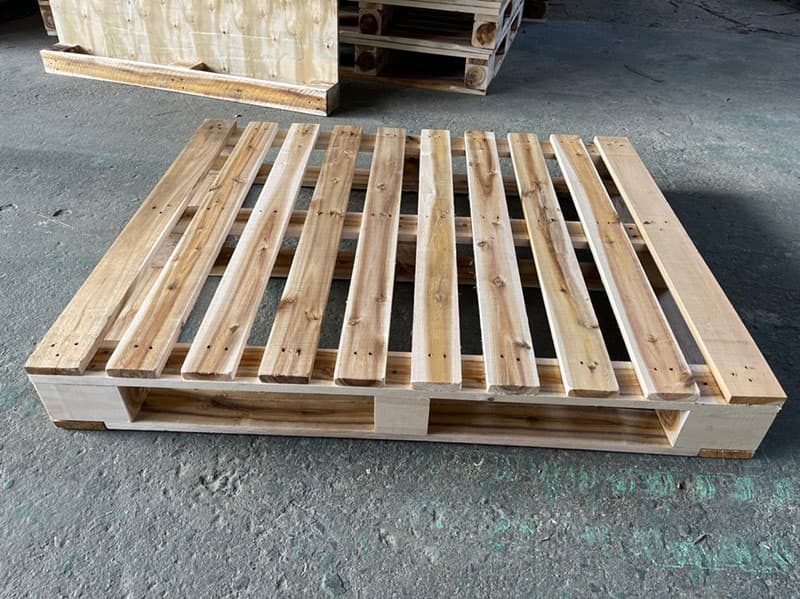
Acacia auriculiformis is the dominant raw material for wood pallet manufacturing in Vietnam, accounting for approximately 70-80% of market share.
Why is acacia auriculiformis preferred for pallets?
| Factor | Detail |
|---|---|
| Load-bearing strength | Handles heavy loads and meets strict requirements in warehousing and freight |
| Moisture and pest resistance | Natural oils extend pallet service life in cold storage and humid environments |
| Domestic supply | Planted widely in Vietnam with a short harvest cycle of 7-10 years - raw material is consistently available |
| Competitive price | Lower cost than imported pine or rubberwood |
4. Acacia auriculiformis vs. other wood pallet materials
| Criterion | Acacia auriculiformis | Pine (imported) | Rubberwood |
|---|---|---|---|
| Durability class (Vietnam) | Class IV | Class V-VI | Class V |
| Hardness | High | Medium | Medium |
| Natural pest resistance | Good (essential oils) | Low - needs treatment | Low - needs treatment |
| Domestic supply | Abundant | Imported - less stable | Moderate |
| Price per pallet | Competitive | Higher (import cost) | Similar to acacia |
| Market share in VN pallets | ~70-80% | ~10-15% | ~5-10% |
Market share figures are estimates based on industry observation. Acacia auriculiformis dominates because it combines strength, natural pest resistance, and low cost in a single locally grown species.
Related articles
| Is acacia wood good? What you need to know | Disadvantages of acacia wood - should you buy? | Acacia wood price - latest update |
Frequently asked questions about acacia wood durability class
1. Which durability class is acacia auriculiformis?
Acacia auriculiformis (yellow wattle) is durability class IV under Vietnam’s national wood classification standard. Class IV indicates medium weight, good structural strength, and reasonable resistance to weathering and pests.
2. What are Vietnam’s wood durability classes?
Vietnam’s standard runs from class I (most durable, e.g. ironwood) through class VIII (least durable, e.g. soft plantation species). Classes I-III are premium hardwoods, classes IV-V are mid-range commercial woods, and classes VI-VIII are soft or fast-growing species with limited structural use.
3. Is class IV wood suitable for pallets?
Yes. Class IV combines adequate load-bearing capacity, manageable weight for machining, and natural pest resistance from essential oils. These three properties make it the most common pallet wood in Vietnam.
4. Why does acacia auriculiformis resist termites naturally?
The wood contains natural essential oils that are toxic or repellent to termites and wood-boring insects. This reduces the need for chemical treatment and extends pallet service life in humid or outdoor environments.
5. How does acacia auriculiformis compare with imported pine for pallets?
Acacia auriculiformis has higher hardness, better natural pest resistance, a stable domestic supply, and a lower price per pallet than imported pine. Pine requires chemical fumigation (ISPM-15) for export use; acacia does as well for export but starts with better baseline resistance.
6. What is the harvest cycle for acacia in Vietnam?
Acacia auriculiformis reaches commercial harvest size in 7-10 years. This short cycle means raw material supply is consistent and prices stay relatively stable compared with slower-growing hardwood species.
Contact ICD Vietnam
Contact ICD Vietnam
Hotline: 0983 797 186 / 090 345 9186 / 090 5859 186
Email: sales@icdvietnam.com.vn | Zalo: Chat Zalo