
Mục lục
A standard wooden pallet (1,200 x 1,000 mm) carries 3,000-4,000 kg when sitting still on a flat floor, 1,000-1,500 kg while being moved by a forklift, and only 600-1,000 kg when placed on a racking system. These three figures - static, dynamic and racking load - are not interchangeable. Using the wrong one is the most common cause of collapsed racks and damaged goods in Vietnamese warehouses. This guide explains each load type, the reference figures for a standard pine pallet, and the five factors that determine actual capacity.
Quick summary
- One pallet, three different load limits: Wooden pallet capacity is not a single number. It splits into static load, dynamic load and racking load - each one smaller than the last.
- Reference figures for a standard 1,200 x 1,000 mm pine pallet: static 3,000-4,000 kg, dynamic 1,000-1,500 kg, racking 600-1,000 kg.
- Racking load is the most critical: If your pallets sit on industrial shelving, the racking figure is the only one that matters for safety.
- Five factors affect real capacity: wood species, pallet design, nail type, moisture content and pallet condition.
Three load types every warehouse manager must know
Any reputable pallet manufacturer publishes all three figures. If a supplier quotes only one number with no context, ask which load type it refers to.
1. Static load capacity
Static load is the maximum weight a pallet can bear when it rests motionless on a flat, firm surface such as a concrete floor. This is always the highest of the three figures.
- When it applies: When loaded pallets are stacked on top of each other. Only the bottom pallet is under static load - every pallet above it is not touching the floor at all.
2. Dynamic load capacity
Dynamic load is the maximum weight a pallet can carry while it is being lifted and moved by a hand pallet truck or forklift. This figure is always lower than the static load because movement introduces vibration, tilt and impact forces.
- When it applies: Every time a load is picked up and transported across the warehouse floor. This is the figure that governs day-to-day handling operations.
3. Racking load capacity
Racking load is the maximum weight a pallet can carry when it is supported only at two opposite edges by a rack beam - not across the full underside. This is always the lowest figure and the most safety-critical for any warehouse that uses shelving.
- When it applies: Whenever pallets are stored on industrial pallet racking. Never place a 1,000 kg load on a pallet rated at 600 kg racking load, even if the same pallet has a dynamic rating of 1,500 kg. The two figures measure completely different loading conditions.
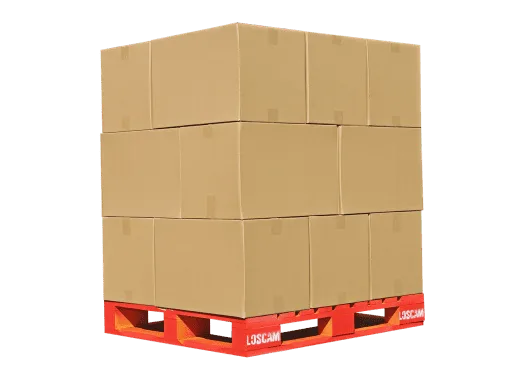
Reference capacity for a standard wooden pallet
The figures below are reference values for a standard pine pallet, 1,200 x 1,000 mm, assembled to correct specification. Actual capacity varies by wood species, design and condition (see factors below).
| Load type | Reference capacity (kg) |
|---|---|
| Static load | 3,000 - 4,000 kg |
| Dynamic load | 1,000 - 1,500 kg |
| Racking load | 600 - 1,000 kg |
Five factors that determine actual wooden pallet capacity
- Wood species: Hardwoods such as acacia and eucalyptus carry higher loads than softwoods such as pine. A pine pallet and an acacia pallet of the same dimensions will have different load ratings.
- Design and construction: More deck boards on the top face, thicker boards, and solid block feet instead of stringer boards all increase strength significantly.
- Nail type: Spiral-shank nails resist pull-out far better than smooth-shank nails, keeping the joint tight under repeated loading and vibration.
- Moisture content: Kiln-dried wood to the correct moisture standard is harder and stiffer than green or wet timber. Wet wood deflects more under load and is prone to splitting at nail points.
- Pallet condition: A new, defect-free pallet achieves its rated capacity. A used pallet with cracked boards, missing nails or soft spots from moisture damage has a significantly reduced capacity - often without any visible warning until it fails.
Related articles
| Standard wooden pallet dimensions (ISO) | Wooden pallet price list 2026 | Wooden pallets - products and pricing |
Frequently asked questions about wooden pallet weight capacity
1. How do I find out the load rating of a pallet I already have?
For internationally standardised pallets such as EPAL, the load figures are stamped directly on the pallet body. For domestically produced pallets or unmarked pallets, contact the manufacturer and request the technical datasheet. Never estimate the racking load by feel or appearance - the consequences of getting it wrong on a rack are serious.
2. Do wooden pallets or plastic pallets carry more weight?
Both can be designed to very high load ratings. Plastic pallets have an advantage in consistency: because they are injection-moulded, every unit from the same mould has identical load ratings. Wooden pallets have small natural variations in timber density and grain, so there is some unit-to-unit variation within the same batch.
3. How should I distribute cargo on a pallet to stay within the weight rating?
Spread the weight evenly across the full deck surface. Avoid concentrating the entire load at the centre point or pushing it to one edge - either condition creates a point load that can snap deck boards even when the total weight is within the rated limit.
4. Can I stack loaded pallets on top of each other?
Yes, using the static load rating as your limit. Only the bottom pallet is under static load; the pallets above are supported by the cargo, not the pallet below. Make sure the goods on each pallet are stable enough to support the weight stacked on top.
5. Does a used wooden pallet have the same capacity as a new one?
Not reliably. Cracks in deck boards, missing or corroded nails, and moisture damage all reduce capacity - sometimes drastically and without obvious visible signs. For racking applications, ICD recommends inspecting used pallets board by board before putting them into service on shelving.
Contact ICD for wooden pallets and a quote
ICD Viet Nam Industrial Production Company Limited
North: Floor 3, Thang Long A1 Building, Bau Hamlet, Thien Loc Commune, Hanoi - 0983 797 186 / 090 345 9186 / 090 5859 186
South: 551/212 Le Van Khuong, Tan Thoi Hiep, District 12, Ho Chi Minh City - 098 6784 186
Email: sales@icdvietnam.com.vn · Zalo: Chat on Zalo now
Tell ICD the load weight, pallet dimensions and whether the pallets will be used on racking or floor-stacked. ICD will recommend the correct specification and send a quote by return.