
Mục lục
Trying to work out the weight of rubber tree wood (acacia)? With more than a decade of experience in pallets and cargo transport solutions, understanding exact material weights is a critical input for every calculation - from shipping costs to load capacity. The weight of rubber tree wood is not fixed; it varies significantly depending on several factors.
Quick summary
One cubic meter of rubber tree wood typically weighs 570 to 650 kg.
That figure can shift considerably depending on moisture content (the single most important variable), the specific acacia species, and the piece dimensions. Fresh-cut rubber tree wood is substantially heavier than kiln-dried wood. Kiln-dried rubber tree wood at 12% moisture content can reach 770 kg/m3.
Weight and density of rubber tree wood
When discussing the weight of rubber tree wood, the key measure is density. One cubic meter normally weighs 570 to 650 kg, depending on moisture content and the specific acacia species. Some sources cite a density of around 770 kg/m3 (approximately 48 lbs per cubic foot), which applies to wood kiln-dried to the standard 12% moisture content.
The spread across these figures comes down to two causes:
- Moisture content: The most influential factor. Freshly harvested rubber tree wood holds a large amount of water, adding significant weight. The 770 kg/m3 figure applies to wood that has been dried to the 12% standard.
- Specific acacia species: The acacia genus covers many distinct species - hybrid acacia, leucaena, and golden wattle each carry slightly different densities.
Factors that affect rubber tree wood weight
Working with rubber tree wood across many transport and manufacturing projects, three main factors consistently determine its weight:
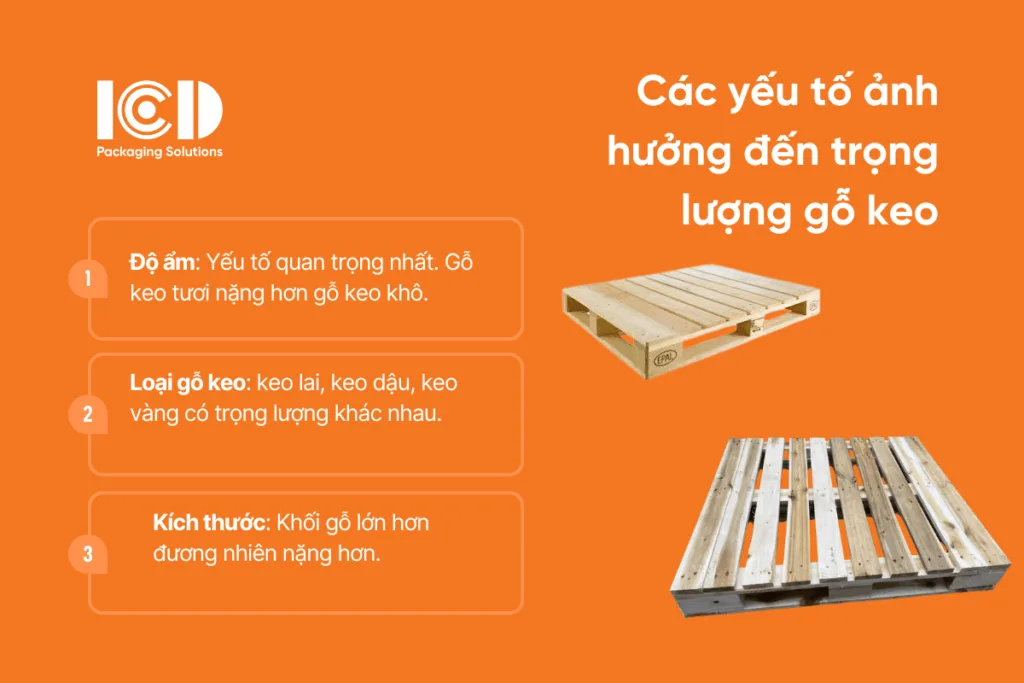
Moisture content
Moisture content has the greatest single effect on wood weight and density. Freshly felled timber contains a large volume of water that increases its mass considerably. Fresh rubber tree wood carries far higher moisture than processed timber and is correspondingly heavier. For applications that demand precision - such as manufacturing export wooden pallets - ICD always ensures the wood is kiln-dried to the standard moisture content to avoid unpredictable weight variation.
Specific acacia species
Although all belong to the genus Acacia, different species - hybrid acacia, leucaena, and golden wattle - can carry slightly different wood densities, resulting in small weight differences between types.
Dimensions
This is the most obvious factor, but no less important. The weight of a piece of wood changes directly with its volume (length x width x thickness). A larger piece is naturally heavier than a smaller one, even when both have the same density.
Worked examples and how to estimate weight
Two concrete examples to make the figures easier to apply:
- Example 1: Estimating the weight of 1 cubic meter of rubber tree wood
A block of rubber tree wood measuring 1 m x 1 m x 1 m will weigh between 570 kg and 650 kg if it is standard dry timber. If the wood has been carefully kiln-dried to 12% moisture content, that figure can reach 770 kg.
- Example 2: Estimating the weight of a standard acacia butcher-block countertop
Assume an acacia countertop with dimensions: 8 ft (length) x 25.5 in (width) x 1.5 in (thickness).
Converting all dimensions to feet:
- Length: 8 ft
- Width: 25.5 in = 25.5 / 12 = 2.125 ft
- Thickness: 1.5 in = 1.5 / 12 = 0.125 ft
Volume: V = 8 x 2.125 x 0.125 = 2.125 cubic feet.
Multiply by the acacia density for dry wood (48 lbs per cubic foot):
Weight = 2.125 cubic feet x 48 lbs/cubic foot = 102 lbs.
In practice, a similar product on the market may weigh only around 50 lbs. The gap can occur because the countertop is not fully solid wood - it may have an internal hollow structure, or the actual density of that specific product differs from the average. This is a detail worth flagging when advising customers on engineered wood products.

Conclusion
Rubber tree wood weight varies considerably and there is no single fixed number. It depends closely on moisture content, the specific acacia species, and the dimensions of the piece. Accurate weight estimation requires knowing all three parameters. Understanding these factors is essential for correctly calculating shipping costs, load capacity ratings, and safe handling practices whenever rubber tree wood is used.
Related articles
| Which wood class does rubber tree (acacia) belong to? | Current rubber tree wood price - latest update |
Frequently asked questions about rubber tree wood weight
1. How much does 1 cubic meter of rubber tree wood weigh?
Typically 570 to 650 kg for standard dry timber. Kiln-dried wood at 12% moisture content can reach approximately 770 kg/m3.
2. Why do different sources give different weight figures for rubber tree wood?
Because moisture content varies between sources. Fresh-cut wood contains far more water than kiln-dried wood, which pushes the weight up significantly. Always check the moisture content when comparing density figures.
3. What moisture content is used for the standard 770 kg/m3 figure?
That figure applies to wood kiln-dried to 12% moisture content, which is the standard for structural and export applications.
4. Does the species of acacia affect the weight?
Yes, slightly. Hybrid acacia, leucaena, and golden wattle each have marginally different densities, leading to small weight differences between types within the same moisture class.
5. How do I estimate the weight of a rubber tree wood piece I already have?
Measure the volume (length x width x thickness in metres) and multiply by the density in kg/m3. Use 570-650 kg/m3 for air-dried timber or 770 kg/m3 for kiln-dried timber at 12% moisture content.
Contact ICD Vietnam
Hotline: 0983 797 186 / 090 345 9186 / 090 5859 186
Email: sales@icdvietnam.com.vn | Zalo: Chat Zalo