
Mục lục
One of the best plastic pallet materials ICD Vietnam distributes is: PPC, HDPE, LLDPE, PP. But which material makes the best plastic pallet? We hope this article helps you choose the right type of plastic pallet from ICD Vietnam.
ICD Vietnam presents information on the plastic materials PPC, HDPE, LLDPE and PP as follows:
1. Plastic pallets made of PPC
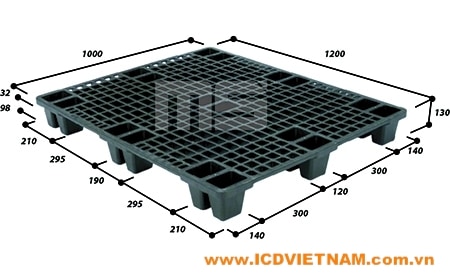
PPC plastic is a new plastic with the formula Poly Propylene Ethylene. PPC plastic is lighter than water, with high elasticity (1050 - 1260MPa), nearly double that of steel. The non-polar polymer structure (Polysone) gives PPC plastic extremely high chemical resistance. Therefore PPC plastic can withstand water, inorganic acids, alkalis and salts, and during cleaning and washing, PPC plastic is not damaged. PPC plastic is sound- and heat-insulating and does not absorb heat. It does not soak up water even after long immersion. In addition, it is fully recyclable like other ordinary plastics.
PPC plastic is environmentally friendly and therefore very safe for users. PPC plastic has extremely high durability, strong impact resistance and friction resistance, making it easy to clean.
- Melting temperature: 162 - 165oC
- Long-term operating temperature: -30oC - 100oC
- Short-term operating temperature: 150oC
2. Pallets made of HDPE
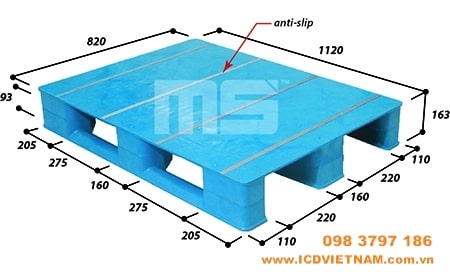
HDPE plastic (High-density polyethylene), also called PEHD (polyethylene high-density), is a high-density thermoplastic. HDPE plastic is known for its high strength-to-density ratio. HDPE density can range from 0.93-0.97 g/cm3 or 970 kg/m3. The density of HDPE plastic is only slightly higher than low-density polyethylene. But because HDPE has little branching, it has strong intermolecular forces. It therefore has higher tensile strength than LDPE (Low-density polyethylene) - a low-density thermoplastic.
HDPE plastic withstands high impact and has good crack resistance. HDPE plastic has high resistance to chemicals, corrosion, rot and abrasion. Material made from HDPE plastic withstands direct sunlight for long periods thanks to UV inhibitors. Therefore HDPE material is often used for tasks requiring outdoor exposure; in other words, the lifespan of HDPE material is very high under harsh weather. HDPE material is usually lightweight, easy to transport and use.
- Thermal expansion coefficient: <0.2 mm/m.oC
- Maximum operating temperature: 45 oC
- Brittle-fracture temperature: < 0 oC
- Electrically and thermally insulating.
See also: What is HDPE plastic? How it is used in plastic pallet manufacturing
3. Plastic pallets made of LLDPE
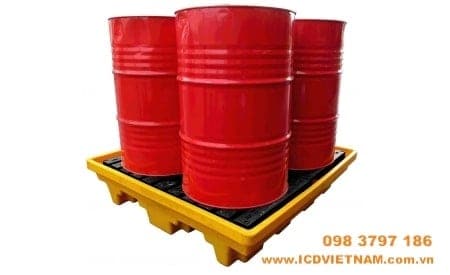
Linear low-density polyethylene (LLDPE) is a substantially linear polymer (polyethylene). It has a large number of short branches, usually made by copolymerizing ethylene with longer-chain olefins. LLDPE plastic has higher tensile strength, higher impact and better puncture resistance than LDPE plastic.
The difference between LDPE and HDPE plastic is mainly in density. This leads to differences in mechanical properties: one rigid, one soft and flexible. LLDPE plastic differs from the other two in molecular structure. LLDPE plastic has many branch chains, so it is both tough and rigid.
Material made from LLDPE can withstand acids and alkalis, resist organic solvents, has good electrical insulation, and retains a certain flexibility even at low temperatures. Mechanical strength such as surface hardness, tensile strength and stiffness are all higher than LDPE but lower than HDPE. LLDPE’s puncture resistance is the best, with good crack resistance, especially suited to producing film thinner than LDPE film yet with high strength.
- LLDPE is non-toxic, tasteless and odorless.
- Softening temperature: 94 - 108 oC
4. Pallets made of PP
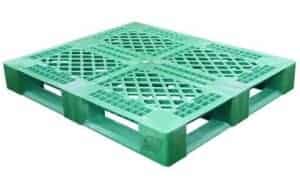
PP plastic is Polypropylene, a polymer produced by the polymerization of propylene. Polypropylene has high mechanical strength (tear and tensile strength), is quite rigid, not as flexible as PE, and does not stretch, so it can be made into fibers. It does, however, tear easily once there is a cut or small puncture.
PP plastic is transparent with a high surface gloss, allowing high-quality, sharp printing. PP is colorless, odorless, tasteless and non-toxic. PP burns with a pale blue flame, flows when melted, and smells almost like burning rubber. It withstands temperatures above 100°C. However, the seam-sealing temperature of PP packaging (140oC) is high compared to PE and can melt and damage outer laminate structures, so PP is rarely used as the innermost layer. PP material resists permeation of O2, water vapor, grease and other gases.
PP plastic is often used in the food industry for being non-toxic and easy to recycle. PP is also used in many other industries thanks to its low cost.
In summary, the above is all the information on the plastic pallet materials ICD Vietnam supplies. Each material has its own outstanding capabilities. We hope this article helps you find the pallet that suits your needs.
To order, please:
- Northern region: Call 0983 797 186 / 090 345 9186 / 090 5859 186 for free advice and orders, or email us
- Southern region: Call 098 6784 186 for free advice and orders, or email us
- To see more products, please Click Here
- Fanpage: see more here
In particular, ICD commits to buying back plastic pallets, intact or broken, when customers no longer need them.
See also: plastic vs wooden pallet comparison | static load and dynamic load