Table of Contents
- 1. What Is a Floor-Mounted Pallet Wrapper?
- 2. Pros of Floor-Mounted Installation
- 3. Cons and Installation Costs
- 4. When to Install Floor-Mounted vs Raised Platform
- 5. FAQ: Floor-Mounted Pallet Wrappers
- Contact ICD for a Quote
- Sources
- A recessed wrapper is more than a machine in a hole
- Ramp or recessed installation?
- Calculate operating cost as well as pit cost
- Site-survey checklist before cutting concrete
Reviewed and updated by ICD - Week 25/2026
A floor-mounted pallet wrapper - where the turntable sits flush with the floor - is increasingly popular in warehouses that operate forklifts and handle heavy loads. It costs more to install than a standard raised-platform wrapper, but for the right operation it pays back quickly in speed and safety. This article gives you a full comparison so you can make the right call.
Author: Le Van Thang, Director of ICD Vietnam - 15 years in packaging and warehouse equipment.
1. What Is a Floor-Mounted Pallet Wrapper?
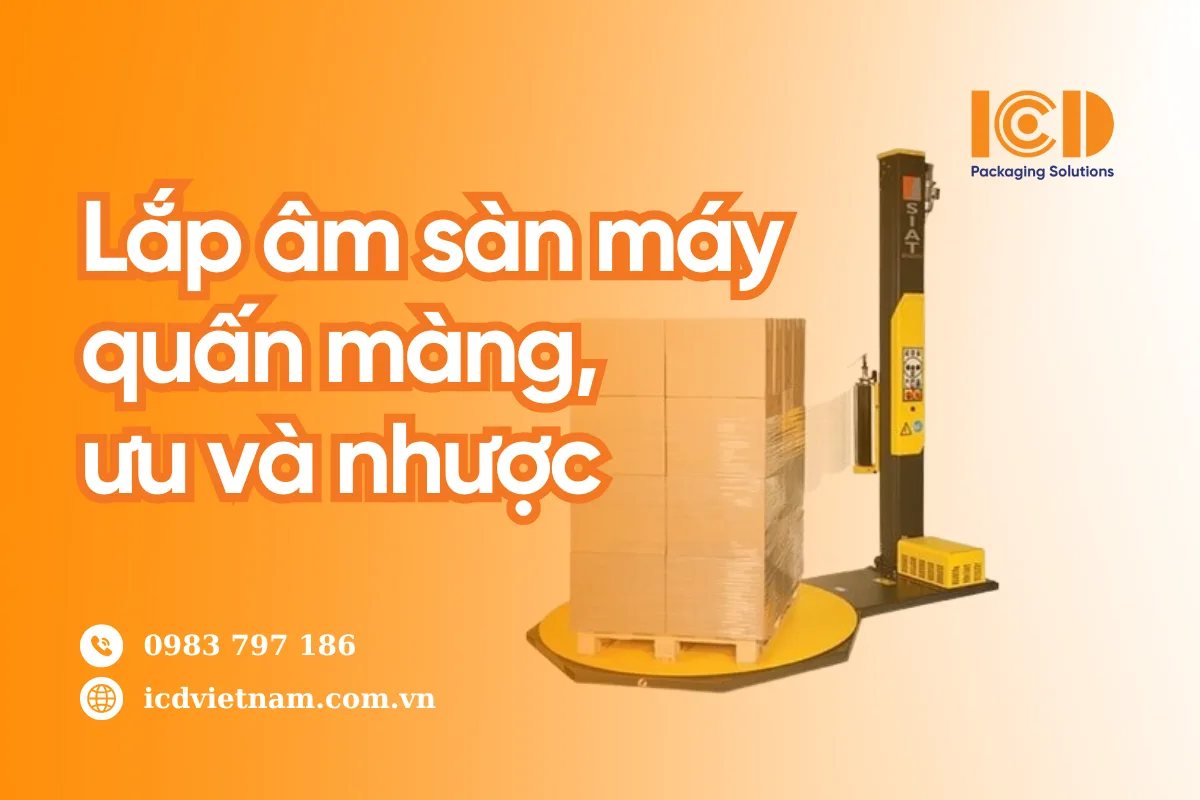
A standard stretch wrapper sits on legs, raising the turntable 150-200 mm above the floor. Forklifts need to lift pallets over the edge or use a loading ramp. A floor-mounted (recessed) wrapper requires cutting a pit in the floor so the turntable surface is level with the warehouse floor. Pallets slide straight on with no lifting.
2. Pros of Floor-Mounted Installation
Maximum forklift convenience. This is the most important benefit. When the turntable is floor-level, forklifts push pallets directly onto the table without raising the forks or using a ramp. Operations are 30-50% faster and tip-over risk drops significantly.
Handles heavier loads safely. No ramp means no risk of pallets tipping during loading. This matters most for loads over 800 kg or awkward shapes.
Cleaner workflow. No loading ramp to trip over or lose. The floor stays flat, which simplifies traffic routing.
Reduces operator fatigue. Workers don’t need to push pallets up a ramp repeatedly throughout a shift.
3. Cons and Installation Costs
Construction cost. Cutting the pit, installing drainage if needed, and finishing the concrete work adds cost on top of the machine price. Contact ICD for a combined machine + installation quote.
Machine is fixed. Once installed, the wrapper cannot be repositioned without excavating again. Plan your layout carefully before committing.
Floor must allow excavation. Epoxy-coated floors, raised floors, or floors with underfloor utilities may not be suitable.
Maintenance requires a lift or descent. Accessing the motor and gearbox at the bottom of the pit is less convenient than with a raised machine.
4. When to Install Floor-Mounted vs Raised Platform
| Situation | Floor-Mounted | Raised Platform |
|---|---|---|
| Primary loading method | Forklift | Hand pallet truck |
| Pallet load | Above 800 kg | Under 800 kg |
| Daily volume | 50+ pallets/day | Fewer than 50/day |
| Floor condition | Can be excavated | Epoxy, raised, or constrained |
| Machine relocation | Not needed | Possible future move |
5. FAQ: Floor-Mounted Pallet Wrappers
Does every pallet wrapper support floor-mounted installation?
Most turntable-type wrappers can be adapted. ICD semi-automatic and fully automatic models all support the recessed configuration. Rotary-arm and overhead wrappers don’t require floor mounting at all.
How deep does the pit need to be?
Typically 150-250 mm depending on the machine model. ICD provides exact dimensions and construction specs with each order.
What about water drainage?
For cold storage or wet areas, add a drain channel around the pit edge. ICD can advise on waterproofing requirements at quotation stage.
Can I retrofit an existing wrapper?
Yes, if the concrete can be cut. We install the pit, lower the machine, and re-level. Contact us for a site assessment.
Contact ICD for a Quote
ICD Vietnam - Pallet Wrapper Specialist
North: Floor 3, Thang Long A1 Building, Thon Bau, Xa Thien Loc, Ha Noi - 0983 797 186 / 090 345 9186
South: 551/212 Le Van Khuong, Tan Thoi Hiep, District 12, HCMC - 098 6784 186
Email: sales@icdvietnam.com.vn | Zalo: Chat on Zalo
Sources
A recessed wrapper is more than a machine in a hole
The pit must support machine and pallet loads, keep the turntable level, protect power routes and allow service access. Final dimensions must come from the exact machine drawing, not a generic depth found online.
- Structural concrete designed for static and dynamic loads.
- Flat transitions so pallet-jack wheels do not catch the turntable edge.
- Protected electrical conduits and moisture control.
- Drainage where washdown, rain or condensation is possible.
- A method to remove the machine for major service.
Ramp or recessed installation?
| Condition | Ramp | Recessed |
|---|---|---|
| Pallet-jack loading | Longer approach and more effort | Direct level entry |
| Changing layout | Easy to relocate | Civil work reduces flexibility |
| Wet floor | Lower moisture risk | Needs drainage planning |
Calculate operating cost as well as pit cost
If level entry saves 20 seconds and the site wraps 150 pallets per shift, it saves 50 minutes of operator time per shift. Compare this with civil work, downtime, ramp footprint, forklift waiting, relocation risk and future replacement cost.
Site-survey checklist before cutting concrete
- Confirm model, drawing revision, turntable diameter and rated load.
- Scan for reinforcement, utilities and post-tension cables.
- Measure pallet-jack turning radius and traffic flow.
- Plan electrical isolation, emergency stop and guarding.
- Agree how the machine will be removed for service.
- Test the finished installation with the actual pallet jack and approved maximum load.