Table of Contents
- Raw material: LLDPE resin and the cling layer
- 6 steps from resin to finished roll
- Cast and blown: how they differ and what it means when wrapping
- Where does stretch come from: the line or the wrapping machine?
- From process to roll label: what to check when buying
- Conclusion
- Frequently asked questions about PE film manufacturing
- What temperature does plastic resin melt at when making PE film?
- How many steps are in the PE film manufacturing process?
- Is stretch film pre-stretched during production?
- Why is a newly made roll sometimes not yet tacky?
- Is cast or blown better for pallet wrapping?
- Does ICD Vietnam manufacture PE film itself?
- Contact for advice on PE film and wrapping machines
- References
Reviewed and updated by ICD - Week 43/2026
Pallet stretch film is made from molten LLDPE resin, extruded into film 8-50 microns thick by one of two methods: cast extrusion, where the melt leaves a flat die at about 220-280 °C and cools quickly on a chill roll at 20-40 °C; or blown extrusion, where the melt leaves a round die and is blown into a bubble. The film is then gauged for thickness, slit to width (the common hand-roll width for pallet wrapping is 500 mm) and wound onto a core.
This article describes the general process of the stretch-film industry, based on technical documents from resin makers, extruder makers and ASTM standards; it does not describe the line of any particular factory, including where the rolls ICD Vietnam supplies are made.
Quick summary:
- The main raw material is LLDPE, a copolymer of ethylene with butene, hexene or octene; the cling layer adds PIB or uses a low-density resin.
- Cast: fast cooling, more even thickness, high output, lower cost. Blown: better cling but slower and less even.
- Stretch when wrapping (100-300%) is a capability built into the film, drawn out at the wrapping machine or hand tool, not a separate step on the extrusion line.
- When buying, insist on a roll label stating thickness, width, length and weight, and check the tolerances in ASTM D4649.
Raw material: LLDPE resin and the cling layer
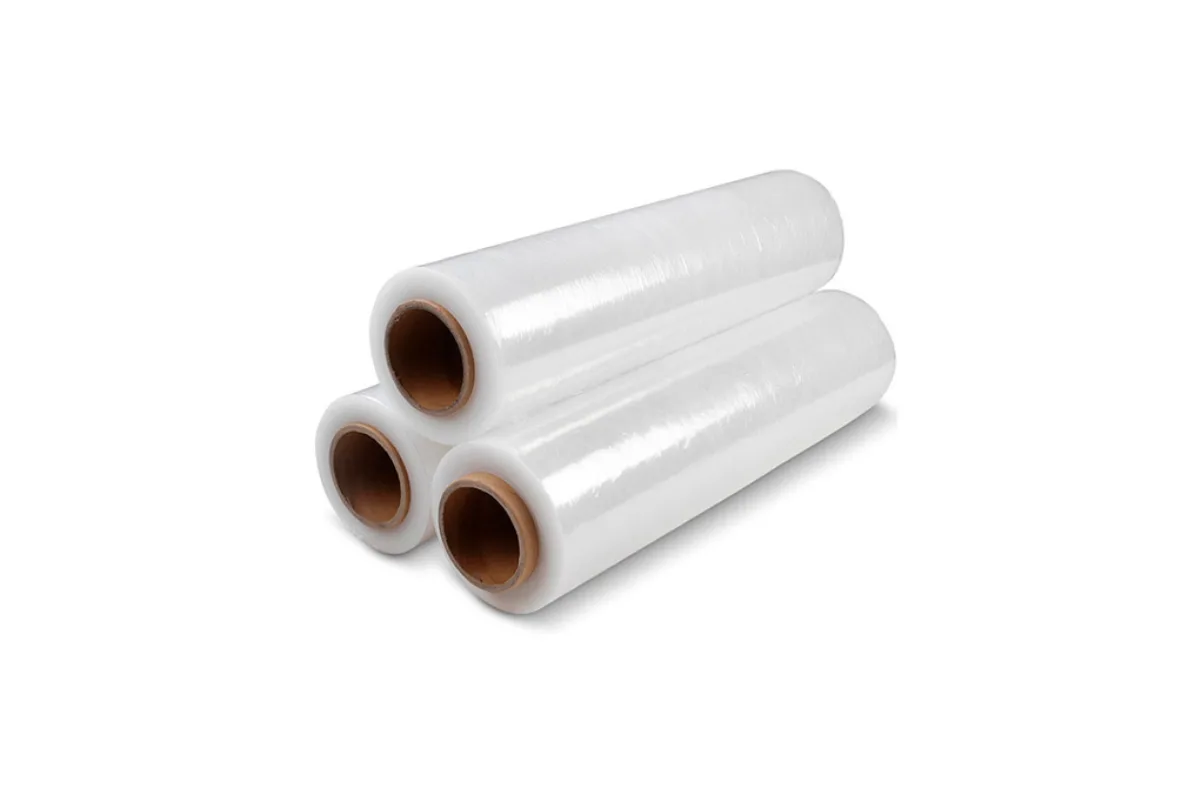
The most common stretch-film material is LLDPE (linear low-density polyethylene), made by copolymerising ethylene with butene, hexene or octene. According to Wikipedia, using hexene or octene gives better elongation at break and puncture resistance. LLDPE density is about 0.917-0.930 g/cm³ according to the British Plastics Federation.
Many stretch films stretch about 500% before breaking but are pulled only 100-300% in use; that spare stretch is the safety margin when wrapping.
The cling layer: why one side of the roll is tacky and the other is not
Stretch film uses no adhesive; cling comes from the surface layer, either by blending 2-8% polyisobutylene (PIB) into the LLDPE or by using a resin of density 0.90 g/cm³ or lower on the cling side. A Dow patent describes a three-layer structure, with one tacky side and a less tacky opposite side, so the roll unwinds smoothly while the film still clings to itself when wrapped.
| Layer | Thickness ratio in Dow’s example | Role |
|---|---|---|
| Cling side | 15% | Branched homogeneous resin, density 0.90 g/cm³ or lower; makes the film stick to itself when wrapped. |
| Load-bearing core | 70% | LLDPE; sets tensile strength, stretch and puncture resistance. |
| Low-cling side | 15% | Resin of density above 0.90 g/cm³; lets the roll unwind smoothly without sticking to rollers. |
A useful detail for buyers: research on PIB-blended LLDPE film shows that cling builds up after production, faster when the roll sits in a warmer store (tested at 25, 35 and 45 °C for up to 28 days). So a roll fresh off the line may not yet have its final cling. ASTM D4649 also recommends the cling side face inward when wrapping so pallets do not stick to each other.
6 steps from resin to finished roll
Whether cast or blown, the line goes through the same sequence: feeding, melting, forming the film, cooling, gauging and slitting, winding. The table below lists the parameters with published sources; actual temperatures depend on resin grade, equipment and each plant’s speed.
| Step | What is done | Sourced parameter |
|---|---|---|
| 1. Feeding and blending | Meter core resin, cling-layer resin and additives into each extruder. | Example in Dow’s patent uses 3 extruders for the 3-layer structure. |
| 2. Melting and filtering | The screw melts the resin into a uniform melt and filters out impurities before the die. | Cast with DOWLEX 2607G: melt temperature 220-280 °C. Blown with one blown-film LLDPE grade: 190-230 °C. |
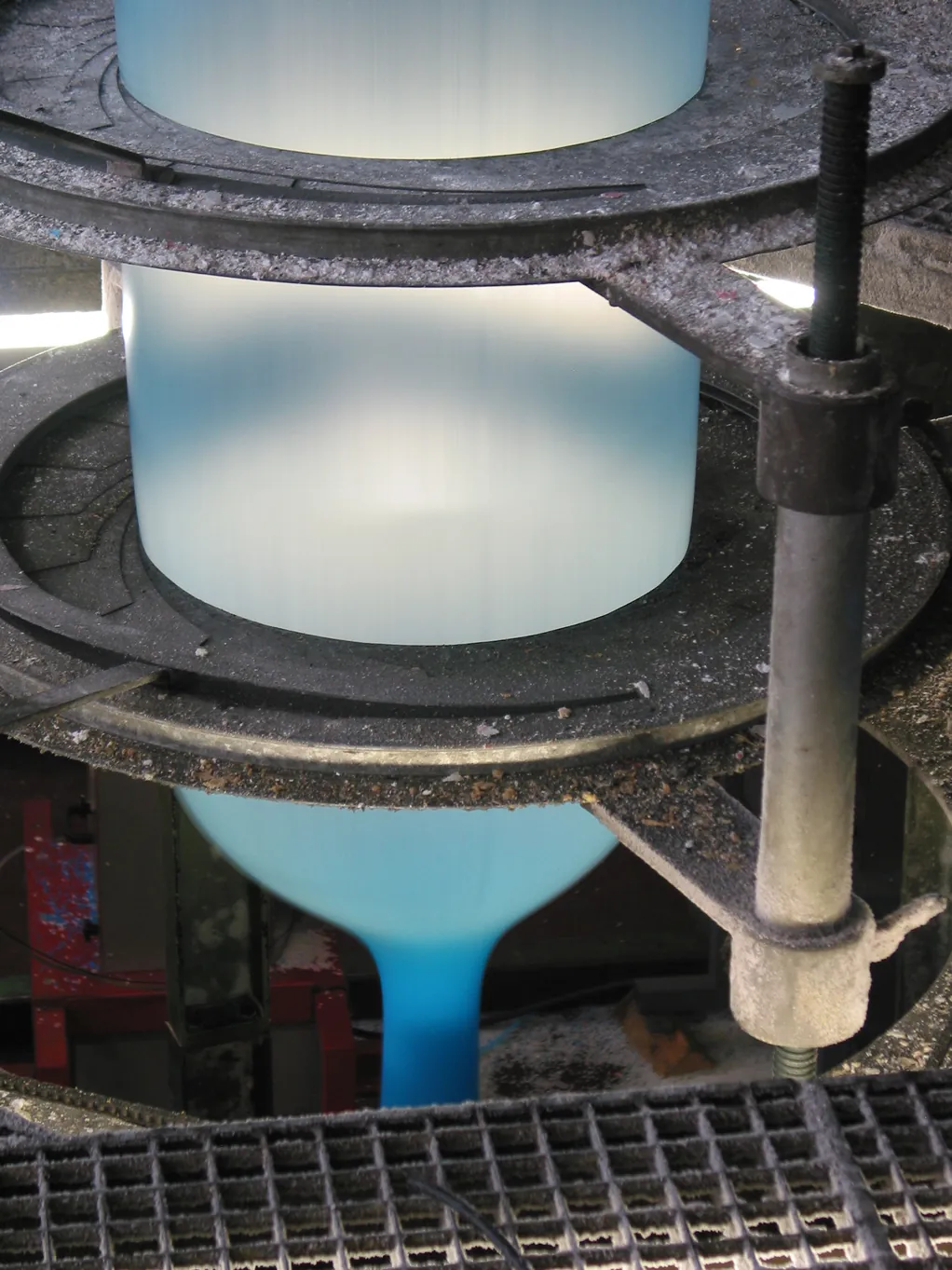
| 3. Forming the film | Cast: a flat die extrudes a thin sheet of film. Blown: a round die extrudes a tube that air inflates into a bubble. | Blown: blow-up ratio (BUR) is usually 2:1 to 3:1 (Qenos). |
| 4. Cooling | Cast: the film drops onto a chill roll, with an air knife or vacuum box pinning it to the roll. Blown: cold air is blown around the bubble. | Cast: chill roll 20-40 °C. Blown: LLDPE output rate is limited by the cooling stage (Qenos). |
| 5. Gauging and slitting | A sensor measures thickness continuously, edges are trimmed, and the wide sheet is slit into several narrow rolls. | SML’s cast line has slitting configurations of 3 x 500 mm or 12 x 500 mm. |
| 6. Winding and storage | Wind onto cores, label, palletise. | Cling develops over several days to weeks in storage (Small et al.). |
Cast lines run at very high speed: SML publishes stretch-film lines running up to 650-800 m/min at 8-50 microns thickness. Dow lists test conditions with DOWLEX 2607G at 250 m/min for 10-35 micron film, meaning speed and target thickness are two variables that together decide which resin suits.
Cast and blown: how they differ and what it means when wrapping
| Criterion | Cast extrusion | Blown extrusion |
|---|---|---|
| Die | Flat die (slot die) | Round die (annular die) |
| Cooling | Fast, by contact with a chill roll | Slower, by blown air |
| Evenness of thickness | Varies about ±3-5% (PlasticsToday, citing SML) | About ±7-10% (same source) |
| Cling | Lower than blown | Better than cast |
| Output and cost | High hourly output, lower cost | Lower output, higher production cost |
Sources give different tolerance figures because the measurement methods differ: ScienceDirect says cast with a self-adjusting die reaches ±1-2% while blown is usually ±3-4%, whereas PlasticsToday cites ±3-5% versus ±7-10%. The overall conclusion does not change: cast gives more even thickness, so the film has fewer thin weak spots and tears less when pulled fast; blown trades that for higher cling.
Where does stretch come from: the line or the wrapping machine?
Stretch capability is built into the structure of LLDPE film, while the actual stretching takes place at the wrapping equipment. Wikipedia describes the turntable wrapping machine as creating stretch by turning the load faster than the film is released, and there are also hand tools that pre-stretch the film with two rollers turning at different speeds.
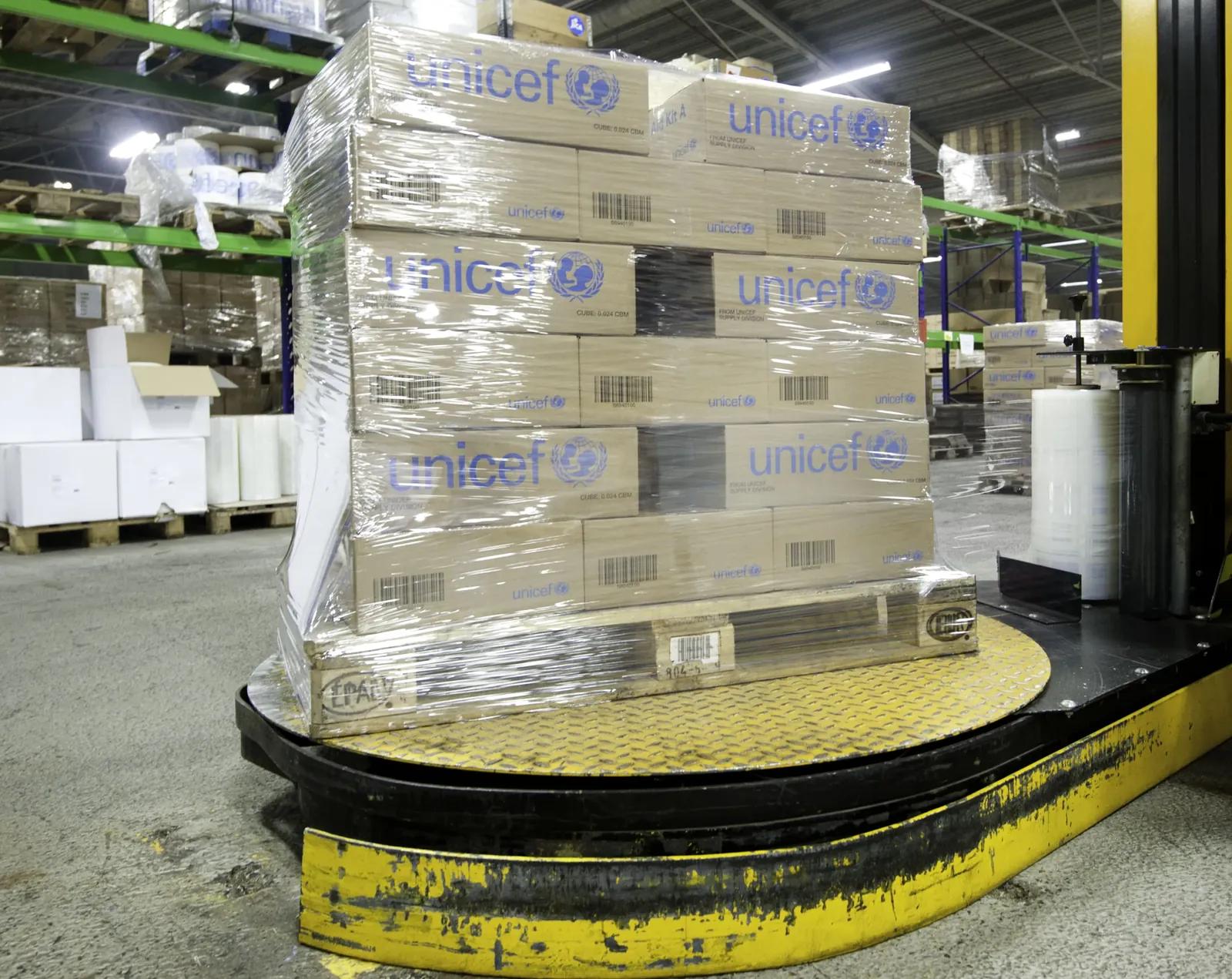
On a wrapping machine with a pre-stretch system, this ratio is a machine setting: on their product pages, ICD Vietnam’s ICD-T1650FZ and ICD-T1800FZ state a maximum film stretch of 250% to reduce film consumption. The usable stretch is also limited by the film roll itself, so a film with lower elongation at break should not be run at 250%; if the film breaks midway just after you raise the stretch ratio, lower the ratio before blaming the supplier.
From process to roll label: what to check when buying
ASTM D4649 is a guide to selecting and using stretch film for indoor loads (warehouses, containers, trailers), letting buyers and sellers agree on purchase specifications. The D4649-20 edition sets out the tolerances below, which you can use as a basis when asking suppliers:
When ordering, the standard also asks that thickness, width, length per roll, core size and the film classification (hand or machine film) be stated; the roll label should carry product name, thickness, width, length, weight and lot number. Performance tests include ASTM D882 (tensile strength, elongation), D5458 (cling), D5459 (elastic recovery), D1922 (tear resistance) and D5748 (puncture resistance).
| Item | Tolerance per ASTM D4649-20 | How to read it on receipt |
|---|---|---|
| Thickness | No more than ±10% off nominal at any point across the width | Measure several points across the width, not just one spot |
| Roll weight | ±7% for a single roll; ±5% for a lot of more than 25 rolls | Weigh the lot and compare with the kg stated on the label |
| Roll length | Within ±5% of the length stated on the label | Measure with a counting wheel as the film unwinds, without stretching |
| Roll diameter | Within ±5% of the nominal diameter | The roll must fit your wrapping machine’s spindle |
An example of matching process to roll label: the ICD-MPE30 roll on the product page weighs 3.0 kg, made of 2.5 kg of film and a 0.5 kg core, with 17 micron film at 500 mm width. At an LLDPE density of about 0.92 g/cm³, each kg of 500 mm wide, 17 micron film is about 128 m long, so this roll is about 320 m long. If the length on a label is far from the figure worked out from weight, thickness and width, that is a point to query. How to read price per kg of real film is in the 2026 PE film price list; how to choose thickness and roll type for your warehouse is in the article on choosing the right PE film.
Specifications of each hand-roll and machine-roll PE film from ICD Vietnam are on the product pages; the factory that made each roll should be confirmed separately with the sales team when quoting.
Conclusion
The manufacturing process of pallet stretch film revolves around LLDPE resin, a multilayer structure and the way the film is formed: cast for even thickness and high output, blown for higher cling. Usable stretch is a capability of the film, drawn out at the wrapping machine. Buyers should rely on the roll label and the ASTM D4649 tolerances instead of comparing micron figures alone.
| Key parameters to remember | Sourced value |
|---|---|
| Cast resin melt temperature (DOWLEX 2607G) | 220-280°C |
| Chill roll temperature in cast extrusion | 20-40°C |
| Melt temperature of one blown-film LLDPE grade | 190-230°C |
| Blow-up ratio (BUR) commonly used | 2:1 to 3:1 |
| Film elongation at break / in use | about 500% / 100-300% |
| Thickness tolerance per ASTM D4649-20 | ±10% at a single point |
Frequently asked questions about PE film manufacturing
What temperature does plastic resin melt at when making PE film?
It depends on the resin grade and the extrusion method. Dow lists DOWLEX 2607G resin for cast stretch film running at a melt temperature of 220-280 °C with a chill roll at 20-40 °C; one LLDPE grade for blown film (Flexirene FG 20 F) recommends 190-230 °C. A real plant sets temperature by resin, equipment and speed.
How many steps are in the PE film manufacturing process?
It can be summarised in 6 steps: feeding and blending, melting and filtering, forming the film, cooling, gauging and slitting, winding and storage. The biggest difference between plants is the film-forming and cooling step of cast versus blown.
Is stretch film pre-stretched during production?
Stretch capability is built into the LLDPE structure (many types stretch about 500% before breaking); the stretching when wrapping happens at the wrapping machine or at hand tools with pre-stretch, with usable stretch of about 100-300% according to Wikipedia.
Why is a newly made roll sometimes not yet tacky?
With PIB-blended film, cling builds up after production and faster when stored at higher temperature (tested at 25, 35, 45 °C up to 28 days). Check cling on a roll that has been stored long enough, and ask the supplier whether the roll is one-side cling or two-side cling.
Is cast or blown better for pallet wrapping?
Cast is more even and cheaper, suited to high-volume machine wrapping; blown clings better but is slower and costs more to produce. Neither is absolutely better: test a sample on your own pallets.
Does ICD Vietnam manufacture PE film itself?
This article describes the industry’s general process, not the line of any factory. ICD Vietnam supplies hand-roll and machine-roll PE film; if you need to know the factory source of a specific roll code, ask directly through hotline 0983 797 186 when requesting a quote.
Contact for advice on PE film and wrapping machines
Send us the type of goods, the pallet size and the daily volume; ICD Vietnam advises on suitable film and wrapping machines. ICD wrapping machines: All ICD models.
ICD Viet Nam Industrial Production Company Limited
- North (Hanoi warehouse): 0983 797 186 / 090 345 9186 / 090 5859 186.
- South (workshop): 098 6784 186.
- Email: sales@icdvietnam.com.vn.
References
- Stretch wrap, Wikipedia (LLDPE, cast and blown, stretch, types of wrapping machine).
- Polyethylene (Low Density) LDPE, LLDPE, British Plastics Federation (density).
- DOWLEX 2607G Polyethylene Resin (datasheet), Dow (melt temperature, chill roll, thickness range).
- Cast film extrusion covers wide range of markets, PlasticsToday (thickness tolerance, citing SML).
- Stretch wrap film lines, SML (thickness, speed, width configurations).
- Cast Film Extrusion, ScienceDirect Topics.
- Blown film extrusion technical guide, Qenos.
- Flexirene FG 20 F datasheet, Versalis.
- Polyisobutylene concentration and extrusion conditions in stretch and cling film, Small et al., Journal of Plastic Film and Sheeting.
- Stretch cling film and fabrication method, Dow, patent US 5955205.
- ASTM D4649-20 Standard Guide for Selection and Use of Stretch Wrap Films, ASTM International (preview on iTeh Standards).
- Specifications of ICD-T1650FZ and ICD-T1800FZ machines and the ICD-MPE30 roll on ICD Vietnam product pages, checked in October 2026.