Table of Contents
- Structure of a pallet stretch wrapper - 5 main parts
- Basic operating principle
- Pre-stretch system - the part that makes the big difference
- Other structures besides the rotary-table machine
- Structural differences: semi-automatic vs fully automatic
- Operating safety under the EN 415-6 standard
- Periodic maintenance - points to check
- Stretch wrapper structure Q&A
- Why does a stretch wrapper vibrate heavily when running?
- Is a table motor that gets too hot a sign it is broken?
- PE film keeps snapping while wrapping - machine fault or film fault?
- What are the main parts of a pallet stretch wrapper?
- What is the operating principle of a pallet stretch wrapper?
- How does a semi-automatic stretch wrapper differ from a fully automatic one?
- Does a pallet stretch wrapper use single-phase or three-phase power?
- How many motors does a stretch wrapper have?
- How much load can a stretch wrapper table take?
- Contact us to buy a machine
- References
Reviewed and updated by ICD - Week 43/2026
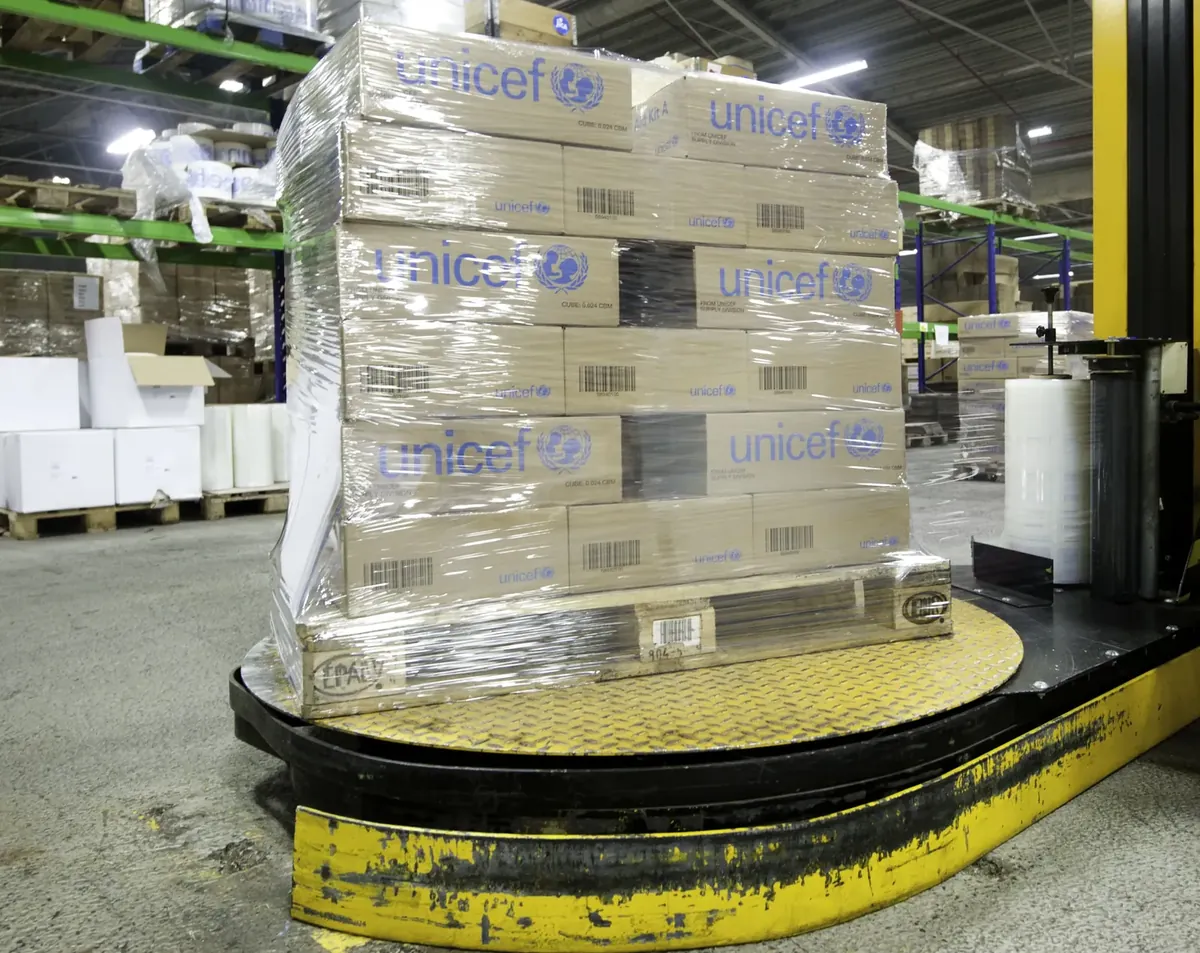
A rotary-table pallet stretch wrapper has 5 parts: a rotary table (1,500-2,400 mm diameter, 1,000-2,000 kg load depending on the model), a film column with a roll carriage and tension rollers, a motor with an inverter, a control panel and a frame. When it runs, the table turns the pallet at 0-12 rpm while the film carriage rises and falls along the column, so the PE film wraps around the load in a spiral from the base to the top.
- 5 main parts: rotary table, film column, motor, control panel, frame
- Principle: the table turns the pallet and the PE film wraps in a spiral
- Semi-automatic vs automatic: the difference is in the film clamp/cut system and column control
- See real models: ICD pallet stretch wrapping machines
Understanding the structure and operating principle of a pallet stretch wrapper helps a business run it more efficiently, spot signs of failure early and maintain it properly. This article analyses the 5 main parts and the working principle of both semi-automatic and fully automatic machines.
Structure of a pallet stretch wrapper - 5 main parts
The five main parts of a pallet stretch wrapper are the rotary table, film column, motor and drive, control panel and frame; the diagram below shows where each part sits.
Whether semi-automatic or fully automatic, a pallet stretch wrapper has the same 5 core parts. The difference lies in the level of automation of each part, not in the overall structure.
1. Rotary table (turntable): A round load-bearing steel disc, 1,500-2,400 mm in diameter, rated 1,000-2,000 kg depending on the model. The top surface has anti-slip ribs so the pallet does not shift when the table turns. Under the table are the drive belt and the electric motor that turns it. Rotation speed can be set from 0-12 rpm with the inverter.
Table diameter and real load rating differ quite a lot between models, so read the specifications of each machine instead of relying on a general figure:
| Model (ICD Vietnam catalog) | Table diameter | Maximum load | Maximum wrapping height |
|---|---|---|---|
| ICD-T1650FM | 1650 mm | 1,000 kg | 2,000 mm (2,400 mm optional) |
| ICD-X0MS, X0PS | 1500-2400 mm (optional) | 1,500 kg | 2,000 mm |
| ICD-Y1650F | 1650 mm | 1,500 kg | 2,000 mm |
| ICD-T1650F | 1650 mm | 2,000 kg | 2,100 mm |
| ICD-2000BF | 1650 mm | 2,000 kg | 2,500 mm |
2. Film column (film carriage): An upright post fixed beside the rotary table, whose height matches the maximum wrapping height (2,000-2,500 mm depending on the model; the ICD-2000BF is tallest at 2,500 mm). On the column are the holder for the PE film roll and a system of rollers that set the film tension. On a semi-automatic machine, the carriage is raised and lowered by hand or by a push button.
On an automatic machine, the carriage raises and lowers itself according to a pre-set program.
3. Motor and drive system: There are usually 2 separate motors: the table motor (enough power to turn the pallet steadily) and the carriage lift motor (enough power to raise and lower it smoothly).
The inverter that sets motor speed allows flexible adjustment without jerking and without sudden force that could topple the goods.
On a machine with an electric pre-stretch unit, the film carriage has a third motor that pulls the film through the rollers. The catalog specifications of two models show clearly how the power is divided:
| Model | Table / rotary-arm motor | Film-pulling motor | Column lift motor | Power supply |
|---|---|---|---|---|
| ICD-T1650FM (rotary table) | 0.75 kW | 0.4 kW | 0.37 kW | 220 V single-phase |
| ICD-R1800FZ-PL (rotary arm) | 1.5 kW | 0.4 kW | 0.55 kW | 380 V three-phase |
4. Control panel: From a simple push-button panel (basic semi-automatic) to a touchscreen that stores programs (high-end automatic). The basic settings you can adjust are: table speed, number of wraps at the top, middle and bottom, wrapping height and film tension.
On a semi-automatic rotary-table machine, the three settings the operator adjusts most are film tension, table speed and carriage lift speed; these three decide how tight the wrap is and how much each wrap overlaps. Automatic machines such as the ICD-X100, T1650FZ and T1800FZ also have a photoelectric switch mounted on the carriage that detects the top of the load itself, so the height does not have to be set by hand for each pallet.
5. Frame and housing: Welded steel structure with a powder-coated, corrosion-resistant finish. The design must keep the machine stable when the table carrying a heavy load turns at maximum speed. On the mobile model (Y1650F), the frame is lighter and has lockable wheels built in.
Basic operating principle
The rotary table turns the pallet while the carriage travels along the column, so the film is pulled off the roll and wrapped around the load in a spiral; film tension, set by the rollers on the carriage, decides how tight the wrap is.
The wrapping cycle for one pallet follows the order in the diagram: place the pallet in the centre of the table, clamp or tie the film start to the base of the pallet, then start. The table turns and wraps a few reinforcing turns at the base first, then the carriage climbs gradually along the column while the table keeps turning, so the film covers the body of the load in a spiral. At the top, the machine adds reinforcing wraps, the carriage descends, the table stops, and the film tail is cut and pressed against the load.
During this process, film tension is the most important technical setting. Too much tension crushes the goods or snaps the film. Too little tension leaves the pallet not held firmly.
Setting the right tension for each type of load is an important operating skill; ICD Vietnam technicians show the operator how to adjust these settings when the machine is handed over.
Pre-stretch system - the part that makes the big difference
Pre-stretch is a pair of rollers turning at different speeds on the film carriage that stretches the film 150-300% before it touches the load, saving film and increasing holding force.
High-end fully automatic machines add a pre-stretch unit between the film roll and the point where it wraps onto the pallet. The system has 2 rollers turning at different speeds: the output roller turns faster than the input roller, creating a pulling force that stretches the film before wrapping.
200% pre-stretch means the film is stretched to 3 times its original length before it wraps onto the pallet. In other words, 1 metre of original film becomes 3 metres after stretching, so the same roll wraps more pallets; the real film saving also depends on the number of wraps and the tension setting.
| Pre-stretch ratio | 1 m of film becomes | Example ICD Vietnam models |
|---|---|---|
| 200% | 3 m | ICD-S800E (horizontal machine); Maxgo robot (1:3 ratio) |
| 250% | 3.5 m | ICD-X100, ICD-2000BF (maximum) |
| 300% | 4 m | Robopac TP3 (maximum) |
The film stretches once more on its way from the carriage to the load. The packaging research group at RIT (USA) calls the stretch between the two rollers primary stretch, and the extra stretch the film gives when the machine pays out less film than the circumference of the load secondary stretch; too much secondary stretch is what makes film snap or crush cartons. According to this research, 250% pre-stretch is gradually becoming common in the industry. So on a machine with pre-stretch, set the tension at the carriage just enough for the film to hug the load, and do not use tension as a substitute for the stretch unit.
Other structures besides the rotary-table machine
Besides the rotary table, pallet wrappers have three other main structures: the rotary arm (the pallet stays still while an arm carrying the film circles it), the horizontal wrapping ring (for long goods) and the self-propelled robot that drives around the pallet. The European safety standard EN 415-6:2013 on pallet wrapping machines applies to pallet stretch wrappers, mobile wrappers and semi-automatic self-propelled wrappers.
| Structure | How the wrapping motion is produced | Suited to | ICD Vietnam models |
|---|---|---|---|
| Rotary table | Pallet turns on the table, carriage rises and falls | Stable loads up to 2,000 kg | T1650F, Y1650F, X0MS, 2000BF |
| Rotary arm | Pallet stays still, arm carrying the carriage circles it | Light, unstable loads, high-speed lines | R1800FZ-PL (35-45 pallets/hour), mobile XT4512 |
| Horizontal wrapping ring | Goods travel through on a conveyor, the ring carrying the film circles them | Pipes, steel sections, timber, doors | S800E (800 mm ring) |
| Self-propelled robot | Robot carries the film column and drives around the pallet by itself | Very heavy pallets, wrapped on the spot | Robopac TP3, XT4550, Maxgo |
ICD R1800FZ-PL rotary-arm wrapper installed on a line: the pallet enters on a conveyor and stays still while the arm circles it.
The rotary-arm type also comes in a mobile, battery-powered version. The ICD-XT4512 uses 4 x 12 V 20 Ah batteries, wraps pallets up to 1,500 kg and 1,600 mm tall, and can be driven to where the pallet sits instead of bringing the pallet to the machine; the Maxgo robot runs on 2 x 12 V 107 Ah batteries and works about 8 hours per 8-10 hour charge.
Structural differences: semi-automatic vs fully automatic
The two machine types share the frame, table and motors; the difference lies in the clamp, film cutter, pre-stretch level and control panel, as in the table below.
| Part | Semi-automatic | Fully automatic |
|---|---|---|
| Rotary table | Electric motor + inverter | Electric motor + inverter (same) |
| Film column | Raised and lowered by hand or push button | Raised and lowered automatically by program |
| Film start clamp | Operator clamps by hand | Automatic pneumatic clamp |
| Film cutting | Operator tears by hand | Automatic hot-knife or mechanical blade |
| Pre-stretch | None or low | Yes, 150-300% |
| Control panel | Simple push buttons | Programmable screen, stores programs |
The automatic film clamp and cutter usually run on compressed air, so the warehouse needs an air compressor alongside. For example the ICD-T1650FZ uses a pneumatic clamp with an air supply of 0.4-0.8 MPa and reaches 30-50 pallets/hour; a semi-automatic machine such as the T1650F needs only a 220 V socket.
Operating safety under the EN 415-6 standard
The three main danger zones of a wrapping machine are the gap between the rotary table and fixed parts (clamp, cutter), the film rollers (which can draw in a hand) and the rotating zone of the arm or robot; EN 415-6 is the European standard setting safety requirements for these hazards, and on real machines these zones are protected by covers, interlocked guards or sensors that stop the machine.
Periodic maintenance - points to check
Maintaining a pallet stretch wrapper consists of weekly tasks (belt, column slide, rollers) and monthly tasks (bolts, electrics, pre-stretch rollers).
A pallet stretch wrapper has fewer maintenance points than a complex packaging machine, but skipping maintenance still leads to early failure and large repair bills.
Weekly: check the tension of the table drive belt (a belt that is too loose lets the table slip, one that is too tight wears quickly), lubricate the film column slide with industrial grease, and check the film tension rollers.
Monthly: check connecting screws and bolts, especially the bolts that fix the table to the frame (constant vibration can loosen them). Clean the control panel and check the wire connections. Check the wear of the pre-stretch rollers (if fitted).
| Interval | Item | Sign that action is needed |
|---|---|---|
| Weekly | Table drive belt | Table slips, turns with a jerk, or the belt wears fast |
| Weekly | Film column slide (grease) | Carriage rises and falls with jerks or noise |
| Weekly | Tension adjustment rollers | Film wrinkles or snaps abnormally |
| Monthly | Screws, bolts, especially the bolts fixing the table to the frame | Machine vibrates heavily when running |
| Monthly | Control panel, wiring, pre-stretch rollers | Buttons act up, roller surface worn |
Stretch wrapper structure Q&A
Below are frequently asked questions about the structure, working principle and faults of pallet stretch wrappers.
Why does a stretch wrapper vibrate heavily when running?
Heavy vibration usually comes from one of 3 causes: (1) the pallet is not centred on the rotary table, creating an eccentric force; (2) the rotary table has come loose from the frame; (3) the drive belt is worn or loose. Check in this order before calling a technician.
Is a table motor that gets too hot a sign it is broken?
A slightly hot electric motor is normal, especially in continuous operation. If the motor is much hotter than usual, with squealing, a burning smell or the machine cutting out, the motor may be overloaded (pallet heavier than rated) or the cooling fan clogged with dust. Clean the fan and check the load first.
PE film keeps snapping while wrapping - machine fault or film fault?
The most common cause is film tension set too high for the film thickness in use. Lower the tension by 1-2 steps and try again. If it still snaps, check whether the tension roller is jammed or has a chipped edge.
What are the main parts of a pallet stretch wrapper?
5 main parts: rotary table, film column, motor, control panel and frame.
What is the operating principle of a pallet stretch wrapper?
The rotary table turns the pallet in a circle while the PE film is wrapped around it in a spiral.
How does a semi-automatic stretch wrapper differ from a fully automatic one?
The main difference is in the film clamp/cut system and the film column control - an automatic machine automates these operations completely.
Does a pallet stretch wrapper use single-phase or three-phase power?
Standard rotary-table machines such as the T1650F, Y1650F and X0MS use 220 V single-phase power, which can be plugged in at most warehouses. The R1800FZ-PL rotary-arm machine and the S800E horizontal machine use 380 V three-phase; self-propelled robots and mobile rotary-arm machines run on rechargeable batteries.
How many motors does a stretch wrapper have?
A basic rotary-table machine has 2 motors: one to turn the table and one to raise and lower the film carriage. A machine with electric pre-stretch adds a third motor that pulls the film through the rollers, for example the T1650FM has a 0.75 kW table motor, a 0.4 kW film-pulling motor and a 0.37 kW column motor.
How much load can a stretch wrapper table take?
Depending on the model, commonly from 1,000 to 2,000 kg: T1650FM 1,000 kg, Y1650F and X0MS 1,500 kg, T1650F and 2000BF 2,000 kg. Pallets heavier than the table rating should use a self-propelled robot or a rotary-arm machine, because the pallet stays still on the floor.
Contact us to buy a machine
- See prices by machine model: PE stretch wrapping machine price list 2026
- Most popular model: T1650F stretch wrapper - contact us for a quote
- All models: ICD Vietnam pallet stretch wrapping machines
- Hotline: 0983 797 186 | 098 6784 186
- Quote: request a quote
References
- Stretch wrap, Wikipedia (LLDPE stretch film, types of wrapping machine, pre-stretch carriage with two rollers at different speeds).
- Wyns, Cook, Dunno (2018), Post-wrapping behavior of high-performance stretch film, Journal of Applied Packaging Research (primary stretch, secondary stretch).
- CEN, EN 415-6:2013 Safety of packaging machines, Part 6: Pallet wrapping machines.
- Technical specifications of rotary-table, rotary-arm, horizontal and robot wrapping machines on the ICD Vietnam product pages, checked in October 2026.