
Table of Contents
- Fault 1: PE film snaps while wrapping
- Fault 2: Uneven wrapping, gaps at the corners
- Fault 3: The machine vibrates heavily when running
- Fault 4: The table motor overheats
- Fault 5: The table does not turn or turns weakly
- Fault 6: PE film does not cling to itself
- Fault 7: The film carriage will not rise
- Fault 8: The machine will not start even though the power is on
- Quick reference: fix it yourself or call a technician
- What to prepare when you call a technician
- Frequently asked questions
- How many common faults does a pallet stretch wrapper have?
- What is the most common cause of PE film snapping while wrapping?
- Which faults can I fix myself and which need a technician?
- How hot can the wrapper motor get before I must stop the machine?
- Why does a battery-powered stretch wrapper not power up?
- Is film that loosens after a few days in storage a machine fault?
- Urgent technical support contact
- References
Reviewed and updated by ICD - Week 44/2026
Most faults on a rotary-table pallet stretch wrapper can be fixed on the spot in a few minutes if you check in the right order: the film roll, then the pallet load, and only then the machine. The eight common faults are snapping film, uneven wrapping, vibration, an overheating motor, a table that will not turn, film that will not cling, a film carriage that will not rise, and a machine that will not start. Faults that need a technician are an inverter error code, a motor that makes noise or smells of burning, and vibration that persists after the pallet has been re-centred.
- 8 common faults: snapping film, uneven wrapping, vibration, overheating motor, table not turning, film not clinging, carriage not rising, machine not starting
- Many faults come from tension settings, the wrong type of film roll or missing maintenance, not from a broken machine
- You can fix yourself: snapping film, uneven wrapping, film not clinging
- Call a technician for: inverter fault, motor noise, abnormal vibration after the pallet has been checked
In my experience since joining ICD Vietnam in 2011, most calls reporting a “broken machine” end with adjusting the tension, changing to the right type of film roll or putting the pallet back in the centre of the table. Understanding the cause lets you fix things quickly on site without waiting for a technician. This article is for rotary-table pallet wrappers such as the ICD-T1650F, Y1650F, X0MS, X0PS and 2000BF, with separate notes for rotary-arm machines, battery-powered machines and machines with a pneumatic clamp; handheld mini wrappers are handled differently.
Fault 1: PE film snaps while wrapping
This is the most common fault, and the most frequent cause is film tension set too high for the thickness of film in use: lower the tension by 1-2 steps on the adjuster and run again. Research on stretch film from the Rochester Institute of Technology explains the mechanism clearly: when the machine pays out less film than the circumference of the load, the film has to stretch further between the carriage and the load (secondary stretch), and too much extra stretch leads to the film snapping or crushing the cartons.
The second cause is using the wrong roll. A pallet wrapper needs a machine roll: at ICD Vietnam, the ICD-MPE150 and MPEM machine rolls are 20-30 microns thick, 500 mm wide with a 76 mm core, while the MPE21 and MPE30 hand rolls are 17 microns with a light core, made for hand wrapping. Fitting a hand roll to a machine with a pre-stretch unit makes the film snap easily when the machine raises the tension.
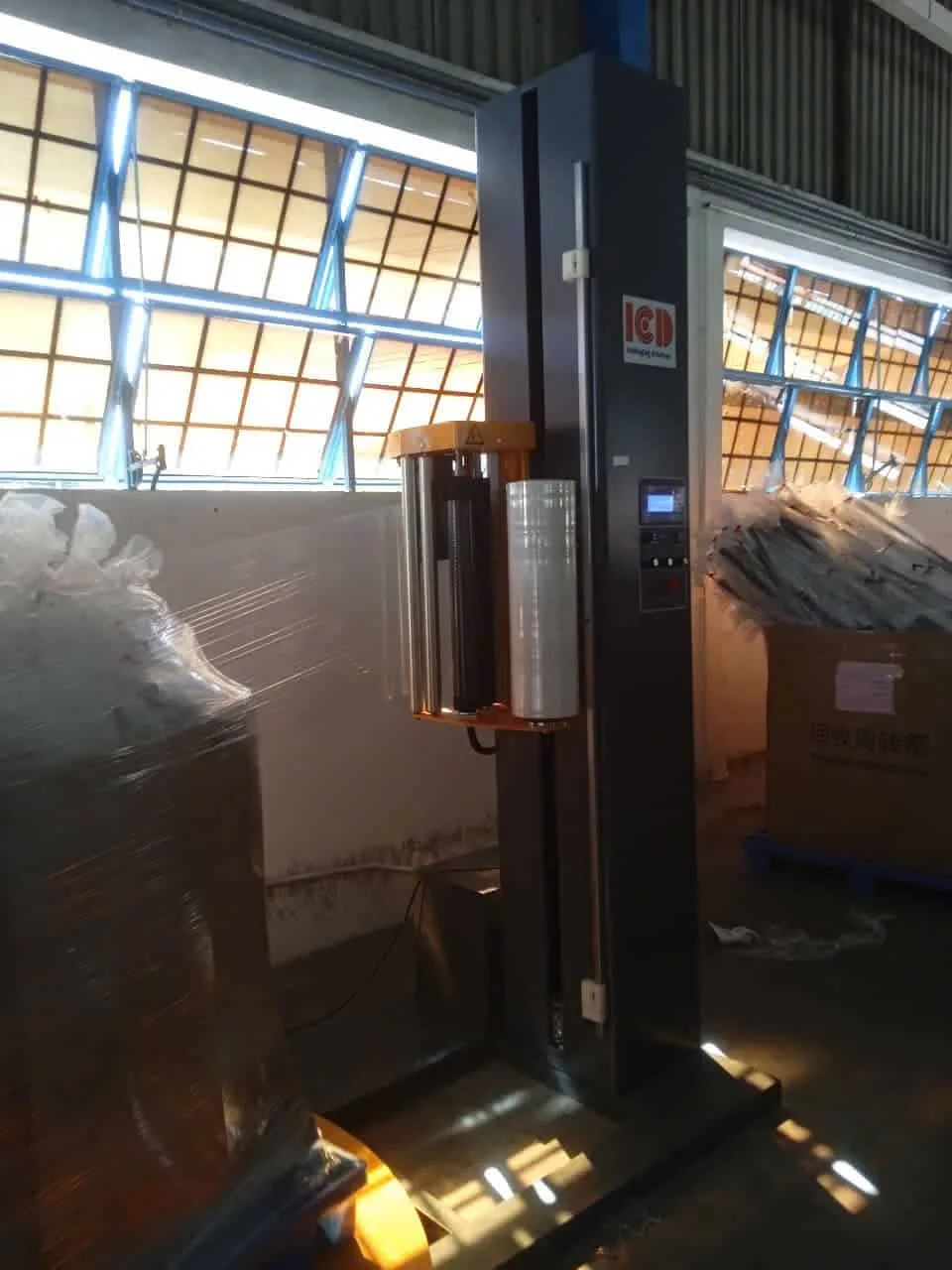
If the film still snaps after the two steps above, check three more points. Does the tension roller have a chipped, sharp edge: run a hand along the roller and replace it if there is a sharp spot. Is the roll edge dented from a drop or a knock in transit: film that repeatedly snaps at the same edge points to this. Last, poor-quality film with many weak points in the roll: try a roll from a different batch to compare. For loads with sharp corners, use corner protectors before wrapping.
Fault 2: Uneven wrapping, gaps at the corners
Film that leaves gaps in bands or exposes the corners of the carton is usually caused by the carriage lift speed not matching the table rotation speed: the carriage rises too fast during each turn of the table, so each wrap overlaps the previous one too little. The fix is to reduce the carriage rise speed (on a semi-automatic machine, raise the column more slowly); keeping the lift speed and lowering the table speed gives even less overlap. Run a test pallet and look at all four sides to be sure there are no gaps between wraps.
The base and top of the pallet need extra reinforcing wraps. On the control panel these two settings are usually the number of bottom wraps and top wraps; setting them to 0 or 1 is a common reason loads slide off the pallet even though the body of the load looks sealed. For light, tall loads, run the table slowly so the film does not push the load, and lower the carriage speed to match.
Fault 3: The machine vibrates heavily when running
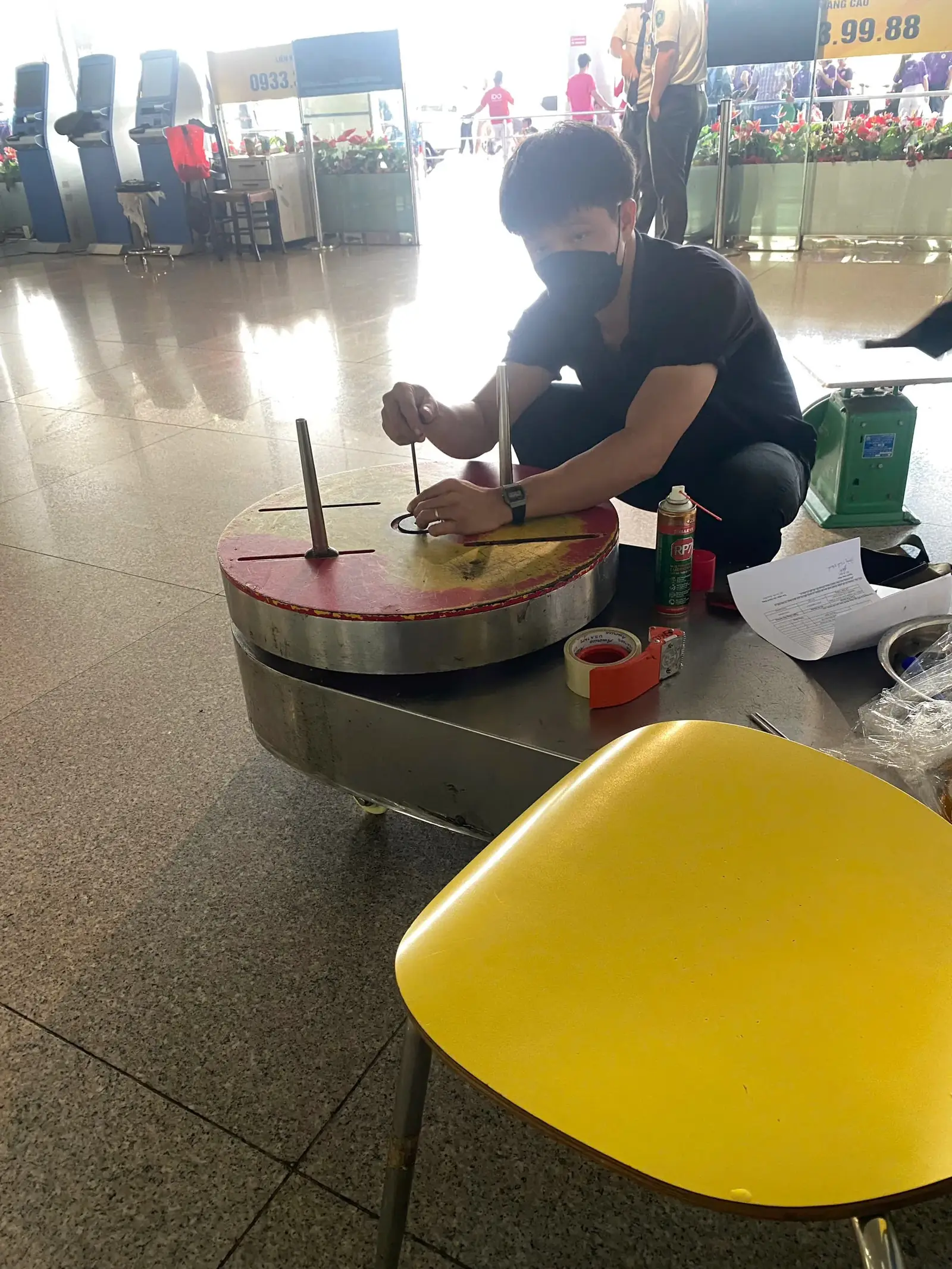
The main cause is a pallet placed off-centre on the rotary table, creating an eccentric force as it turns. First check and re-centre the pallet, and check whether the pallet weight exceeds the table’s rated load: the ICD-T1650FM takes 1,000 kg; the Y1650F, X0MS and X0PS take 1,500 kg; the T1650F, T1650FZ and 2000BF take 2,000 kg.
If it still vibrates after centring, check whether the drive belt is loose or worn, whether the bolts holding the table to the frame are loose, and whether the machine stands on a flat floor. On the ICD-Y1650F with 4 wheels for moving, one bad wheel can also shake the whole table, so check the wheels before removing the table. Do not keep running the machine while it vibrates heavily: stop and deal with it at once.
Fault 4: The table motor overheats
A motor getting warm during continuous running is normal; the worry is when the motor is much hotter than usual, with noise, a burning smell or the machine cutting out by itself. Then check in this order: does the pallet exceed the table’s rated load (reduce the load or the speed), is the motor cooling fan clogged with film dust (dust clogging the fan is a common cause), and has the machine been running continuously for many hours without a rest.
Continuous running time and rest time for the motor follow the guide supplied with the machine, because each model has a different motor rating; for example the table motor of the ICD-T1650FM is 0.75 kW, while the R1800FZ-PL uses a 1.5 kW motor. If you have reduced the load and cleaned the fan and it is still hot: call a technician to check the motor windings.
Fault 5: The table does not turn or turns weakly
A table that will not turn is mostly caused by a safety step blocking the machine, so check in order from easy to hard:
- Has the circuit breaker tripped.
- Is the EMERGENCY STOP button pressed (twist it to release).
- Is the inverter showing an error on the screen (note the error code to report to a technician).
- Is the drive belt broken or slipped off (look through the gap under the table).
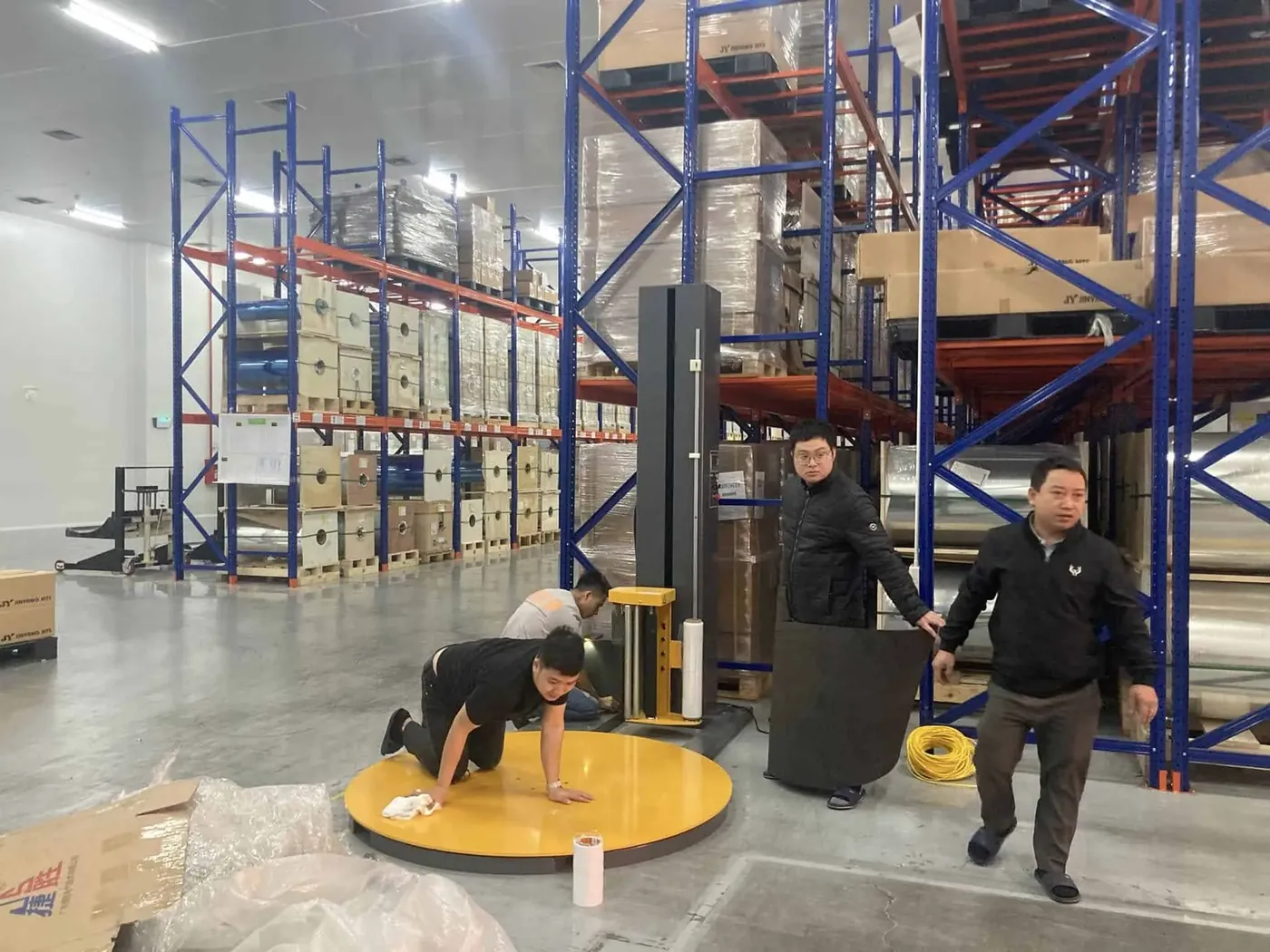
The opposite fault, where the table keeps turning without stopping or the carriage does not stop at the top of the load, is common on machines with a photoelectric switch that measures the load height itself, such as the ICD-X100, T1650FZ and T1800FZ. A sensor eye covered in film dust or knocked out of line will not detect the top of the load: wipe it clean with a soft cloth, no strong chemicals, then test run.
Fault 6: PE film does not cling to itself
PE stretch film clings to itself through the natural tack of the film surface, not through glue; in many films this tack comes from a tackifier additive such as PIB (polyisobutylene), which the ASTM D4649 guide lists among stretch film materials. So film that does not cling is usually due to dust or oil on the film surface (change to a new roll), or a roll fitted backwards so the cling side faces outward.
ASTM D4649 advises the cling side to face the load so that packages do not stick to each other. A roll kept too long or in a hot warehouse also loses tack: use fresher rolls, store in a cool, dry place, and rotate stock so older rolls are used first. If it still does not cling, switch to a roll from a different batch to rule out poor-quality film.
Temperature also affects pallets that have already been wrapped. In a 30-day test by RIT (USA) on 20.3-micron machine film, the film’s holding force fell by an average of 41% when the load was kept at 38°C, compared with 26% at 23°C. Hot summer warehouses in Vietnam are a reason to recheck the tightness of pallets stored for a long time before shipping.
Fault 7: The film carriage will not rise
On a semi-automatic machine: check whether the column raise and lower control switch works. On an automatic machine: check the column position sensors (usually limit switches at the bottom and top of travel). A common cause after the machine has just been moved or has vibrated a lot is a loose wire from the film column controller at the control box: switch off the power, then recheck the plugs.
Lubricate the column slide rail if the column runs heavily. If the column runs heavily but is not jammed: grease the rail right away, because left too long the carriage will rise and fall with jerks and cause uneven wrapping as in fault 2.
Fault 8: The machine will not start even though the power is on
First check that the machine is getting the right type of power supply, because each model uses a different supply. Then check whether a fuse in the electrical cabinet has blown, the power key is on, the EMERGENCY STOP button is released, and whether a timer or safety sensor is reporting a fault (read the indicator lights on the control panel).
A machine with a pneumatic film clamp such as the ICD-T1650FZ needs an air supply of 0.4-0.8 MPa; if the compressor is off or the pressure has dropped, the automatic film clamp and cut cycle will not run even though the machine has power. If you cannot find the cause: call ICD Vietnam technical support, and do not open the electrical cabinet yourself unless you have electrical knowledge.
Quick reference: fix it yourself or call a technician
The table below groups the 8 faults by what the operator can check and the sign that it is time to call a technician.
| Fault | Operator checks | Call a technician when |
|---|---|---|
| Snapping film | Lower tension 1-2 steps, change to the right machine roll, check the rollers and roll edge | Rollers or the pre-stretch unit are worn and a part must be replaced |
| Uneven wrapping, gaps at the corners | Adjust table and carriage speed, increase base and top wraps | The carriage rises and falls with jerks even after greasing |
| Vibration | Re-centre the pallet, check the load, wheels, belt, bolts | Vibration with a metallic noise after the steps above |
| Motor overheating | Reduce load, clean the fan, let the machine rest | Burning smell, squealing, machine cutting out |
| Table not turning | Breaker, emergency stop, drive belt | Inverter shows an error code |
| Film not clinging | Change to a clean roll, fit with the cling side correct, use a fresher roll | No machine technician needed, change the film batch |
| Carriage not rising | Switch, wire plugs, rail grease | Limit switch or column motor faulty |
| Not starting | Right type of supply, fuse, power key, battery, air pressure | Cause unclear, electrical cabinet must be opened |
What to prepare when you call a technician
Having the machine model, purchase date, inverter error code and a short video taken when the machine shows the fault helps the technician narrow it down by phone, and in many cases the fix can be guided remotely.
Pallet stretch wrapping machines carry a 12-month warranty from the date of sale under the ICD Vietnam warranty and repair policy; during this period, report to a technician before taking apart any electrical parts yourself.
See also the consequences of using a stretch wrapper incorrectly to understand why correct operation matters not only for the machine but for the goods. The preventive maintenance schedule is in the guide to periodic stretch wrapper maintenance.
Frequently asked questions
How many common faults does a pallet stretch wrapper have?
8 common faults: snapping film, uneven wrapping, vibration, overheating motor, table not turning, film not clinging, carriage not rising, machine not starting.
What is the most common cause of PE film snapping while wrapping?
Film tension set too high for the film thickness: lower the tension by 1-2 steps on the adjuster, and check that you are using the right machine roll (such as the ICD-MPE150 or MPEM, 20-30 microns thick, 76 mm core) and not a 17-micron hand roll.
Which faults can I fix myself and which need a technician?
You can fix yourself: snapping film, uneven wrapping, film not clinging. Call a technician for: inverter fault, motor noise, abnormal vibration after the pallet has been checked.
How hot can the wrapper motor get before I must stop the machine?
A motor that is warm during continuous running is normal. Stop the machine when the motor is much hotter than usual with squealing, a burning smell or the machine cutting out; reduce the load, clean the cooling fan, and if it is still hot call a technician to check the windings.
Why does a battery-powered stretch wrapper not power up?
Usually the battery is not fully charged. The ICD-XT4512 mobile rotary-arm machine uses 4 x 12 V 20 Ah batteries and needs a 10-12 hour charge; the Maxgo robot uses 2 x 12 V 107 Ah batteries and an 8-10 hour charge for about 8 hours of running. Charge fully, then check the emergency stop button and fuse.

Is film that loosens after a few days in storage a machine fault?
Not necessarily. Stretch film relaxes gradually after wrapping, losing most of its holding force in the first few hours, and faster in a hot warehouse: RIT’s test measured a 41% drop after 30 days at 38°C, compared with 26% at 23°C. Add reinforcing wraps at the base and top, and recheck pallets stored for a long time before shipping.
Urgent technical support contact
- Technical hotline, Northern Vietnam: 0983 797 186 | 090 345 9186
- Technical hotline, Southern Vietnam: 098 6784 186
- All ICD models: ICD pallet stretch wrapping machines
- Email: sales@icdvietnam.com.vn
- Hanoi warehouse: 3rd Floor, Thang Long A1 Building, Bau Hamlet, Thien Loc Commune, Hanoi. Southern workshop: 551/212 Le Van Khuong Street, Tan Thoi Hiep Ward, District 12, Ho Chi Minh City.
References
- ASTM D4649 Standard Guide for Selection and Use of Stretch Wrap Films, ASTM International (stretch film materials, PIB tackifier, cling side orientation).
- Wyns, Cook, Dunno (2018), Post-wrapping behavior of high-performance stretch film, Journal of Applied Packaging Research (secondary stretch and film breakage).
- Dunno, Symanski (2021), Evaluation of stretch film behavior during long-term storage under different atmospheric conditions, Journal of Applied Packaging Research (holding force at 23°C and 38°C).
- Stretch wrap, Wikipedia (LLDPE material, types of wrapping machine).
- EN 415-6:2013 Safety of packaging machines, Part 6: Pallet wrapping machines (safety requirements for operating and maintaining pallet wrappers).
- Warranty and repair policy, ICD Vietnam (pallet stretch wrapping machines, 12 months).
- Technical specifications of wrapping machines and PE film on the ICD Vietnam product pages, checked in October 2026.