Table of Contents
- Why does proper maintenance matter?
- Should you schedule maintenance by running hours or by calendar?
- Safety before maintenance: switch off and lock out the power
- Quick check before each shift
- 40-hour milestone (about 1 week for a one-shift warehouse)
- 200-hour milestone (about 1 month for a one-shift warehouse)
- 2,000-hour milestone: check wear and safety devices
- 5,000-hour milestone: replace worn parts
- Parts to replace regularly and keep in stock
- Notes specific to automatic machines and wrapping robots
- Signs you should call technical support right away
- ICD warranty and technical support policy
- Frequently asked questions
- What milestones does the stretch wrapper maintenance schedule have?
- What are the 3 most important points to maintain on a stretch wrapper?
- How long will a stretch wrapper last with proper maintenance?
- Do you need to switch off the power just to clean a stretch wrapper?
- What grease should be used to lubricate a stretch wrapper?
- Should you oil the pre-stretch rollers?
- How often should the turntable belt be replaced?
- Does a stretch wrapper need its gearbox oil changed?
- Contact technical support
- References
Reviewed and updated by ICD - Week 43/2026
Stretch wrapper maintenance should follow running hours: the Robopac Masterplat manual sets milestones at 40 hours (clean the machine, drain the air filter), 200 hours (wipe the rubber rollers with alcohol, grease the chains, check the gearbox oil), 2,000 hours (check chain wear and safety devices) and 5,000 hours (replace wheels and gearbox oil). Every task is done only after the machine is switched off and the compressed air is released.
- Maintenance milestones are counted in running hours or cycles, not by feel: 40 hours, 200 hours, 2,000 hours, 5,000 hours (Robopac Masterplat Plus / TP3 manual).
- A one-shift warehouse: 40 hours is about 1 week and 200 hours about 1 month; a 2-3 shift warehouse reaches each milestone 2-3 times sooner.
- Wipe the rubber pre-stretch rollers with alcohol; never put oil or grease on the roller surface.
- Before any work: switch off the breaker, lock out and tag out, release compressed air.
- ICD Vietnam technical support: 0983 797 186 (North) | 098 6784 186 (South). Stretch wrappers carry a 12-month warranty.
A pallet stretch wrapper is much simpler than many other packaging machines, but it runs continuously in a dusty warehouse with vibration and heavy loads. Skipping scheduled maintenance lets small faults pile up until the machine stops suddenly just when the warehouse needs to ship. This guide gives a maintenance schedule based on the running-hour milestones published by the machine maker, with how to carry out each task.
I am Le Van Thang, working with stretch wrappers and packaging supplies at ICD Vietnam since 2011. Most breakdowns we are called to fix do not start with a major fault but with a small job that was forgotten: dry chains, film glue on the rollers, a filter full of water. That is why the schedule below puts the jobs that are quick but often skipped first.
Why does proper maintenance matter?
Proper maintenance keeps the turntable rotating smoothly and the film tension stable, and stops small faults (slack belts, dry bearings, loose wire terminals) from becoming failures that halt the warehouse for days.
To understand each part that needs maintenance, see the detailed analysis of the structure and operating principle of a pallet stretch wrapper.
Should you schedule maintenance by running hours or by calendar?
Schedule it by running hours or wrap cycles. The Robopac Masterplat Plus / TP3 manual states each milestone in both units (40 hours or 1,000 cycles, 200 hours or 5,000 cycles, and so on), taking as the standard cycle a pallet 1,500 mm high weighing 1,500 kg, 500 mm wide film, 2 turns at the base and 2 at the top, turntable at 12 rpm.
A one-shift warehouse and a three-shift warehouse have the same number of weeks but machine hours that differ threefold, so a “once a month” schedule can be too frequent for one and too sparse for the other. The table below is my conversion of the manual’s hour milestones into real time, assuming the machine runs 8 hours a shift, 6 days a week; if your warehouse runs more or less, recalculate from actual hours.
| Manual milestone | 1-shift warehouse (48 hours/week) | 2-shift warehouse (96 hours/week) | Main tasks |
|---|---|---|---|
| 40 hours / 1,000 cycles | About 1 week | About 2-3 days | Clean the machine, drain water and clean the air filter |
| 200 hours / 5,000 cycles | About 1 month | About 2 weeks | Wipe rollers with alcohol, grease and adjust chains, check gearbox oil |
| 2,000 hours / 10,000 cycles | About 10 months | About 5 months | Check chain wear, check safety devices |
| 5,000 hours / 50,000 cycles | About 2 years | About 1 year | Replace turntable and film carriage wheels, replace gearbox oil |
The simplest tip is to stick a notebook beside the control cabinet and, at the end of each shift, write down the machine hours, or read the cycle counter on the screen if the machine has one. When the running total reaches a milestone, the person in charge does that milestone’s group of tasks.
Safety before maintenance: switch off and lock out the power
Every cleaning, greasing, or belt adjustment job must be done with the machine switched off and the power locked out. The OSHA hazardous energy control rule (29 CFR 1910.147) requires lockout and tagout at the breaker so nobody switches the machine on by accident while another person is working in the turntable zone or under the film carriage. The Robopac manual also states clearly that maintenance may be done only when the machine is disconnected from the electrical and compressed air supply, by a trained person.
- Stop the cycle and lower the film carriage to its lowest point: a carriage hanging high can fall when a belt or chain is removed.
- Switch off, open the main breaker, lock out and tag out: stops anyone else from starting the machine while you work.
- Release compressed air on machines with pneumatics: clamp and film-cut cylinders can still kick while under pressure.
- Press the start button to confirm the machine does not run: verify that the power is truly isolated.
- Wait for the turntable and motor to stop completely and cool down: avoids trapped hands and burns from touching the motor housing.
Quick check before each shift
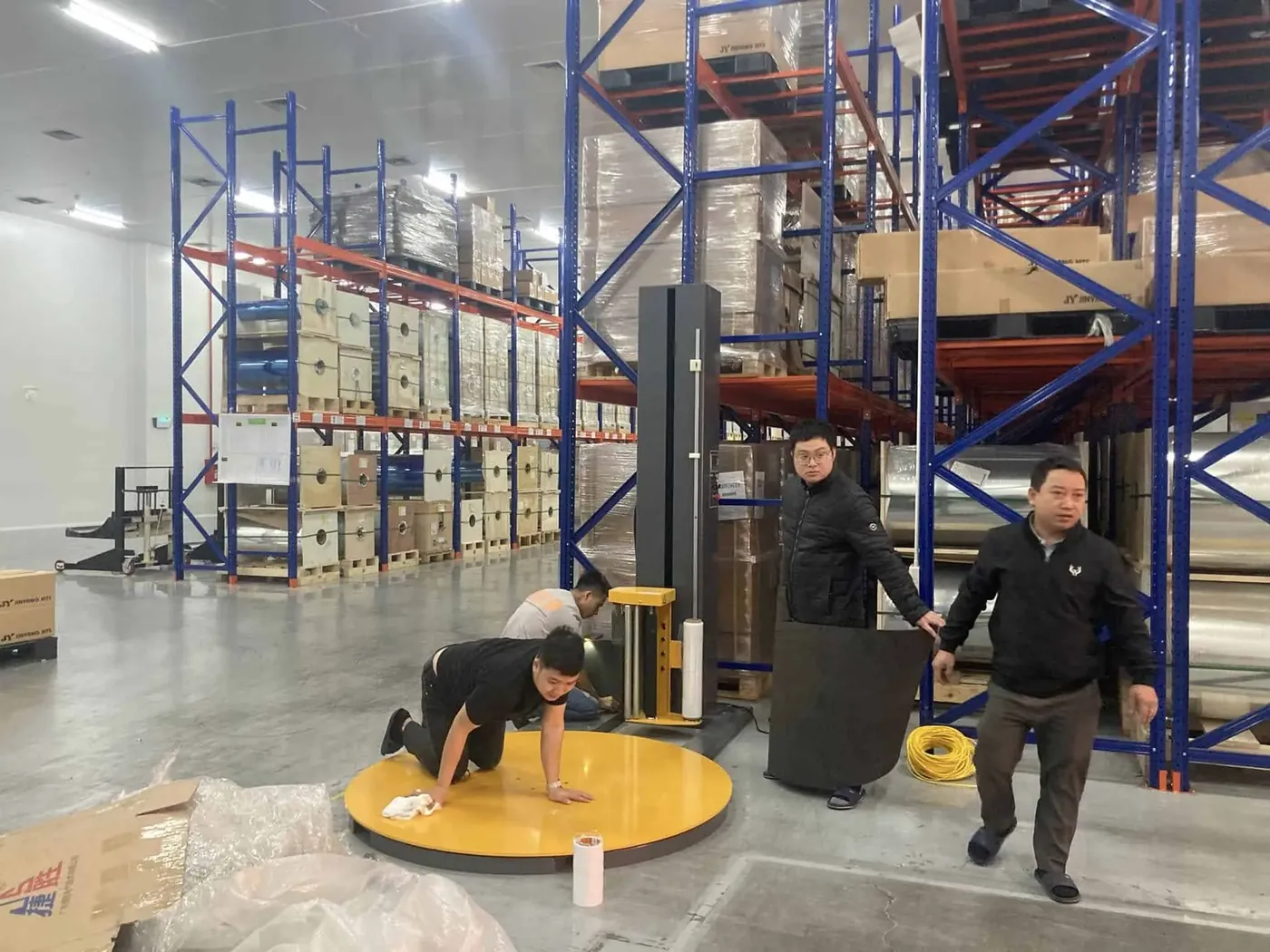
Before each shift, the operator needs only a few minutes of looking and testing to catch major faults early: the emergency stop works, the sensors are clean, no film is wound around a shaft, the film roll is mounted the right way round. This is not in the manufacturer’s hour-milestone table, but in our experience it is the step that catches the most faults early.
40-hour milestone (about 1 week for a one-shift warehouse)
At 40 hours the main job is cleaning: wipe dust and film scraps off the whole machine, drain standing water from the compressed air filter, and clean the filter element. The Robopac manual says to wipe with a cloth or blow with air, and to clean the filter element with an air jet and alcohol.
Wipe dust and scraps of PE film stuck to the turntable, the film mast, and the rollers. Dust building up on the rollers changes the friction and affects film tension. Visually check the drive belt for cracks, frayed edges, or slack or tight tension.
Check the bolts connecting the turntable to the frame: constant vibration can loosen bolts after a few weeks if they are not checked.
200-hour milestone (about 1 month for a one-shift warehouse)
The 200-hour milestone is for lubrication and tension: wipe the rubber rollers of the pre-stretch carriage with alcohol, grease and check the tension of the carriage lift chain, grease and check the tension of the turntable drive chain, check the gearbox oil level, and grease the pre-stretch carriage gears.
The rubber rollers are where film glue builds up most. A layer of glue makes the film slip on the roller, the real stretch ratio falls below the setting, and the film breaks easily. Wipe with alcohol until the rubber surface is clean with no oily film, then let it dry before threading the film again.
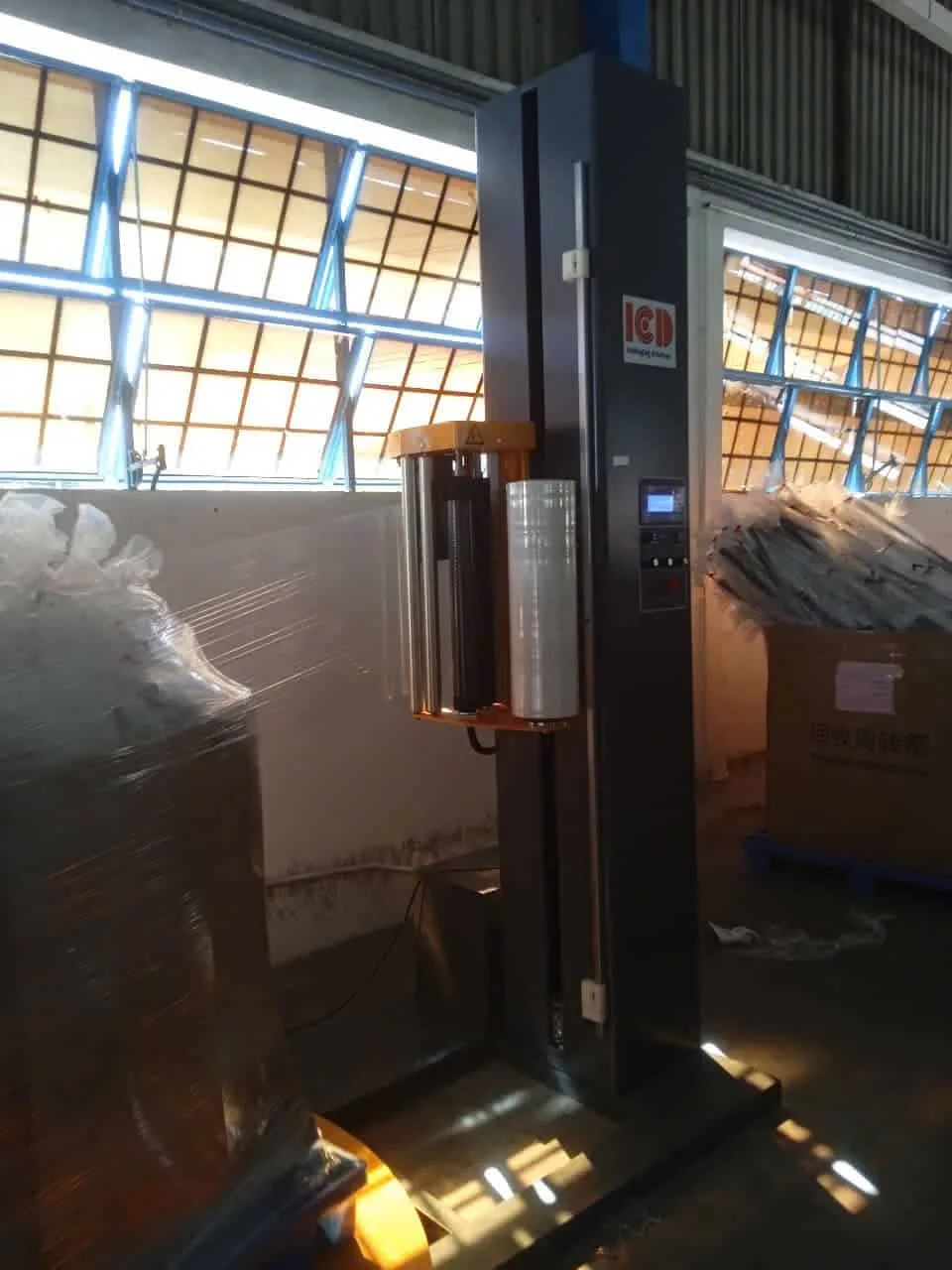
Beyond the points in the manual, apply industrial grease to the film mast slide rails and oil to the pivot of the tension-adjusting roller.
NLGI #2 is a grease consistency grade on the scale of the NLGI, a medium consistency widely used for bearings and slide rails. The Robopac manual uses lithium-based grease for bearings (for example Shell Alvania R2, Esso Beacon 2, Mobilux), gear oil of 320 cSt viscosity for the gearbox (460 cSt for worm gearboxes), and chain oil from VG68 to VG220 depending on ambient temperature; do not mix different oils. Apply it only to bearings, pivots, slide rails, and chains; never put it on the rubber roller surface of the pre-stretch unit, because the rollers need friction to pull the film and grease will transfer onto the PE film.
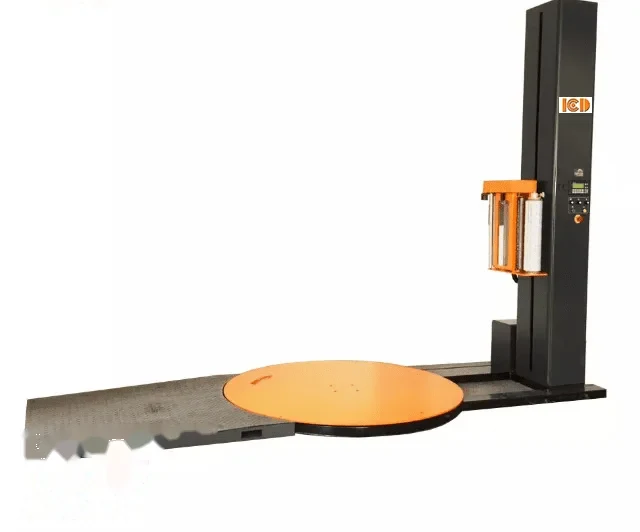
Chain tension is adjusted to the specified tightening torque of each model. For the Masterplat line, the manual gives the torque when adjusting the carriage lift chain tension as 3 Nm and the turntable drive chain as 5 Nm (the TP version is 3 Nm). Machines from other makers have their own figures, so check the manual supplied with the machine before adjusting.
Check the motor: touch the motor housing after the machine has run continuously for a while; if it is unusually hot compared with earlier times, see whether the cooling fan is clogged with dust. Check the inverter: see whether its display shows any fault and wipe dust off its ventilation openings.
Check electrical connections: look inside the control cabinet to see whether any wire terminals are loose or any wires exposed.
For machines that clamp and cut film with compressed air (for example the ICD-T1650FZ, which works at 0.4-0.8 MPa according to its product page), at each maintenance visit drain standing water from the air filter, check that the gauge pressure is within this range, and listen for air leaks at the fittings. Pressure below this range stops the film clamp from gripping the film tail firmly.
2,000-hour milestone: check wear and safety devices
At 2,000 hours (10,000 cycles), the Robopac manual requires checking wear on the carriage lift chain and the turntable drive chain, and testing the effectiveness of safety devices such as the emergency stop, limit switches, and the carriage fall-prevention device. This round needs someone with electrical and mechanical skills, or a call to the ICD technical team.
For a 2-shift warehouse this milestone comes after about 5 months, so many warehouses combine it into one general inspection every six months, together with the tasks below.
Check the drive belt: measure tension by pressing on the middle of the belt. For a belt span of about 640-960 mm, a reasonable deflection is about 10-15 mm. Replace the belt if you see cracks or an unusually rough surface.
Check the rollers: turn each roller by hand and look for any roller that turns unusually hard (a failed bearing) or makes strange noise. Check the control panel: test each button, check the indicator lights, and recalibrate the position sensor if there is one.
Check all bolts and nuts: use a wrench to check and retighten to the specified torque.
After the general inspection, run the machine unloaded for a few cycles, then wrap one sample pallet: the turntable must turn smoothly, the film carriage must move up and down freely, the film must stretch evenly with no wrinkles or breaks, and the machine must stop at the right position. Record the result in the maintenance log to compare next time.
5,000-hour milestone: replace worn parts
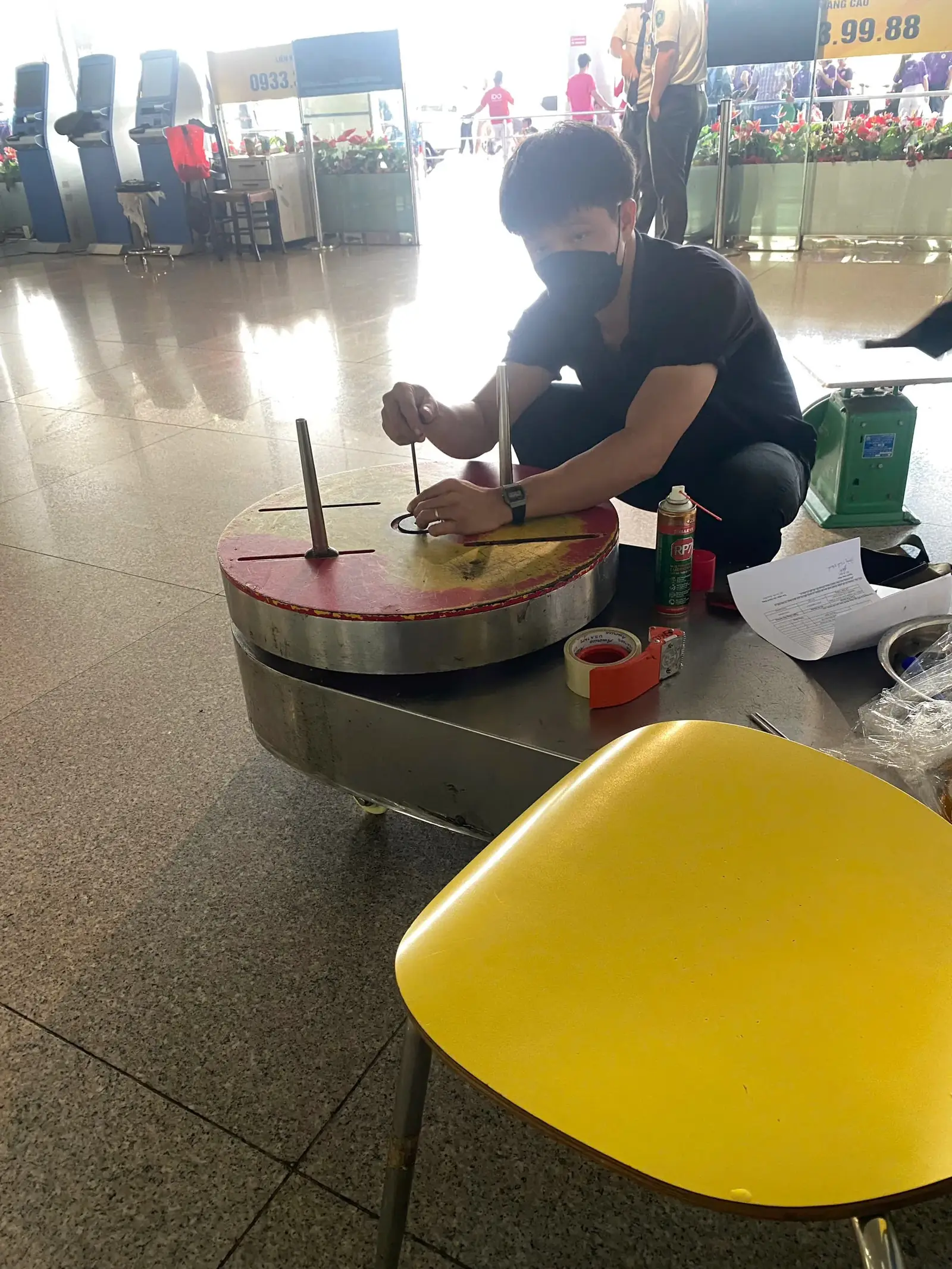
The 5,000-hour milestone (50,000 cycles) is when parts are replaced, not just checked: the Robopac manual requires replacing the turntable support wheels, replacing the carriage lift wheels, and changing the gearbox oil, except for gearboxes that are lubricated for life. For a one-shift warehouse, this milestone arrives after about 2 years by the conversion above.
Worn turntable support wheels make the turntable run off-center, vibrate, and squeal; worn carriage lift wheels make the carriage jerk up and down and leave an uneven wrap. These two signs can appear before the milestone if the machine often wraps pallets heavier than the standard 1,500 kg cycle, so check the wheels as soon as you see the turntable vibrate, without waiting for the hours.
Parts to replace regularly and keep in stock
Parts with a clear replacement milestone in the manual are the turntable support wheels, the carriage lift wheels, and the gearbox oil (5,000 hours). Belts, bearings, sensors, the inverter, and the film mast wiring are replaced according to actual condition. The Masterplat manual also lists spare parts to keep at the warehouse so you do not have to stop the machine waiting for supply:
| Part | When to replace | Signs it needs earlier replacement |
|---|---|---|
| Turntable support wheels | 5,000 hours (manual suggests keeping 14 twin wheels as spares) | Turntable vibrates, squeals, runs off-center |
| Film carriage lift wheels | 5,000 hours (keep 8 wheels as spares) | Film carriage jerks up and down |
| Gearbox oil | 5,000 hours, except lubricated-for-life types | Low oil level, noisy gearbox |
| Roller brake pads (carriages with a brake) | According to condition (keep 1 set as spare) | Weak, unstable film tension |
| Drive belt | According to condition (keep 1 belt as spare for the pre-stretch carriage) | Cracks, frayed edges, slipping |
| Roller bearings | According to condition | Noise, hard to turn |
| Film mast wiring | According to condition | Exposed insulation, hidden breaks |
| Position sensor | When it fails | Machine does not stop at the right position |
| Inverter | When it fails | Frequent fault alarms |
Notes specific to automatic machines and wrapping robots
Automatic machines and robots have extra assemblies that semi-automatic machines do not, so the schedule needs a few more jobs. For a self-propelled wrapping robot, the Robopac Wrapman manual sets external cleaning every 38 hours; every 320 hours, oil the endless chain and check the carriage fall-prevention system, the emergency stop, the brake, and the roller chain tension; every 2,000 hours, or at least once a year, a major service done by a manufacturer-trained technician.
| Machine type | Extra assembly to watch | What to do |
|---|---|---|
| Automatic with pre-stretch | Two rubber pre-stretch rollers | Wipe film glue off with alcohol at 200 hours, check wear, never oil the roller surface |
| Automatic with film clamp and cutter | Film clamp, cutting knife, pneumatic cylinder | Clear film jammed in the clamp, check the cutting blade, drain the air filter |
| Battery-powered robot (ICD-Maxgo) | 2 x 12V 107Ah batteries, guide wheels | Charge fully for 8-10 hours per the specification, never let it run flat; clean the guide wheels |
| Machine with a conveyor (T1800FZ) | Conveyor rollers, drive chain | Grease the chain, check that rollers turn freely and are not warped |
For these machines, record the running hours and the number of pallets wrapped each month, because maintenance milestones by operating hours (40 hours, 200 hours) are closer to reality than calendar milestones when the warehouse runs multiple shifts.
Signs you should call technical support right away
Do not repair these faults yourself; stop the machine and call ICD technical support: turntable vibrating abnormally even though the pallet is centered; the inverter showing fault alarms continuously; the motor making strange noise (especially metallic knocking); the control panel not responding; a burning electrical smell from the control cabinet.
The Robopac manual also classifies clearly: an inverter fault (code E30 on the Masterplat line) is in the group where you must contact technical support, while a film break alarm (E60) is an operator-level fault you can fix by rethreading the film and checking the rollers.
See also common faults when using a stretch wrapper and how to tell faults you can fix yourself from those that need a technician.
ICD warranty and technical support policy
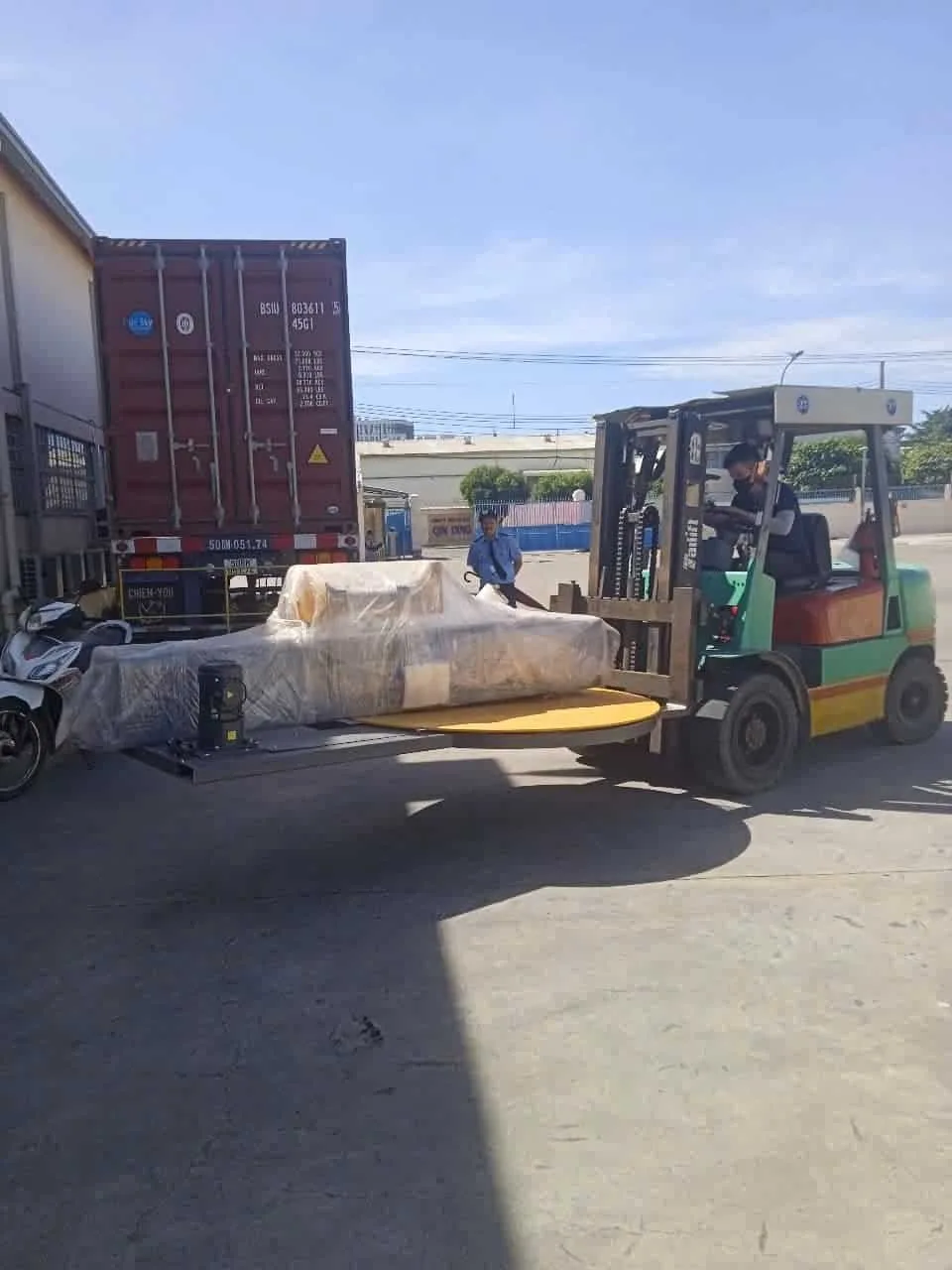
ICD Vietnam stretch wrappers carry a 12-month warranty under the warranty and repair policy published on the website. The T1650F and other ICD models use standard parts such as chains, wheels, belts, and bearings, which are convenient to replace when a milestone arrives. During the warranty period, keep a full maintenance log by the milestones above: when the machine has a problem, a log of running hours and work done helps the technician find the cause faster.
Frequently asked questions
What milestones does the stretch wrapper maintenance schedule have?
According to the Robopac Masterplat Plus / TP3 manual: 40 hours (clean, drain the air filter), 200 hours (wipe rollers with alcohol, grease and adjust chains, check gearbox oil), 2,000 hours (check chain wear and safety devices) and 5,000 hours (replace wheels and gearbox oil), plus a quick check before each shift.
What are the 3 most important points to maintain on a stretch wrapper?
The drive belt and chains, the film-adjusting rollers (including the rubber pre-stretch rollers), and the control panel together with the safety devices.
How long will a stretch wrapper last with proper maintenance?
Manufacturers do not publish one general lifespan figure for all machines, because lifespan depends on running hours, pallet load, and the warehouse environment. The Robopac manual sets replacement of the turntable wheels, carriage wheels, and gearbox oil at 5,000 hours, meaning the machine is designed to run through many replacement cycles of worn parts if maintained at the right milestones.
Do you need to switch off the power just to clean a stretch wrapper?
Yes. Even wiping the turntable or clearing jammed film from the rollers requires switching off the machine, opening the breaker, and locking out the power, because the turntable and film carriage can move unexpectedly. This is required by the OSHA hazardous energy control rule 29 CFR 1910.147; the Robopac manual adds the requirement to cut off the compressed air supply.
What grease should be used to lubricate a stretch wrapper?
Lithium-based industrial grease of NLGI grade 2 suits the film mast slide rails, bearings, and shafts; chains use chain oil from VG68 to VG220 depending on temperature, and the gearbox uses gear oil as specified in the manual. If the machine’s own manual states a different type, follow the manual, and do not mix different oils.
Should you oil the pre-stretch rollers?
No. The pre-stretch rollers need friction with the film to stretch it; grease makes the film slip, the pull is insufficient, and it also transfers dirt onto the load. The Robopac manual says to wipe the rubber roller surface with alcohol at the 200-hour milestone; grease only the bearings and gears of the pre-stretch carriage.
How often should the turntable belt be replaced?
Replace it according to condition: when the belt is cracked, frayed at the edges, glazed, or slips when the turntable is heavily loaded. Keep one spare belt, as the Robopac manual recommends. After fitting a new belt, check the tension again after the first few days of running because a new belt stretches quickly during this period.
Does a stretch wrapper need its gearbox oil changed?
Yes, except for lubricated-for-life gearboxes. The Robopac Masterplat manual requires checking the gearbox oil level at the 200-hour milestone and changing the oil at the 5,000-hour milestone.
Contact technical support
Send us the machine model, the estimated running hours, and the problem you are seeing; ICD Vietnam will advise what to do and which spare parts to use. Stretch wrappers carry a 12-month warranty.
- See all models: ICD pallet stretch wrapping machines
- Northern Vietnam (Hanoi warehouse): 3rd Floor, Thang Long A1 Building, Bau Hamlet, Thien Loc Commune, Hanoi - 0983 797 186 | 090 345 9186
- Southern Vietnam workshop: 551/212 Le Van Khuong Street, Tan Thoi Hiep Ward, District 12, Ho Chi Minh City - 098 6784 186
- Email: sales@icdvietnam.com.vn
- Quote for a new machine: Request a quote
References
- Robopac Masterplat Plus / TP3 user and maintenance manual (Robopac, maintenance milestones by hours and cycles, lubricants, spare parts, error codes).
- Robopac Wrapman user manual, scheduled maintenance section for wrapping robots (38 hours, 320 hours, 2,000 hours).
- OSHA - Control of Hazardous Energy (Lockout/Tagout), 29 CFR 1910.147.
- Plant Engineering - Tensioning belt drives (force-deflection method, 1/64 inch per inch of span).
- NLGI - National Lubricating Grease Institute, lubricating grease consistency scale.
- PMMI - ANSI/PMMI B155.1 safety standard for packaging machinery.
- Specifications of the ICD-T1650FZ, ICD-Maxgo, and ICD-T1800FZ on ICD Vietnam product pages (accessed October 2026).