
Table of Contents
- What is PE film? Chemistry and polymer chain structure
- PE film types: LDPE, LLDPE, HDPE and other variants
- Key technical properties of PE film
- Uses of PE film by industry
- How PE film differs from other plastic films
- How to choose the right PE film: a 5-point checklist
- What is PE shrink film? Telling shrink film, stretch film and cling film apart
- PE film FAQ
- Contact ICD Vietnam
- References
Reviewed and updated by ICD - Week 43/2026
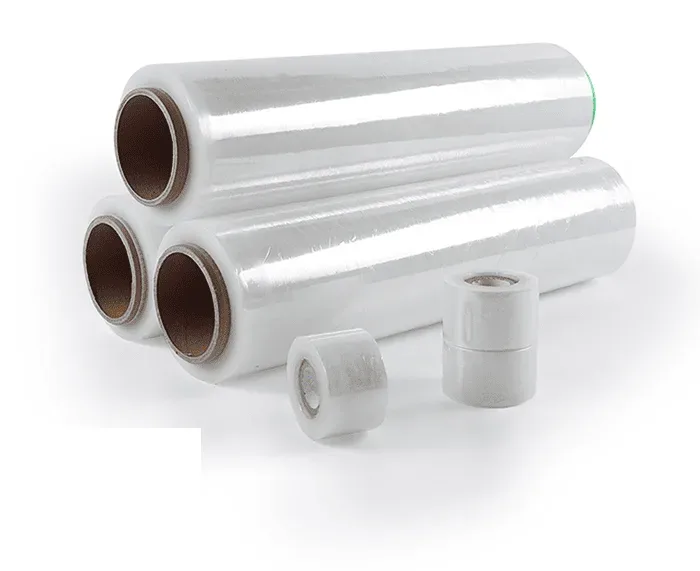
PE film is a plastic film made of polyethylene, produced from ethylene gas polymerized into long chains (-CH2-CH2-)n; the three main types are LDPE, LLDPE and HDPE, which differ in how much the chains branch and in density (0.910 - 0.965 g/cm³). The PE film used to wrap pallets (stretch film) is mostly LLDPE and holds the load through its elastic force once stretched, while “PE shrink film” is heat-shrink film that must be heated before it hugs the product.
Polyethylene is the most produced plastic in the world: according to 2017 figures, more than 100 million tonnes of PE resin are made each year, about 34% of the plastics market. Because it is flexible, absorbs almost no water and is cheap, PE film appears in nearly every stage of packaging, from plastic bags and food wrap to the stretch film rolls used on pallets in warehouses.
Having worked in packaging supplies at ICD Vietnam since 2011, I find the most common mistake is not paying too much or too little for the film, but choosing the wrong type: using heat-shrink film to wrap a pallet, using film that is too thin for sharp-cornered loads, or leaving a wrapped pallet in the sun all day and finding the film slack and the load exposed. This article explains what PE film is, how the PE types differ, which properties are backed by sources, and how to choose film for the job.
What is PE film? Chemistry and polymer chain structure
PE film is a thin film made of polyethylene, a polymer containing only carbon and hydrogen with the general formula (C2H4)n. During polymerization the double bond in the ethylene molecule opens and the units join end to end into a very long chain, where n can reach tens of thousands of units.
What sets the properties of each PE type is the branches that grow off the main chain. The fewer the branches, the more tightly the chains pack together, the more crystalline regions there are, and the denser and stiffer the plastic; the more branches, the looser the packing and the lighter, softer and more flexible the plastic. According to Wikipedia, PE crystallinity ranges from about 35% in LDPE and LLDPE up to 80% in HDPE, and density rises almost linearly with crystallinity.
The production method decides the degree of branching. LDPE is made by free-radical polymerization at high pressure, which creates both long and short branches. LLDPE and HDPE are made at low pressure with Ziegler-Natta, Phillips or metallocene catalysts: HDPE has almost no branching, while LLDPE is copolymerized with added 1-butene, 1-hexene or 1-octene to create many evenly spaced short branches. It is these short branches that make LLDPE both flexible and tough, which is why it stretches well into pallet wrap.
PE film types: LDPE, LLDPE, HDPE and other variants
The three most common PE types used for film are LDPE, LLDPE and HDPE, classified by density and degree of branching. The table below places the commonly used density range next to the main properties and uses of each type.
Besides the types in the table below there is UHMWPE (ultra-high molecular weight, millions of atomic mass units), which is very tough and abrasion resistant and is used for machine parts, artificial joints and bulletproof fibre rather than ordinary packaging film. At the other end, VLDPE (0.880 - 0.915 g/cm³) is softer than LLDPE and is also used in some stretch films.
| PE type | Density (g/cm³) | Chain structure | Main properties | Typical film uses |
|---|---|---|---|---|
| LDPE (Low Density) | 0.910 - 0.940 | Many long and short branches | Soft, the clearest of the three, easy to process | Bags, wrap film, shrink film |
| LLDPE (Linear Low Density) | 0.915 - 0.925 | Nearly straight, many short branches | Better tensile strength, impact resistance and puncture resistance than LDPE; can be made into thinner film | Pallet stretch film, bags, agricultural film |
| MDPE (Medium Density) | 0.926 - 0.940 | Few branches | Better stress-crack resistance than HDPE | Shrink film, sacks, carrier bags |
| HDPE (High Density) | From 0.941 | Almost no branching | Stiff, high tensile strength, less clear | Thin rustling bags, rigid packaging, bottles, pipes |
One point to note: higher density makes the plastic stiffer and stronger in tension but less flexible; lower density makes it flexible and easy to stretch but softer. No PE type is best for every job, only the one that suits how you use it.
Key technical properties of PE film
Five properties make PE film so widely used: it stretches well (in the LLDPE case), absorbs almost no water, resists many chemicals, is lighter than water and can be recycled; its main weakness is poor heat resistance.
Stretches well. LLDPE PE film can stretch to several times its original length before breaking. According to the ICD Vietnam stretch film product pages, film is stretched about 150 - 200% when wrapped by hand; machines with a pre-stretch unit usually stretch 200 - 250% according to the machine catalogs. Elongation at break of each film is measured by the ASTM D882 thin-film tensile test and listed on the film maker’s data sheet; figures vary with the base resin and thickness, so ask for this sheet when you buy.
Stretching decides how many pallets a roll can wrap. Take a 1000 x 1200 mm pallet 1.5 m tall, which needs about 44 m of film around the load. Hand-roll film 17 microns thick and 500 mm wide, with LLDPE density about 0.92 g/cm³, weighs about 7.8 g per metre. If you stretch it 150% when hand wrapping, 1 m of film becomes 2.5 m, so each pallet uses about 17.6 m of roll film, or about 138 g. A roll holding 3.3 kg of film (excluding the core), such as the ICD-MPE38, therefore wraps about 24 pallets; the product page lists 30 - 40 pallets depending on how it is wrapped.
Absorbs almost no water. Polyethylene contains only carbon and hydrogen and has no polar groups to hold water molecules, so according to Wikipedia it absorbs virtually no water and blocks water vapour better than most other plastics. This is why a pallet wrapped in PE film is protected from rain, dust and moisture in transit. On the other hand, non-polar gases such as oxygen and CO2, and odours, pass through PE film fairly easily, so single-layer PE film cannot replace a gas barrier film in food packaging.
Resists many chemicals. According to Wikipedia, most grades of LDPE, MDPE and HDPE are not attacked by strong acids or strong bases and tolerate mild oxidizing and reducing agents. The weak point is strong oxidizers, and at high temperature PE dissolves in aromatic solvents such as toluene and xylene or in chlorinated solvents. If you need to wrap loads containing solvents or strong oxidizing chemicals, ask the film supplier for a chemical compatibility sheet before use.
Poor heat resistance. Commercial LDPE melts at about 105 - 115 °C, MDPE and HDPE at about 120 - 130 °C. But pallet film runs into trouble long before that: film that has been stretched tends to shrink back toward its original state when it warms up, so a pallet left in strong sun for a long time can end up with slack, wrinkled film or tears at the corners. For this reason, do not wrap film around products that are still hot from the oven, and do not leave film rolls in the sun before use.
Light and recyclable. With a density below 1 g/cm³, PE film is lighter than water, so packaging weight per pallet is small. Clean PE film that is collected can be melted and made into recycled resin pellets for other products; film that is dirty or stuck with paper labels is harder to recycle.
Uses of PE film by industry
PE film is used most in logistics to wrap pallets, followed by food packaging, agriculture and construction; each industry uses a different PE type and thickness.
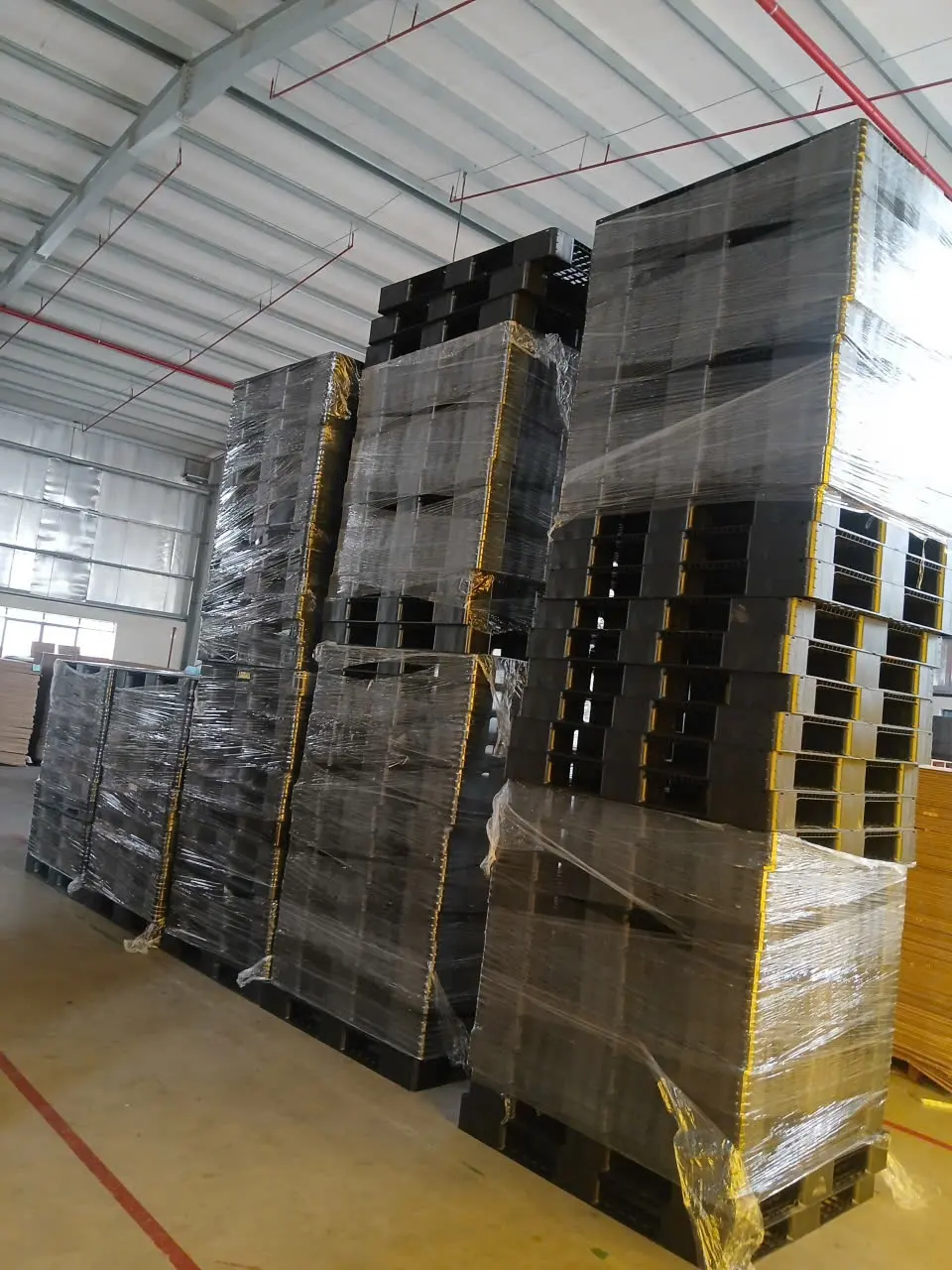
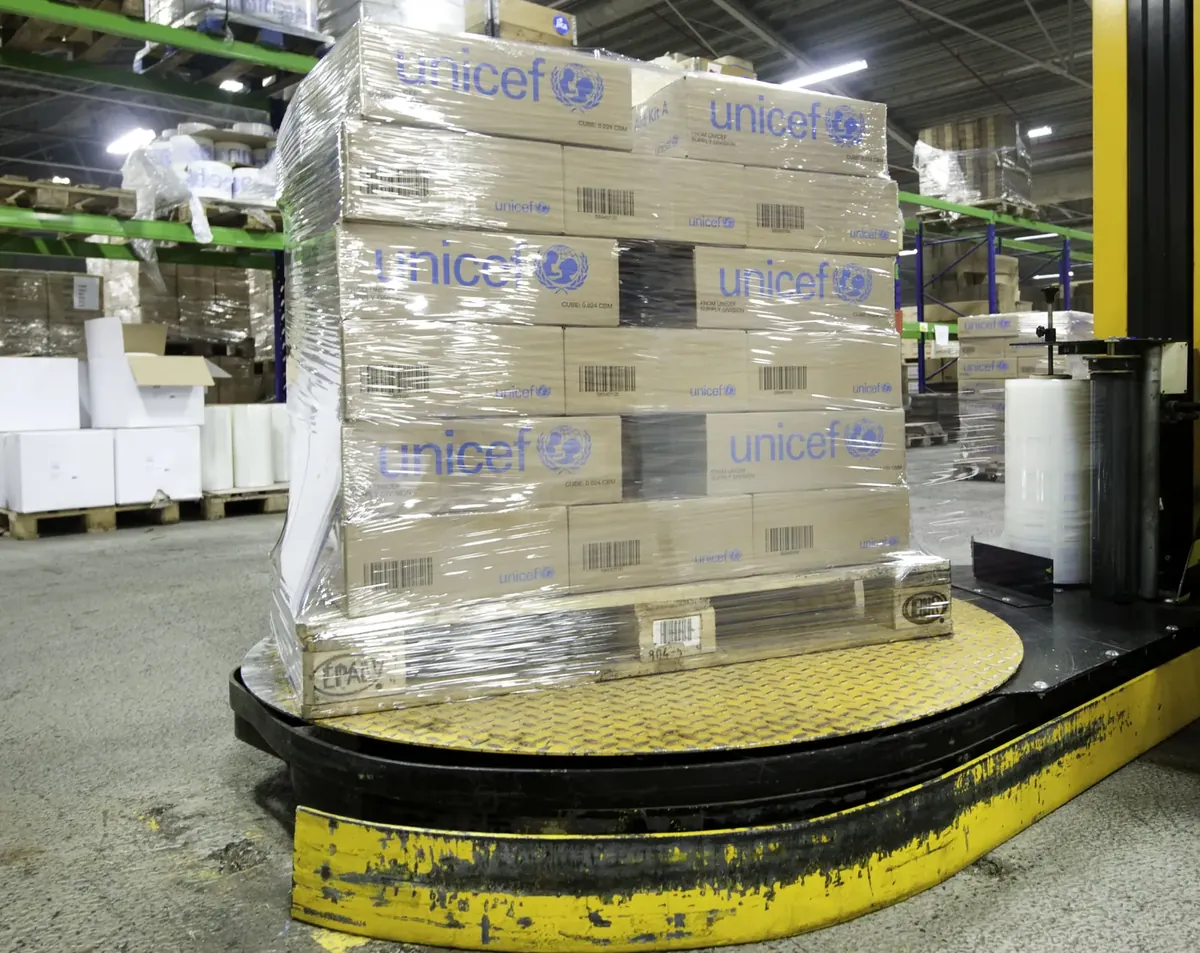
Logistics and warehousing. This is the use I see every day: pallets of goods are wrapped in PE film before loading onto trucks and into containers. Hand rolls suit warehouses with few pallets; high-volume warehouses move to machine rolls. Modern stretch wrapping machines let you set the number of base and top wraps, table speed and stretch ratio, so each type of load gets its own wrapping program; according to the catalogs, the rotary-table machines ICD Vietnam currently sells have a rated output of about 20 - 50 pallets per hour.
Food. Cling film, bags and multipack shrink wrap for drinks can all be made from PE. In Vietnam, plastic packaging in direct contact with food must meet QCVN 12-1:2011/BYT of the Ministry of Health; in Europe it is Regulation (EU) No 10/2011 on plastic materials in contact with food. Industrial pallet film is not made to touch food directly, so do not use it in place of cling film.

Agriculture. PE is used for mulch film, greenhouse film and silage film. Film used outdoors for a long time needs a type that the manufacturer states contains UV stabilizer additives, because ordinary PE film left in the sun quickly turns brittle and yellow; when buying, ask clearly how long the manufacturer commits to outdoor service life.
Construction. Thick PE film is used as a damp-proof layer under concrete slabs and to cover materials and surfaces during works, while much thicker HDPE sheet is used as waterproofing membrane (geomembrane) for ponds and landfills. This is a product group quite different from pallet wrap in thickness and in how it is installed.
How PE film differs from other plastic films
The differences between PE, PVC, PP and PET lie in the atom groups on the polymer chain: PE has only C and H, PVC adds chlorine, PP has methyl groups, and PET is a polyester with an aromatic ring; this leads to differences in flexibility, clarity and heat resistance.
In use: PE is flexible and stretches well, so it is used for pallet wrap, bags, cling film and multipack shrink wrap. PVC film is soft and needs plasticizers, and is common in bottle-label shrink sleeves. PP is stiffer and more heat resistant than PE and is used for OPP film, bags and boxes. PET is very clear and strong in tension but does not stretch like PE, and is used for water bottles, trays and premium printed film.
In short: if you need a flexible, stretchy film to hold a load together, choose PE; if you need a stiffer, clearer, more heat-resistant film, consider PP or PET. PVC is still found in bottle-label shrink sleeves because of its high shrink rate, but since it contains chlorine, many food businesses have moved to polyolefin (POF) shrink film.
How to choose the right PE film: a 5-point checklist
Choosing the right PE film means going through 5 questions: what it is for, which resin and thickness, whether any certification is needed, what the cost per pallet is, and whether the supplier delivers reliably.
- Define the job: for pallet wrapping use LLDPE stretch film; for food wrap use film that meets the food-contact regulation; for multipack shrink use heat-shrink film; for construction waterproofing use thick PE or HDPE sheet.
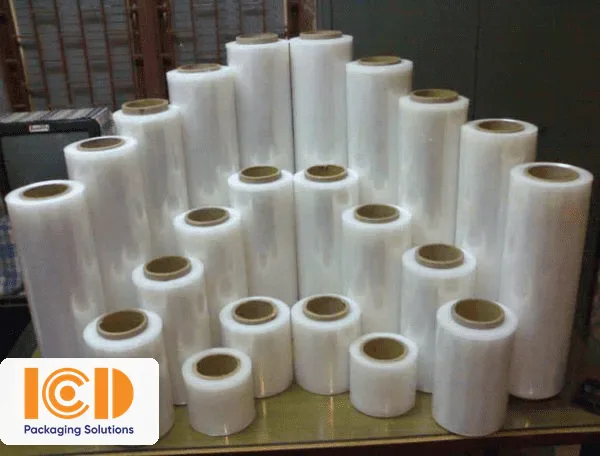
- Choose thickness by load and wrapping method: ICD Vietnam hand rolls are 17 microns for ordinary loads; the MPE150 and MPEM machine rolls are 20 - 30 microns for wrapping machines and for heavy, sharp-cornered loads.
- Check the paperwork: food wrap needs test results to QCVN 12-1:2011/BYT; for goods exported to a market with its own requirements, ask the importer first.
- Calculate cost per pallet, not just price per kg: cheap film that needs more wraps can cost more; ask for a quote with thickness, width and core weight specified (request a quote from ICD Vietnam).
- Ask about supply: stock levels, delivery time and support when the film snaps or sticks to itself during wrapping.
When you compare quotes, ask separately about the paper core weight: the ICD-MPE38 roll is listed at 3.8 kg but the core weighs 0.5 kg, so it holds 3.3 kg of film.
What is PE shrink film? Telling shrink film, stretch film and cling film apart
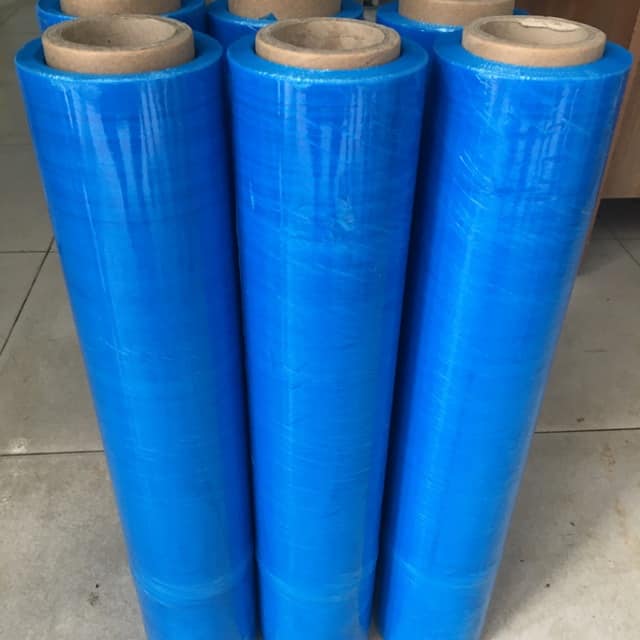
PE shrink film is PE film that is oriented by stretching during manufacture and shrinks to hug the product when heated; PE stretch film holds the load through elastic force once stretched, with no heat needed; cling film is thin and sticks to surfaces by itself. Confusing the three is the most common buying mistake.
| Criterion | PE shrink film | PE stretch film | Cling film |
|---|---|---|---|
| How it holds the load | Shrinks when heated | Springs back after being stretched | Sticks to surfaces by itself |
| Equipment | Shrink machine, heat tunnel, heat gun | Hand wrapping or a pallet wrapping machine | Pulled and pressed on by hand |
| Reference thickness | Depends on the size and weight of the pack | Hand rolls 17 microns, machine rolls 20 - 30 microns (ICD Vietnam product pages) | Very thin |
| Main use | Multipack shrink for bottles, cans and retail packs | Securing pallets and logistics packages | Food wrap and small items |
Heat-shrink film is itself divided by base resin. POF (multilayer polyolefin) shrink film is clear and shrinks evenly, and is commonly used for food, gifts and pharmaceuticals. PVC shrink film is cheap and shrinks well but contains chlorine and wrinkles easily, and is commonly used for bottle labels. PE shrink film is thick and tough and takes high tension, so it suits bundling bottles and cans and heavy industrial goods, though it is less clear than POF.
So when someone asks to buy “shrink film” to wrap pallets, they almost certainly need PE stretch film: heat-shrink film has to be used with heating equipment and cannot be wrapped by hand the way stretch film can.
PE film FAQ
Is PE film safe for food?
Yes, provided it is film that was manufactured and tested for food contact. In Vietnam, plastic packaging in direct contact with food must meet QCVN 12-1:2011/BYT; in Europe Regulation (EU) No 10/2011 applies. Recycled plastic may only be used in food contact when it has gone through an authorized recycling process, such as Regulation (EU) 2022/1616 in Europe. Industrial pallet film is not used to wrap food directly.
Why does PE film shrink back in hot sun?
When stretched, the polymer chains are straightened along the direction of pull. When heated, the chains gain energy to move and tend to return to their original coiled state, so the film goes slack, wrinkles or shrinks, even though the temperature is far below the melting point (about 105 - 130 °C depending on the PE type). Heat-shrink film uses exactly this effect in a controlled way. That is why you should not leave wrapped pallets or film rolls in strong sun for long.
How many microns of PE pallet film is enough?
For ordinary loads wrapped by hand, 17-micron film is enough; ICD Vietnam sells hand rolls 500 mm wide and 17 microns thick. For machine wrapping, or heavy, sharp-cornered or long-distance loads, use 20 - 30 micron machine rolls and add reinforcing wraps at the base and top. Thicker film is stronger but costs more per pallet, so choose the thinnest film that still holds the load.
How many pallets does one roll of PE film wrap?
It depends on the film weight in the roll, the pallet size and the number of wraps. For example, a 1000 x 1200 mm pallet 1.5 m tall, hand wrapped with 17-micron film stretched 150%, uses about 138 g of film, so a roll holding 3.3 kg of film wraps about 24 pallets; the ICD-MPE38 product page lists 30 - 40 pallets depending on how it is wrapped. A machine with 250% pre-stretch uses noticeably less film for the same pallet.
How does PE shrink film differ from PE pallet wrap?
PE shrink film needs heat to shrink and hug a multipack, and is used with a shrink machine or heat gun. PE pallet wrap (stretch film) holds the load through elastic force once stretched, and is applied by hand or with a wrapping machine with no heat. The two cannot replace each other.
Can PE film be recycled?
Yes. Clean PE film is collected, melted and made into recycled resin pellets for bags, packaging or other plastic products. Film that is dirty or stuck with paper labels or tape is harder to recycle, so separate the clean film at the warehouse. Recycled pellets are not used for food-contact packaging unless they have gone through an authorized recycling process.
Contact ICD Vietnam
For advice on choosing PE film by type of load and wrapping method, send ICD Vietnam the pallet size, load weight and pallets per day. Price: contact us for a quote.
ICD Vietnam Industrial Manufacturing Co., Ltd.
- Northern Vietnam (Hanoi warehouse): 3rd Floor, Thang Long A1 Building, Bau Hamlet, Thien Loc Commune, Hanoi - 0983 797 186 / 090 345 9186 / 090 5859 186.
- Southern workshop: 551/212 Le Van Khuong Street, Tan Thoi Hiep Ward, District 12, Ho Chi Minh City - 098 6784 186.
- Email: sales@icdvietnam.com.vn. Zalo: https://zalo.me/719060935915885643.
References
- Polyethylene (PE) plastic material properties - British Plastics Federation (BPF).
- Polyethylene, Wikipedia (classification by density, branching structure, melting temperature, chemical resistance).
- Regulation (EU) No 10/2011 on plastic materials in contact with food; Regulation (EU) 2022/1616 on recycled plastic in contact with food.
- QCVN 12-1:2011/BYT National technical regulation on safety and hygiene for synthetic plastic packaging and utensils in direct contact with food, Ministry of Health.
- ASTM D882 Standard Test Method for Tensile Properties of Thin Plastic Sheeting, ASTM International.
- ICD Vietnam PE stretch film and stretch wrapping machine product pages (read on 17/10/2026).