
Table of Contents
- What is black PE film? Composition and how it blocks light
- How does black PE film differ from clear PE film?
- The real advantages of black PE film
- Drawbacks to weigh before switching to black film
- Which goods is black PE film used for?
- ICD Vietnam black PE film specifications
- How to check good black PE film before buying in bulk
- Frequently asked questions about black PE film
- Can black PE film wrap fresh food directly?
- Does black PE film harm the goods inside?
- How long does black PE film resist UV?
- How often should black PE film be replaced on pallets stored outdoors?
- Can black PE film be recycled?
- Can black PE film be used on a pallet wrapping machine?
- How do you cut black PE film neatly and safely?
- Buying and requesting a quotation for black PE film
- Contact ICD Vietnam
- References
Reviewed and updated by ICD - Week 44/2026
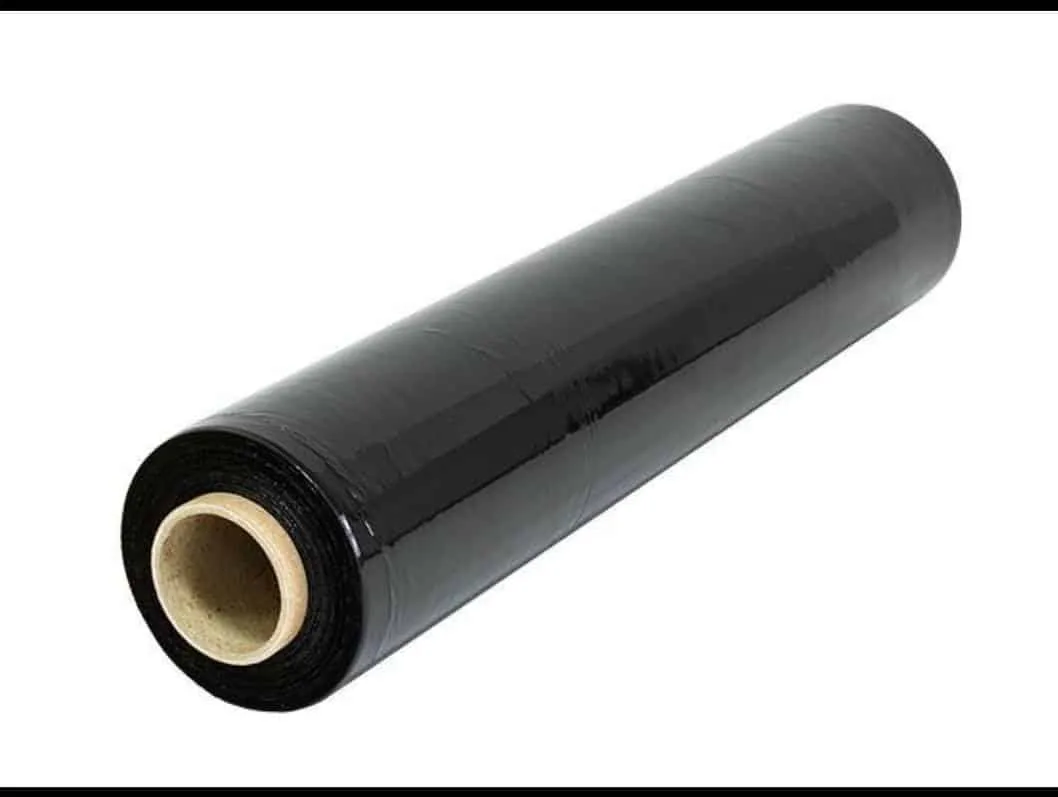
- Black PE film is LLDPE stretch film mixed with carbon black, used to hide the goods and reduce the UV light reaching the surface of the load.
- The level of UV protection depends on the carbon black content and particle size and on film thickness; there is no single figure for every roll.
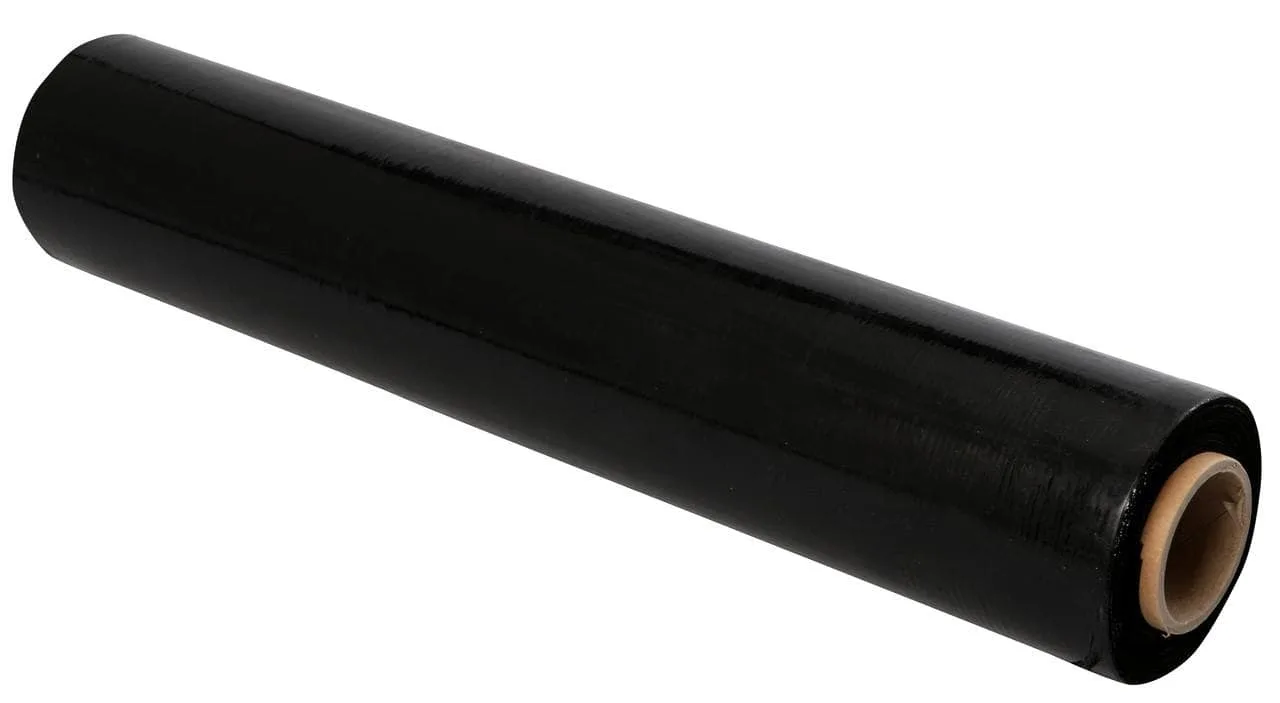
- ICD Vietnam black hand wrap: 2.1 kg roll, 500 mm wide, 17 micron thick, 76 mm or 54 mm core.
- Machine rolls MPE150 and MPEM (20 - 30 micron) come in clear, black and blue.
- Drawbacks to know: it hides labels, runs hotter in the sun, and is harder to sort for recycling.
Black PE film is LLDPE stretch film mixed with carbon black, used to hide goods on a pallet, keep the details of a package private and reduce the UV light reaching the goods when they are stored outdoors. The black colour does not make the film tougher or cheaper than clear film; the main difference is how much light it blocks. This article explains how carbon black resists UV, when to use black film and when clear film still suits better, and how to check a roll of black film before buying in bulk.
What is black PE film? Composition and how it blocks light
Black PE film is a pallet wrapping film made from LLDPE (linear low density polyethylene), like clear PE film, but with carbon black particles dispersed in the resin. Carbon black is a very fine carbon powder that does not dissolve in the resin but is mixed and spread evenly when the film is extruded. These particles absorb visible light and UV, which is why the film is black and cannot be seen through.
According to technical literature from Cabot, a carbon black manufacturer, carbon black particles absorb UV and slow down the breakdown of the polymer itself. The effect is not fixed: the finer the primary particles, the better the UV absorption; the more even the dispersion, the fewer the gaps; and the thicker the film and the higher the content, the better it blocks. Cabot states that optimal UV protection is usually reached at a content of about 2 - 3%.
A study in the journal Polymer Degradation and Stability (Liu and Horrocks, 2002) tested LLDPE film 75 micron thick and found that film with carbon black resists UV markedly better than film without it, especially with small particles of about 20 nm; raising the content from 1.5% to 3.5% by weight improved it further. Common pallet film is only 17 - 30 micron thick and is stretched when wrapped, far thinner than the test samples, so no fixed number of months in the sun can be inferred for every roll of black film.
How does black PE film differ from clear PE film?
Both use the same LLDPE base resin and the same wrapping method, so they share hand wrapping tools and wrapping machines. The difference lies in what the black colour adds and what it takes away. The table below compares them from the practical side of warehouse use, without percentages, because UV blocking depends on each film’s formulation.
| Criterion | Black PE film | Clear PE film |
|---|---|---|
| See-through | You cannot see the goods inside | Goods and labels clearly visible |
| UV reaching the load surface | Reduced by carbon black, by an amount that depends on content and thickness | Nearly all light passes through unless a UV additive is used |
| Temperature in the sun | Absorbs more light, so it runs hotter | Absorbs less |
| Checking goods, scanning codes | Labels must be stuck on the outside, or the film removed | Labels can be read through the film |
| Recycling | Hard to sort with NIR machines | Easier to sort |
| ICD Vietnam specification | 2.1 kg hand roll, 17 micron; machine rolls MPE150 and MPEM come in black | Hand rolls MPE21 - MPE50; machine rolls MPE150, MPEM |
Besides black and clear, ICD Vietnam machine rolls also come in blue. Coloured film is often used to tell batches, customers or delivery routes apart by eye. Colour does not change how much film a pallet needs; thickness, roll width and tension while wrapping decide whether the pallet is secure.
The real advantages of black PE film
Black PE film is worth it when hiding the goods matters more than seeing them. The four benefits below have a clear basis; promises like “99% UV protection” or “lasts dozens of months outdoors” without a stated film formulation should be questioned with the supplier.
One point is often misunderstood: black colour does not make the film stickier or tougher. Cling between layers comes from the tackifier additive and the resin formulation, and toughness comes from the quality of the LLDPE resin and the thickness. The ICD Vietnam black film product page states that the film is made from LLDPE, carbon black and a toughening additive, which means toughness is set by the additive, not by the colour.
Drawbacks to weigh before switching to black film
Most articles introducing black film mention only the advantages. In warehouse operations, the four points below often cause more trouble than the cost of the film.
It also hides labels and barcodes
Black film covers the pallet label, the dispatch slip and the carton barcodes. A warehouse that scans for receiving and dispatch will have to stick labels on the outside after wrapping, or leave an unwrapped window where the label goes. Agree the outside label position with the receiving side in advance so they do not have to cut the film to check the goods.
Hotter in the sun
A black surface absorbs more light, so a pallet wrapped in black film runs hotter than one in clear film when left in the sun. A study by the Rochester Institute of Technology (RIT, 2021) found that the film’s holding force dropped about 41% after 30 days at 38°C, compared with about 26% at 23°C, and dropped most sharply in the first 2 hours after wrapping. For black-film pallets sitting in a sunny yard, check the tightness again before handling, and consider an extra reinforcing wrap at the base.
Hard to check goods by eye
The storekeeper cannot see goods that have fallen over, been dented or are leaking inside. For liquid or fragile goods, check carefully before wrapping and photograph the bare pallet to compare when a complaint comes in.
Harder to recycle than clear film
LDPE and LLDPE are plastic resin code 4. Clean film can in theory be recycled, but a WRAP (UK) report points out that carbon black plastic cannot be detected by near-infrared (NIR) sorting machines, so on automated sorting lines black plastic is usually rejected and sent to landfill or incineration. If the warehouse collects used film to sell to a recycler, keep black film separate and do not mix it with clear film.
Which goods is black PE film used for?
Black film suits pallets that need to be hidden or have to sit outdoors. For goods that only move inside a covered warehouse and need a lot of counting, clear film is still more convenient. The groups of goods that commonly use black film:
- Textiles, footwear: hides packaging and samples, reduces fading when pallets wait for dispatch in the yard.
- Electronics, components: keeps quantities and models private in transit.
- High-value or unreleased goods: does not expose brands or logos on the cartons.
- Supplies and materials stored temporarily outdoors: reduces UV on plastic packaging and woven bags.
- Cosmetics, chemicals in clear bottles: adds a light-blocking layer outside the carton.
For export goods, black film is not a requirement of the buyer or the shipping line. It is the goods owner’s choice when they want to keep the goods private; labels, shipping marks and documents on the pallet must still be readable as agreed, so they are usually stuck on the outside of the film.
For cold storage, black film has no particular advantage in temperature or humidity over clear film of the same thickness. If cold storage is the only reason, choose by the film’s thickness and cling at low temperature rather than by colour.
ICD Vietnam black PE film specifications
ICD Vietnam has black film in both hand rolls and machine rolls. The figures below come from the ICD Vietnam product pages, read on 17 Oct 2026; prices depend on quantity, so please contact us for a quote.
| Roll type | Weight | Thickness | Width | Core |
|---|---|---|---|---|
| Black PE hand wrap film | 2.1 kg (1.8 kg film + 0.3 kg core) | 17 micromet | 500 mm | 76 mm or 54 mm |
| ICD-MPE150 machine roll film (clear, black, blue) | 15 kg | 20 - 30 micromet | 500 mm | 76 mm |
| ICD-MPEM machine roll film (clear, black, blue) | 7 - 18 kg | 20 - 30 micromet | 500 mm | 76 mm |
The 2.1 kg hand roll is light, suited to wrapping by hand or with a handheld dispenser. Machine rolls are heavier and thicker and are used only on pallet wrappers with a roll holder. By ICD Vietnam’s calculation, 1.8 kg of film 17 micron thick is about 230 m long, enough to wrap about 5 pallets of 1200 x 1000 mm, 1.5 m high, with 10 wraps per pallet when hand wrapping without much stretch.
How to check good black PE film before buying in bulk
Black film is harder to judge by eye than clear film because the colour hides flaws. The three quick checks below can be done in the warehouse without any measuring equipment.
- Look at colour and surface: an even black with no grey streaks or bright spots, a smooth surface, no hard particles or pinholes mixed in.
- Stretch it and look through it: stretch a length of film as it would be stretched when wrapping, then hold it up to a lamp or lay it over a white carton. Good film stays evenly black; film with little carbon black shows grey patches or printed text through it.
- Wrap a test pallet: wrap the usual number of wraps and see whether the film tears at the corners, clings firmly between layers, and whether the film tail comes loose by itself.
The stretch-and-look-through step matters most. Film gets thinner when it is stretched, so a roll that looks solid black when whole can still let light through once on the pallet. If you need complete hiding, put on more overlapping layers instead of stretching the film very tight, or choose a thicker roll.
Frequently asked questions about black PE film
Can black PE film wrap fresh food directly?
It should not. ICD Vietnam black PE film is an industrial film for wrapping outside cartons and pallets, and ICD Vietnam does not publish any certification allowing direct food contact. Wrapping the outside of a pallet or a plastic crate holding food is fine, because the film does not touch the food.
Does black PE film harm the goods inside?
The film is only wrapped around the outside of the packaging, so it does not affect the goods when used correctly. Note that a black-film pallet runs hotter in the sun, so heat-sensitive goods should not be left outdoors long whatever colour they are wrapped in.
How long does black PE film resist UV?
There is no single figure. According to Cabot’s literature and the study by Liu and Horrocks, UV resistance depends on the carbon black content and particle size and on film thickness. Ask the supplier for the carbon black content and UV additive, and test one sample pallet in the yard before using it widely.
How often should black PE film be replaced on pallets stored outdoors?
There is no fixed interval. Check regularly: if the film starts to turn brittle, fade or tear at the corners, or the pallet gets loose, wrap it again. The RIT 2021 study shows that film loses holding force faster at higher temperatures, so pallets in the sun need checking more often than pallets inside the warehouse.
Can black PE film be recycled?
LDPE and LLDPE are plastic resin code 4 and can in principle be recycled. However, according to WRAP, plastic coloured with carbon black cannot be detected by NIR sorting machines and is often rejected on automated lines. Collect black film separately and ask the buyer whether they accept it. Do not burn film, because uncontrolled burning of plastic gives off smoke and toxic gases.
Can black PE film be used on a pallet wrapping machine?
Yes. The ICD-MPE150 and ICD-MPEM machine rolls come in black, 20 - 30 micron thick, 500 mm wide with a 76 mm core, and fit like clear film rolls. The 2.1 kg hand roll is for hand wrapping or a handheld dispenser.
How do you cut black PE film neatly and safely?
Use a utility knife or sharp scissors, cut while the film is still lightly taut on the pallet, then press the film tail against the layer below. Wear gloves when cutting with a knife, never cut toward your body, and put the blade away after use.
Buying and requesting a quotation for black PE film
ICD Vietnam sells black PE film by the roll, in hand-wrap and machine-wrap grades; see the stretch films currently available in the stretch film (PE) category. For an accurate quotation, send ICD Vietnam the goods you need to shield from light, whether you wrap by hand or by machine, the film width, the roll weight and the number of rolls per month. We suggest requesting a sample to wrap a few pallets before placing a large order. Hotline and Zalo are in the contact section at the end of this guide.
Contact ICD Vietnam
Send ICD Vietnam your type of goods, pallet size, where they are kept (inside a warehouse or in the yard) and pallets per day to get advice on black or clear film, hand roll or machine roll. Price: contact us for a quote by quantity.
ICD Vietnam Industrial Manufacturing Co., Ltd.
- Northern Vietnam (Hanoi warehouse): 3rd Floor, Thang Long A1 Building, Bau Hamlet, Thien Loc Commune, Hanoi - 0983 797 186 / 090 345 9186 / 090 5859 186.
- Southern workshop: 551/212 Le Van Khuong Street, Tan Thoi Hiep Ward, District 12, Ho Chi Minh City - 098 6784 186.
- Email: sales@icdvietnam.com.vn. Zalo: Chat Zalo.
- Quote: Request a quote.
- Learn more about other ICD PE films or read the article What is PE film for an overview.
References
- Specialty carbon blacks for plastic film and sheet applications, Cabot technical literature.
- Liu, Horrocks (2002), effect of carbon black on UV stability of LLDPE films, Polymer Degradation and Stability.
- Dunno, Symanski (2021), stretch film holding force and temperature, Journal of Applied Packaging Research, RIT.
- Recyclability of black plastic packaging, WRAP.
- Wikipedia - Resin identification code: LDPE is resin code 4.
- Properties of polyethylene (PE) plastic - British Plastics Federation (BPF).
- ICD Vietnam product pages: black PE hand wrap film 2.1 kg, ICD-MPE150, ICD-MPEM (read 17 Oct 2026).