Table of Contents
- Definition: How do semi-automatic and fully automatic differ?
- Detailed comparison: Semi-automatic vs fully automatic
- PE film use depends on pre-stretch, not on the level of automation
- When to choose a semi-automatic machine?
- When to choose a fully automatic machine?
- What about wrapping robots?
- 3 common machine selection situations
- Automatic and semi-automatic stretch wrapper FAQ
- How do semi-automatic and fully automatic stretch wrappers differ?
- Does a semi-automatic machine have pre-stretch?
- Do automatic machines break down more than semi-automatic ones?
- Can I upgrade a semi-automatic machine to an automatic one and reuse the old machine?
- How many automatic machines can one worker operate at once?
- How much does a pallet stretch wrapper cost?
- Contact us for advice and a quote
- References
Reviewed and updated by ICD - Week 43/2026
Semi-automatic and automatic stretch wrappers differ in how the film is attached and cut: on a semi-automatic machine the operator attaches the film start to the pallet, presses run, then cuts and tapes down the film tail for every pallet; an automatic machine clamps and cuts the film itself and usually connects to a conveyor. The wrapping speeds on the two spec sheets are quite close, for example the semi-automatic ICD-X0MS at 30 pallets/hour and the automatic ICD-X100 at 30-40 pallets/hour, so the real difference is whether someone has to stand at the machine every cycle.
- Semi-automatic: the table turns by itself, the operator attaches the film start, cuts and tapes the film tail for each pallet.
- Fully automatic: the machine clamps the film start, measures the height and cuts the film itself; people only bring the pallet in and take it out (or a conveyor does this).
- Pre-stretch (stretching the film before wrapping) is not tied to the level of automation: the semi-automatic ICD-X0PS still has 250% pre-stretch.
- Price of the two types: contact us for a quote; payback is calculated with the formula in this article, and there is no single figure for every warehouse.
- See available models: ICD automatic stretch wrapping machines
The question “should I buy an automatic or a semi-automatic stretch wrapper” is the most common one from first-time buyers. The answer is not “which type is better” but “which type fits the pallets, the way goods reach the machine and the staff of your warehouse”. Having worked with packaging supplies and machines at ICD Vietnam since 2011, I find buyers usually compare the speeds in the catalog, when what decides the matter is the time a person has to stand beside the machine.
Definition: How do semi-automatic and fully automatic differ?
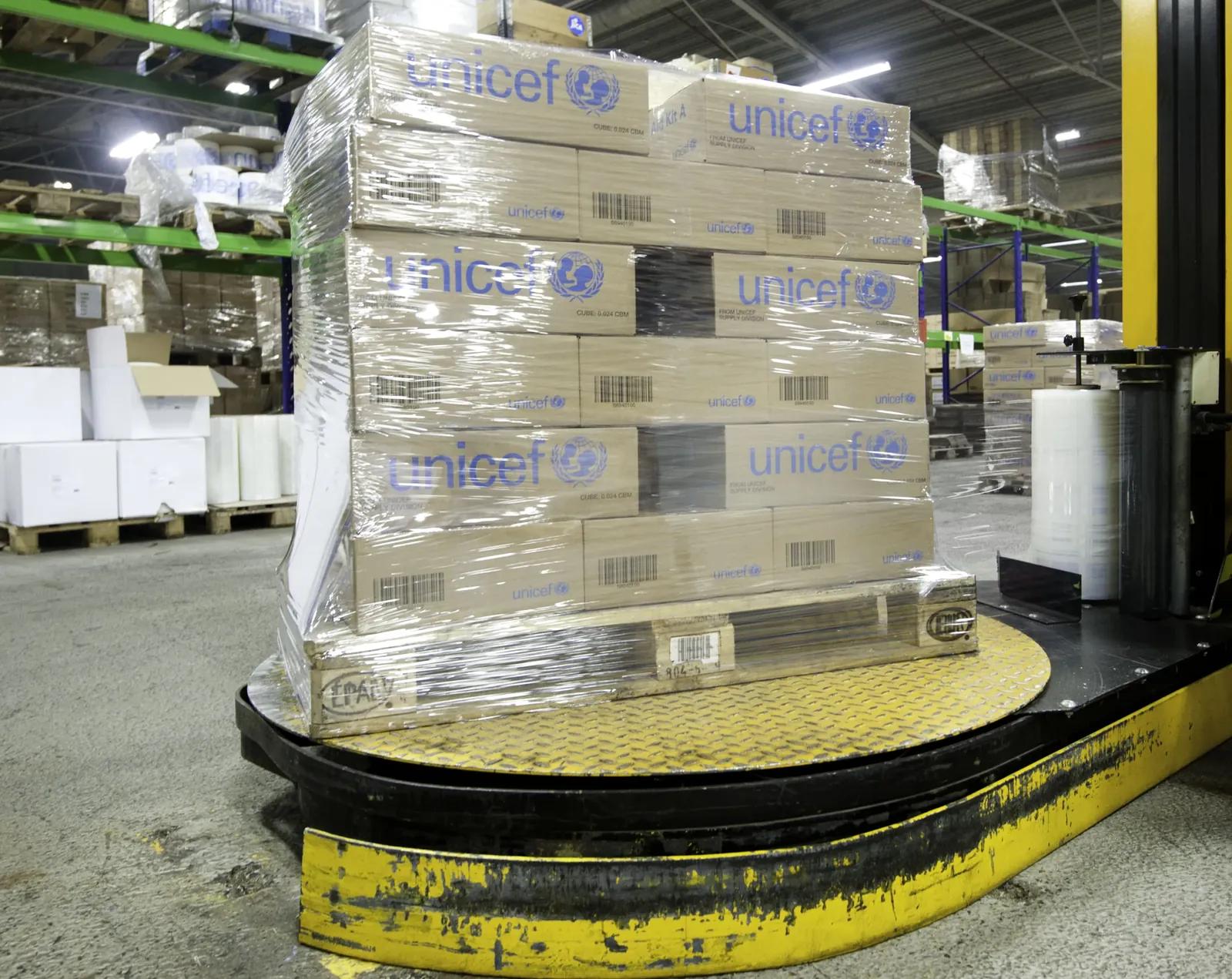
The difference lies in how much a person steps in during the wrapping cycle. According to Wikipedia, a semi-automatic wrapper is usually a rotary-table type where the operator attaches and cuts the film; an automatic machine adds a conveyor to bring goods in and out and attaches, tapes and cuts the film itself.
Semi-automatic: An electric motor turns the rotary table by itself. The worker needs to: (1) take the PE film start and wrap it onto the base of the pallet to begin, (2) choose a program or adjust the film column height with push buttons, (3) tear the film and tape it down at the end. The table and film carriage run automatically following the height sensor, but the start and end of the cycle always need a person.
Fully automatic: The worker only: (1) places the pallet on the table or conveyor, (2) chooses a program, (3) presses start. The machine does everything itself: clamps the film start, measures the height, raises and lowers the carriage and cuts the film when done. The ICD-X100 product page describes it clearly: the cut and clamp system means workers do not have to cut the film themselves and place it on the pallet.
This is the key difference: a semi-automatic machine frees labor from walking around the pallet, but still needs 1 person present at the start and end of each cycle; an automatic machine lets the operator walk away while it wraps. For a closer look at types of stretch wrapping machines by other criteria, see the in-depth ICD Vietnam article.
Detailed comparison: Semi-automatic vs fully automatic
The table below compares on the criteria that really affect running cost; specifications are drawn from the ICD Vietnam stretch wrapper product pages. Price of the two types: contact us for a quote.
| Criterion | Semi-automatic | Fully automatic |
|---|---|---|
| Attaching and cutting film | A person does it for every pallet | The machine clamps and cuts |
| Operator | Present at the start and end of each cycle | Brings the pallet in and takes it out; on a conveyor line almost no need to stand at the machine |
| Speed on the spec sheet | ICD-X0MS: 30 pallets/hour | ICD-X100: 30-40 pallets/hour; ICD-T1650FZ: 30-50 pallets/hour |
| Pre-stretch | Depends on model: the ICD-X0MS has none, the ICD-X0PS has 250% | ICD-X100 250%; ICD-2000BF selectable 100/150/250% |
| Wrapping quality | Film start and tail depend on the person | Consistent according to the preset program |
| Maintenance | Few mechanisms, simple | Extra clamp, cutter, pneumatic or conveyor mechanisms, needs more technical skill |
| Suited to | Pallets arriving sporadically through the day, goods of many sizes | A continuous flow of pallets, uniform goods, a conveyor |
The speeds are the packing speeds listed on the product pages; real speed also depends on pallet height, number of wraps and the time a forklift takes to bring goods in and out.
PE film use depends on pre-stretch, not on the level of automation
The film used per pallet is decided by the pre-stretch unit, not by whether the machine is semi-automatic or automatic. Many comparisons equate “semi-automatic = wastes film”, but the ICD-X0PS is a semi-automatic machine with 250% pre-stretch and uses as little film as an automatic machine of the same ratio; conversely the ICD-X0MS has no pre-stretch and so uses more film.
How to estimate (same model as the ICD Vietnam stretch wrapper price article): a 1.2 × 1.0 m pallet 1.8 m tall, wrapped with 2 layers, needs about 49 m of stretched film. Metres of film used = 49 ÷ (1 + stretch). A machine that pulls film only through a brake, stretching about 40%, uses about 35 m per pallet; a 250% pre-stretch machine uses about 14 m, about 60% less.
So when you are undecided, split it into two questions: do you need pre-stretch (a film cost question), and do you need automatic film clamp and cut (a question of who stands at the machine). A warehouse with few pallets that still wants to save film can choose a semi-automatic machine with pre-stretch instead of jumping to an automatic one. The metres of film are estimated under the assumptions above; each warehouse should measure again with real pallets.
When to choose a semi-automatic machine?
Choose a semi-automatic machine when the operator still has free hands between pallets, meaning pallets arrive at the machine sporadically rather than as a continuous flow. The ICD-T1650F (semi-automatic) product page says this machine suits a warehouse wrapping 50-150 pallets a day.
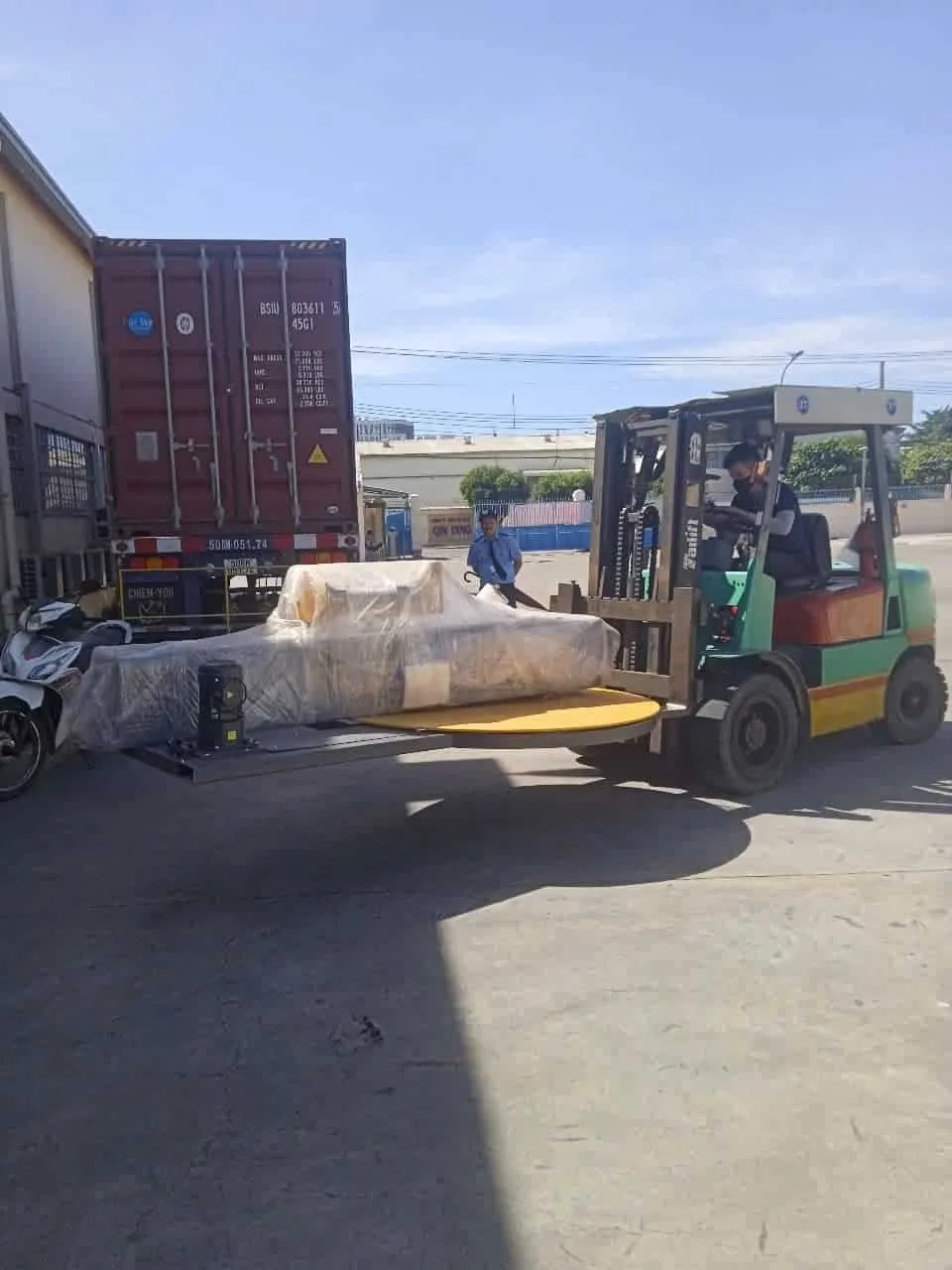
The most common case is a warehouse that is just starting to replace hand wrapping on a limited budget. A semi-automatic machine cuts physical effort immediately without investing in a conveyor or compressed air. When the warehouse expands, the old machine can still be used as a secondary machine for small orders.
Goods of varied sizes that change often also suit a semi-automatic machine, because staff adjust by hand for each pallet. A fully automatic machine works best when goods are uniform and the programs are preset.
A warehouse that needs to move the machine between several packing areas should look at the model with wheels. The Y1650F semi-automatic wrapper is designed to be compact, light and mobile (1,500 kg load, 2,000 mm wrapping height), suited to a warehouse that needs flexible positioning; the product page notes the machine should only be moved when the table is empty.
When to choose a fully automatic machine?
Investing in fully automatic makes sense when the time a person stands at the machine becomes the bottleneck: pallets arrive continuously, uniform goods allow a fixed wrapping program, or the line needs a conveyor to bring goods in and out without waiting for a person.
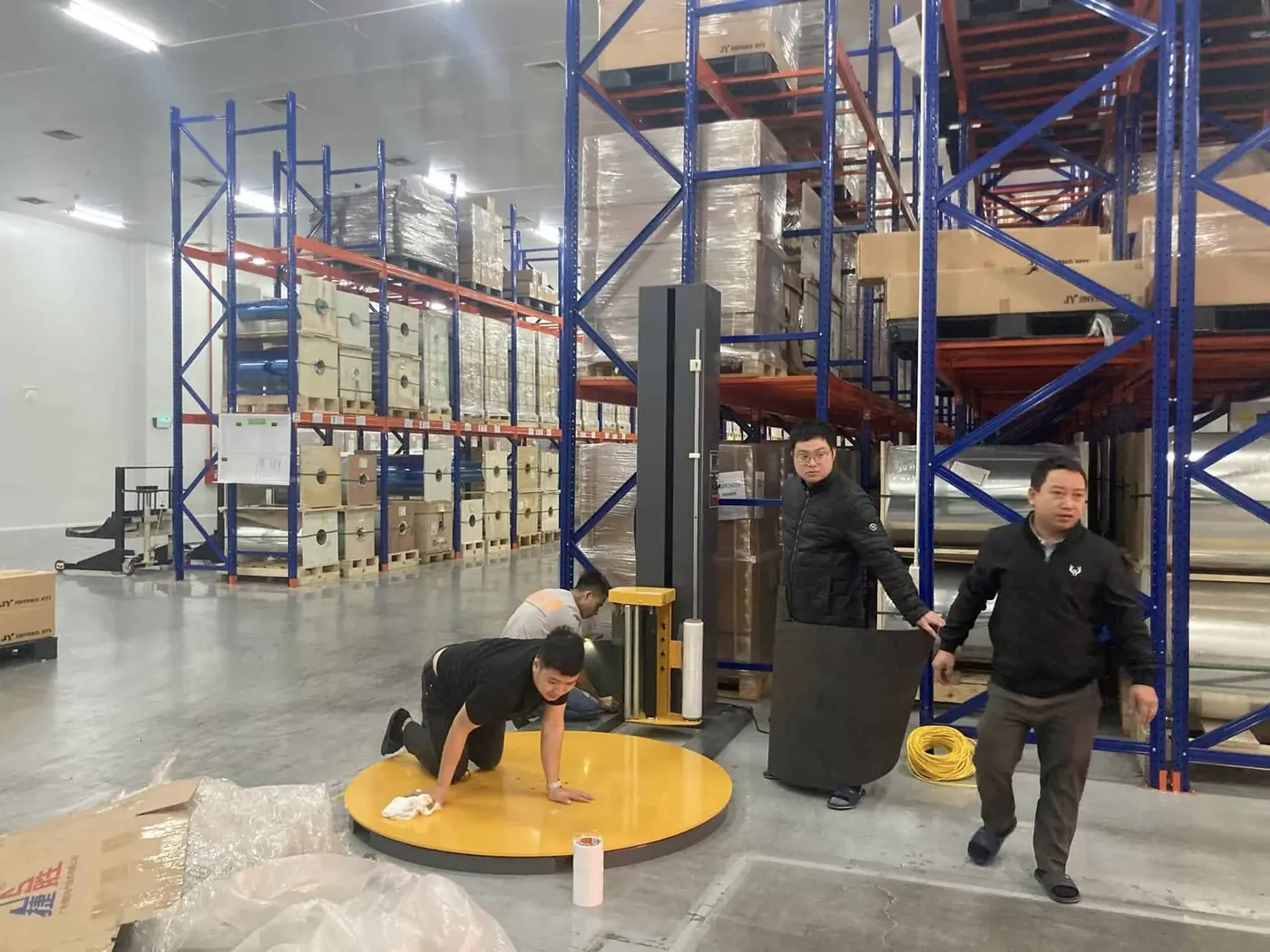
A simple conversion: at 30 pallets/hour, each cycle takes about 2 minutes. A warehouse wrapping 150 pallets/day on a semi-automatic machine needs a person at the machine for about 150 × 2 = 300 minutes, about 5 hours a day, not counting forklift waiting time. At 300 pallets/day that figure is about 10 hours, more than one shift; at that point an automatic machine with a conveyor frees both the person and the forklift.
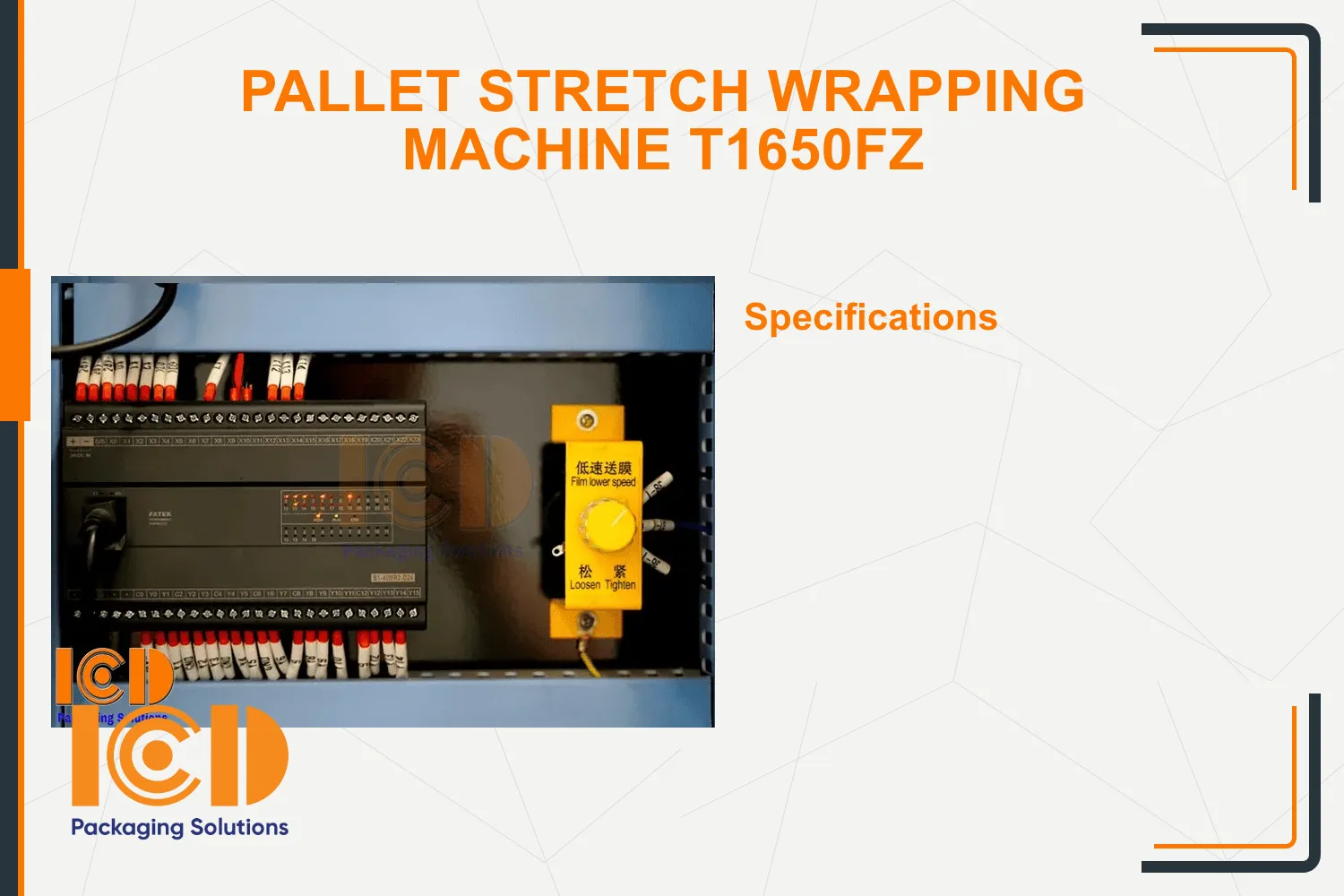
An automatic machine also needs infrastructure: the ICD-T1650FZ uses compressed air at 0.4-0.8 MPa; the ICD-T1800FZ on a conveyor uses 380 V power at 2.5 kW. Check the power supply and floor space before settling on a model.
What about wrapping robots?
The self-propelled robot is the third segment, entirely different from both semi-automatic and automatic rotary-table machines: the robot circles a pallet that sits right on the floor, suiting goods that are too heavy or oversized, or a warehouse with no room for a table. For a full analysis of the Robopac and Maxgo automatic wrapping robots - when to choose a robot over a rotary table and how to calculate the cost - see the dedicated ICD Vietnam article.
3 common machine selection situations
The three situations below put the choice into the two questions above: the time a person stands at the machine and the need to save film.
| Warehouse situation | Reasonable choice | Reason |
|---|---|---|
| Pallets arrive sporadically, the operator has free time between cycles | Semi-automatic; to save film choose a model with pre-stretch (such as the ICD-X0PS) | The person still has time to attach and cut the film, so there is no need to invest in a clamp and cutter |
| A continuous flow of pallets, uniform goods, standing time over 1 shift | Automatic with cut and clamp (ICD-X100) or a conveyor line (ICD-T1800FZ) | Frees people and forklifts, wraps consistently by program |
| Narrow warehouse, irregular or oversized goods | Mobile wrapping robot | No rotary table needed, wraps loads placed on the floor |
The models in the table are examples based on the product page specifications; contact ICD Vietnam to choose a model by your pallets per day and warehouse floor plan.
Automatic and semi-automatic stretch wrapper FAQ
How do semi-automatic and fully automatic stretch wrappers differ?
The difference lies in attaching and cutting the film: a semi-automatic machine needs a person to attach the film start and to cut and tape down the film tail for each pallet; an automatic machine clamps the film start and cuts the film itself and usually connects to a conveyor. The wrapping in the middle of the cycle is done by the machine in both types.
Does a semi-automatic machine have pre-stretch?
Some models do and some do not. The ICD-X0PS is a semi-automatic machine with 250% pre-stretch, while the ICD-X0MS has no pre-stretch. Pre-stretch decides the film used per pallet, so if the main goal is to save film, a semi-automatic machine with pre-stretch already delivers it.
Do automatic machines break down more than semi-automatic ones?
The failure rate is not significantly higher if maintenance follows the schedule, but an automatic machine has extra clamp, cutter, pneumatic or conveyor mechanisms, so there are more parts to inspect and repair costs when it fails are usually higher. ICD Vietnam stretch wrappers carry a 12-month warranty.
Can I upgrade a semi-automatic machine to an automatic one and reuse the old machine?
A semi-automatic machine cannot be upgraded to fully automatic, because the mechanical structure of the two types is fundamentally different (extra clamp, cutter and control mechanisms). The old machine can still be kept as a secondary machine for small orders and oversized goods.
How many automatic machines can one worker operate at once?
It depends on the cycle time and the distance between machines. With an automatic machine, the person only needs to bring the pallet in and take it out, so during the roughly 2 minutes the machine wraps, they can do other work or serve the next machine if placed close together. Measure the real forklift in-and-out time to work out how many machines one person can serve.
How much does a pallet stretch wrapper cost?
The price depends on the level of automation, pre-stretch, table rating and accessories such as a scale and conveyor. ICD Vietnam stretch wrapper price: contact us for a quote by model and need; a detailed price list by model is in the contact section at the end of the article.
Contact us for advice and a quote
Send us your pallets per day, pallet size and load, and how goods reach the machine (forklift or conveyor); ICD Vietnam will advise on a model and quote in writing. Stretch wrappers carry a 12-month warranty.
- See models: Full PE stretch wrapping machine price list
- Northern Vietnam (Hanoi warehouse): 3rd Floor, Thang Long A1 Building, Bau Hamlet, Thien Loc Commune, Hanoi - 0983 797 186 | 090 345 9186
- Southern workshop: 551/212 Le Van Khuong Street, Tan Thoi Hiep Ward, District 12, Ho Chi Minh City - 098 6784 186
- Email: sales@icdvietnam.com.vn
- Quote: get a quote within 2 hours
References
- Stretch wrap, Wikipedia (definition of semi-automatic and automatic wrappers, pre-stretch).
- Specifications of the ICD-X0MS, ICD-X0PS, ICD-X100, ICD-2000BF, ICD-T1650F, ICD-T1650FZ, ICD-T1800FZ and ICD-Y1650F models on the ICD Vietnam product pages, checked in October 2026.
- Film-use estimate model by pre-stretch: ICD Vietnam PE stretch wrapper price article (49 m of stretched film for a 1.8 m pallet wrapped with 2 layers).