Table of Contents
- 1. Who may drive a forklift and how much training is needed
- 2. Checking the truck before every shift
- 3. Rules for driving
- 4. Load, load centre and stability
- 5. Pedestrians and accident-prone areas
- 6. Parking, battery charging and refuelling
- 7. Maintenance and repair: who may do what
- 8. Manual hand trucks: what carries over
- Frequently asked questions
- Contact ICD Vietnam
- References
Reviewed and updated by ICD - Week 43/2026
Safe use of a forklift comes down to four things: only trained people drive, check the truck before every shift, operate within speed, visibility and load limits, and park correctly whenever you leave the seat. The sections below take them one by one, comparing OSHA (United States) provisions with Vietnamese regulations, so a company can turn them into house rules for its own warehouse.
This guide focuses on ride-on forklifts (electric, diesel, LPG). A manual hand pallet truck has no engine and falls outside the main scope of these provisions, although many lifting principles still apply and are covered in section 8. Every figure below carries a source; where something is a practical judgement from warehouse practice rather than a clause, the text says so.
1. Who may drive a forklift and how much training is needed
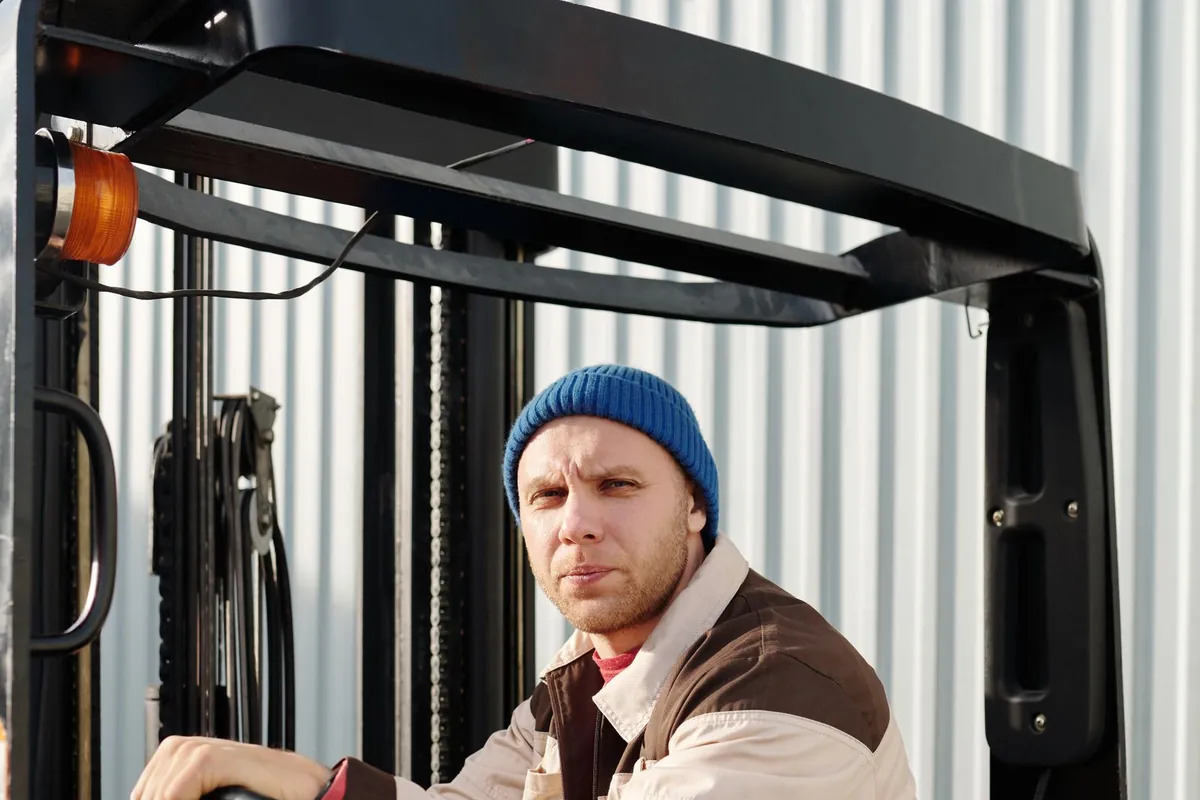
OSHA 1910.178(l) requires employers to ensure every forklift operator has completed training and evaluation before being assigned a truck. The programme combines three parts: classroom instruction, supervised practical training, and a performance evaluation in the actual workplace. Trainees may drive only under the supervision of an experienced person and only where this creates no hazard for others. The employer must keep a certification with the operator’s name, training date, evaluation date and the person who carried them out, and must re-evaluate at least once every three years.
Refresher training does not wait for the three-year mark when one of five situations arises: the operator is seen driving unsafely, has had an accident or near miss, an evaluation shows unsafe driving, the operator is assigned a different type of truck, or workplace conditions change in a way that affects safety. The last point is very practical: rearranging racking, adding a ramp or switching to taller loads are all reasons to retrain, even if the truck and driver stay the same.
| Item | OSHA 1910.178(l) (United States) | QCVN 25:2015/BLDTBXH and the Occupational Safety and Health Law (Vietnam) |
|---|---|---|
| Scope | Industrial trucks with electric or internal-combustion engines, including motorised hand trucks | Motorised forklifts with a lifting capacity of 1,000 to 10,000 kg (section 1.1.1) |
| Initial training | Classroom, supervised practice, workplace evaluation | Initial safety training before assignment, with an occupational safety certificate |
| Periodic | Re-evaluation at least every 3 years | Annual periodic training (section 3.6.3) |
| When changing truck | Refresher training when assigned a different type of truck | Retraining when changing truck type; skills test after a break of 6 months or more (section 3.6.7) |
| Records | Certification with name, training date, evaluation date and trainer | Written decision assigning the operator (section 3.6.5) |
On the Vietnamese side, QCVN 25:2015/BLDTBXH (section 3.6) applies to motorised forklifts with a lifting capacity from 1,000 kg to 10,000 kg. The regulation requires operators to receive initial safety training before assignment, annual periodic training and an occupational safety certificate; assigning an operator requires a written decision from the employer; anyone moving to a different type of truck must be retrained, and anyone who has been away from the job for six months or more must have their skills re-tested before returning. The 2015 Occupational Safety and Health Law (Article 14) also makes the employer responsible for organising training and issuing safety cards before assigning people to work with strict safety requirements.
2. Checking the truck before every shift
OSHA 1910.178(q)(7) requires trucks to be examined before being placed in service, at least daily; trucks used around the clock are examined after each shift. Defects found must be reported and repaired immediately. If a truck is defective, needs repair or has an unsafe condition, paragraph (p)(1) requires it to be taken out of service until restored, and paragraph (q)(9) says the same for a component that overheats abnormally. QCVN 25 goes one step further: each truck must have a shift handover log recording the start-of-shift check and the condition during the shift, signed by both the person handing over and the person receiving.
Neither document gives a detailed checklist for each truck model. OSHA does publish a sample daily checklist, prepared by OSHA and the Industrial Truck Association (ITA), on its forklift topic page. The list below is what warehouses commonly apply; compare it with the manufacturer’s manual before turning it into a form:
- Walk around the truck looking for hydraulic oil, fuel or battery acid leaks; check tyres and wheels.
- Forks straight and uncracked, fork locking pins in place; mast chains and hydraulic hoses not torn or leaking.
- Test the foot brake, parking brake, horn, lights and reversing alarm; test lifting, lowering and tilting without a load.
- Fuel level or battery charge enough for the shift; the battery fixed firmly in its compartment, terminals not exposed.
- Capacity plate and warning labels still legible (1910.178(a)(6)).
3. Rules for driving
The most important block of rules is in 1910.178(n). The truck must be kept under control at all times, observe the plant speed limit and keep roughly three truck lengths from the truck ahead. Do not overtake a truck travelling the same way at intersections, blind spots or other dangerous places; no horseplay or stunt driving. At intersections between aisles and wherever the view is blocked, the operator must slow down and sound the horn. If the load blocks the view ahead, travel with the load trailing (in reverse), and always look in the direction of travel with a clear view. On wet or slippery floors reduce speed, and at any speed the truck must be able to stop safely.
On ramps, 1910.178(n)(7) requires driving up or down slowly; on grades above 10%, a loaded truck must keep the load on the uphill side. On any grade, the forks and load are raised only enough to clear the surface and tilted back if the truck allows it. The phrase “reverse down a slope when loaded” often seen in guidance material is simply a consequence of the principle that the load always stays uphill. When turning, slow down and steer smoothly, never sharply (1910.178(n)(15)). Dockboards must be secured before driving over them, crossed slowly, and never loaded beyond their rated capacity.
Do not carry passengers unless a seat is designed for them, and do not let anyone stand or walk under the raised forks, even unloaded (1910.178(m)(2), (m)(3)). Placing hands or feet between the mast uprights or outside the truck’s outline is prohibited (m)(4). Do not drive toward a person standing in front of a workbench or fixed object (m)(1).
4. Load, load centre and stability
The simplest rule is also the one most often broken: lift only loads within the truck’s rating, and the load must be stable and securely stacked (1910.178(o)(1), (o)(2)). When an off-centre load is unavoidable it must be handled carefully. Insert the forks as far as possible under the load, tilt the mast back to stabilise, and tilt only as much as needed to hold the load when stacking. Tilting the load forward while it is raised is prohibited, except when placing it on a rack or stack (o)(6).
The rated capacity on the data plate is always tied to a distance from the front face of the forks to the load’s centre of gravity, called the load centre. Appendix A of 1910.178 notes that trucks rated up to 30,000 lb (about 13.6 tonnes) are normally rated at a 24-inch (about 610 mm) load centre. When a load is longer than usual, its centre of gravity moves out and lifting capacity falls accordingly. An example worked in the same appendix: a 3,000 lb truck (about 1,360 kg) with a 24-inch load centre has an allowable moment of 72,000 inch-lb; a 60-inch load (30-inch load centre, about 760 mm) can weigh at most 2,400 lb (about 1,090 kg). When you meet long, bulky or off-centre loads, recalculate this way or ask the truck supplier; do not estimate by eye.
| Provision | Rule | What to write into the warehouse rules |
|---|---|---|
| 1910,178(m)(2) | Nobody stands or walks under raised forks | Mark no-stand lines around loading areas, with a spotter when stacking high |
| 1910,178(n)(1), (n)(4) | Keep 3 truck lengths; slow down and sound the horn at intersections | Convex mirrors and stop signs at every aisle intersection |
| 1910,178(n)(7) | Grades above 10%: load on the uphill side; forks raised just enough to clear the surface | State which ramps in your warehouse need this rule |
| 1910,178(o)(2), (o)(6) | Load within rating; do not tilt the load forward while raised | Post the capacity and load centre plate at the operator’s position |
| 1910,178(m)(5) | Leaving the truck: lower the forks fully, neutral, power off, set the brake | State the distance that counts as leaving the truck (25 ft, about 7.6 m) or out of sight |
| 1910,178(q)(7) | Examine the truck at least daily | Shift handover log signed by both sides, per QCVN 25 section 3.6.4.6 |
5. Pedestrians and accident-prone areas
OSHA’s overview page on forklifts lists the common injury types: a truck driven off the edge of a loading dock, a truck falling between the dock and an unsecured trailer, people struck by trucks, and people falling while standing on a pallet or raised forks. OSHA also notes that seated counterbalance trucks are more likely to cause falling-load accidents than motorised hand trucks, because they lift much higher. This is the basis for splitting the rules by truck type and workplace instead of applying one generic set.
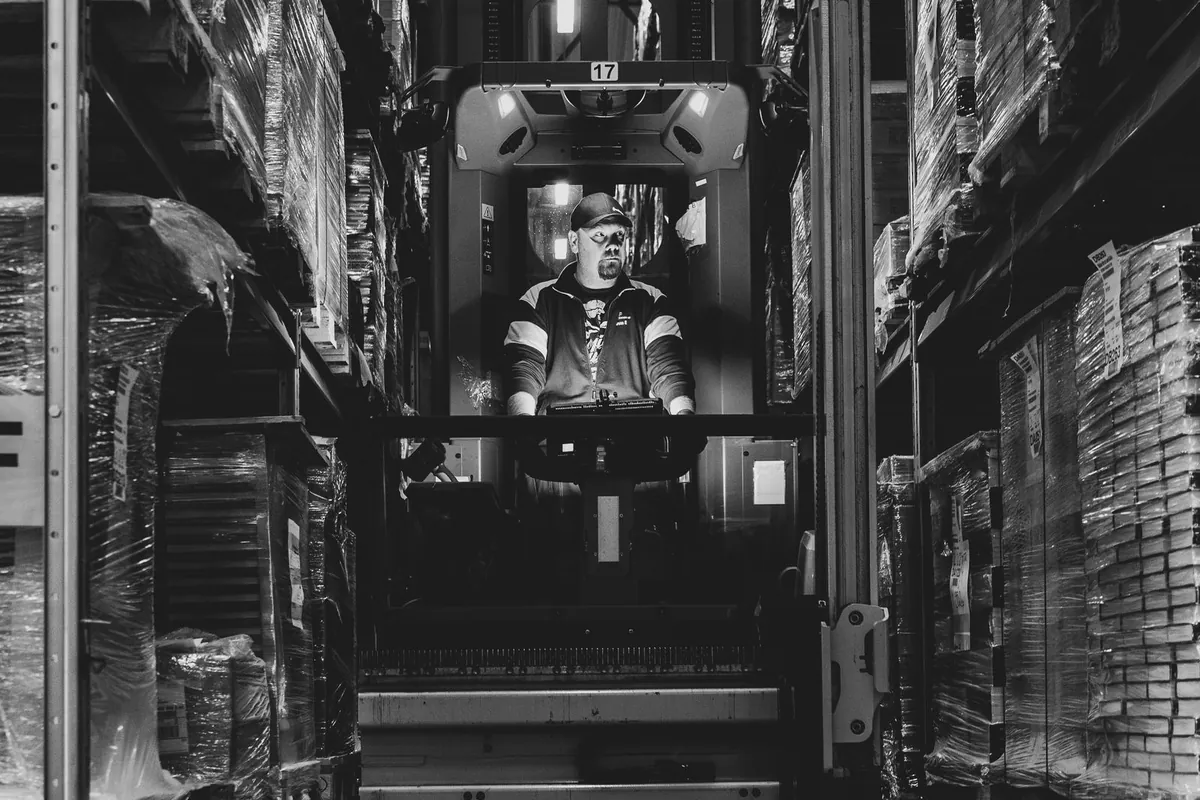
Where trucks and people move together, QCVN 25 requires specific measures to stop unauthorised people from entering the forklift working area (3.6.4.8) and spotters at positions the operator cannot see (3.6.6). Separating traffic with floor paint, convex mirrors, lights and reversing alarms is what many warehouses do in practice to meet this requirement; it is not a specific mandatory clause. Pedestrians should assume the driver may not see them, walk in their own lane and wait for visual confirmation from the driver before crossing.
When a truck goes on or off a loading dock or into a trailer, 1910.178(k)(1) requires setting the brakes of the delivery truck and chocking its rear wheels so it cannot roll away, (m)(7) requires checking that the trailer floor is strong enough before driving in, and (m)(6) requires keeping a safe distance from the dock edge. A forklift must not be used to open or close a container door.
6. Parking, battery charging and refuelling
Leaving the truck does not end the danger. 1910.178(m)(5) treats a truck as unattended when the operator is 25 ft (about 7.6 m) or more away but still has it in view, or at any distance if it is out of sight. The forks must then be fully lowered, controls in neutral, power off and brake set; on a slope, chock the wheels. Even under 25 ft, the forks must still be lowered and the brake set.
Battery charging is done only in a designated area with ventilation to disperse gas, and with equipment for handling acid spills, a means of lifting batteries and a fire extinguisher (1910.178(g)). The truck must be stopped in position with the brake set before changing or charging the battery; no smoking, open flame or sparks, and no metal tools on top of an open battery. When mixing solution, always pour acid into water, never water into acid. Refuelling diesel, petrol or LPG trucks requires the engine to be off and compliance with the current fire standard for the relevant fuel ((f), (p)(2)).
7. Maintenance and repair: who may do what
1910.178(q)(1) provides that all repairs are made by authorised persons, and (q)(4) requires disconnecting the battery before repairing the electrical system. Replacement parts must be equivalent in safety to the original design ((q)(5)). A truck must not be modified in a way that changes the relative position of its components or adds or removes parts differently from how it was received from the manufacturer, and counterweight must not be added without the manufacturer’s approval ((q)(6)). Modifications that affect capacity and operating safety require the manufacturer’s prior written approval ((a)(4)).
In Vietnam, Article 30 of the 2015 Occupational Safety and Health Law requires machinery and equipment with strict safety requirements to be inspected under Article 31, periodically checked and maintained, with a safety technical file created and kept. The equipment list issued with Circular 36/2019/TT-BLDTBXH includes motorised forklifts with a lifting capacity of 1,000 kg or more (Section I, item 18). QCVN 25 section 3.6.4.2 adds that each truck must have a log of periodic maintenance, servicing and repairs. The specific inspection interval is stated on the certificate issued by the inspection body, and companies should follow the date on that certificate.
Owners do not need to do repairs themselves. ICD Vietnam distributes genuine Xilin forklifts with a 12-month warranty and also carries out forklift repairs and rentals, in line with the spirit of the provisions above: repairs by qualified people, and a replacement truck while you wait.
8. Manual hand trucks: what carries over
Provision 1910.178(a)(1) applies to trucks with electric or internal-combustion engines, including motorised hand trucks. A manual hand truck such as the ICD BF-III 2.5-tonne low-lift hand truck has no engine and so falls outside this definition, but the principles of rated capacity, not standing under the load and not putting hands or feet under the forks still hold. The Sugiyasu (Bishamon) guide for the BM40/BM50 hand truck clearly warns against placing hands or feet under a raised load or forks.

This also shows a point that is often misunderstood in forklift safety material: the inspection requirement under Circular 36/2019 applies to motorised forklifts of 1,000 kg and above, and does not automatically apply to manual hand trucks. This is analysed separately in ICD Vietnam’s article on whether a hand pallet truck needs an inspection certificate.
Frequently asked questions
1. Who is allowed to drive a forklift?
A person who has been trained, evaluated and assigned the truck in writing by the company. For motorised forklifts of 1,000 kg and above, QCVN 25 also requires annual periodic training and an occupational safety certificate; OSHA requires re-evaluation at least every three years.
2. What should I do if the truck shows abnormal signs?
Stop the truck, take it to a safe place, tell the supervisor and do not keep using it. OSHA 1910.178(p)(1) and (q)(1) require a defective or unsafe truck to be taken out of service, with all repairs made by authorised persons.
3. What should pedestrians working near forklifts watch for?
Walk in your own lane, do not cross the truck path until the driver has confirmed visually, do not stand under raised forks and do not stand in the loading zone. The company must have measures to keep people with no duties out of the area where trucks operate (QCVN 25, section 3.6.4.8).
4. What does the daily truck check include?
At least daily before use (OSHA 1910.178(q)(7)). The detailed content follows the manufacturer’s manual: leaks, tyres, forks and chains, brakes, horn, lights, lifting and lowering without a load, fuel or battery charge. Record it in the shift handover log signed by the person handing over and the person receiving.
5. What support does ICD Vietnam offer when buying a forklift?
ICD Vietnam distributes genuine Xilin (Ningbo Ruyi) forklifts with a 12-month warranty, carries out forklift repairs, offers forklift rental and supports instalment purchases. Specific terms are given when you order.
Contact ICD Vietnam
Hotline: 0983 797 186 | 090 345 9186 | 090 5859 186
Zalo: icdvietnam | Email: sales@icdvietnam.com.vn
Request a quote now to get advice on choosing the right forklift. Delivery within Hanoi and Ho Chi Minh City in 1-3 working days under ICD Vietnam’s shipping policy.
References
- Provisions on training, operation, travel, lifting loads, maintenance, and Appendix A on stability: 29 CFR 1910.178 - Powered industrial trucks.
- Common accident types and the sample daily checklist: OSHA - Powered Industrial Trucks (Forklifts).
- Sections 1.1.3, 1.3.2 and 3.6 on safe management of forklift use: QCVN 25:2015/BLDTBXH (Circular 51/2015/TT-BLDTBXH).
- List of motorised forklifts of 1,000 kg and above: Circular 36/2019/TT-BLDTBXH.
- Articles 14, 30 and 31 on training, use and inspection of strictly regulated equipment: Occupational Safety and Health Law 84/2015/QH13.
- Warning against placing hands or feet under the load: Sugiyasu (Bishamon), Hand Pallet Truck BM40/BM50 Operation and Service Manual, Rev.1 20.09.
- Written by Le Van Thang, ICD Vietnam; ICD Vietnam has operated since 2011 and distributes Xilin forklifts. Updated October 2026.