Table of Contents
- 1. Overview of a hand pallet truck’s structure
- 2. The parts of a hand pallet truck in detail
- 3. How the lifting system works
- 4. Structural differences between a hand pallet truck and a forklift
- 5. Reading the markings and labels on a hand pallet truck
- 6. Small parts to know when servicing a hand pallet truck
- Frequently asked questions
- Contact us for advice on the right truck
- References
Reviewed and updated by ICD - Week 43/2026
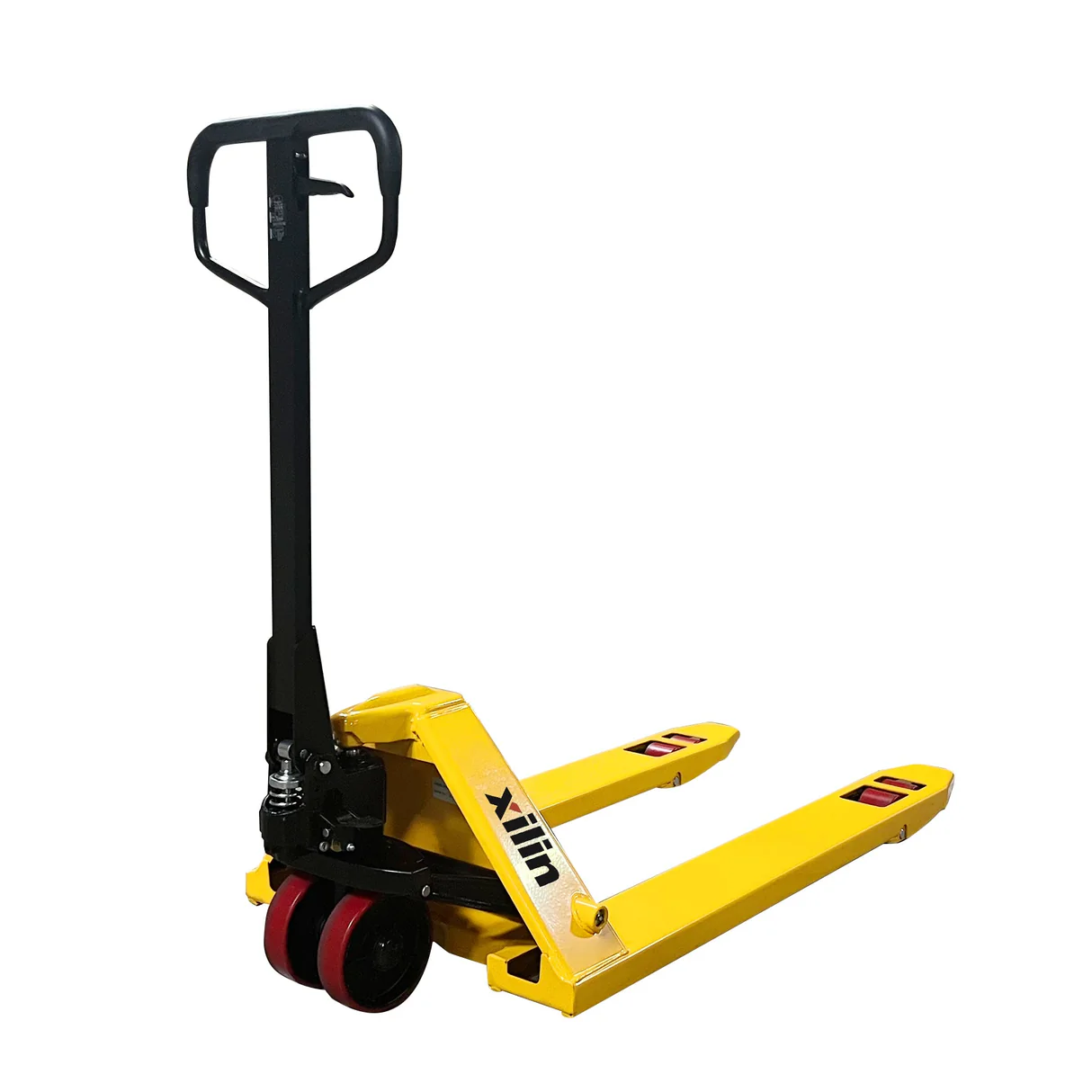
A hand pallet truck has five main assemblies: a steel fork frame, a hydraulic pump unit, a control handle, a steering wheel with load wheels under the fork tips, and a linkage that carries the lift to the fork tips. It has no engine, mast or counterweight like a forklift; all the lifting force comes from the operator’s pumping through the hydraulic unit.
To many people a Xilin hand pallet truck is just a lifting machine. But having worked with lifting equipment at ICD Vietnam since 2011, I see that every part of the truck has a clear job. I have seen costly failures start from one small component, such as a worn wheel or a leaking hydraulic system. Understanding the structure of a pallet truck is not only knowledge for engineers; it is a skill for anyone who wants to run a warehouse safely and efficiently.
QUICK SUMMARY
- Technical guide: a part-by-part look at the structure of a hand pallet truck, using manufacturer specifications for the Xilin BF-III, DF-III, DB and WB series.
- Core parts: fork frame, hydraulic pump unit, handle, wheels and linkage.
- How it works: why one person pumping by hand can still lift a 2.5-tonne pallet.
- Comparison: which parts differ between a hand pallet truck, a diesel forklift and an electric forklift.
1. Overview of a hand pallet truck’s structure
A low-lift pallet truck is the simplest lifting tool in a warehouse: a U-shaped steel frame with two forks, a pump unit sitting on the steering wheel, and a handle that both steers and pumps. Knowing this layout helps you pick the right truck for your pallets, spot failures early and know which part needs servicing.
A powered forklift, whatever its size or fuel, is built from the same main systems working together: an engine system supplying energy, a drive and travel system, a hydraulic system that does the lifting, and a chassis that keeps it stable. The hand pallet truck keeps the two essentials, the chassis and the hydraulics, while the operator provides the energy and the movement.
2. The parts of a hand pallet truck in detail
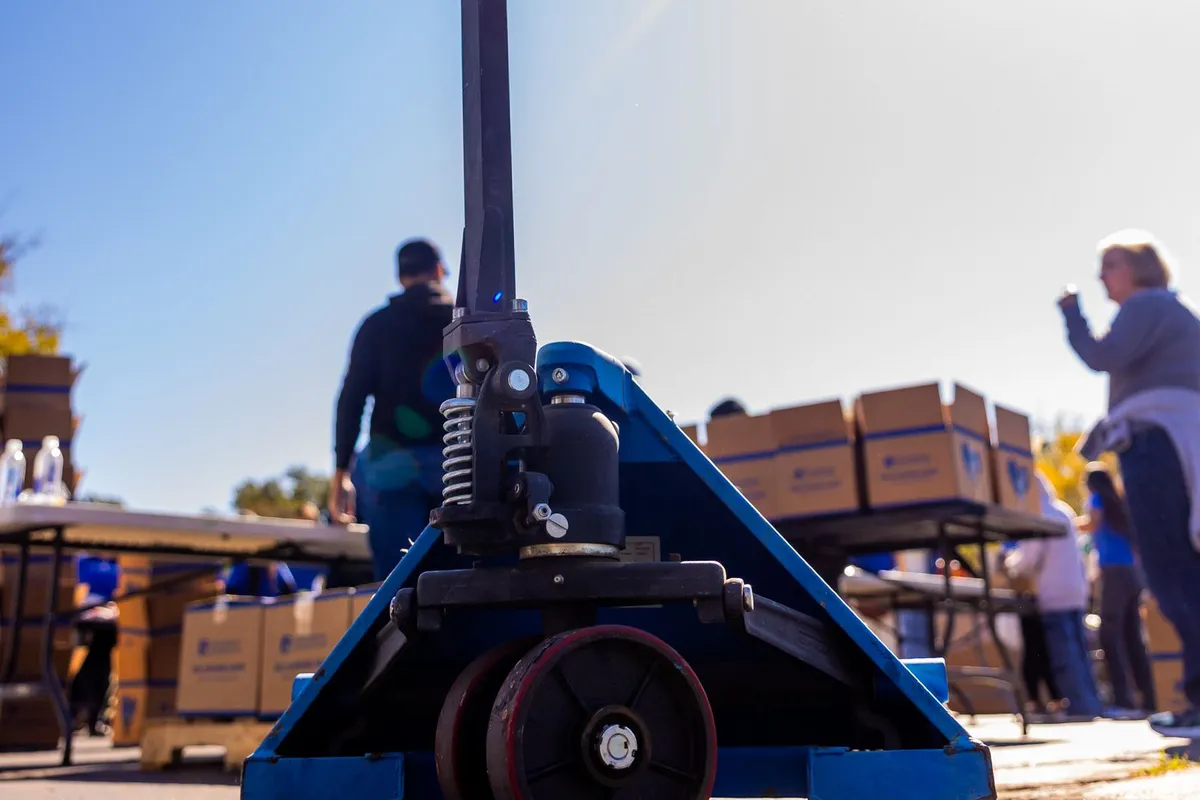
Each part has its own job: the forks carry the load, the pump creates the lifting force, the handle controls it, the wheels bear the weight and the linkage transmits the motion. Below is each assembly, with figures from Xilin’s documentation.
Fork frame
The fork frame is two pressed steel blades joined at the rear, the part that enters the pallet openings. Xilin series come in two fork lengths, 1,150 and 1,220 mm, each fork 150 mm wide, with an overall width of 520, 550 or 680-685 mm. Xilin describes the DB series as having reinforced fork tips and solid welds to take the knocks of entering a pallet.
Hydraulic pump unit
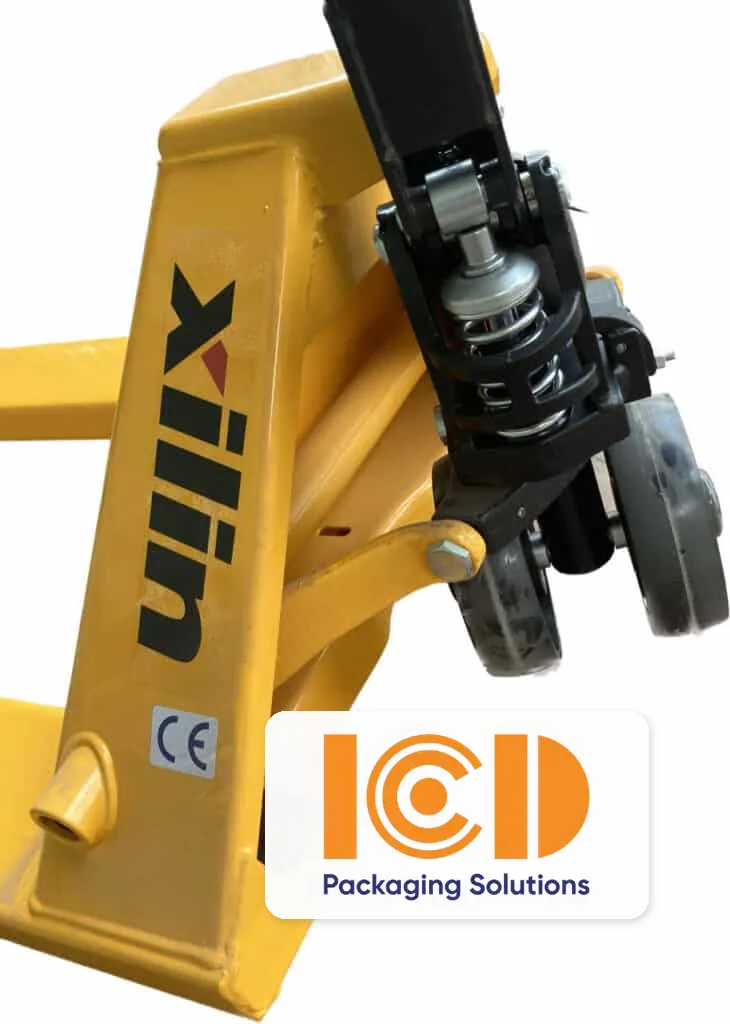
The pump unit is the heart of the truck: a small pump piston connected to the handle, a lift cylinder with a large ram, an oil reservoir, a check valve that holds oil while pumping, and a release valve that lowers the forks. On the BF-III the pump body is cast in one piece with no welds and has an overload valve; on the DF-III the piston and lift rod are chrome-plated; the 5-tonne WB has an overload protection valve and a fast-lift mode when the load is under 600 kg. The pump’s internal structure is covered separately in our guide to hand pallet truck hydraulic pumps.
Control handle
The handle is both the steering bar and the pump lever. It carries a three-position lever: lift (pump), neutral to pull the truck without pumping, and lower to open the release valve. A spring at the foot of the handle returns it upright when released. Xilin lists a steering angle of 180° for the DF-III and 190° for the DB.
Steering wheel and load wheels
The steering wheel sits under the pump unit, 180 mm in diameter on the BF-III, DF-III and DB and 200 mm on the WB. The load wheels sit under the fork tips and are smaller (about 70-85 mm) because they must fit inside the pallet openings when the forks are at their lowest, 75-88 mm; they come as single or tandem wheels. PU wheels are quiet and leave fewer marks on epoxy floors; nylon wheels are hard and roll easily on concrete.
Linkage
When the lift rod pushes the rear of the frame up, push rods running inside the forks push the load-wheel brackets at the fork tips down, so both ends of the forks rise together. A bent push rod or worn pin is the common reason one fork lifts unevenly.
3. How the lifting system works
A forklift’s operating principle rests on Pascal’s law of fluid pressure: pressure made at a small piston is passed in full to a large piston, so the output force exceeds the input force in proportion to the piston areas. That is why one person pumping by hand can lift several tonnes, at the price of pumping many times: the DF-III needs 10 strokes to reach full lift, each about 11 mm, while the DB needs 12.
- The operator moves the lever to lift and pumps the handle (on a forklift, the engine does this through a hydraulic pump).
- The pump piston draws oil from the reservoir through the check valve and compresses it to high pressure.
- The high-pressure oil is sent to the bottom of the lift cylinder.
- Oil pressure pushes the lift ram up, raising the fork frame and the load; the check valve holds the oil so the forks do not sink.
- To lower, the operator squeezes the lever to open the release valve, the oil returns to the reservoir, and the forks come down under gravity.
4. Structural differences between a hand pallet truck and a forklift
The biggest difference is the energy source: a forklift has an internal combustion engine or an electric motor, which is why it also needs a mast, tilt cylinders, a counterweight and its own steering system. Diesel and electric forklifts differ mainly in energy source, which leads to differences in noise, emissions and the working environment each suits.
| Component | Low-lift pallet truck | Powered forklift |
|---|---|---|
| Energy source | Human effort to pump and pull | Internal combustion engine (diesel, gas, petrol) or an electric motor with a battery |
| Hydraulic pressure | Hand pump built into the pump unit | Hydraulic pump driven by the engine |
| Lifting | Lift ram pushes the fork frame, maximum lift about 200 mm | Mast of 2 or 3 nested stages, with the carriage sliding along the mast |
| Tilting | None | Tilt cylinders tilt the mast forward or back |
| Balance | Load sits between the forks, no counterweight needed | Cast-iron counterweight at the rear of the truck |
| Steering | Handle turns the steering wheel | Rear-wheel steering, small turning radius |
| Wheels | PU or nylon wheels | Solid tires (flat floors) or pneumatic tires (rough ground) |
Engine / motor
- Internal combustion engine: found on diesel forklifts and gas/petrol forklifts. These engines are powerful and suit outdoor work, but they make noise and produce exhaust.
- Electric motor: found on electric forklifts. It runs quietly and cleanly, ideal for indoor environments and food stores. Power comes from a large battery.
Mast, forks and carriage
The mast is the most visible part of a forklift, usually made of 2 or 3 nested stages to raise loads to different heights. The carriage is the metal plate where the forks are mounted and slide up and down the mast; forklift forks can usually be adjusted for spacing, unlike the fixed welded forks of a hand pallet truck.
Counterweight and steering
The counterweight is a very heavy cast-iron block at the rear of a forklift that balances the load at the front so the truck does not tip. This is why you must never lift more than the permitted load. Most forklifts steer with the rear wheels to get a small turning radius in tight spaces.
5. Reading the markings and labels on a hand pallet truck
The model name and load plate tell you which series a truck belongs to and how much it may carry. For Xilin, the low-lift hand truck series are BF-III, DF-III, DB and WB; in the code of some electric models the number gives the load in hundreds of kg, for example CBD15W-E is a low-lift electric truck rated 1,500 kg.
- Model code: shows the series and pump unit, for example BF-III with the one-piece pump and overload valve, DF-III with the standard pump, WB the 5-tonne series.
- Rated load plate: the maximum the truck may carry; overloading damages the seals and pump and can bend the forks.
- CE label: confirms the manufacturer declares the truck conforms to the EU Machinery Directive 2006/42/EC.
- Serial number: used to trace the production batch and handle warranty claims; note it down when you receive the truck.
6. Small parts to know when servicing a hand pallet truck
When a truck has a problem, the technician checks it against the list of parts below. Knowing the names helps you describe the fault accurately when calling for warranty service.
- Fork frame - pressed steel that carries the whole load.
- Hydraulic pump unit - the pump body containing the piston, valves and oil reservoir.
- Handle and return spring - brings the handle back upright when released.
- Pump piston - takes force from the handle and pushes oil into the cylinder.
- Lift ram - pushes the fork frame up; chrome-plated on the DF-III.
- Seal kit - keeps oil inside the cylinder; worn seals are the main cause of sinking forks and oil leaks.
- Check valve - lets oil move one way while pumping.
- Release valve - opens when you squeeze the lower lever.
- Overload valve - blocks lifting beyond the rated load (on the BF-III and WB).
- Oil reservoir - where oil returns when the forks lower.
- Steering wheel - φ180-200 mm, PU or nylon.
- Load wheels under the forks - small, single or tandem, carrying most of the load.
Related product: see the ICD BF-III low-lift pallet truck, 2.5 tonnes, with a one-piece pump, an overload valve and a rated load of 2,500 kg, distributed by ICD Vietnam.
Frequently asked questions
1. Why do most forklifts steer with the rear wheels?
Rear-wheel steering lets a forklift maneuver in very tight spaces. Its turning radius is much smaller than with front-wheel steering like an ordinary car. The same goes for a hand pallet truck: the steering wheel sits at the tail, under the pump unit.
2. What is the “load center” and why does it matter?
The load center is the distance from the front face of the carriage to the center of gravity of the load. A forklift’s nominal capacity (for example 2.5 tonnes) is only valid when the load center is at the standard value on the truck’s plate. If you place a very long load, the load center moves further out and the truck’s real lifting capacity drops considerably, which can be dangerous.
3. Does the hydraulic oil need changing regularly?
Yes. Like engine oil, hydraulic oil gets dirty and loses its properties after a period of work. On a hand pallet truck, check the oil level and cleanliness regularly; low or aerated oil makes the truck fail to lift or lift slowly.
4. How many wheels does a hand pallet truck have?
A low-lift pallet truck has one or two steering wheels at the rear and a load wheel under each fork tip, single or tandem. Steering wheels on the Xilin series are 180 mm in diameter (BF-III, DF-III, DB) or 200 mm (WB).
5. How can I contact ICD Vietnam?
Hotline 0983 797 186 | 090 345 9186 | 090 5859 186, ICD Vietnam on Zalo, Email: sales@icdvietnam.com.vn.
6. What policies does ICD Vietnam have for hand pallet trucks?
ICD Vietnam distributes Xilin (Ningbo Ruyi) forklifts in Vietnam with a 12-month warranty. Orders within Hanoi and Ho Chi Minh City are delivered in 1-3 days under the shipping policy.
Contact us for advice on the right truck
Hotline: 0983 797 186 | 090 345 9186 | 090 5859 186
Zalo: icdvietnam | Email: sales@icdvietnam.com.vn
Delivery within Hanoi and Ho Chi Minh City in 1-3 working days under ICD Vietnam’s shipping policy.
References
- Specifications and pump unit descriptions for the BF-III, DF-III, DB and WB: Ningbo Ruyi (Xilin), Hand Pallet Truck.
- Circular 36/2019/TT-BLDTBXH of 30 December 2019, annex listing machinery and equipment with strict labor-safety requirements: National Legal Document Database.
- ISO 3691-5:2014 Industrial trucks, Safety requirements and verification, Part 5: Pedestrian-propelled trucks: ISO.
- Directive 2006/42/EC on machinery (Machinery Directive), European Union.