
Table of Contents
- 1. Check the truck before every shift
- 2. Load and load centre: why 1 tonne does not always lift 1 tonne
- 3. Travelling, lifting and lowering
- 4. The no-go zone: under the forks and around the truck
- 5. Xilin high-lift hand stackers at ICD Vietnam
- Frequently asked questions
- Contact us about high-lift hand stackers
- References
Reviewed and updated by ICD - Week 43/2026
Using a high-lift hand stacker safely means checking the truck before every shift, loading it centred and never above rated capacity, travelling with the forks lowered, and never allowing a person, hands or feet under raised forks. Manufacturers do not agree on fork height when travelling with a load: the Noblelift EFS manual limits it to 300 mm, while the Xilin SDJ manual says no more than 0.5 m on long runs. Follow the manual for the truck you actually use.
We compiled this guide from the operating manuals of Noblelift, TTC and Strongway and from Xilin’s spec sheet, instead of generic advice. Wherever a number appears, it comes from a specific manual and the source is listed at the end.
1. Check the truck before every shift
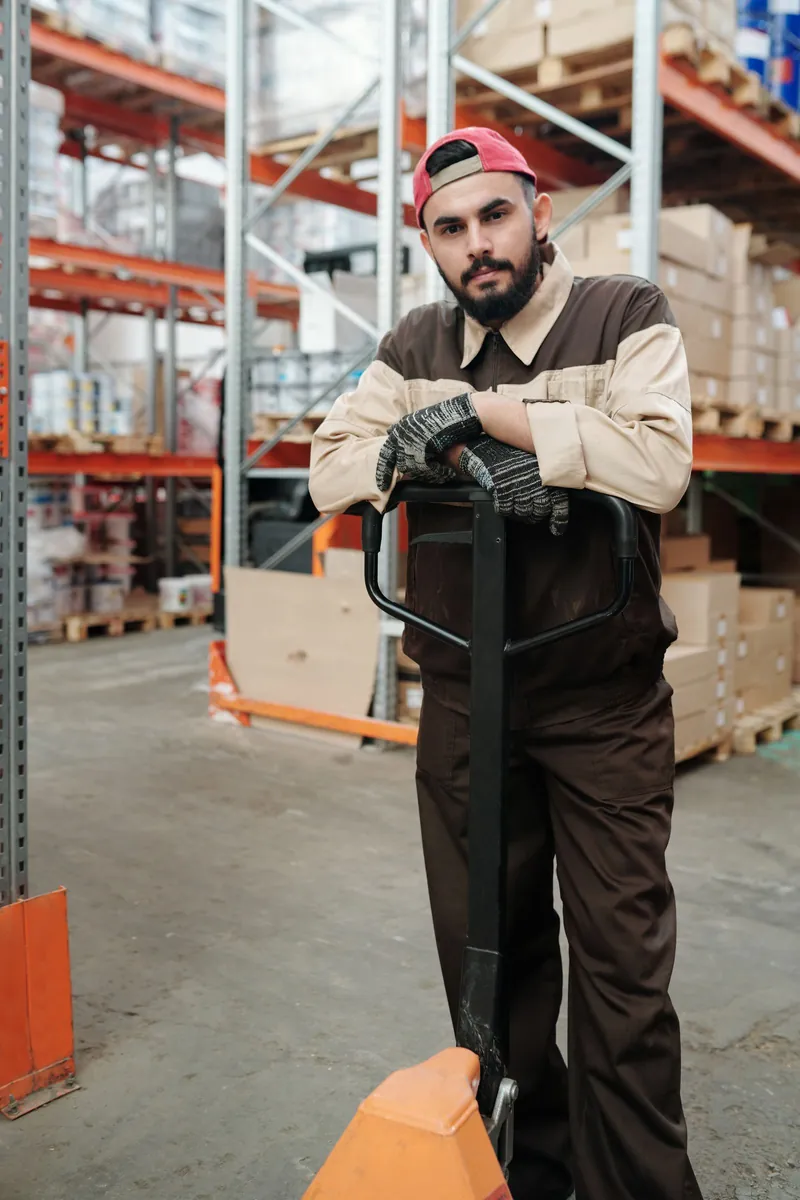
The TTC PA0515 manual requires checking the truck and test-running its functions before each use; the Noblelift EFS manual says not to operate before checking the truck’s condition, especially the wheels, handle, guide frame, steering wheels and lifting frame. This can be boiled down to one short check:
- Wheels: wear, cracks, foreign objects jammed; steering wheels turn freely.
- Handle and controls: not loose, not sticking.
- Mast, forks and chain: forks not bent or cracked; chain not stretched more than 3% (TTC’s limit).
- Hydraulics: no oil leaks, the load holds when raised and lowers under control.
- Chain guards, wheel guards and brake (if fitted): present and working.
- Work area: Strongway advises looking around before lifting or lowering.
2. Load and load centre: why 1 tonne does not always lift 1 tonne
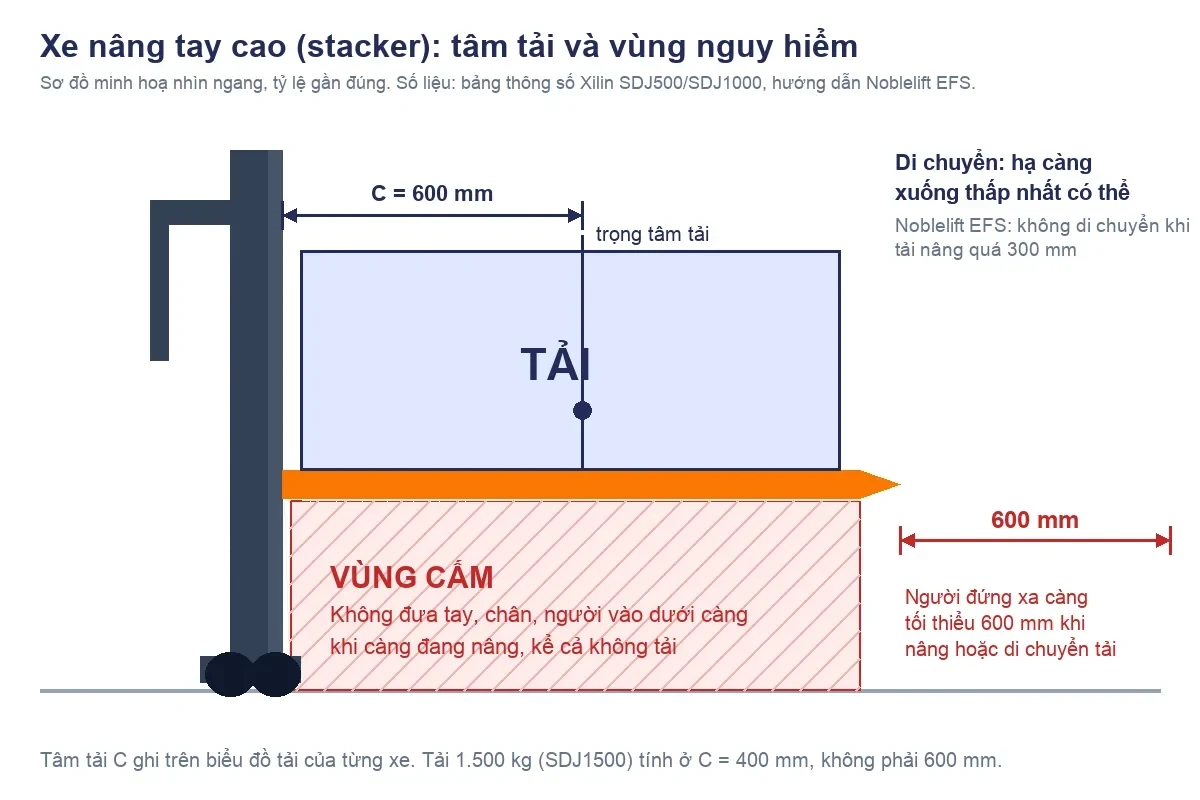
The rated capacity of a high-lift hand stacker always comes with a load centre distance, measured from the front face of the mast to the centre of gravity of the load on the forks. If the load sits farther out than the load centre marked on the truck, lifting capacity falls. Xilin’s spec sheet shows this clearly: the SDJ1000 lifts 1,000 kg at a 600 mm load centre, while the SDJ1500 lifts 1,500 kg at a 400 mm load centre, so you cannot place a load as long as on the SDJ1000 and still expect 1,500 kg.
| Model Xilin | Rated capacity | Load centre c | Lift height h3 | Fully raised height h4 |
|---|---|---|---|---|
| SDJ500 | 500 kg | 600 mm | 1,000 or 1,600 mm | 1,490 or 2,080 mm |
| SDJ1000 | 1,000 kg | 600 mm | 1,000, 1,200, 1,600, 2,500 or 3,000 mm | 1,490 to 3,420 mm |
| SDJ1500 | 1,500 kg | 400 mm | 1,600 mm | 2,080 mm |
Three loading rules drawn from the manuals, identical across manufacturers: never load above rated capacity; spread the load evenly over both forks, not just one; and keep the load’s centre of gravity between the two forks (Noblelift EFS, Strongway, Xilin SDJ manual). The SDJ manual also forbids stacking loose goods that are not secured.
3. Travelling, lifting and lowering
The lower the load, the steadier the truck, so every manual comes down to one principle: when travelling with a load, lower the forks as far as possible. TTC PA0515 says exactly this, along with advice to avoid sudden starts and stops. The specific figure differs from one manufacturer to another:
| Manual | Rule when travelling with a load |
|---|---|
| Noblelift EFS | Do not move the truck when the load is raised more than 300 mm |
| Xilin SDJ | On long runs keep the forks no more than 0.5 m off the floor; when the load is raised, push or pull slowly only, no turning |
| TTC PA0515 | Travel with the load as low as possible; no figure given |
So the safe approach is to take the lowest limit in the manual supplied with your truck, and if there is no manual, lower the forks close to the floor before pushing.
Floor surface. Noblelift states clearly that the truck must not be used on slopes. TTC accepts only a very small gradient, at most 2%, and only when the truck is unloaded. The SDJ manual requires indoor work on a flat, firm floor, and no use in environments with corrosive acid or alkali.
When lifting and lowering. Strongway advises locking the wheels when lifting or lowering (on trucks with a wheel lock). When not in use, lower the forks completely, and do not leave a loaded truck unattended (TTC).
4. The no-go zone: under the forks and around the truck
This is the section where the manuals are most emphatic. The Noblelift EFS manual forbids standing under the forks, forbids carrying people on the forks, and requires everyone to stay at least 600 mm from the forks when a load is lifted or moved. The Xilin SDJ manual forbids anyone standing under the forks or around the truck while loading, and forbids standing on the forks to work.
Chain guards and wheel guards on the truck protect hands and feet, but they do not replace the rules above. Keep these parts in place and do not remove them for convenience.
5. Xilin high-lift hand stackers at ICD Vietnam
ICD Vietnam distributes Xilin high-lift hand stackers from Ningbo Ruyi Group, with a 12-month warranty. For the SDJ1000, the 3 m version has a rated capacity of 1,000 kg at a 600 mm load centre, a fully raised height of 3,420 mm and a weight of 305 kg according to the manufacturer’s spec sheet. Besides selling trucks, ICD Vietnam also repairs forklifts, rents them out and supports instalment purchases. Related product: ICD SDJ1000 3 m high-lift hand stacker.
Frequently asked questions
1. May I stand on the forks of a high-lift hand stacker or carry people on it?
No. The Noblelift EFS manual forbids carrying people on the forks, and the Xilin SDJ manual forbids standing on the forks to work. The forks are for carrying goods only.
2. How high may the load be when travelling?
It depends on the manual: Noblelift EFS does not allow moving when the load is raised more than 300 mm, Xilin SDJ says no more than 0.5 m on long runs, and TTC only says to keep it as low as possible. Follow the manual of the truck you use and lower the forks as far as possible.
3. Does a 1-tonne rating always lift 1 tonne?
Only when the load’s centre of gravity lies within the load centre marked on the truck. The Xilin SDJ1000 is rated 1,000 kg at a 600 mm load centre and the SDJ1500 1,500 kg at a 400 mm load centre. A load placed farther out must be reduced; see each truck’s load chart.
4. Does a manual high-lift hand stacker need an inspection certificate?
Under the wording of Circular 36/2019/TT-BLDTBXH, the list only includes “motorised forklifts with a lifting capacity of 1,000 kg or more”, so a pump stacker driven entirely by human effort is not named on the list. Electric or semi-electric units are still debated, so ask a licensed inspection body.
Contact us about high-lift hand stackers
Northern Vietnam: 0983 797 186 | 090 345 9186 | 090 5859 186
Southern Vietnam: 098 6784 186
Email: sales@icdvietnam.com.vn | Fanpage: facebook.com/icdvietnam.com.vn
References
- Safety rules, the 300 mm and 600 mm limits, no use on slopes: Noblelift, EFS Series Hand Hydraulic Stacker, operating manual.
- Pre-shift check, travelling with a low load, 3% chain stretch, 2% gradient: TTC, Hydraulic Manual Hand Stackers PA series (manual PA0515).
- Lock the wheels when lifting or lowering, lower the forks when not in use: Strongway, Manual Pallet Stacker 2200 lb, manual.
- Rated capacity, load centre, lift height: Ningbo Ruyi (Xilin), Manual Stacker with Fixed Forks SDJ500/1000/1500.
- SDJ operating warnings (flat floor, no more than 0.5 m on long runs, no standing under the forks): Xilin, SDJ/SDJA hand stacker manual.
- List of equipment with strict requirements: Circular 36/2019/TT-BLDTBXH, item 18.