Table of Contents
Reviewed and updated by ICD - Week 43/2026
PE plastic can be recycled technically, because it is a thermoplastic that can be melted and pelletised again, but actual recovery is still low: in the United States in 2018, natural HDPE bottles were recycled at 29.3%, while plastic bags, sacks and film reached only 10%. This article explains why rigid bottles are easier than thin film, what steps produce recycled pellets, how quality changes after repeated processing, and what recycling ratios plastic packaging is required to meet in Vietnam. Background knowledge on the material is in the article what PE plastic is.
1. PE can be recycled, but some types are easy and some are hard
PE is a thermoplastic: it softens and flows when heated and hardens when cooled, so it can be ground, melted and extruded into new pellets. That ability is real, but whether recycling actually happens depends on collection, sorting and how clean the feedstock is, more than on the material itself. This is why the PE codes perform very differently in practice: HDPE, code 2, found in milk bottles, jerrycans and crates, is relatively easy to collect and clean, while LDPE, code 4, is usually thin film and bags, dirty, stuck with labels and likely to tangle in sorting machines.
| Plastic group | US recycling rate 2018 | Why |
|---|---|---|
| Natural HDPE bottles | 29.3% | Rigid, uniform bottles with their own collection channel |
| PET bottles | 29.1% | Code 1, collected as bottles |
| Bags, sacks, plastic film (including LDPE, LLDPE) | 10% | Thin, dirty and light, so collection and cleaning cost is high |
| All plastics combined | 8.7% | Average across all plastic waste |
The figures are for the United States in 2018, sourced from the EPA, and are the latest broken down by group in this dataset. Vietnam has no equivalent table by plastic code, so do not infer a domestic rate from here; the table only shows the trend: rigid bottles are easier than thin film.
2. The process that produces recycled PE pellets
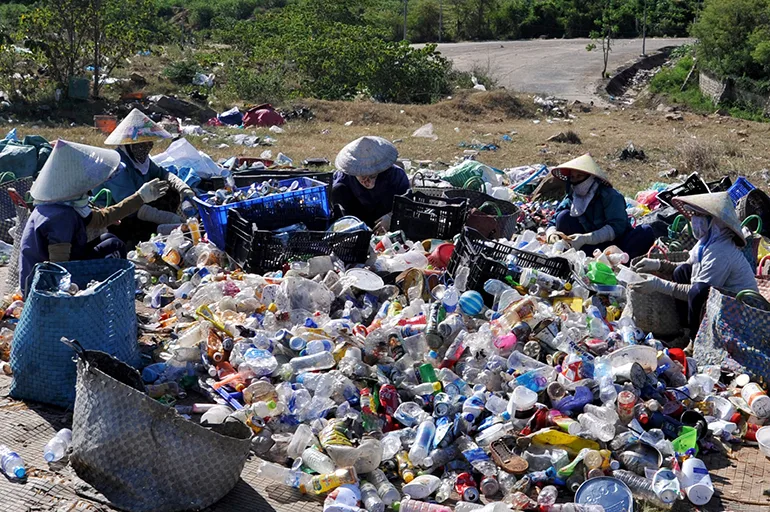
Mechanical recycling of PE has three stages: sorting and removing contaminants, cleaning and drying, then melting and extruding into pellets. The first stage matters most, because paper, labels, metal or other plastics (PVC, PET) mixed in will spoil the whole batch. Each stage does the following.
Step 1: Collection, sorting and incoming inspection
PE scrap is separated by plastic code (HDPE, LDPE) and by colour (milky white, black, other colours) so the recycled pellets have fairly uniform colour and properties. Paper, labels, metal and other polymers must be removed here.
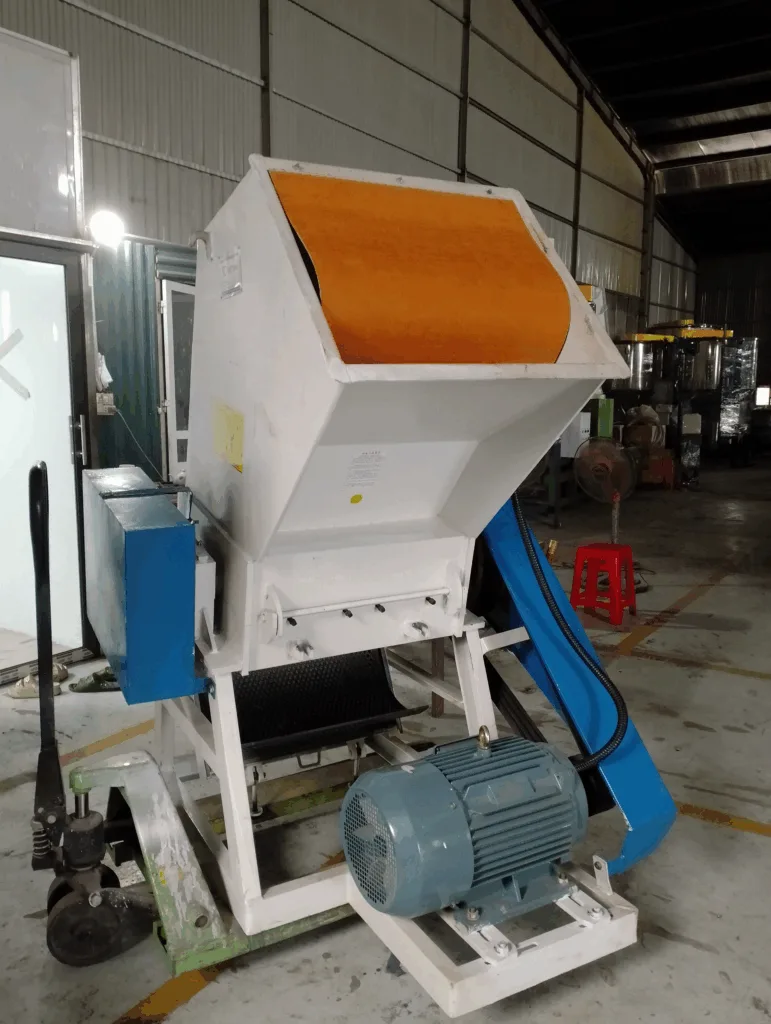
Step 2: Cleaning, grinding and drying
The plastic is washed with water and detergent to remove dust and grease, then ground into small flakes. The flakes must be dried, because leftover moisture creates bubbles during extrusion and lowers the strength of the pellets.
Step 3: Melting, filtering and pelletising
The flakes go into the extruder to melt, pass through a screen that holds back remaining solid contaminants, then are pushed through a die and cut into even pellets. These are recycled PE pellets, used as feedstock for injection moulding, blow moulding or pipe extrusion depending on the grade.
3. Does repeated recycling make PE worse
Yes, and the mechanism is not as simple as the familiar line “polymer chains get shorter”. A 2024 study on HDPE re-extruded many times (Zhang et al., Polymer) recorded more than 95% mass recovered after each pass, meaning no extensive cross-linking, while viscosity rose up to six times around the 4th to 8th pass, because chain scission creates free radicals that then branch. Another study (Mnif and Elleuch, 2015) showed mechanical properties fall after each reprocessing, most at the first, and fall faster when the plastic is both reprocessed and aged. The practical consequence is that recycled pellets are usually blended with virgin resin or used for products that do not need high strength.
4. Applications and safety limits
Recycled PE pellets are usually used for products with no food contact: drainage pipes, bins, pallets, plastic lumber, fencing, secondary shipping packaging and shock-absorbing liners. Food contact is the limit to remember: virgin PE for food packaging must meet rules such as 21 CFR 177.1520 or QCVN 12-1:2011/BYT, while recycled pellets may carry contaminants from earlier use that the plant cannot control, so by default they are not used for food containers or children’s products.
5. Packaging recycling rules in Vietnam
Decree 08/2022/ND-CP places recycling responsibility on packaging producers and importers. Under Appendix XXII, rigid HDPE, LDPE, PP and PS packaging must be recycled at a ratio of 15%, rigid PET packaging at 22%, and the mandatory specification is to recover at least 40% of the mass of the packaging that is recycled at this ratio. Companies selling goods in plastic packaging should check against the original text whether they fall under the obligation, because exemption conditions and the timetable may change.
Frequently asked questions
Can PE plastic be recycled?
Yes. PE is a thermoplastic, so it can be melted and pelletised again. Actual recovery is low: in the United States in 2018, 29.3% of natural HDPE bottles, 10% of bags, sacks and film, and 8.7% of all plastics were recycled.
Is recycling code 2 and code 4 PE different?
Yes. Code 2 (HDPE) is usually bottles, jerrycans and rigid crates, so it is easier to collect and clean. Code 4 (LDPE) is usually film and thin bags, which pick up contaminants easily and take more effort to clean.
Can recycled PE be used for food containers?
It should not. Recycled pellets may carry contaminants from earlier use. Food packaging needs virgin resin that meets rules such as 21 CFR 177.1520 or QCVN 12-1:2011/BYT.
Does PE get worse when recycled many times?
Yes. Mechanical properties fall after each reprocessing (Mnif and Elleuch, 2015), and the chain structure changes through scission and branching (Zhang, 2024), so recycled pellets are usually blended with virgin resin.
Is PE packaging recycling mandatory in Vietnam?
Packaging producers and importers fall under the recycling obligation of Decree 08/2022/ND-CP, Appendix XXII: rigid HDPE, LDPE, PP and PS packaging 15%, rigid PET 22%. Check the original text to see whether you are covered.
Contact ICD Vietnam for advice
ICD Vietnam Industrial Manufacturing Co., Ltd.
North: 3rd Floor, Thang Long A1 Building, Bau Hamlet, Thien Loc Commune, Hanoi, 0983 797 186 / 090 345 9186 / 090 5859 186
South: 551/212 Le Van Khuong Street, Tan Thoi Hiep Ward, District 12, Ho Chi Minh City, 098 6784 186
Email: sales@icdvietnam.com.vn
Zalo: Chat on Zalo now
References
- US EPA, Plastics: Material-Specific Data (US plastic recycling figures 2018) - epa.gov
- Decree 08/2022/ND-CP, Appendix XXII (mandatory recycling ratios by packaging type) - congbao.chinhphu.vn
- Zhang J. et al. (2024), Effect of mechanical recycling on molecular structure and rheological properties of HDPE, Polymer 126866 - doi.org
- Mnif R., Elleuch R. (2015), Effects of reprocessing cycles and ageing on HDPE blends, Matériaux et Techniques, doi:10.1051/mattech/2015056
- 21 CFR 177.1520, Olefin polymers (Cornell LII) - law.cornell.edu
- Wikipedia, Polyethylene (classification by density, melting point, UHMWPE, PEX, 34% market share) - en.wikipedia.org