

Table of Contents
Reviewed and updated by ICD - Week 43/2026
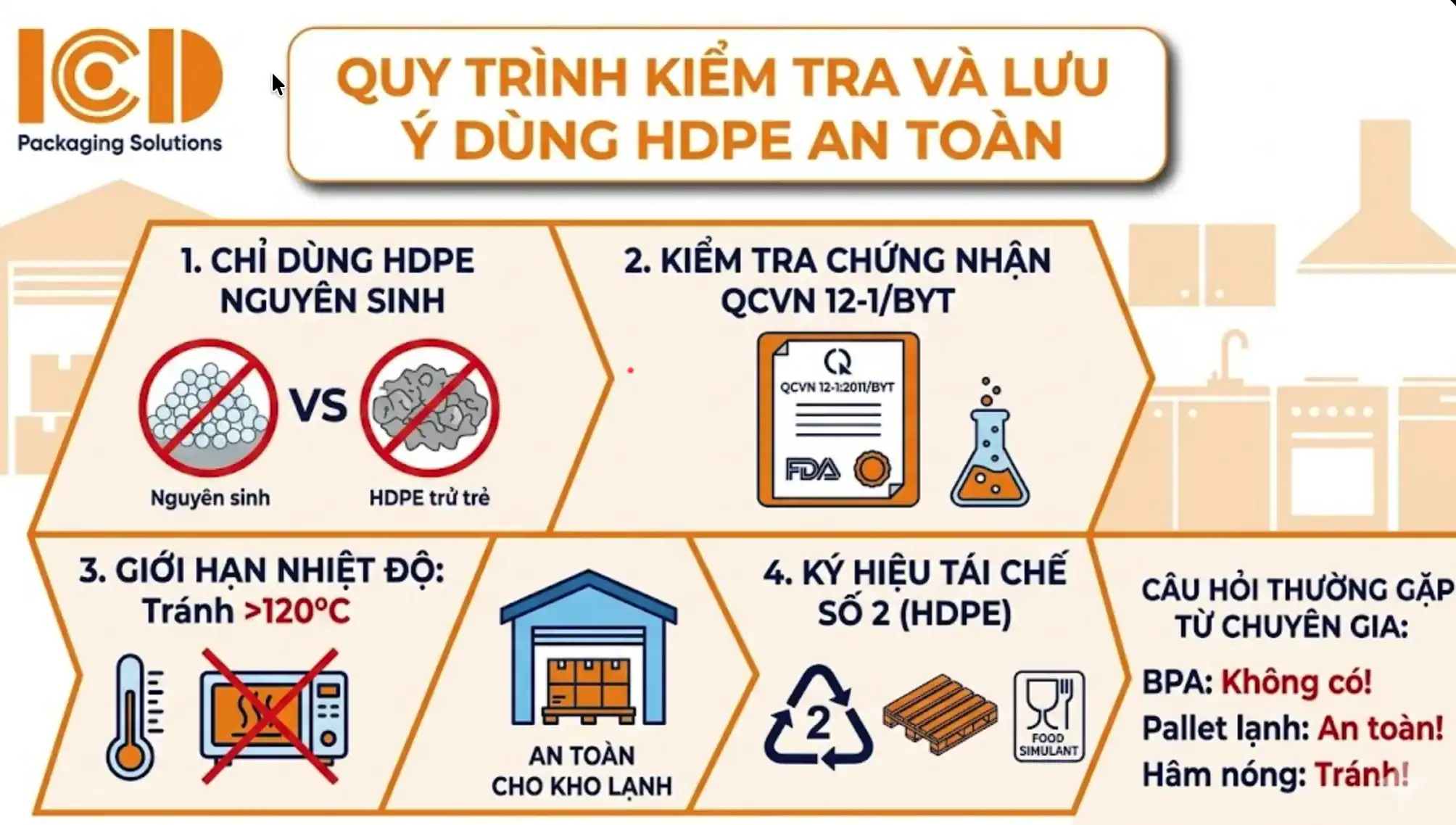
HDPE can be used for food when it is the right grade, used within the right temperature conditions and backed by test records: polyethylene for food contact is regulated by 21 CFR 177.1520 (United States), Regulation (EU) No 10/2011 (Europe) and QCVN 12-1:2011/BYT (Vietnam). The number 2 on a product only identifies the material and does not replace these records.
This article approaches the question from the application side: where HDPE appears in the food chain, which legal framework applies, and how a buyer verifies a product. The mechanism of migration and the toxicity studies are analysed in a separate article on whether HDPE plastic is safe.
Where is HDPE used in the food chain?
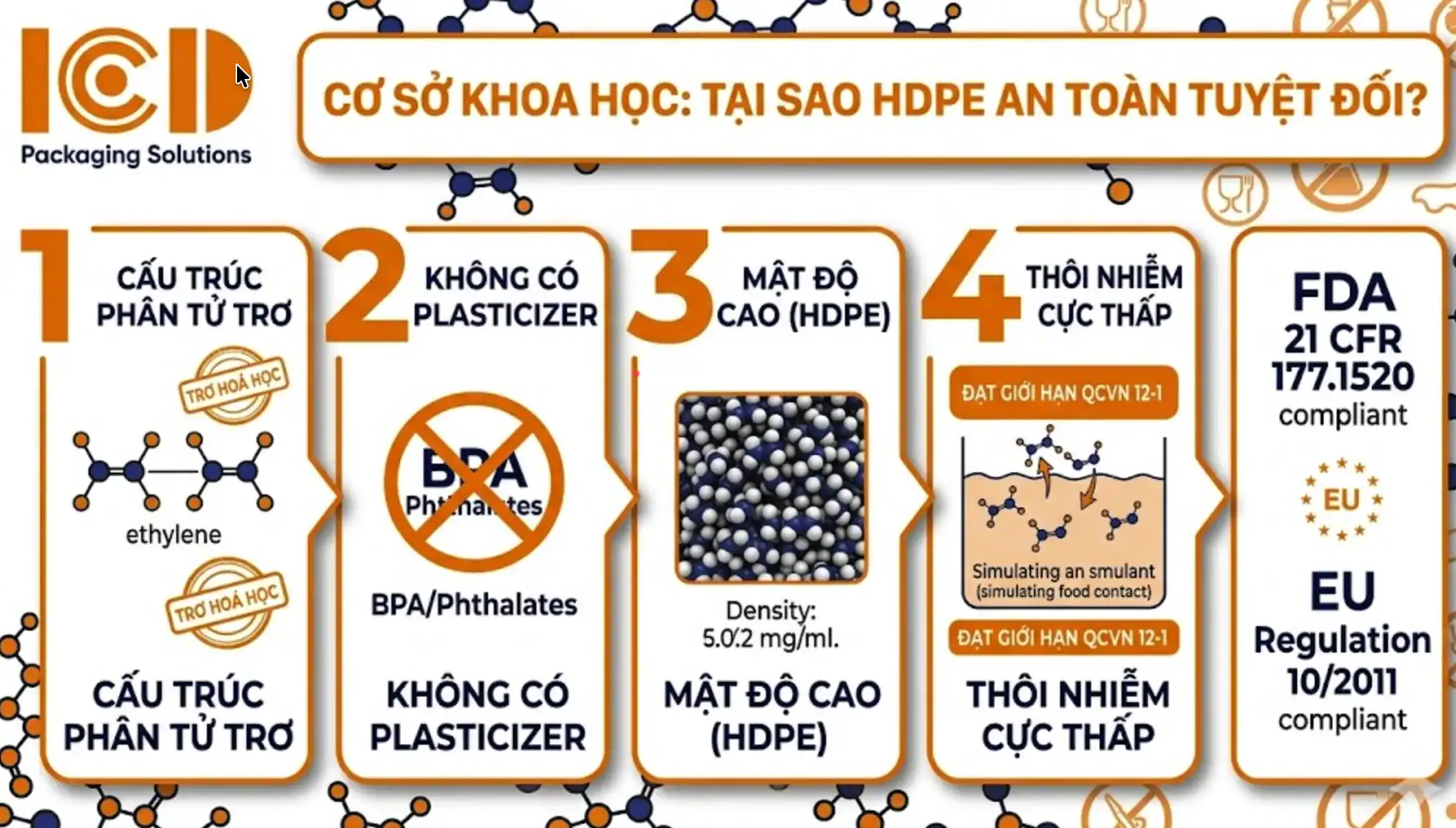
At consumer level, HDPE makes milk bottles, juice bottles, cooking oil jerrycans, tubs and lids. The reasons are its high density (0.93 to 0.97 g/cm3), which gives stiffness and a good moisture barrier, its inertness to many ordinary foods, and the fact that it needs no plasticiser, unlike soft PVC. At industrial level, HDPE makes containers, trays, returnable crates and plastic pallets in food processing plants and cold stores.
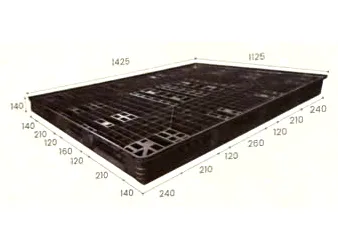
For cold stores, the point worth noting is the brittleness temperature: according to the Chevron Phillips data sheet (ASTM D746), HDPE stays ductile to below -75 °C, so pallets and crates do not crack in deep-freeze conditions. Plastic pallets also do not absorb water, do not rot and are easy to wash with pressure water.
Legal framework: three documents to remember
In Vietnam, plastic products in direct contact with food are subject to QCVN 12-1:2011/BYT of the Ministry of Health: the regulation sets migration limits (for example, the dry residue of polyethylene must not exceed 30 µg/ml) and requires a declaration of conformity. In the United States, 21 CFR 177.1520 lists olefin polymers, including polyethylene, and the permitted additives. In Europe, Regulation (EU) No 10/2011 sets an overall migration limit of 10 mg/dm2 and a list of authorised substances.
Two common claims need correcting. First, HDPE is not the only plastic that is authorised: LDPE, PP, PET and many others have their own rules. Second, QCVN 12-1:2011/BYT has no mandatory clause that the plastic must be virgin; for recycled plastic, Europe has its own Regulation (EU) 2022/1616, which requires the recycling process to be assessed and authorised (EFSA issued a scientific opinion on HDPE recycling processes in 2015).
Temperature and microwaves
A figure of 120 °C for HDPE, or a rule such as “do not use with food above 120 °C”, is misleading. The melting peak of HDPE is 129 to 135 °C, but the real continuous use temperature is about 65 to 80 °C, up to 90 °C for short periods (GEP Plastics). Pouring 100 °C boiling water into a thin HDPE bottle already exceeds the short-term limit. For microwaves, use only containers clearly marked microwave-safe; PP tubs are often marked this way, while HDPE is generally not recommended.
Other plastics in food packaging
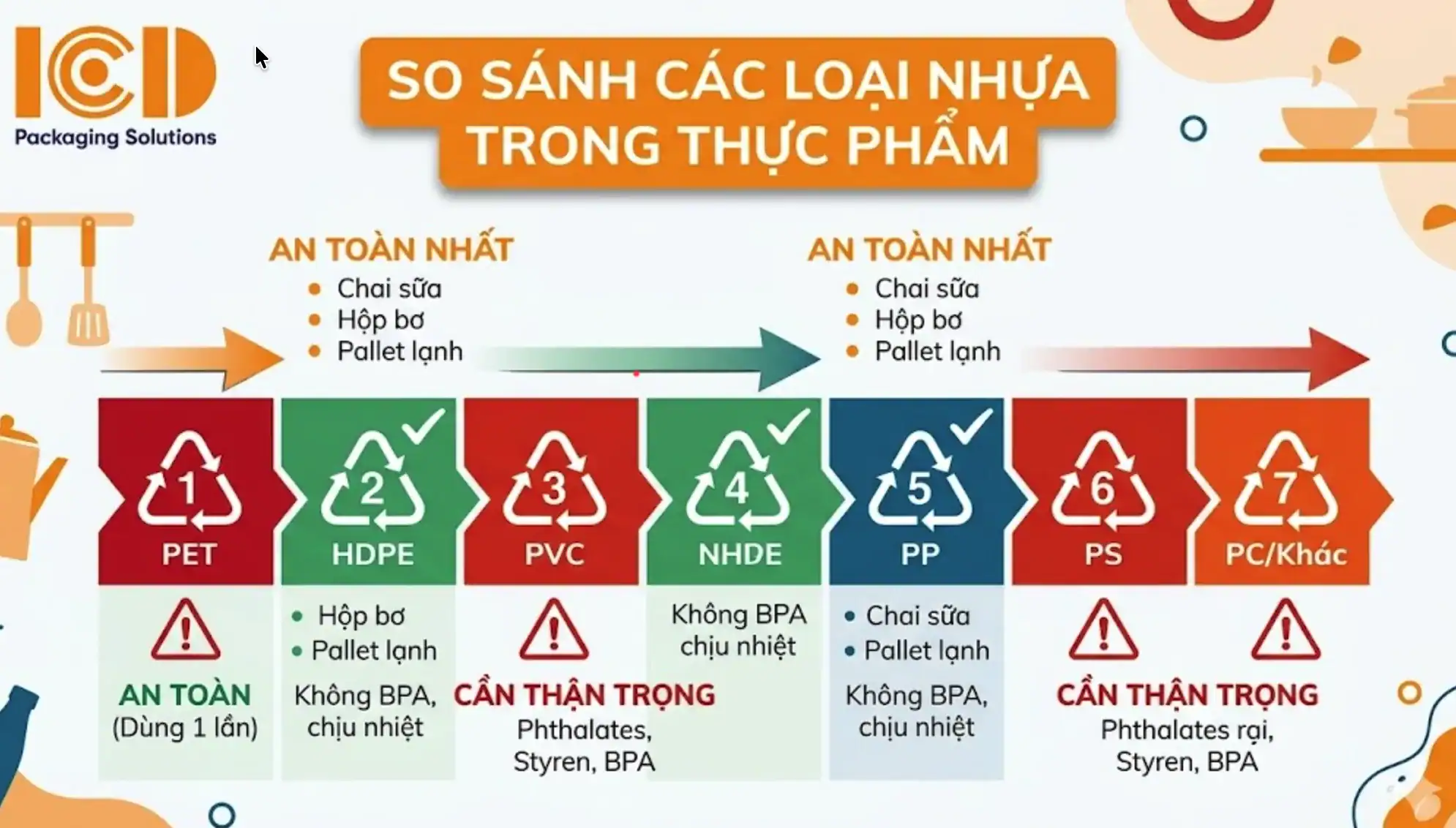
| Code | Plastic type | Notes for food contact |
|---|---|---|
| 1 | PET | Mainly single-use water bottles; do not fill with hot liquids |
| 2 | HDPE | Used for milk, jerrycans, crates; limit high temperatures |
| 3 | PVC | Soft PVC contains plasticisers; avoid hot and fatty food |
| 4 | LDPE | Bags, wrapping film, soft lids |
| 5 | PP | Better heat resistance than HDPE; microwave-safe containers if marked |
| 6 | PS | Foam boxes, cups; avoid hot and fatty food |
| 7 | Other | Includes polycarbonate (which may contain BPA) and multilayer plastics; check each product |
The rule “numbers 2, 4 and 5 are safe, avoid 3, 6 and 7 entirely” is too simple: group 7 includes bioplastics, and the safety of every group depends on the grade, additives and conditions of use.
How to verify HDPE for food use
Do three things when buying HDPE packaging or utensils for food. Ask for the declaration of conformity under QCVN 12-1:2011/BYT or migration test results from an accredited laboratory. Ask whether the resin data sheet states food-contact use and FDA or EU 10/2011 compatibility. Check the number 2 on the product, but treat it only as information about the material. If a supplier cannot provide any of these records, look for another source.
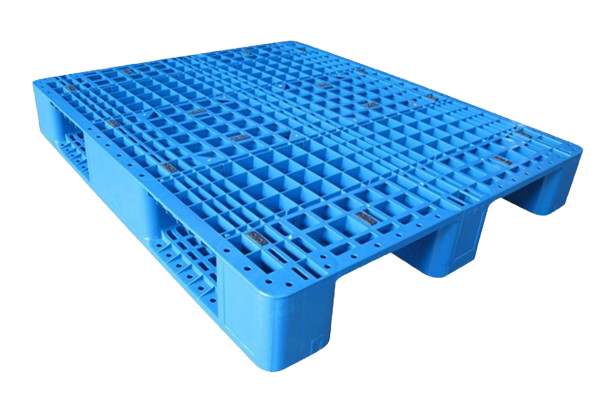
For plastic pallets, a distinction is needed: pallets carrying packaged goods normally have no direct food contact, so the main concerns are easy cleaning, no rotting and no mould. When fresh produce or unpackaged food is placed directly on a plastic surface, ask for records as you would for packaging. As for used HDPE bottles, never reuse bottles that once held chemicals, oil or pesticides to hold food.
ICD Vietnam has worked in the plastics industry since 2011 and supplies HDPE plastic pallets; we do not sell HDPE resin. If you need advice on the right pallet for a food warehouse or cold store, see the contact section at the end of the article.
Frequently asked questions
Does HDPE plastic contain BPA?
No. BPA is a substance used to make polycarbonate and some epoxy resins; HDPE is a polymer of ethylene and contains no BPA.
Are HDPE plastic pallets safe for a food warehouse?
Yes, they can be used, because pallets do not rot, do not grow mould and are easy to wash. Pallets carrying packaged goods normally have no direct contact; if unpackaged food is placed directly on the surface, food-contact records for the product are needed.
How do I know whether HDPE is suitable for food?
Ask for the declaration of conformity under QCVN 12-1:2011/BYT or migration test results, and a resin data sheet that states food use. The number 2 only identifies the material.
Can HDPE be used in a microwave?
Generally not recommended. Use it only when the manufacturer states it is microwave-safe; PP tubs are usually more suitable.
Can recycled HDPE be used for food packaging?
Only when the recycling process is assessed and authorised under the rules (for example Regulation (EU) 2022/1616 in Europe). Ordinary recycled HDPE from mixed scrap is not used for direct food contact.
Contact ICD Vietnam for plastic pallet advice
ICD Vietnam Industrial Manufacturing Co., Ltd.
Northern Vietnam: 3rd Floor, Thang Long A1 Building, Thon Bau, Thien Loc Commune, Hanoi - 0983 797 186 / 090 345 9186 / 090 5859 186
Southern Vietnam: 551/212 Le Van Khuong Street, Tan Thoi Hiep Ward, District 12, Ho Chi Minh City - 098 6784 186
Email: sales@icdvietnam.com.vn
Zalo: Chat on Zalo now
References
- eCFR, 21 CFR 177.1520 Olefin polymers (polyethylene for food contact in the United States) - ecfr.gov
- Ministry of Health (Vietnam), QCVN 12-1:2011/BYT on safety and hygiene of synthetic plastic packaging and utensils in direct contact with food - nafiqad5.gov.vn
- Regulation (EU) No 10/2011 on plastic materials and articles intended to come into contact with food (overall migration limit 10 mg/dm2) - eur-lex.europa.eu
- EFSA CEF Panel, Scientific opinion on the safety assessment of recycling processes for HDPE (2015) - efsa.onlinelibrary.wiley.com
- GEP Plastics, HDPE sheet data sheet (long-term service temperature 80 °C, short-term 90 °C) - geplastics.co.za
- Chevron Phillips Chemical, Marlex 9010 technical data sheet (Vicat, HDT, brittleness temperature) - cpchem.com