Table of Contents
- Quick comparison table of electric and diesel forklifts
- Working environment: the first deciding factor
- The economics: how are investment and running costs worked out?
- How do durability and maintenance differ?
- Working time and intensity: can an electric truck run several shifts?
- Inspection and safety: both types must comply
- When should a business buy an electric forklift?
- When should a business buy a diesel forklift?
- 5 factors for choosing diesel or electric
- Why do many businesses still choose diesel?
- Trend: lithium-battery electric forklifts
- Xilin electric forklifts at ICD Vietnam
- Frequently asked questions
- Contact us for advice on choosing a forklift at ICD Vietnam
- References
Reviewed and updated by ICD - Week 43/2026
Choose an electric forklift when it works in an enclosed warehouse on a flat floor and needs to be clean and quiet; choose a diesel forklift when it runs outdoors, on poor ground, lifts very heavy loads or must run several shifts back to back with nowhere to charge or swap batteries. An electric forklift emits no exhaust at the workplace, has fewer parts to maintain and usually costs less per hour in energy, in return for a higher purchase price and dependence on the battery.
A diesel forklift, by contrast, suits continuous work, harsh outdoor environments and rough terrain. This article goes through each criterion so you can check it against your own warehouse, with a way to work out energy cost yourself from the manufacturer’s specification sheet instead of relying on rough figures, and the inspection rules both types must follow.
Quick comparison table of electric and diesel forklifts
The core difference lies in the energy source: an electric forklift draws power from a battery to run a motor, while a diesel forklift burns diesel fuel in an engine. That brings differences in where it works, cost and maintenance. The table below summarises the main differences between the two:
| Criterion | Electric forklift | Diesel forklift |
|---|---|---|
| Working environment | Indoors, enclosed warehouses, cold stores, flat floors | Outdoors, construction sites, yards, ventilated places |
| Exhaust and noise | No on-site exhaust, quiet operation | Engine exhaust, loud noise |
| Initial investment | Higher (battery and charger included) | Lower |
| Energy cost | Low, less dependent on the oil price | Higher, varies with the oil price |
| Hill climbing, poor ground | Limited, needs a hard, flat floor | Better, high ground clearance, large tyres |
| Working time | Depends on battery capacity, needs charging or battery swap | Continuous, just refuel |
| Maintenance cost | Lower | Higher (oil, filters, coolant) |
One point comparison tables often skip: “electric forklift” is a whole family, from walkie electric pallet trucks, stand-on electric forklifts and reach trucks for high racking to seated counterbalance trucks. Diesel forklifts, meanwhile, come almost only as seated counterbalance trucks. So the fairest comparison is between an electric counterbalance truck and a diesel truck of the same capacity; for jobs such as pulling pallets in narrow aisles or stacking onto racks, diesel has no equivalent version.
Working environment: the first deciding factor
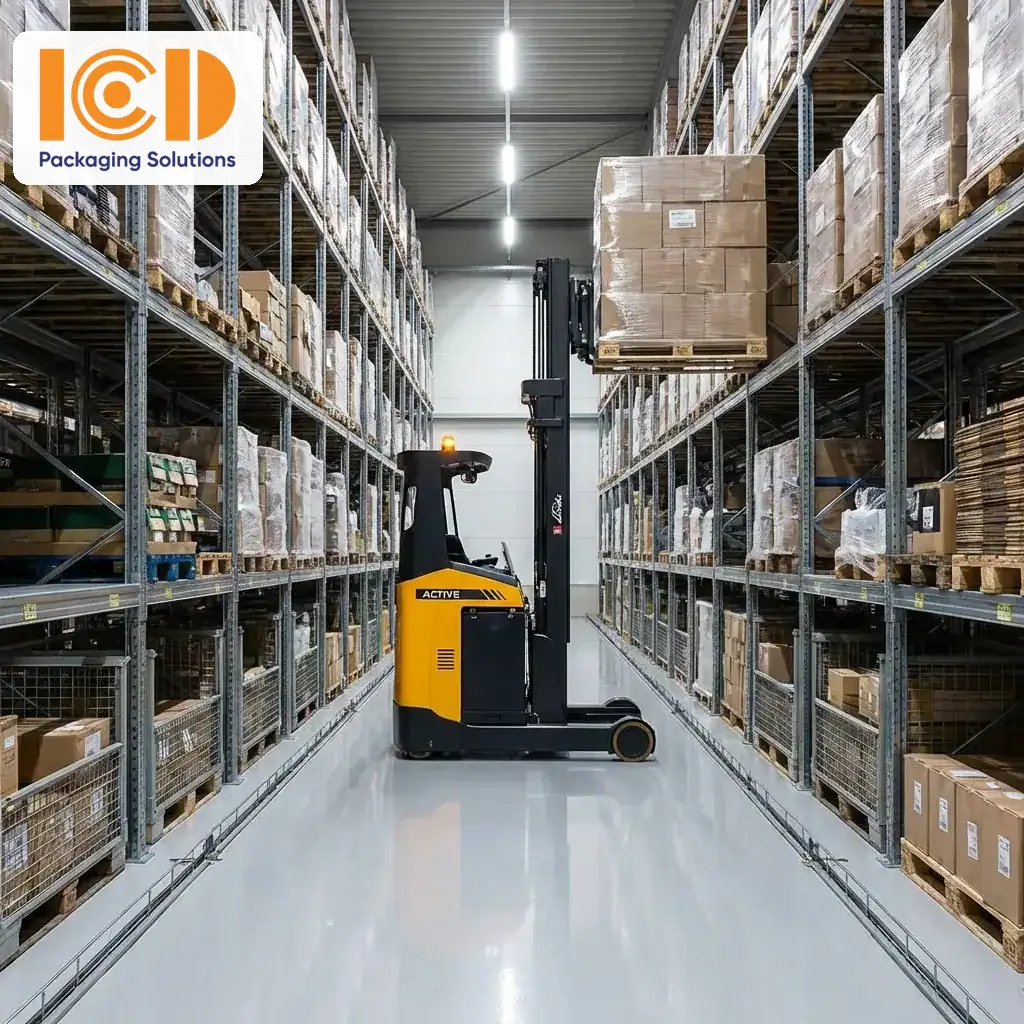
The working environment decides almost immediately which type to choose. The electric forklift is regarded as the standard for modern warehouses, especially industries with strict hygiene demands such as food, electronics or healthcare. With no exhaust system, it keeps warehouse air cleaner and noise lower for the people working around it.
The reason exhaust deserves thought is not only the smell of smoke. In 2012 the International Agency for Research on Cancer (IARC) of the World Health Organization classified diesel engine exhaust in Group 1, the group of agents carcinogenic to humans. In an enclosed, poorly ventilated warehouse, this is a real health risk for workers spending a whole shift beside the truck, and the reason many food and pharmaceutical plants keep diesel trucks out of production areas.
However, electric forklifts usually have solid tyres and low ground clearance, so they need a flat running surface, preferably a concrete or epoxy-painted floor. For electric pallet trucks, ground clearance is only a few tens of millimetres: according to the Xilin specification sheet, the CBD15W-E has a ground clearance of 32 mm and the CBD15W-Lix 35 mm. Potholes, floor joints or warehouse door thresholds higher than this will catch the underside.
The diesel forklift is the real “warrior” outdoors. With a high ground clearance and large pneumatic tyres, this type can cross rough terrain and mud or work in the rain with little worry about electrical short circuits. That is why diesel forklifts still dominate timber yards, steel yards and construction sites.
The economics: how are investment and running costs worked out?
An electric forklift has a higher initial purchase price than a diesel one of the same capacity because the battery and charger must be counted, but its energy and maintenance costs per hour are usually lower. So to know which is cheaper for your warehouse, you need to work out total cost of ownership (TCO) over the whole life of the truck, not just compare purchase prices.
Many articles offer figures like “saves hundreds of millions of dong a year” or “pays back in 2 years”. These figures depend entirely on running hours, average load, and electricity and diesel prices at the time of calculation, so reusing them for another warehouse is very easy to get wrong. A more reliable way is to calculate it yourself from the data of your own truck and warehouse.
How to work out energy cost per hour yourself
Specification sheets from forklift manufacturers are usually laid out on the model of the VDI 2198 guideline (German Association of Engineers), which includes a line for energy consumption in a standard work cycle: kWh per hour for electric trucks, litres per hour for diesel trucks. With these two figures, the calculation is simple:
- Electric forklift: energy cost per hour = consumption (kWh/hour) x the industrial electricity price you pay.
- Diesel forklift: fuel cost per hour = consumption (litres/hour) x the current diesel price.
- Multiply the result by your real running hours per year to get the annual energy cost.
The standard cycle is only a common baseline for comparing trucks. If your warehouse works harder, over longer distances or lifts higher, real consumption will be higher, but the ratio between the two types is still a good basis for deciding.
Items to add to total cost of ownership
Beyond energy, total cost of ownership over many years also includes the items below. Ask for a quote on each item for the exact truck line you are considering, then add them up over the number of years you plan to use the truck:
- Initial purchase price (an electric truck includes the battery and charger).
- Energy or fuel for the operating hours per year.
- Periodic maintenance: engine oil, filters and coolant for diesel; distilled water, terminals and hydraulic oil for electric.
- First battery replacement for electric trucks using lead-acid batteries.
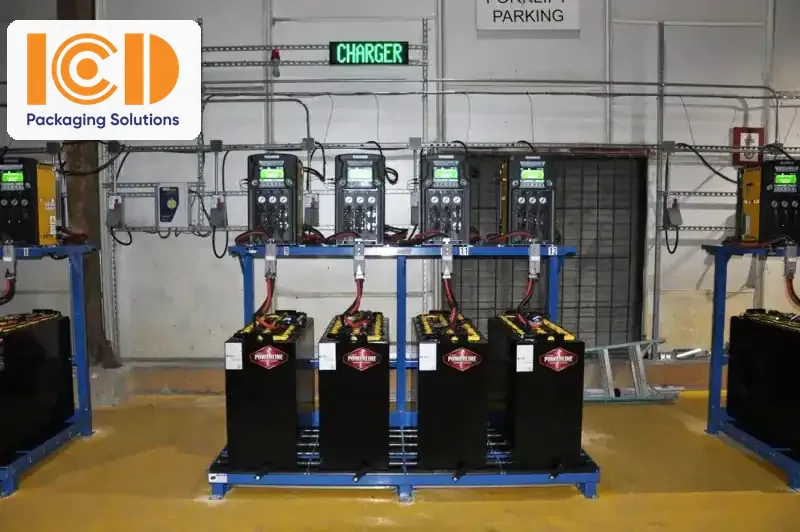
- Charging area, sockets and ventilation (a one-off investment) for electric trucks.
- Periodic safety inspection, which applies to both types with a load rating of 1,000 kg or more.
Put the two total-cost columns side by side and you will see in which year your own warehouse reaches break-even. The more hours the warehouse runs each year, the larger the electric truck’s energy saving and the sooner it makes up the price difference.
How do durability and maintenance differ?
An electric forklift has a simpler drivetrain than a diesel one: no internal combustion engine with pistons, engine cylinders, a cooling system or an engine oil filter. So the electric truck’s maintenance list is shorter, focused mainly on brakes, wheels, the battery and the hydraulic lift system. Note that an electric truck still has hydraulic cylinders to raise the forks like a diesel truck, so hydraulic oil and seals still have to be checked.
With lead-acid batteries, the most frequent task is checking and topping up distilled water. The operating manual of the Xilin CQDH series electric forklift describes measuring electrolyte density, with a standard of 1.24 at 25 °C for tropical climates; an electrical check every 3 months; and replacing HL-N46 or HL-N68 hydraulic oil after 12 months. The maker also notes that electrolyte temperature while charging should not exceed 45 °C, so the charging area should be cool and airy.
A diesel forklift, by contrast, is like a miniature truck. You must change engine oil, replace the air filter and fuel filter, and check coolant regularly. Without careful maintenance, a diesel engine degrades easily, burns more fuel and emits more black smoke, lowering the truck’s resale value.
Working time and intensity: can an electric truck run several shifts?
Continuous working time is the biggest weakness of electric forklifts using traditional lead-acid batteries. When the battery runs low, the truck must stop for several hours of charging and let the battery cool before use, which is hard for businesses running three continuous shifts. The common fix is buying a spare battery set to swap in turn, but this cost is not small and it needs space and battery-lifting tools.
Lithium batteries change this equation for small trucks. Xilin designed the CBD15W-II Li lithium electric pallet truck with a side-mounted battery, and changing the battery takes only about 10 seconds, with no tools or extra equipment. The CBD15W-Lix uses a 48V/20Ah battery weighing only 9.7 kg, and its electromagnetic brake has a regenerative braking function, meaning it recovers some energy when slowing down. With trucks like these, preparing two batteries to alternate is enough to keep the truck running almost continuously.
A diesel forklift is different: just refuel and the truck keeps working at once. That high availability keeps it a familiar choice in peak goods periods or at ports, where trucks run day and night.
Inspection and safety: both types must comply
Whether electric or diesel, motorised forklifts with a lifting capacity of 1,000 kg or more fall in the list of machinery and equipment with strict occupational safety requirements, Section I, item 18 of Circular 36/2019/TT-BLDTBXH of 30 December 2019 (effective 1 March 2020). So choosing an electric truck does not let a business avoid the inspection obligation under Article 31 of the Law on Occupational Safety and Hygiene No. 84/2015/QH13.
The inspection procedure for self-propelled industrial forklifts with a rated load of 1,000 to 10,000 kg is QCVN 25:2015/BLDTBXH, issued with Circular 51/2015/TT-BLDTBXH of 8 December 2015. The periodic inspection cycle is 3 years, and may be shorter depending on the truck’s condition. This regulation states that it does not apply to low-lift trucks that do not stack loads, so for an electric pallet truck that only lifts a pallet about 110 mm (such as the CBD15W-E), ask the inspection body whether the truck is subject to inspection.
Operators are also closely regulated. Operating machinery and equipment on the list above is work with strict requirements under Circular 06/2020/TT-BLDTBXH of 20 August 2020, so operators must receive safety training under Decree 44/2016/ND-CP (amended by Decree 04/2023/ND-CP). QCVN 25:2015 also requires the business to assign operators by written decision, check the truck at the start of each shift and retrain operators when they switch to another type of truck. On design, the international safety standard for self-propelled forklifts is ISO 3691-1.
When should a business buy an electric forklift?
Prioritise investing in an electric forklift if your business falls into the cases below:
- Operating in the food, pharmaceutical or fast-moving consumer goods (FMCG) industries.
- A small, tight warehouse that needs a small turning radius.
- An enclosed, roofed warehouse that needs a quiet working environment for staff.
- Steady working intensity of about 1-2 shifts a day.
- Wanting to cut monthly operating costs as much as possible.
For a narrow warehouse, the figure worth looking at is the minimum aisle width (Ast) on the specification sheet. The Xilin CBD15W-E electric pallet truck has a minimum aisle width (Ast) of about 2,260 mm and a turning radius of 1,454 mm according to the maker’s specification sheet, small enough to work between racks where a seated counterbalance truck struggles to turn.
When should a business buy a diesel forklift?
A diesel forklift is the right choice when:
- Working in outdoor yards with no charging power or uneven ground.
- Lifting very heavy blocks of goods that the available electric trucks cannot handle reliably.
- Often climbing loading ramps (container ramps) to load goods, requiring high tractive force.
- Working overnight, three shifts with no break time to charge or swap batteries.
On hill climbing, read the loaded gradeability line on the specification sheet. Small electric pallet trucks are designed for flat floors: the manual for the Xilin CBD15W-LiX states a maximum loaded gradient of only 5% and requires use on a hard, flat floor. If your container ramp is steeper than the figure on the specification sheet, an electric truck of that type is not a suitable choice.
5 factors for choosing diesel or electric
If you need a table to decide quickly, check the five factors below. The more factors your warehouse falls into one column, the more it leans to that truck type; environment and regulation factors are usually decisive.
| Factor | Choose diesel | Choose electric |
|---|---|---|
| Environment | Outdoors, open warehouse | Indoors, enclosed warehouse, food or pharmaceutical store |
| Operating time per day | Several shifts back to back, no break for charging | By shift, with time to charge or swap batteries |
| Maximum load | Very heavy, beyond the load range of available electric trucks | Within the load range of the electric line under consideration |
| Terrain | Rough floor, slope, dirt | Flat floor, epoxy |
| Environmental regulation | Not important | No exhaust required (pharmaceutical, food, chemical warehouses) |
Why do many businesses still choose diesel?
Although an electric truck’s running cost is usually lower, quite a few Vietnamese businesses still choose diesel, and most of the reasons are sound. The first reason is capital: an electric truck needs a higher initial investment, and businesses with thin capital tend to prioritise the smaller up-front spend even though total cost over many years may be higher.
The second reason is electrical infrastructure. Many warehouses do not have three-phase power of enough capacity for a charging area, and upgrading the electrical system is a separate investment. With it comes the worry of batteries wearing out early, often from experience with low-quality batteries or incorrect charging, which leads buyers to choose diesel to be safe.
For a business with only one or two trucks, the cost of building a charging area and ventilation divided across so few trucks becomes hard to justify. Finally there is the need to run ad hoc outside hours: when a truck must be ready at any moment, just topping up fuel remains a clear advantage of diesel. Understanding these reasons helps you see whether your case really needs diesel, or only needs the real bottleneck solved, such as adding quick-swap lithium batteries.
Trend: lithium-battery electric forklifts
Lithium battery technology is narrowing the working-time gap between electric and diesel trucks. Unlike lead-acid batteries, lithium batteries need no distilled water, are much lighter and can be opportunity-charged during breaks, so they suit warehouses that want to drop weekly battery maintenance altogether.
In Xilin’s electric pallet truck lines, customers can choose between lead-acid and lithium batteries. According to the maker’s specification sheet, the CBD15W-E uses a 24V/65Ah battery weighing 36 kg or a 24V/105Ah battery weighing 49 kg, with an optional 24V/50Ah lithium battery supplied with a 24V/20A charger. The maker’s manual also notes that lithium batteries work well in a range of -10 to 45 °C, and that if the truck is stored for a long time it should be charged and discharged once every 3 months.
Electric forklifts emit no exhaust at the workplace, so they also support a business in emission-reduction programmes and environmental reporting. Even so, a lithium battery costs more than a lead-acid one, so it is most worth the investment when the truck runs many hours and needs flexible opportunity charging.
Xilin electric forklifts at ICD Vietnam
Choosing the wrong truck line wastes not only money but also labour productivity. ICD Vietnam is a distributor of Xilin forklifts of the Ningbo Ruyi Group, focused on pallet trucks and electric forklifts for indoor warehouses: electric pallet trucks, stand-on electric forklifts and reach trucks for racked warehouses.
Related product: see the ICD EPT20 low-profile electric pallet truck in the electric forklift range supplied by ICD Vietnam.
Frequently asked questions
1. Is an electric or a diesel forklift cheaper?
A diesel forklift is usually cheaper to buy, while an electric one is usually cheaper to run because its energy and maintenance costs are lower. To know which is cheaper for your warehouse, work out total cost of ownership: multiply the energy consumption on the specification sheet (kWh/hour or litres/hour) by the electricity price, diesel price and running hours per year, then add purchase price, maintenance, battery replacement and the charging area.
2. Does an electric forklift have to be inspected?
Yes, if it is a motorised forklift with a lifting capacity of 1,000 kg or more. This type is in the list of Circular 36/2019/TT-BLDTBXH of 30 December 2019, inspected under QCVN 25:2015/BLDTBXH with a periodic cycle of 3 years, the same as a diesel forklift.
3. Can an electric forklift work outdoors?
Electric forklifts suit hard, flat floors indoors best. Electric pallet trucks have a ground clearance of only about 32-35 mm and low loaded gradeability, so they do not suit dirt yards, uneven ground or slopes. If you must work outdoors often, a diesel forklift is the safer choice.
4. How do lithium-battery electric forklifts differ from lead-acid ones?
A lithium battery needs no distilled water, is much lighter and can be opportunity-charged during breaks. For example the 48V/20Ah battery of the Xilin CBD15W-Lix weighs only 9.7 kg, while the CBD15W-II Li changes its side battery in about 10 seconds. In return, a lithium battery costs more than a lead-acid one.
5. How do I contact ICD Vietnam?
Call the hotline 0983 797 186, 090 345 9186 or 090 5859 186, message Zalo icdvietnam, or email sales@icdvietnam.com.vn. Send aisle information, floor type, load and number of shifts with it to get advice faster.
6. What policies does ICD Vietnam have for forklifts?
ICD Vietnam distributes Xilin (Ningbo Ruyi) forklifts in Vietnam, with a 12-month warranty. Delivery terms and technical support are stated specifically when you order.
Contact us for advice on choosing a forklift at ICD Vietnam
Hotline: 0983 797 186 | 090 345 9186 | 090 5859 186
Zalo: icdvietnam | Email: sales@icdvietnam.com.vn
Delivery within Hanoi and Ho Chi Minh City in 1-3 working days under ICD Vietnam’s shipping policy.
References
- Specifications of the CBD15W-E/CBD20W-E electric pallet trucks: Ningbo Ruyi (Xilin), Electric Walkie Pallet Truck.
- Specifications of the CBD15W-Lix lithium electric pallet truck: Ningbo Ruyi (Xilin), Li-ion Powered Pallet Truck CBD15W-Lix.
- Quick-swap battery of the CBD15W-II Li: Ningbo Ruyi (Xilin), Li-ion Powered Pallet Truck CBD15W-II Li.
- Battery charging notes: Ningbo Ruyi (Xilin), Common sense of the use of electric stacker; operating manuals of the Xilin CQDH series electric forklift and the CBD15W-LiX.
- IARC, Press Release No. 213 of 12 June 2012 on diesel engine exhaust: International Agency for Research on Cancer.
- Circular 36/2019/TT-BLDTBXH of 30 December 2019, list of machinery and equipment with strict occupational safety requirements: National Database of Legal Documents.
- QCVN 25:2015/BLDTBXH on occupational safety for forklifts, issued with Circular 51/2015/TT-BLDTBXH of 8 December 2015: National Database of Legal Documents.
- Law on Occupational Safety and Hygiene No. 84/2015/QH13 of 25 June 2015; Circular 06/2020/TT-BLDTBXH of 20 August 2020; Decree 44/2016/ND-CP, amended by Decree 04/2023/ND-CP.
- ISO 3691-1, Industrial trucks, Safety requirements and verification, Part 1: Self-propelled industrial trucks; VDI 2198, Type sheets for industrial trucks.