Table of Contents
Reviewed and updated by ICD - Week 43/2026
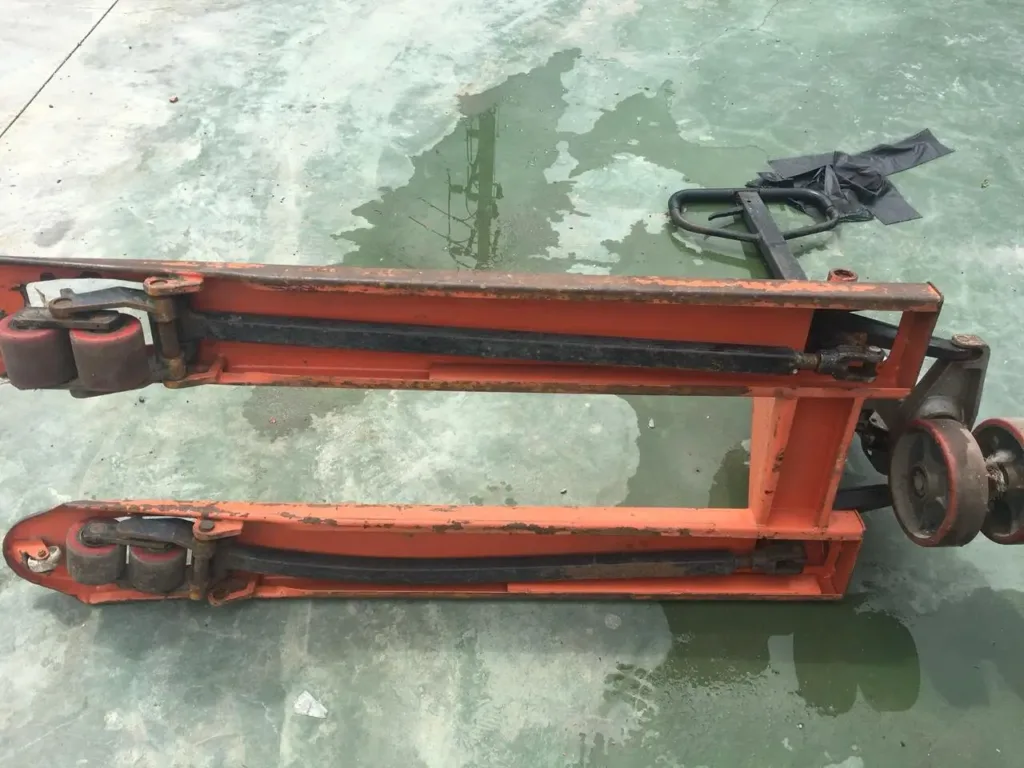
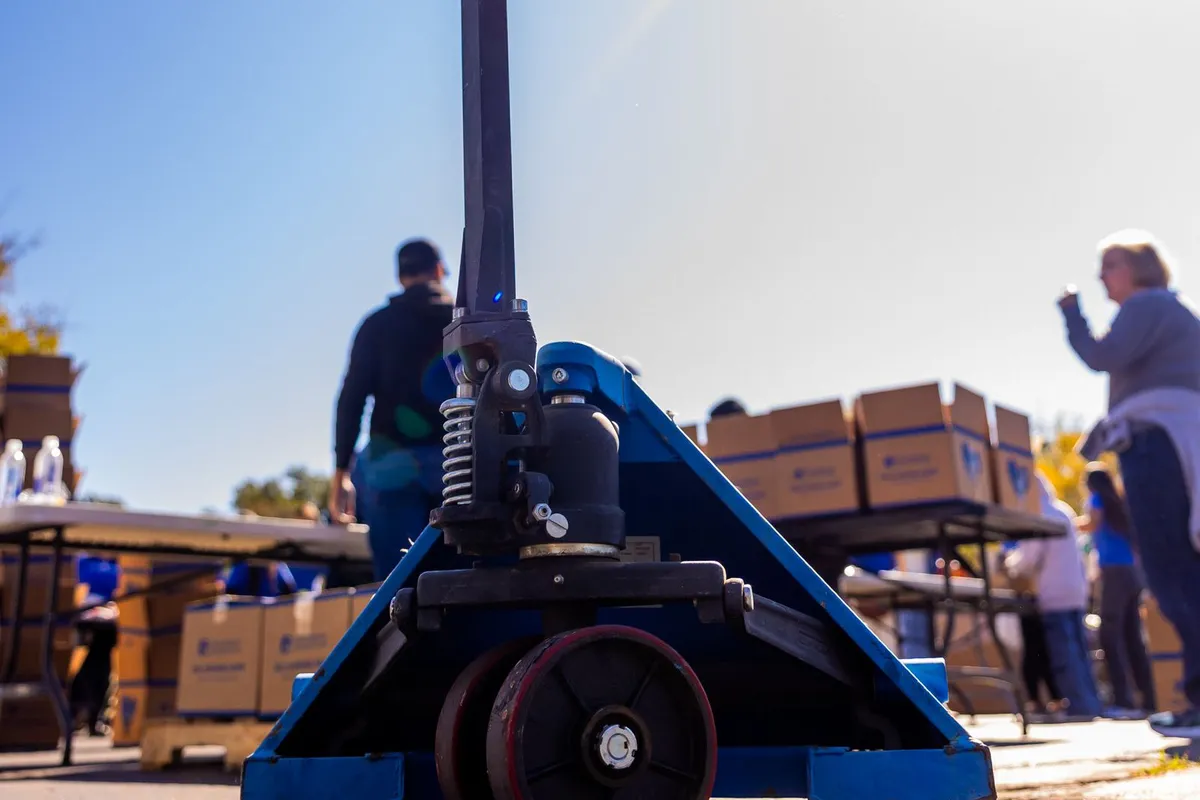
The hydraulic jack of a hand pallet truck is the pump assembly right behind the handle: a small pump rod forces oil through a ball valve into the lift cylinder, and the ram pulls a linkage that presses the two load wheels down, which lifts the fork frame and the load off the floor. Unlike a bottle jack or a floor jack used to raise a vehicle, this jack does not lift straight into the load but indirectly through the linkage, so each stroke raises the forks only a short distance: about 11 mm on a Xilin DF-III.
Quick summary:
- The jack assembly consists of a pump rod, a ram, two one-way ball valves, a release valve and the sealing gaskets, all inside one pump body.
- The six common faults should be checked in order from the cheapest job (oil, air) to the most laborious (taking the pump apart, replacing the ram).
- The oil for the pump assembly is 46# anti-wear hydraulic oil, about 0.41 litres, according to the Xilin manual.
How does a pallet jack’s jack differ from an ordinary hydraulic jack?
In principle the two are identical: when the pump piston retracts it draws oil from the reservoir through the intake valve, when it advances it pushes oil through the check valve into the lift cylinder, and pressure only builds when the intake ball is pressed shut. The difference lies in the link from the cylinder to the load, and that decides where you look when the truck fails.
| Criteria | Bottle jack | Floor jack | Pallet jack’s jack |
|---|---|---|---|
| How force reaches the load | Vertical ram pushing straight into the load | Horizontal piston pushing an angled lever arm, the saddle rising in an arc | Ram pulls a linkage, the linkage presses the load wheels down and the fork frame rises |
| Wheels | None | Small wheels, used only on hard, flat floors | Steering and load wheels, pulling the whole load along |
| How high it lifts | Limited if the ram is single-stage | Low chassis but long reach | Only enough to lift the pallet off the floor, typically from about 190 mm at full lift |
| What it is used for | Lifting and holding an object still | Raising a low vehicle to work underneath | Lifting a pallet slightly and moving it around the warehouse |

The practical consequence is clear. If the handle has force, the ram has moved up and the forks still do not lift, the fault is in the mechanical part (linkage, pins) and not the hydraulics, and taking the pump apart at this point just wastes effort. Conversely, if the ram does not move up or sinks back, that is a matter of oil, valves and seals. The rest of the article follows this approach.
What does the jack assembly consist of and how does it work?
Before getting into faults, watch the video below to picture the two pump strokes. Summary from the video: pulling the handle up draws oil from the reservoir through the first ball valve; pressing the handle down makes the small pump rod force oil through the second ball valve into the large cylinder and push the ram up, and the cycle repeats until the pallet reaches the desired height.
According to the Xilin spare parts catalogue for the BF-series pump assembly, the main parts have the following sizes; other models can differ, so check the code on your truck when needed.
- Pump rod Ø18 x 97 mm, with a dust seal and a size 18 Y-seal, and a return spring that pushes the rod up after each press of the handle.
- Ram Ø31.5 x 263 mm, with a guide sleeve, Y-seal and dust seal of size 31.5.
- Two steel balls act as the check valves, sizes 6.35 mm and 5 mm.
- The release valve is adjusted by an M10 x 1 screw; the cylinder cap O-ring is 65 x 2.65 mm.

All three working strokes are tied to a specific part, and that is where you infer the fault:
While the truck holds a load, the oil pressure created by the load itself presses the outlet ball onto its seat and holds the ram in place. So if the outlet ball or the release valve does not seal, the forks will sink gradually even though not a drop of oil leaks out. The Ø31.5 mm ram has about 3 times the cross-section of the Ø18 mm pump rod, and together with the lever arm at the handle, human hand force is enough to lift a heavy load; in return, the lift per stroke is short.
Six common faults and the order in which to check them
The six faults below are listed in the order to check them: cheap and fast jobs first, taking the pump apart saved for last.
1. Spongy handle, many strokes needed before the forks move
Low oil or air in the system. The air is compressed and swallows the stroke, so pressure does not reach the ram. According to Xilin’s instructions, after the truck has been transported or laid on its side, move the lever to the lower position and pump the handle several times to bleed the air, then check the oil level and top up if it is low. A DF-III needs about 10 strokes for the full travel; if your truck needs clearly more even after bleeding, go to item 3.
2. Forks will not lower
Check whether the chain pulling the release valve is tight or broken, whether the plate is jammed, and whether the release valve adjusting screw is out of position. These are all outside the pump body. If the release valve is already open and the ram still will not retract, suspect a bent ram or one stuck in the cylinder; with a bent or deeply scored ram even a new seal will not hold for long, so replace the ram rather than trying to straighten it.
3. Light handle but the forks will not rise
Usually a dirty check valve ball or a worn valve seat, so the pumped oil makes a loop without being held. Take out the valve assembly, wash the ball and seat with a degreaser, and look for scratches on the ball or dents in the seat; replace a deformed ball or a worn seat. If the oil is cloudy or has debris, drain all the old oil.
4. Lifts and then sinks slowly
Use the internal/external leak test above. With no oil stain: suspect a worn Y-seal on the ram, or an outlet ball and release valve that do not seal. Replacing the ram seal means taking the ram out, wiping the cylinder bore clean and fitting the seal the right way round.
5. Oil leaking outside
Wipe the whole pump assembly clean, pump a few times and see where the oil seeps from. Oil around the ram neck is the rod seal; under the handle is the pump rod seal; at the edge of the cylinder cap is the O-ring.
6. Heavy handle, forks will not rise
Wrong type of oil or oil that is too dirty. The pump assembly needs 46# anti-wear hydraulic oil, and engine oil must never be used. Drain all the old oil, wash the reservoir, fill with new 46# oil and bleed the air again as in item 1.
Taking the pump apart has two easy mistakes: the return spring on the pump rod is under compression, and the order of the seals when reassembling. If you are not confident, contact ICD Vietnam, whose technical team repairs hand pallet trucks; call the hotline at the end of the article for advice first.
Maintenance to make the jack last longer
The jack assembly needs hardly any complicated maintenance, but a few small jobs done regularly decide the life of the seals and valves. The schedule below follows the Xilin hand pallet truck manual.
- Check the oil level every 3 months; use 46# anti-wear hydraulic oil, about 0.41 litres for the pump assembly, and never engine oil.
- Lubricate joints and pins monthly; check the wheels and axle daily.
- At the end of a shift lower the forks to their lowest so the ram retracts into the cylinder, which reduces dust settling on the rod and seals.
- Never lift beyond the load rating on the truck’s plate.
Frequently asked questions
1. What is the hydraulic jack of a hand pallet truck?
It is the hydraulic pump assembly behind the handle, made up of a pump rod, a ram, two one-way ball valves, a release valve and seals. Oil is pumped into the lift cylinder and the ram pulls a linkage so the fork frame lifts the load.
2. How does a pallet jack’s jack differ from a bottle jack?
Same principle of pumping oil through a check valve, but a bottle jack pushes straight into the load while a pallet jack lifts indirectly through a linkage and load wheels, so the travel is short and there is extra mechanical hardware to check when it fails.
3. What should I check first if a pallet jack will not pump up?
Check oil and air first: bleed the air by moving the lever to the lower position and pumping the handle several times, then look at the oil level. Only if that does not cure it move on to the release valve, ball valves and seals; take the pump apart last.
4. Why will the truck not pump up after I changed the oil?
Usually air got into the pump assembly during the oil change. Bleed the air as above and pump a few times; only if it still does not rise suspect the ball valve or seals.
5. What oil should I use in a pallet jack’s jack, and how much?
According to the Xilin manual, use 46# anti-wear hydraulic oil, about 0.41 litres for the pump assembly, with the level checked every 3 months. Never use engine oil.
Contact us for advice on the right truck
Hotline: 0983 797 186 | 090 345 9186 | 090 5859 186
Zalo: icdvietnam | Email: sales@icdvietnam.com.vn
ICD Vietnam distributes Xilin forklifts and also repairs and rents forklifts. New trucks carry a 12-month warranty; delivery within Hanoi and Ho Chi Minh City takes 1-3 working days under the shipping policy.
See a related product: ICD BF-III 2.5-tonne low-profile hand pallet truck, with a one-piece cast pump and overload valve, distributed by ICD Vietnam.
References
- Ningbo Ruyi (Xilin), manual and spare parts catalogue for the BFC6 weighing hand pallet truck: 46# hydraulic oil, oil quantity, bleeding, inspection schedule, sizes of the pump rod, ram, valve balls and O-ring.
- BF-III and DF-III hand pallet truck specifications: Ningbo Ruyi (Xilin), Hand Pallet Truck.
- Wikipedia, the Hydraulic jack, Bottle jack and Floor jack sections of the article Jack (device), and the Pallet jack article (linkage lifting principle, typical lift height): comparison of jack types.
Written by Le Van Thang and the ICD Vietnam technical team, distributor of Xilin (Ningbo Ruyi) forklifts. Last updated: 19 October 2026.