Table of Contents
- Formula for PE film roll weight
- Example: a 300 m roll, 500 mm wide, 17 micron thick
- Working backwards: from film weight to roll length
- Converting between micron, mil and gauge
- How many grams of film does one pallet use?
- Checking with a scale: three tests that need no expensive equipment
- Frequently asked questions
- Contact us for PE film advice
- References
Reviewed and updated by ICD - Week 43/2026
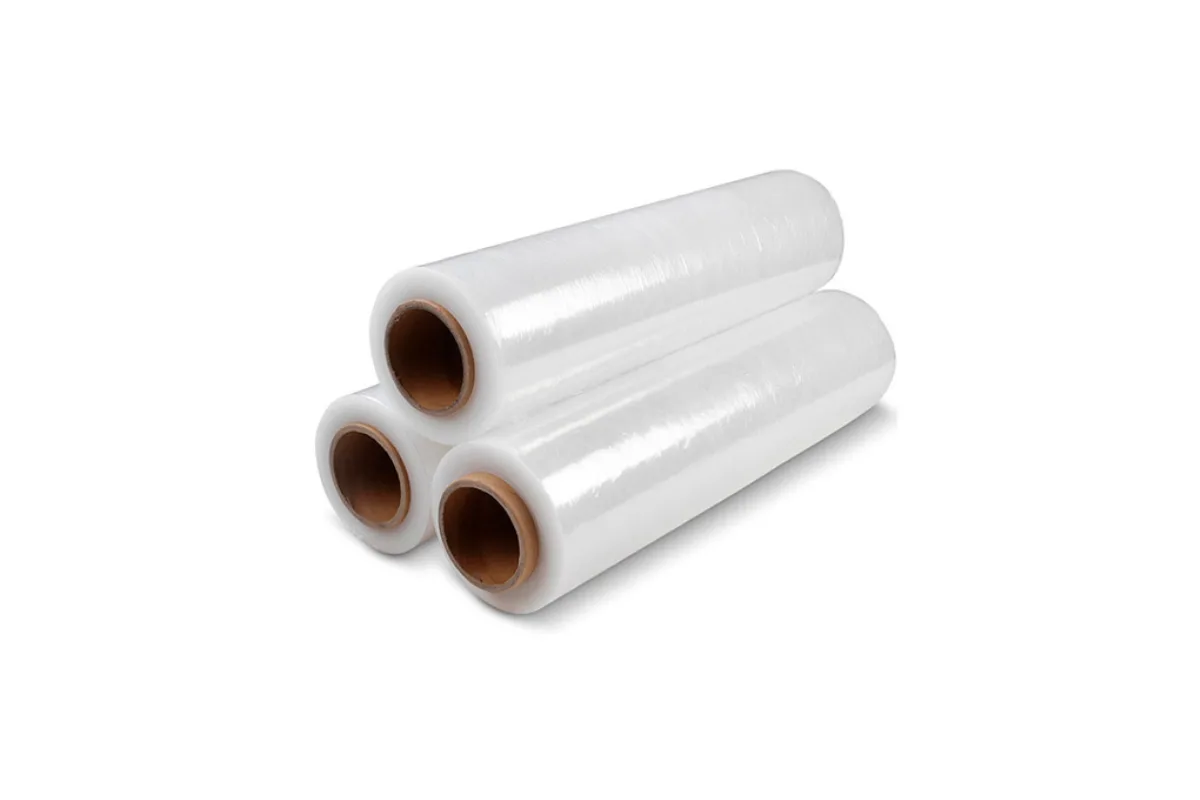
PE film weight (kg) = length (m) x width (m) x thickness (m) x 920 (kg/m³). Pallet stretch film is made from LLDPE, with a density of 0.918-0.919 g/cm³ according to resin producers’ data sheets, rounded to 920 kg/m³. A roll 300 m long, 500 mm wide and 17 micron thick holds 2.346 kg of film; add a 0.5 kg core and the whole roll weighs 2.846 kg.
Knowing this calculation lets you check two things at once: whether a delivered roll holds the film weight the supplier states, and how many grams of film each pallet actually uses so you can set a purchasing allowance. The tool right below calculates the second; the rest of the article explains the formula, unit conversion and how to cross-check against real weighing.
| Chu vi pallet | - |
| Number of wraps | - |
| Film length per pallet | - |
| Film weight per pallet | - |
| Film cost per pallet | - |
| Cost per day | - |
| Cost per month (26 days) | - |
Formula for PE film roll weight
Film weight equals film volume times density, and film volume is length times width times thickness. Add the core weight to get the weight of the whole roll.
Whole roll weight (kg) = film weight + core weight
Convert units to meters before calculating: 17 micron is 0.000017 m (divide by 1,000,000), and a 500 mm width is 0.5 m. The most common mistake is forgetting to convert micron to meters, which throws the result off by a factor of a million.
Where does the 920 kg/m³ density come from?
Pallet wrap is stretch film made from LLDPE, which is different from heat-shrink film. Resin producers’ data sheets give density measured under ASTM D792: grade VINPOL LH03218, designed for cast pallet stretch film, is 0.918 g/cm³; grade InnoPlus LL7625A, also used for cast stretch film, is 0.919 g/cm³. Converting to kg/m³ means multiplying by 1,000, so using 918, 919 or the rounded 920 gives results that differ by less than 0.2%.
Watch the units: 0.92 is in g/cm³. The formula uses meters, so it must be converted to 920 kg/m³; if you mistakenly enter 0.92 in the meter formula, the result will be 1,000 times smaller than reality.
Example: a 300 m roll, 500 mm wide, 17 micron thick
This roll is equivalent to the 17 micron, 500 mm wide hand-wrap group that ICD Vietnam supplies, in whole-roll weights from 2.1 to 5.0 kg. The 2.1 kg roll (ICD-MPE21) has a 0.3 kg core, while the 2.4 kg roll (ICD MPE2.4) has a 0.5 kg core, so the roll that is 0.3 kg heavier on the label holds only a little over 0.1 kg more film. That is why you must subtract the core before comparing two rolls.
Working backwards: from film weight to roll length
Length (m) = film weight (kg) / (width (m) x thickness (m) x 920). This calculation is useful when comparing two suppliers, because prices are usually quoted per kg while the person wrapping needs meters.
| Roll | Film weight | Thickness | Estimated length |
|---|---|---|---|
| ICD-MPE21 hand roll (2.1 kg whole roll) | 1.8 kg | 17 micron | about 230 m |
| ICD-MPE30 hand roll (3.0 kg whole roll) | 2.5 kg | 17 micron | about 320 m |
| ICD-MPE50 hand roll (5.0 kg whole roll) | 4.5 kg | 17 micron | about 575 m |
| 15 kg machine roll (1 kg core) | 14 kg | 20 micron | about 1,520 m |
| 15 kg machine roll (1 kg core) | 14 kg | 23 micron | about 1,320 m |
| 15 kg machine roll (1 kg core) | 14 kg | 30 micron | about 1,015 m |
The table uses a 500 mm width and a density of 920 kg/m³; roll and core weights follow the ICD Vietnam product pages. With the same 14 kg of film, a 20 micron roll is about 50% longer than a 30 micron roll. When comparing prices, convert to price per meter or pallets wrapped per kg of film, and do not compare prices per roll. A real roll much shorter than the calculated figure is a sign that the film is thicker than declared, or that the core is heavier than the label says.
Converting between micron, mil and gauge
Import documents often give thickness in mil or gauge. 1 mil equals 0.001 inch, which is 25.4 micron; by trade convention, 1 mil equals 100 gauge, so 1 micron is about 3.94 gauge.
How many grams of film does one pallet use?
The tool at the top of the article estimates from pallet perimeter, number of wraps and stretch factor. For the default pallet of 120 x 100 cm, 150 cm tall, with 20 micron film stretched 200%, the result is about 135 g per pallet.
Film gets longer when stretched but its weight does not change because the amount of plastic is the same. The film weight used on a pallet therefore equals the area to cover times nominal thickness times density, divided by (1 + stretch ratio). A 250% stretch makes the film 3.5 times its original length, so the same covered area needs only 1/3.5 of the film. For the default pallet and the tool’s assumptions (hand wrapping stretches about 150%, machine about 250%), hand wrapping uses about 162 g and the machine about 116 g, roughly 29% less. According to Wikipedia, stretch film is usually stretched 100-300% in use and breaks at about 500%, so the more you stretch, the more you need the right film and the right machine.
This is a theoretical figure. A test on a dynamic load test bench following the EUMOS 40509 and 40511 standards, published in the journal Sensors in 2021, measured real carton pallets weighing 655 kg and 1.7 m tall. Standard 23 micron film wrapped with 17 turns used 448 g per pallet and failed the stability criterion at 0.5 g acceleration; a different film wrapped with 24 turns used 225 g and passed. The authors call this a pilot study.
Two points follow. The real film usage for a heavy pallet is a few hundred grams, higher than the theoretical figure for a small pallet, so treat the tool’s result as the minimum for planning. And load stability depends on the film type and wrapping pattern, not only on the micron figure.
Checking with a scale: three tests that need no expensive equipment
A calculated figure is only trustworthy after it has been checked against real weighing. The three tests below can be done right in the warehouse:
- Check a delivered roll: weigh the whole roll, subtract the separately weighed core, then compare with the weight on the label.
- Check thickness: cut several 10 x 10 cm film samples before stretching, weigh them on a 0.001 g precision scale and take the average; 17 micron film weighs about 0.156 g, 20 micron about 0.184 g, 23 micron about 0.212 g.
- Check allowance per pallet: weigh the roll before and after wrapping 10 to 20 pallets of the same load, then divide the difference by the number of pallets.
To measure thickness directly with an instrument, ASTM D6988 explains how to choose equipment and measure plastic film thickness; the density of plastic is tested under ASTM D792.
Frequently asked questions
What is the formula for PE film weight?
Film weight (kg) = length (m) x width (m) x thickness (m) x 920 (kg/m³); add the core weight to get the whole roll weight. Remember to convert micron and mm to meters before calculating.
What is the density of PE pallet film?
Stretch film made from LLDPE has a density of about 0.918-0.919 g/cm³ (measured under ASTM D792, per resin producers’ data sheets), equal to 918-919 kg/m³. In practice it is rounded to 920 kg/m³.
How many meters long is a PE film roll holding 1.8 kg of film?
At a 500 mm width and 17 micron thickness, 1.8 kg of film is about 230 m long. Formula: length (m) = film weight (kg) / (width (m) x thickness (m) x 920).
How does film stretch affect film use per pallet?
Film gets longer when stretched but its weight does not change, so the more you stretch, the less film the same covered area takes. For the tool’s default pallet, a 250% stretch uses about 29% less film than 150%. Stretch beyond the limit of the film type and the film thins and breaks easily.
Are the calculated results perfectly accurate?
No. The thickness on the label is nominal, the core differs from roll to roll, and film use per pallet also depends on wrapping pattern, operator skill and machine. Use the results for planning, then adjust to real weights before and after wrapping.
Contact us for PE film advice
Send ICD Vietnam your type of goods, pallet weight, wrapping method (hand or machine) and number of pallets per day; we will recommend a suitable film type, thickness and roll size. Price: contact for a quote.
ICD Vietnam Industrial Manufacturing Co., Ltd.
- Northern Vietnam (Hanoi warehouse): 3rd Floor, Thang Long A1 Building, Thon Bau, Thien Loc Commune, Hanoi - 0983 797 186 / 090 345 9186.
- Southern Vietnam workshop: 551/212 Le Van Khuong Street, Tan Thoi Hiep Ward, District 12, Ho Chi Minh City - 098 6784 186.
- Email: sales@icdvietnam.com.vn. Zalo: Chat Zalo.
Customers in the Hanoi area can also ask about ICD Vietnam’s PE film supply in Hanoi.
References
- VINPOL LH03218 - LLDPE data sheet for pallet stretch film: density 0.918 g/cm³ (ASTM D792).
- InnoPlus LL7625A - technical data sheet, PTT Global Chemical: density 0.919 g/cm³ (ASTM D792), elongation at break (ASTM D882).
- Tkaczyk S. et al. (2021), Study of the Stability of Palletized Cargo by Dynamic Test Method Performed on Laboratory Test Bench, Sensors 21(15), 5129: EUMOS 40509 and 40511 tests on a 655 kg pallet.
- Stretch wrap, Wikipedia: stretch range of stretch film in use.
- ASTM D6988 - Standard Guide for Determination of Thickness of Plastic Film Test Specimens; ASTM D792 - Standard Test Methods for Density and Specific Gravity of Plastics by Displacement.
- Roll weight, core and thickness of hand-wrap and machine-roll film - ICD Vietnam product pages, retrieved October 2026.