
Table of Contents
Reviewed and updated by ICD - Week 44/2026
A dunnage bag (also called an air bag or air dunnage bag) is an empty bag placed in the gap between cargo units in a container, truck or rail car and then inflated with compressed air, so the load is pressed tight and cannot shift or tip when the vehicle brakes, the ship rolls or the rail car is switched. A standard Kraft paper bag is inflated to about 0.2 bar and bursts at about 0.6 bar; bags used on North American railroads must meet a grade set by the Association of American Railroads (AAR).
I am Le Van Thang, and I have worked in packaging supplies at ICD Vietnam since 2011. This article follows the order I use when I explain dunnage bags to a customer who has never used one: how the bag works, where the holding force comes from, what is inside, which type to choose and how to read an AAR level. Wherever a figure appears, the source is listed at the end so you can check it yourself.
What is a dunnage bag?
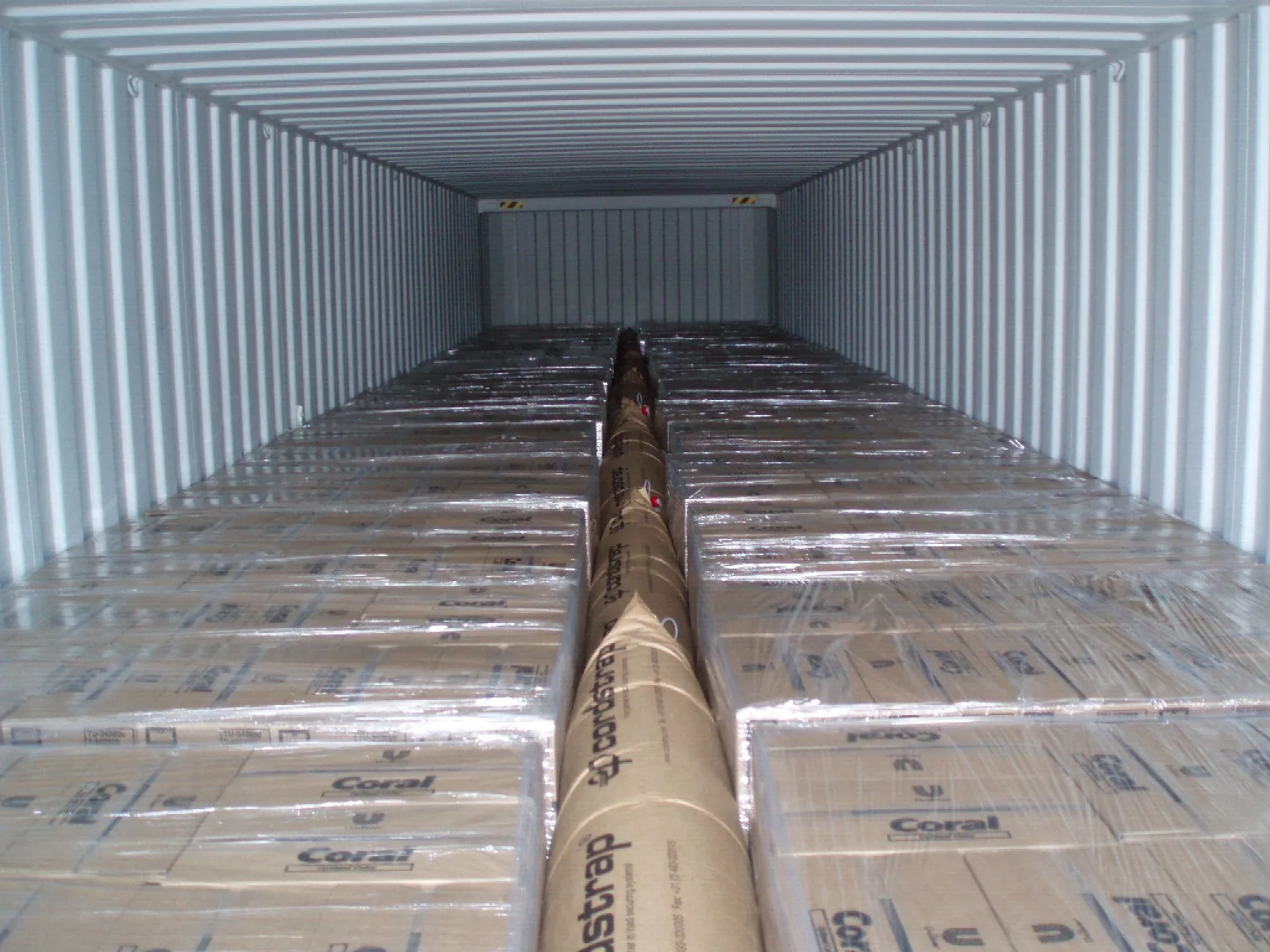
A dunnage bag is a bag-type void filler. It is placed in the gap after the cargo has been loaded, and only then inflated with compressed air. Once inflated, it presses against the two opposite surfaces and turns loose cargo units into one block that leans on itself and on the walls of the vehicle, so the block can resist the forces acting on it throughout the journey.

After many years working with import and export companies, I have seen that the most painful cost is usually not freight but damage: crushed or broken cartons, re-issued documents and lost trust with the buyer. A load only needs to shift a few centimetres under hard braking for the outer cartons to crush each other. That is why I treat a dunnage bag as insurance, not as a minor accessory.
The role of a dunnage bag in multimodal transport
The main job of a dunnage bag is to hold the load in place, followed by cushioning and surface protection. Holding the load matters most at sea and by rail, where the forces repeat thousands of times in one trip. The bag fills the void and presses the units against each other and against the container wall, so the cargo has no room to slide sideways or lengthwise.
The second job is to absorb part of the impulse. When a truck takes a bend, brakes hard or a ship meets a wave, the air in the bag is compressed for a moment and then pushes back, like an elastic cushion between two units. The third job is to prevent direct impact between cargo and cargo or cargo and wall, the leading cause of dented cartons and scratched wooden crates.
How does a dunnage bag work?
A dunnage bag holds cargo by pressing on it: the pressure inside the bag multiplied by the area of bag touching the cargo. A bigger bag is not the whole answer. What counts is whether that pressing force is larger than the force the load wants to move with, and whether the bag can survive the rebound when the cargo pushes into it.
A question I get very often is “why must a Level 1 bag be inflated to the full 0.2 bar, can I inflate it less so it will not burst?” The answer is that the forces on the road are much larger than when the cargo stands still. The CTU Code of the IMO, ILO and UNECE uses the following design accelerations to calculate cargo securing:
| Mode | Forward | Rearward | Sang ngang |
|---|---|---|---|
| Road | 0.8 g | 0.5 g | 0.5 g |
| Rail | 0.5 g (1.0 g for short impacts under 150 ms) | 0.5 g (1.0 g for short impacts) | 0.5 g |
| Sea, area A | 0.3 g | 0.3 g | 0.5 g |
| Sea, area B / C | 0.3 g | 0.3 g | 0.7 g / 0.8 g |
Read the table in a simple way: when a truck brakes hard, a 10-tonne load can be pushed forward with a force equal to 8 tonnes pulling horizontally. Friction between the cargo and the floor carries part of it, and the rest has to be taken by the wall, the blocking timbers or the dunnage bags. If the bag is under-inflated it is not stiff enough, the cargo has room to build up speed, and every impact is harder than the last.
How do static and dynamic holding force differ?
Static force is the force the bag produces right after it is inflated to the recommended pressure, for example about 0.2 bar for a Level 1 paper bag. This force creates friction and initial stiffness, keeping the load from moving when the container is lifted, lowered or when the vehicle starts to roll. It is like tightening a strap before setting off.
Dynamic force appears when the cargo is thrown against the space the bag occupies. The air in the bag is compressed further, the pressure rises instantly and pushes the cargo back. Precisely because pressure can spike at that moment, the bag must have a burst pressure several times its working pressure. In the ICD Vietnam catalogue the ratio is about three to one at every level; for example Level 2 works below 0.4 bar and bursts at 1.2 bar.
What gap size is right for a dunnage bag?
The suitable gap is set by the bag manufacturer for each size, and the CTU Code requires following those instructions for inflation pressure and maximum gap. As one public example, the intermodal loading guide of the Union Pacific railroad uses a standard AAR Level 1 bag for gaps of 4 to 12 inches (about 10 to 30 cm), a square-type bag for gaps of 12 to 24 inches (about 30 to 60 cm), and adds honeycomb paper boards on both sides of the bag when the gap is wider than 12 inches.
The two mistakes I see most often are both about the gap. If the gap is too narrow for the bag, the bag cannot expand fully: it reaches its pressure while the real contact area is still small. If the gap is too wide, the bag swells into a round ball, the flat contact with the cargo shrinks, the force drops and the bag is easily cut by pallet edges. A wide gap should first be narrowed with a board or filler pieces before the bag goes in.
How is a dunnage bag built?
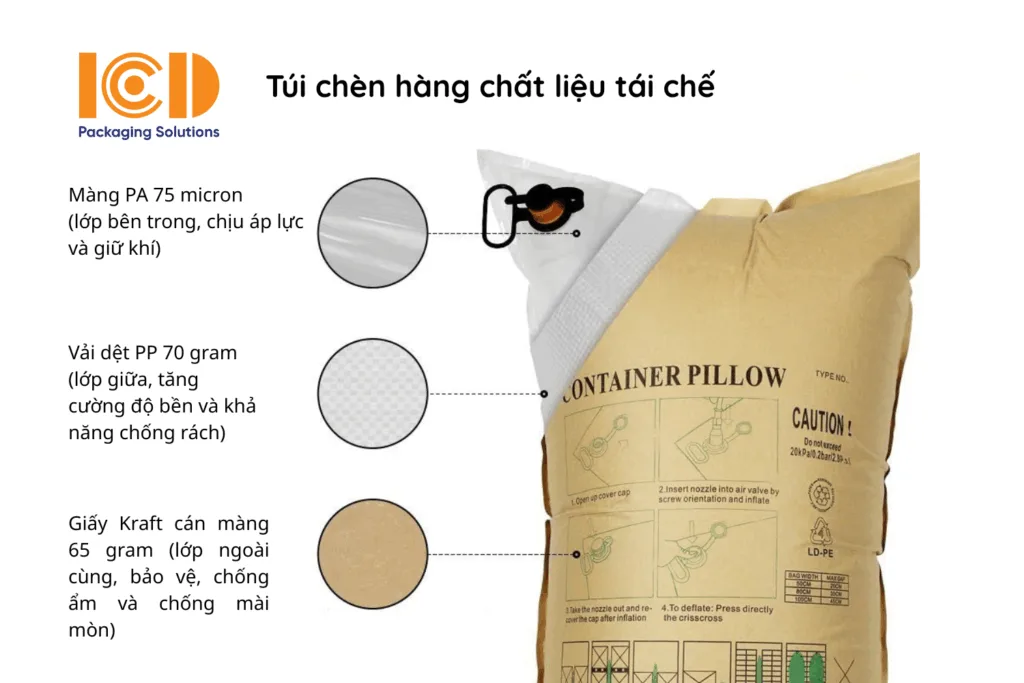
A dunnage bag has three parts: a load-bearing outer shell, an inner bag that holds the air and an inflation valve. The shell decides how much force the bag can take and whether cargo edges will tear it; the inner bag decides whether the air is kept for the whole journey; the valve decides whether inflation is fast or slow and whether air leaks out.
The outer shell: load-bearing and tear resistance
There are two common types of shell. A multi-layer Kraft paper shell, laminated with plastic on the outside for light moisture resistance, is reasonably priced and suits cartons and ordinary palletised cargo; paper bags are normally used once. A woven PP fabric shell has crossing threads, so it is tough, hard for sharp edges to puncture, and can be deflated and reused if the shell and valve are intact.
When I work with steel and paper-roll customers, I usually advise not to save on the price difference. Cargo with sharp edges and loads concentrated at one point, such as steel coils and paper rolls, easily cuts paper bags, even multi-layer ones. A woven PP bag costs more but resists cutting better and can be used several times, so per trip it is usually not as expensive as the purchase price suggests.

The inner bag: holding the air and stabilising pressure
The inner bag is an airtight plastic film, made from PE or from PA laminated with PE. The PA layer makes the film tougher and better at holding air than plain PE. Remember that the air in the bag expands with temperature: a container standing in the sun in a hot yard warms up noticeably and the pressure in the bag rises with it, so inflate to the recommended level rather than over-inflating to be safe.
The valve and the inflation gun

A quick-fill valve has a larger diameter than a traditional valve, so it inflates faster and saves time when packing cargo in the warehouse or yard. The diagram above compares a standard 10 mm valve with a 30 mm quick-fill valve, with an inflation time ratio of about 1:3. The valve has a cap or a self-sealing mechanism that locks the air in when the gun is removed.
A dedicated inflation gun connects to compressed air, and many models have a pressure gauge so you know when to stop. Without a gauge, the packer inflates by feel, and that is when bags end up under-inflated (weak holding force) or over-inflated (likely to burst). I always advise customers to buy a gauge with the gun, even if they pack only a few containers a month.
What types of dunnage bag are there?
By shell material, dunnage bags fall into three main groups: Kraft paper bags, woven PP fabric bags and carton void-fill air bags. The first two secure loads inside transport vehicles; the third is a small cushioning bag inside a box, with a very different use. The table below summarises them according to the ICD Vietnam catalogue.
| Bag type | Outer shell | Used for | Level in the catalogue |
|---|---|---|---|
| Kraft paper bag | Plastic-laminated Kraft paper, PA + PE liner | Cartons, palletised cargo, ordinary road and sea transport | Level 1 is the usual choice (working 0.2 bar, burst 9.1 PSI); higher levels are quoted by code |
| Woven PP fabric bag | Woven PP fabric, PA + PE liner | Heavy cargo, sharp edges, steel coils, machinery, cargo where bags will be reused | Level 0 to 5 |
| Carton void-fill air bag | Thin PE/LLDPE film | Cushioning inside a box: e-commerce, cosmetics, fragile goods | Not rated by AAR level |
One point is often misunderstood: a paper bag is not automatically “for light cargo” and a PP bag is not automatically “for heavy cargo”. The strength level is decided by the construction of each code, so when ordering, state the level you need instead of only the material. ICD Vietnam’s range currently includes Kraft paper bags in 12 sizes from 50 x 100 to 120 x 240 cm, woven PP bags, PE/LLDPE carton void-fill bags 20 to 40 micron thick and Mega valve inflation guns that inflate at 0.2 to 0.8 bar.
What does the AAR level of a dunnage bag mean?
The AAR level is the classification scale for air bags from the Association of American Railroads, set out in General Information Bulletin No. 9 on dunnage bags, used for cargo in rail cars and intermodal cargo on North American railroads. Each level is tied to a type of gap and to the total weight of cargo in the car, with a maximum inflation pressure and a burst pressure for testing.
| Level | AAR application | AAR test pressure (maximum inflation / burst) | ICD Vietnam catalogue (working / burst) |
|---|---|---|---|
| Level 1 | Lateral gap, mainly intermodal cargo | Not given in the test table | Below 0.2 bar / 0.6 bar |
| Level 2 | Longitudinal gap, cargo in the car up to 75,000 lbs (about 34 tonnes) | 5 / 17 psig (0.34 / 1.17 bar) | Below 0.4 bar / 1.2 bar |
| Level 3 | Up to 160,000 lbs (about 72.6 tonnes) | 8 / 25 psig (0.55 / 1.72 bar) | Below 0.55 bar / 1.7 bar |
| Level 4 | Up to 216,000 lbs (about 98 tonnes); horizontal paper rolls up to 190,000 lbs | 10 / 30 psig (0.69 / 2.07 bar) | Below 0.7 bar / 2.0 bar |
| Level 5 | Longitudinal gap between cylindrical surfaces, horizontal paper rolls | 10 / 21 psig, tested at an 18 inch gap | By woven PP bag code |
Levels 2 to 4 are tested at a 12 inch gap and Level 5 at an 18 inch gap. Comparing the last two columns, the working and burst pressures in the ICD Vietnam catalogue match the AAR test values closely at each level. A bag recognised by AAR must be retested after three years, and the list of approved bags is published by AAR.
Two things need to be said plainly. First, AAR is a rule of the North American railroad industry; cargo going by sea or by road in Vietnam does not need an AAR-rated bag. Second, for cargo exported to the United States where the container will ride on a domestic train, the railroad usually requires AAR bags in the loading plan, so the shipper should ask the carrier in advance to avoid repacking at the port.

How do you choose a level for sea cargo?
For sea cargo, the CTU Code principle is that the bag must have a holding capacity larger than the force the load puts on it. Holding capacity is calculated as burst pressure times contact area times a safety factor: 0.75 for single-use bags and 0.5 for reusable bags. The contact area is smaller than the bag size because the edges of the bag bulge round; the CTU Code calculates it as (width minus 1.57 times the gap) times (height minus 1.57 times the gap).
As an illustration, I calculated by that formula: a 120 x 180 cm paper bag in a 20 cm gap has a contact area of about 0.89 x 1.49 = 1.32 m². With a burst pressure of 9.1 PSI (about 0.63 bar) and a factor of 0.75, the holding capacity is about 61 kN, equal to the force of roughly 6 tonnes pulling horizontally. If the row of cargo behind the bag weighs 10 tonnes and travels in a sea area that must be calculated at 0.5 g sideways, the sideways force is about 49 kN before friction, and this bag is sufficient; at 0.8 g it is not, and a higher-level bag or a split load is needed.
Certification and quality inspection
The ICD Vietnam product catalogue states that woven PP bags have AAR certification, SGS certification and an MSDS chemical safety sheet, and that every batch is drop-tested, pull-tested and vibration-tested. When your paperwork needs a certificate, ask for the certificate for the exact bag code and the exact level you plan to buy, because certification belongs to each construction, not to a whole product family.
What are the benefits of using dunnage bags?
The biggest benefit is less damaged cargo, which means lower compensation costs, less handling of faulty goods and a better reputation with buyers. The bag fills gaps that timber or foam struggle to fill evenly, and its force is spread over a wide flat surface instead of concentrating on a few points like blocking timbers.

The second benefit is speed. Placing and inflating a bag takes less time than cutting and nailing timber or packing foam, so it shortens container loading time at the warehouse and yard. The bags are also compact and light, with no sawing on site and no nails or wood splinters left behind.
The third benefit is reuse with woven PP bags: deflate, fold, send back or use on the next trip if the shell and valve are intact. A business with a steady return flow between two warehouses will see this saving clearly. Paper bags are normally single-use, but they are much more compact and lighter to remove than blocking timber.
Frequently asked questions about dunnage bags
What is a dunnage bag used for?
A dunnage bag is used to fill the gap between cargo units, or between cargo and the wall of a container, truck or rail car, and is then inflated to press the load tight. As a result the cargo does not shift, tip or hit itself when the vehicle brakes, takes a bend or meets waves.
Can a dunnage bag be reused?
Yes, mainly woven PP bags: deflate and reuse them when the shell and valve are intact and not torn. Kraft paper bags are normally single-use because paper loses strength once compressed and damp. The CTU Code also applies a lower safety factor to reusable bags (0.5 compared with 0.75).
Which dunnage bag level (Level) should I choose?
For cargo in rail cars in North America, choose by AAR level: Level 1 for lateral gaps in intermodal cargo, Levels 2 to 4 by the total weight of cargo in the car (75,000, 160,000, 216,000 lbs) and Level 5 for horizontal paper rolls. For sea and road transport, choose a bag whose holding capacity is greater than the force the cargo applies, calculated by the CTU Code method.
Can a dunnage bag burst?
A bag inflated to the recommended pressure rarely bursts, because the burst pressure is about three times the working pressure according to the level table in the ICD Vietnam catalogue (Level 1: 0.2 bar working, 0.6 bar burst). The risk rises when the bag is over-inflated, when the container heats up strongly or when sharp edges cut the bag.
Can a dunnage bag be used for any gap?
No. Each bag size has a maximum gap set by the manufacturer. If the gap is too narrow the bag does not expand enough; if it is too wide the bag swells round and loses pressing area. For example, the Union Pacific guide uses a standard Level 1 bag for gaps of 10 to 30 cm and a square bag for gaps of 30 to 60 cm, with honeycomb board padding when the gap is over 30 cm.
Can sharp edges puncture a dunnage bag?
They can, especially Kraft paper bags against wooden pallet edges, steel straps or metal units. Put a carton sheet, honeycomb board or padding at sharp contact points, and for cargo that regularly has sharp edges switch to woven PP bags.
How much does a container dunnage bag cost?
The price depends on the material (Kraft paper or woven PP), the size, the level and the order quantity. ICD Vietnam quotes per order: send the gap size, the type of cargo and the number of containers per month to receive a suitable quote.
Contact us for dunnage bag advice
ICD Vietnam supplies Kraft paper dunnage bags, woven PP bags, carton void-fill air bags and inflation guns. Send us the gap size, the type of cargo and the shipping route; our advisers will recommend the bag type, size and level. Price: contact for a quote.
ICD Vietnam Industrial Manufacturing Co., Ltd.
- North Vietnam (Hanoi warehouse): 3rd Floor, Thang Long A1 Building, Thon Bau, Thien Loc Commune, Hanoi - 0983 797 186 / 090 345 9186 / 090 5859 186.
- Southern workshop: 551/212 Le Van Khuong Street, Tan Thoi Hiep Ward, District 12, Ho Chi Minh City - 098 6784 186.
- Email: sales@icdvietnam.com.vn. Zalo: Chat Zalo.
References
- Concept and load-securing mechanism of the dunnage bag: International Safe Transit Association (ISTA).
- Association of American Railroads (AAR) - General Information Bulletin No. 9, Product Performance Profile for Pneumatic Dunnage: levels, load weights, test pressures, list of approved bags.
- IMO/ILO/UNECE Code of Practice for Packing of Cargo Transport Units (CTU Code), MSC.1/Circ.1497 - chapter 5 (accelerations), Annex 7 section 2.3, Annex 7 Appendix 4 (holding capacity of air bags).
- Union Pacific - Air Bag Placement and Usage Guidelines for Securing Intermodal Pallet Loads.
- ICD Vietnam air dunnage bag catalogue (Air dunnage bag ICD Vietnam Catalogue): PA/PE construction, woven PP, level table, inflation valves, quality testing; ICD Vietnam product page consulted October 2026.