
Table of Contents
Reviewed and updated by ICD - Week 43/2026
PA6 (nylon 6) is a polyamide made by ring-opening polymerisation of caprolactam, melting at about 220 °C with a density of 1.13 g/cm³. Unreinforced PA6 resin is stiff and tough, but it absorbs moisture: at 23 °C and 50% RH it settles at about 2.6 to 3.4% water, and the tensile modulus drops from 3100 to about 1000 MPa.
This article is only about PA6: what it is, where it beats and trails PA66, and why it appears most often in warehouse trolley wheels. Figures come from the BASF Ultramid B3K datasheet and from Blickle and Bulldog Castors wheel documentation. The shared baseline figures for the PA group are in the article on what PA plastic is, in the same section.
What is PA6 plastic
PA6 is another name for nylon 6, a polymer made from caprolactam by ring-opening polymerisation, with the repeat unit [NH-(CH₂)₅-CO]ₙ. The 6 is the number of carbon atoms in the repeat unit (Asahi Kasei). PA6 is an engineering plastic: much stiffer and more wear-resistant than PE and PP, with a low friction coefficient and good resistance to oils, grease and fuel.
Virgin resin is usually off-white to opaque white and takes colour well. The main difference from PA66 is that PA6 melts lower (220 versus 260 °C), shrinks less in the mould (0.75% versus 1.5 to 1.8%) and usually costs less, so it is the more common PA grade when high heat resistance is not needed.
Advantages and disadvantages of PA6
On the plus side, PA6 is light (1130 kg/m³, about one sixth of steel according to Mitsubishi Chemical), tough, wear-resistant and good at damping, so it replaces metal in bushings, gears, rollers and wheels. Resistance to oils, grease and fuel is a strength that plastics makers cite for the whole polyamide family. It insulates well when dry and runs quieter than metal parts, but see the wheel section below, because hard nylon still rumbles more than PU.
The biggest drawback is moisture uptake. BASF lists saturated water absorption of B3K at 9 to 10% (immersed) and 2.6 to 3.4% at 50% RH. As it absorbs moisture the resin swells slightly and mechanical properties change clearly: tensile modulus falls from 3100 to 1000 MPa, and yield stress from 80 to 40 MPa. Some sources claim that for thick parts this change is ‘negligible’; the datasheet shows the opposite at the level of mechanical properties, so load-bearing parts must be designed with conditioned (moist) data.
The second drawback is low heat resistance under load: HDT A (1.8 MPa) is only 60 °C and HDT B (0.45 MPa) is 180 °C; for long-term use, the temperature index after 20,000 hours is 100 °C. The third is UV: unstabilised PA6 gradually turns brittle outdoors, so outdoor parts must use a stabilised grade with carbon black (BASF).
| Property (BASF Ultramid B3K) | Dry | Equilibrium at 23 °C, 50% RH |
|---|---|---|
| Tensile modulus (ISO 527) | 3100 MPa | 1000 MPa |
| Yield stress | 80 MPa | 40 MPa |
| Moisture in the resin | 0.03 to 0.06% after drying | 2.6 to 3.4% |
| Saturated water absorption (immersed at 23 °C) | - | 9 to 10% |
PA6 versus PA66
Both belong to the polyamide family but differ in structure: PA6 comes from one monomer, while PA66 comes from hexamethylenediamine and adipic acid. PA66 melts 40 °C higher and has an HDT about 15 °C higher, in exchange for greater shrinkage and more demanding processing. The table below uses two BASF datasheets (B3K and A3K, unreinforced).
| Property | PA6 (B3K) | PA66 (A3K) |
|---|---|---|
| Melting point | 220 °C | 260 °C |
| HDT A, 1.8 MPa | 60 °C | 75 °C |
| HDT B, 0.45 MPa | 180 °C | 220 °C |
| Mould shrinkage | 0.75% | 1.5% longitudinal, 1.8% transverse |
| Equilibrium absorption at 50% RH | 2.6 to 3.4% | 2.5 to 3.1% |
| Injection temperature | 250 to 270 °C | 280 to 300 °C |
Choose PA6 when you need toughness, a good surface finish, a fair price and a moderate working temperature; choose PA66 when the part sits near a heat source or carries continuous load at higher temperature. For hand trolley wheels in a warehouse, the working range rarely exceeds 60 °C, so both grades work; Bulldog Castors notes that both nylon 6 and nylon 66 are used for wheels and wheel cores.
PA6 plastic wheels in warehouses: real figures
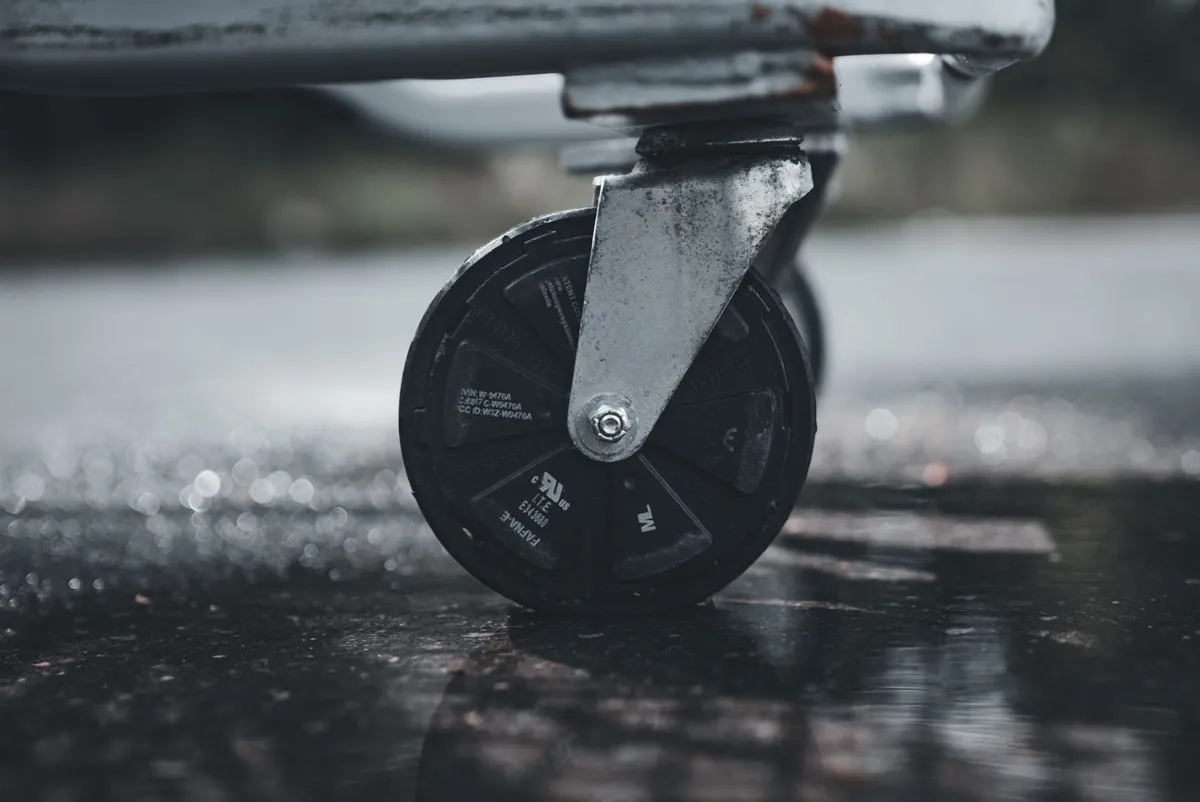
Hard nylon wheels measure about 70 Shore D for ordinary nylon and 80 Shore D for cast nylon (Blickle); Bulldog Castors lists 80 to 90 Shore D and a working temperature range of -30 to +80 °C. The tread is hard, so floor pressure is high: Blickle puts the average floor pressure of a nylon wheel at about 40 N/mm² (cast nylon 60), against 8 N/mm² for a 92 Shore A PU wheel and 3.5 N/mm² for 75 Shore A PU. In other words, the harder the wheel, the less it sinks in and the lighter it rolls, but the flatter and stronger the floor must be.
| Tread material | Hardness | Average floor pressure | Suitable for |
|---|---|---|---|
| Nylon | 70 Shore D | 40 N/mm² | Heavy loads, flat concrete floors |
| Cast nylon | 80 Shore D | 60 N/mm² | Very heavy loads, high wear |
| PU 92 Shore A | 92 Shore A | 8 N/mm² | Floors that scratch easily, where a soft ride is needed |
| PU 75 Shore A | 75 Shore A | 3.5 N/mm² | Where floor protection and minimum noise are needed |
Two common claims need a second look. First, ‘nylon protects epoxy floor coating’: Blickle data shows nylon produces about 5 times the floor pressure of 92 Shore A PU, so on thin epoxy or polished tile a PU wheel is usually kinder to the floor; no source shows nylon protecting an epoxy floor. Second, ‘nylon eliminates squeal’: wheel makers state generally that nylon wheels are noisier than PU when passing over joints, and the advantage of nylon is low rolling resistance.
On oils and grease, nylon resists oil and fuel better than many rubbers, but ‘completely inert’ and ‘service life of 3 to 5 years’ are two statements with no source. Wheel life depends on load, distance, floor surface and tread hardness; there is no general figure for every condition.
Choosing a nylon wheel or a PU wheel
Choose nylon for heavy loads, flat concrete floors, oily environments and light push effort; choose PU when the floor is epoxy or tile or when quiet running matters, such as electronics plants, cleanrooms and hospitals. For hand pallet trucks and warehouse trolleys, nylon wheels are the usual choice because they carry big loads and do not sink in. Pick the right hardness and remember that PA6 absorbs moisture: a wheel left for a long time in a damp warehouse may change size slightly and be softer than when new.
Besides wheels, the supplies that usually go with them in a warehouse are pallets. ICD Vietnam lists many plastic pallet sizes and load ratings. See the plastic pallet lines to choose by load and rack type.
Frequently asked questions
What is PA6 plastic?
PA6 (nylon 6) is a polyamide made by ring-opening polymerisation of caprolactam, melting at about 220 °C, with a density of about 1.13 g/cm³, and it absorbs moisture.
At what temperature does PA6 melt?
About 220 °C according to the BASF Ultramid B3K datasheet. Injection temperature is usually 250 to 270 °C.
Can PA6 replace metal?
Yes, in many light, wear-heavy parts such as bushings, gears and wheels. Parts that run hot under load (above 60 °C for unreinforced PA6) need a different grade or metal.
How do PA6 and PA66 differ?
PA66 melts higher (260 versus 220 °C), has a higher HDT and shrinks more. PA6 is tougher, has a nicer surface and usually costs less.
Does PA6 absorb moisture?
Yes. At 23 °C and 50% RH it reaches 2.6 to 3.4%, and up to 9 to 10% saturated when immersed. Moisture drops the tensile modulus from 3100 to about 1000 MPa.
Which is better, nylon or PU wheels?
It depends on the floor and the load: nylon carries heavy loads and rolls lightly, but is noisier and creates higher floor pressure; PU is quieter and kinder to the floor.
Contact ICD Vietnam
ICD Vietnam Industrial Manufacturing Co., Ltd.
North: 3rd Floor, Thang Long A1 Building, Bau Hamlet, Thien Loc Commune, Hanoi, 0983 797 186 / 090 345 9186 / 090 5859 186
South: 551/212 Le Van Khuong Street, Tan Thoi Hiep Ward, District 12, Ho Chi Minh City, 098 6784 186
Email: sales@icdvietnam.com.vn
Zalo: Chat on Zalo now
References
- BASF, Ultramid B3K (PA6) Product Information, 09/2026: density 1130 kg/m3, melting point 220 °C, saturated absorption 9 to 10%, equilibrium at 23 °C/50% RH 2.6 to 3.4%, HDT A 60 °C, drying at 80 °C for 4 hours - download.basf.com
- BASF, Ultramid A3K (PA66) Product Information, 09/2026: melting point 260 °C, saturated absorption 8 to 9%, equilibrium 2.5 to 3.1%, HDT A 75 °C, shrinkage 1.5/1.8%
- Asahi Kasei, What are polyamide resins (nylon resins)? (structure, carbon count in the PA name, pros and cons) - asahi-kasei-plastics.com
- Mitsubishi Chemical Group, Nylons as Engineering Plastics (PA6 and PA66, water absorption, wear per ISO 7148-2) - mcam.com
- Blickle, Info box wheel and castor series (tread hardness: nylon 70 Shore D, cast nylon 80 Shore D, PU 92 Shore A; average floor pressure nylon 40, PU 92 Shore A 8 N/mm2) - blickle.com
- Bulldog Castors, Engineering Polymers: Material Properties of Polymeric Caster Wheels (nylon 80 to 90 Shore D, -30 to +80 °C, nylon 6 and 66 both used for wheels and wheel cores) - bulldogcastors.co.uk
- BASF, Ultramid (PA) brochure, section Behavior on exposure to weather (K grades are weather-resistant, carbon black works best) - basf.com
- Wikipedia, Caprolactam and Nylon 66 (chemical structure references, linked in the article)