
Table of Contents
- Where did slip sheets come from, and why are more companies using them?
- What is a slip sheet? Definition and how it works
- Types of slip sheet by material and tab count
- Slip sheet specifications to know
- Slip sheet vs pallet: detailed comparison
- Advantages of slip sheets in logistics
- Disadvantages and limitations to keep in mind
- Slip sheet applications by industry
- How to choose the right slip sheet for your business
- The real cost question: hidden costs of switching to slip sheets
- How to calculate the number of slip sheets to order from your output
- In short: who are slip sheets for?
- Slip sheet FAQ
- How many times can a slip sheet be reused?
- Are slip sheets safe for food?
- What is the current price of slip sheets in Vietnam?
- Can slip sheets be recycled?
- Can slip sheets be used together with plastic or wooden pallets?
- Do slip sheets need fumigation or ISPM 15 treatment?
- How much weight can a slip sheet carry?
- How wide should the tab of a slip sheet be?
- Contact ICD Vietnam for advice
- References
Reviewed and updated by ICD - Week 43/2026
A slip sheet is a thin sheet of multi-ply kraftliner paper or plastic that goes under a load in place of a pallet. It has one or more extra edges, called tabs, that a forklift fitted with a push-pull attachment grips to drag the whole load. The sheet is only about 0.9 - 1.5 mm thick instead of the 150 mm of a pallet, so it cuts tare weight and gives height back to the container.
Slip sheets are thin load sheets that replace the traditional pallet in loading and transport, above all for export cargo shipped in containers. What you gain in volume and weight you pay for in equipment: both the sender and the receiver need forklifts fitted with a push-pull attachment. This article explains what a slip sheet is under the ISO 12776 definition, the types by material and tab count, the specifications to know, how slip sheets compare with pallets, the real drawbacks, and how to work out whether your business should switch.
Where did slip sheets come from, and why are more companies using them?
Slip sheets were first developed in the United States as a cheap, light load base that takes up little space and is easier to dispose of than a pallet, according to the introduction of ISO 12776. The system only pays off when both the sender and the receiver have the right equipment, so slip sheets are most common on stable, repeat routes: an export factory shipping to the same group of importers, or a central warehouse supplying satellite warehouses of the same company.
We do not quote a global slip sheet market size or an annual growth rate here, because those figures circulating online cannot be traced back to a named report with a publication year. The drivers on the business side are more certain: container freight is charged per trip, wooden pallets travelling internationally must be treated under ISPM 15, and a one-way pallet that never comes back is a pure loss. Having worked in packaging materials at ICD Vietnam since 2011, I find that questions about slip sheets almost always come from these same three pressures.
What is a slip sheet? Definition and how it works
Under ISO 12776:2008, a slip sheet is a flat rectangular sheet of material with a tab on one or more edges, used as a base for assembling, handling, storing and transporting goods as a unit load. The tab is the part that projects beyond the dimensions of the load so that the gripper of a push-pull attachment has something to hold.
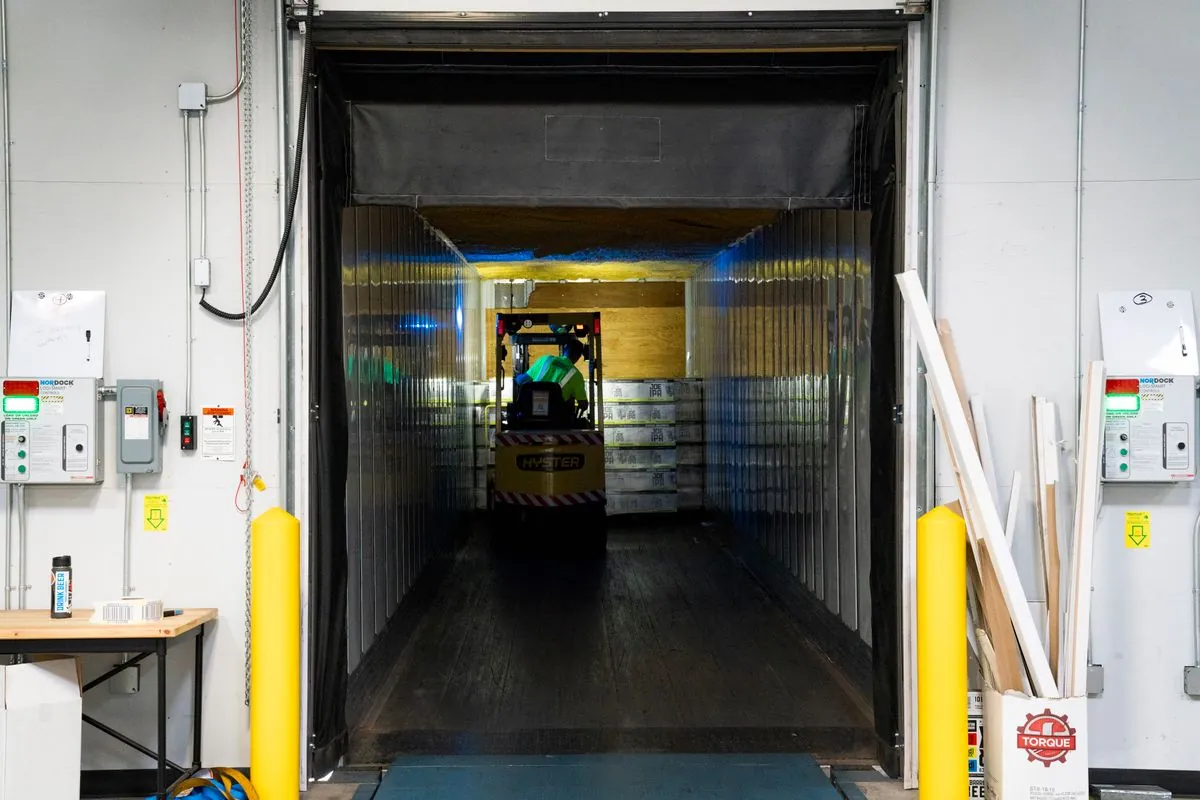
Operation comes down to three movements. To pick up a load, the gripper on the push-pull attachment holds the tab and drags the slip sheet and load together onto flat carrying plates (platens) in place of forks. While travelling, the load rests on the platens the way it would rest on forks. To set it down, a push plate at the back pushes the load off the platens onto the warehouse or container floor. ISO calls this device a push-pull attachment: a mechanical, hydraulic or pneumatic mechanism mounted on a forklift to pick up and place a load on a slip sheet.
A one-tab slip sheet has a load surface equal to or slightly larger than the base of the load, and a tab (lip) of 75 - 105 mm with a score line at its foot. The gripper holds the tab, and the forklift approaches from the side that carries the tab. Two-, three- and four-tab sheets have additional tabs on the other edges.
Because the forklift does not slide forks into legs as it does with a pallet, the tab is the critical detail. If the tab is too narrow, the driver has trouble seeing it and the gripper has too little to hold; if it is folded, wet or torn, the load can hardly be picked up at all. That is why slip sheets usually have a score line at the foot of the tab: the tab folds up against the load when not in use and drops down when the forklift approaches.
Types of slip sheet by material and tab count
Slip sheets are classified on two main criteria: material and number of tabs. ISO/TR 12776 names three typical material groups: corrugated fibreboard, solid fibreboard made of pressed paper layers (usually kraftliner), and plastic sheet such as polyethylene or polypropylene.
Corrugated slip sheets are the cheapest but weak when damp, and can usually be gripped and pulled only once or twice. Solid kraftliner slip sheets are the most common type: they resist tearing better, last several cycles, and cope with cold and damp environments when given a waterproof coating. Plastic slip sheets are the most durable and are used for many cycles in closed-loop systems, but they cost the most. This matches the equipment classification published by North Carolina State University.
At ICD Vietnam, the slip sheet range we sell is multi-ply kraftliner paper in 0.9 mm or 1.5 mm thickness, each available in a non-waterproof version and a waterproof version with an HDPE coating. Solid plastic slip sheets are not currently in our product range; if your route genuinely needs this type, talk to us first and we will advise on a suitable option.
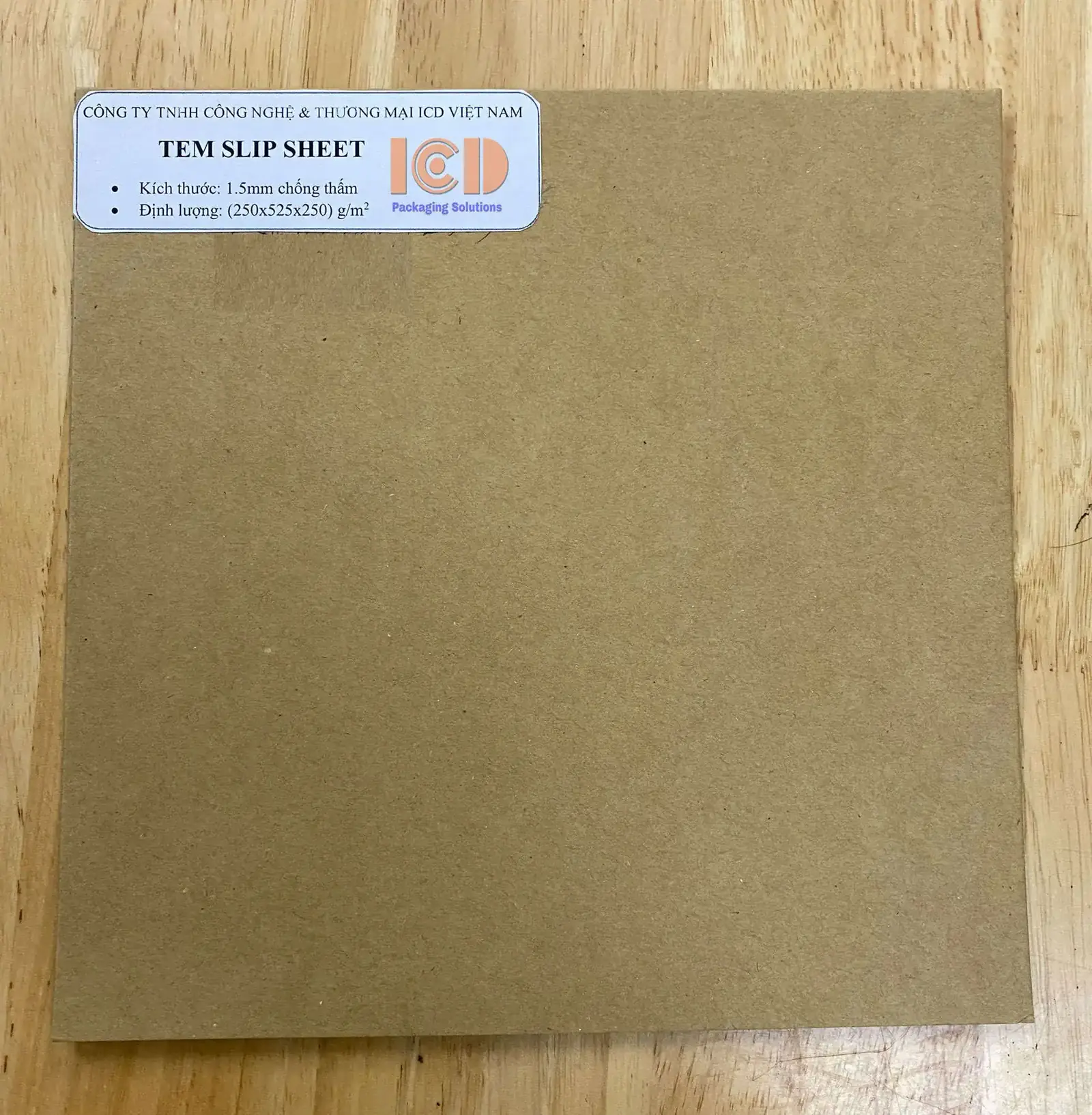
By tab count, slip sheets come with 1 tab, 2 tabs (on two opposite edges or two adjacent edges), 3 tabs and 4 tabs. A one-tab sheet suits cargo that is always approached from one side, such as a one-way packing line. A two-tab sheet with opposite tabs lets the load be picked up from either end, which helps when loading a container from both directions. Three- and four-tab sheets are used when a load may be picked up from several sides in a warehouse or rail car. Sheets with adjacent tabs need corner cut-outs so the folded-up tabs do not overlap.
More tabs does not mean better: each tab projecting 75 - 105 mm takes up that much extra container floor length when loads are stacked tight against each other. So only put tabs on the edges the forklift will actually approach.
Slip sheet specifications to know
Four specifications need to be settled when ordering slip sheets: load surface size, tab width, thickness and surface coating. Load capacity is not a fixed number tied to thickness; it depends on how the cargo is distributed, the tensile strength of the sheet and how many times it is gripped and pulled.
Load surface and tab dimensions
ISO/TR 12776 requires the load surface (the part under the load) to approximate the base of the load: its length may not be shorter than the load length nor exceed it by more than 50 mm; its width may fall short by up to 50 mm or exceed the load width by up to 25 mm. Tab width is normally 75 mm to 105 mm, with an overall dimensional tolerance of ±7 mm. Choose the load surface size from the standard load dimensions, referring to ISO 6780 and ISO 3676.
ICD Vietnam slip sheets come in standard sizes of 1000 x 1200 mm and 1200 x 1200 mm, and can also be cut to size on request. The actual size should be ordered from the base of your package plus the tab, not copied from the pallet size you currently use.
Thickness, weight and coating
ISO/TR 12776 sets minimum thicknesses by material: 3.0 mm for single-wall corrugated board, 1.0 mm for solid fibreboard and 0.6 mm for plastic. A thicker sheet is stiffer and keeps the tab from buckling when gripped, especially with bagged cargo or loads with an uneven base.
According to the ICD Vietnam product page, a standard-size paper slip sheet weighs about 3 kg (0.9 mm, non-waterproof), 3.6 kg (0.9 mm, waterproof), 4.8 kg (1.5 mm, non-waterproof) and 5.5 kg (1.5 mm, waterproof). The claim, sometimes seen online, that a slip sheet weighs under 1 kg does not match the real product. The HDPE coating blocks moisture and suits long sea voyages or high-humidity warehouses; the uncoated version is for dry cargo and enclosed storage.

Standards and accompanying documents
Neither paper nor plastic slip sheets fall within the scope of ISPM 15. This IPPC (FAO) standard applies only to packaging made of wood such as pallets, wooden crates and dunnage, so slip sheets need no heat treatment or IPPC mark. Slip sheets are sometimes described as “complying with ISPM 15”, which misstates the position: they do not comply, they sit outside the scope of the regulation.
On material safety, the ICD Vietnam product page lists RoHS and MSDS for the slip sheet lines, and SGS in addition for the 1.5 mm waterproof line. We also do not describe paper slip sheets as “HACCP compliant”, because HACCP is a food safety control system for a production facility, not a certificate issued for a piece of packaging material. If food touches the sheet directly, ask the supplier for documents that meet the rules of the importing country.
Slip sheet vs pallet: detailed comparison
Slip sheets win on thickness, tare weight and empty storage space; pallets win on equipment compatibility, rack storage and number of reuse cycles. The table below uses real ICD Vietnam product data and the standards cited above. It leaves out prices, because price depends on the specification and quantity of each order.
| Criterion | Paper slip sheet | Plastic pallet | Wooden pallet |
|---|---|---|---|
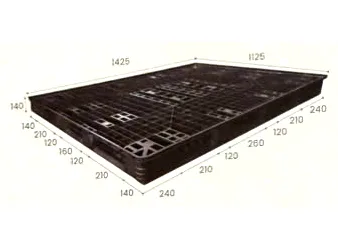
| Base height | 0.9 - 1.5 mm | about 150 mm (for example a 1100 x 1100 x 150 mm pallet) | commonly 120 - 150 mm depending on design |
| Tare weight per unit | about 3 - 5.5 kg (ICD standard size) | about 9.5 - 12 kg (ICD 1100 x 1100 x 150 mm plastic pallet) | heavier than a plastic pallet of the same size |
| Number of uses | typically 1 - 3 times | many cycles, years of use | many cycles if repaired |
| Handling equipment | forklift with push-pull at both ends | forklift, standard pallet jack | forklift, standard pallet jack |
| Rack storage | no, most are not rigid enough | yes (within the rack load rating of the model) | yes (within the rack load rating of the model) |
| ISPM 15 for export | outside the scope | outside the scope | must be treated and IPPC-marked |
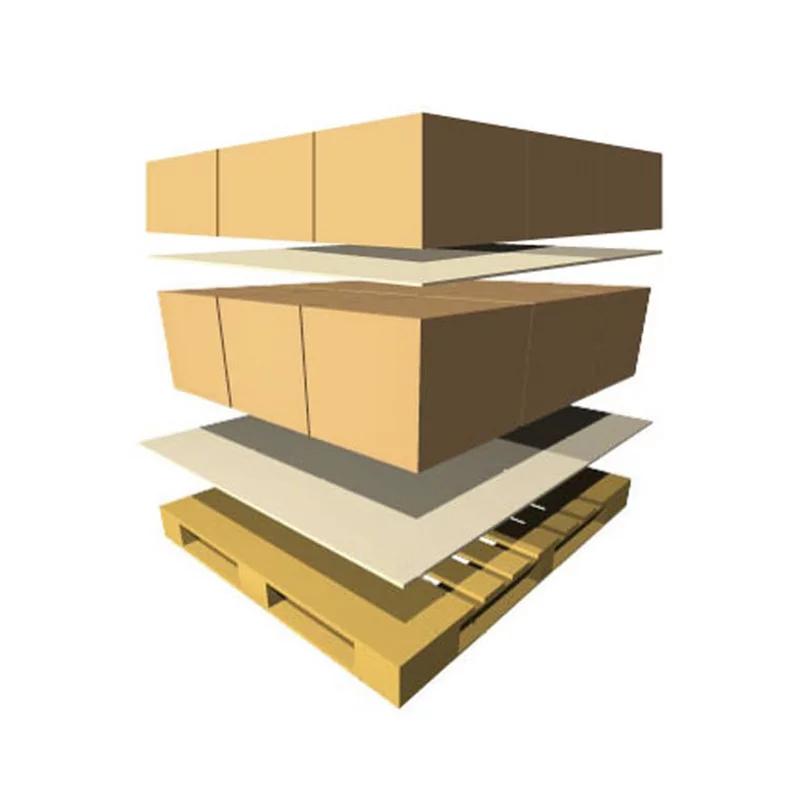
The last two rows deserve a closer look. Wikipedia summarises that most slip sheets are not rigid enough to support cargo on rack shelving, so loads are usually put on a pallet in storage and only moved onto a slip sheet at the dispatch door. And the advantage of being exempt from ISPM 15 is not unique to slip sheets: plastic pallets also fall outside the scope of that standard.
Advantages of slip sheets in logistics
The biggest advantage of slip sheets is that they give height and payload back to the vehicle. A 40-foot High Cube container has an interior height of about 2,700 mm according to carrier Hapag-Lloyd. If cargo is stacked two tiers high, each on a 150 mm pallet, the pallets alone take up 300 mm, about 11% of the interior height. With 1.5 mm slip sheets, the base shrinks to 3 mm. Whether that height becomes real cargo depends on whether your carton height lets you add another layer, so calculate with your own carton dimensions.
On weight, an order of 20 units switching from 1100 x 1100 x 150 mm plastic pallets (about 9.5 - 12 kg each) to paper slip sheets (about 3 - 5.5 kg each) cuts roughly 80 - 180 kg of tare, calculated from real ICD Vietnam product weights. For heavy cargo close to the container payload limit, that saving can be turned into extra goods.
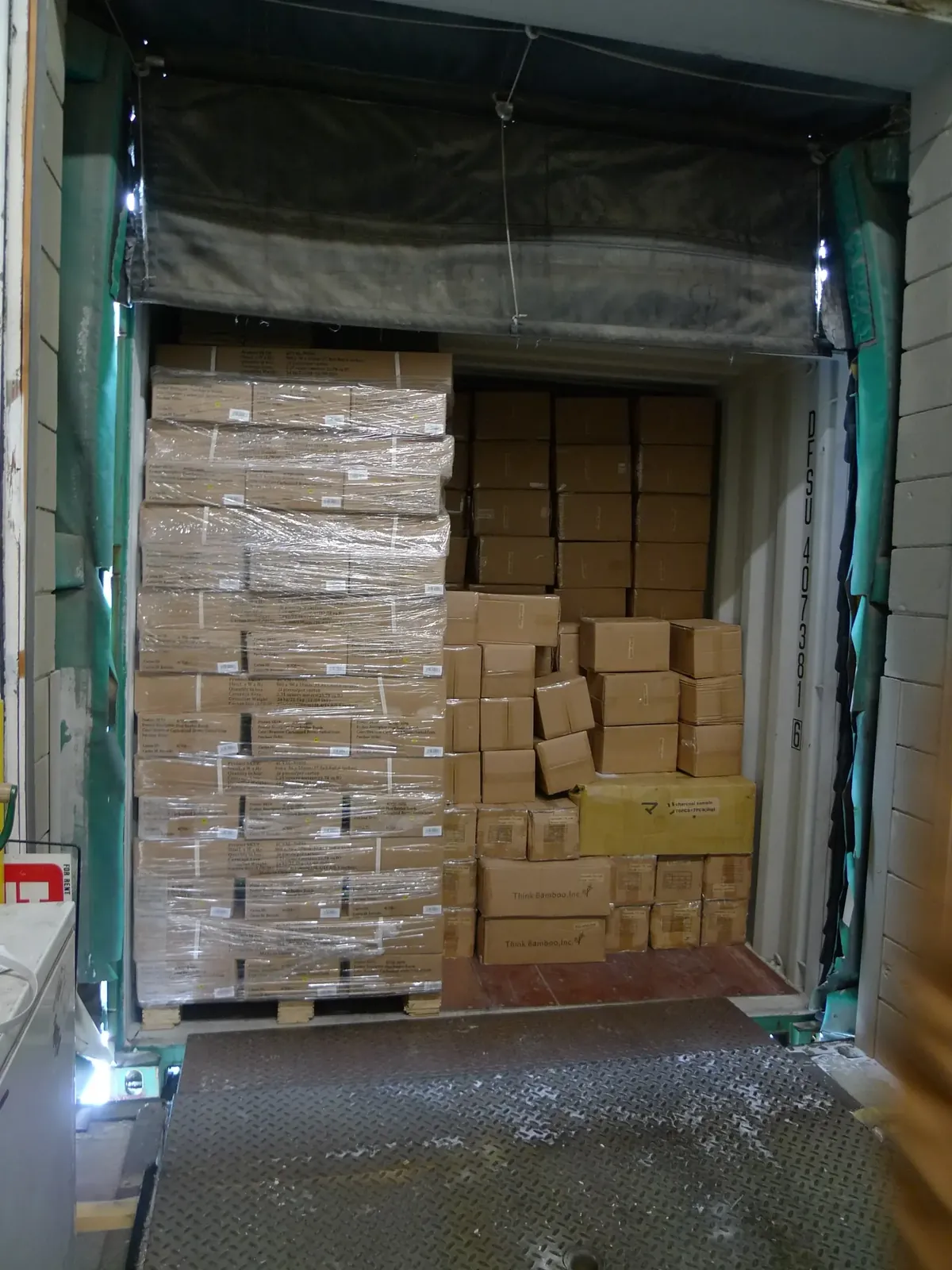
For empty storage, 1,000 stacked 0.9 mm slip sheets are only about 0.9 m high, the same as one stack of six 150 mm pallets. A regular exporter can therefore hold a large stock of base material without giving up a whole warehouse zone to empty pallets.
The fourth benefit is that the empties-return problem disappears. A slip sheet travels one way with the goods and is recycled at the destination, so there is no cost of collecting empty pallets and shipping them back. Uncoated kraftliner slip sheets recycle like ordinary paperboard; the HDPE-coated type needs a check with the local collector at the destination on how to dispose of it.
Finally, because a slip sheet is not wood packaging, it needs no heat treatment and no IPPC stamp under ISPM 15 as a wooden pallet does for export, which removes one procedural step from every shipment.
Disadvantages and limitations to keep in mind
The biggest drawback of slip sheets is dependence on equipment at both ends. If the receiving warehouse has no forklift with a push-pull attachment or roller forks, a load sitting on the container floor has to be unloaded by hand. Both ISO 12776 and Wikipedia stress this condition. The cost of a push-pull attachment depends on the capacity and the forklift model; if you do not have one, you must buy it, rent it or use a handling service that owns the equipment, and you should confirm with the receiver before changing how you pack.

The second limit is load weight and shape. Slip sheets do not suit very heavy loads concentrated on one point, or cargo with pointed feet, sharp edges or an uneven base, because the sheet tears or is punctured easily and the tab can deform. The permitted load depends on thickness, tensile strength and how the cargo is distributed; ask the supplier to state the load rating for your actual package and handling method instead of trusting a generic range.
The third limit is the short service life. A paper slip sheet is typically used 1 - 3 times and then recycled, because each grip-and-pull wears the tab edge and the paper gradually absorbs moisture. If the same load has to be handled many times inside your own operation, the total cost of slip sheets can be higher than that of a circulating pallet.
The fourth limit is that the load must be secured firmly. Without the structure of a pallet holding the base, cartons can shift when the load is dragged, so the load usually has to be stretch-wrapped or strapped, adding a step and packaging cost. In addition, slip sheets cannot be used with a standard pallet jack and in most cases cannot be placed on rack shelving.
Slip sheet applications by industry
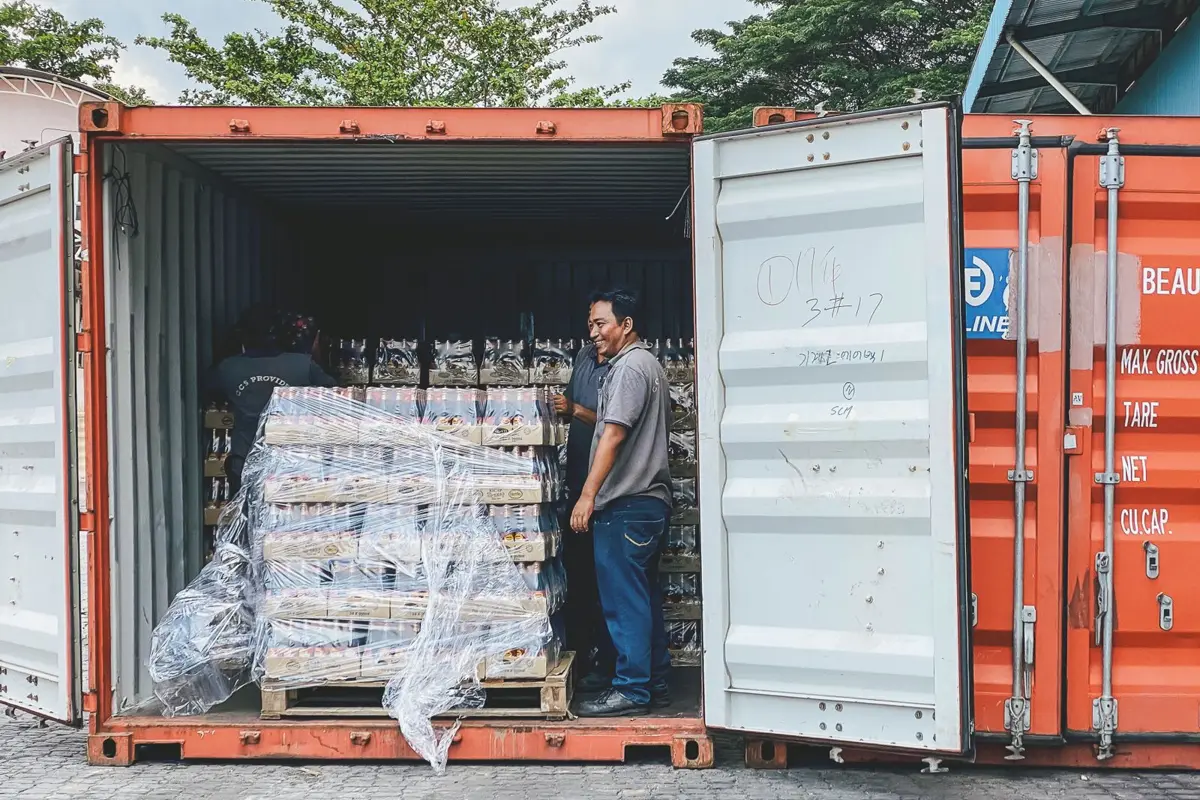
Slip sheets suit palletless cargo best when it is cartons of uniform size, bagged goods with a flat base, and high-volume one-way export. Food and beverage products packed in cartons, such as confectionery, milk, soft drinks and canned food, use slip sheets to carry more cartons per container. Bottled goods such as fish sauce, soy sauce and cooking oil work if they are packed in sturdy cartons and the load is wrapped.

Pharmaceutical, cosmetic and packed chemical industries choose slip sheets because they are clean, produce little wood dust, have no nails or splinters and carry no pests the way untreated wood can; moisture-sensitive goods should use the waterproof HDPE-coated type. For corrosive or hazardous chemicals, add sealed packaging that meets dangerous goods regulations; the slip sheet is only the load base.
Electronics, components, garments and export agricultural products such as coffee, cashew nuts and bagged rice are also heavy users, since the cargo is light to medium weight, container volume matters, and the export route is steady. According to the ICD Vietnam product page, the waterproof line is usually chosen for agricultural products, seafood and long sea voyages.
How to choose the right slip sheet for your business
Choosing correctly takes five steps: check the route, the cargo, the equipment at both ends, the tab dimensions and the supporting documents.
Step one is to assess the transport route. If your business mainly ships one way and does not need pallets to come back, slip sheets are the economical choice. If cargo circulates many times internally, a reusable pallet is usually cheaper. Next, assess the cargo: for dry goods in an enclosed warehouse choose the non-waterproof version; for sea freight, moisture-sensitive goods and cold storage choose the HDPE-coated version; for heavy packages or loads that will be gripped many times choose 1.5 mm thickness.
Step three is to check equipment: does your current forklift already have a push-pull attachment, and does the receiving warehouse have equivalent equipment? If you only ship a few lots a month, hiring a handling service with push-pull may cost less than investing in your own. Step four is to choose size and tab count: the load surface follows the base of the package, with tabs on the edges the forklift approaches; a route that is only picked up from one side needs just 1 tab, while pickup from both ends of the container calls for 2 opposite tabs.
The last step is to compare suppliers on specifications and documents, not on price alone: basis weight of the paper layers, thickness, coating type, the material safety data sheet (MSDS) and test results if your overseas customer requires them. Run a small trial lot on your own forklift and your own packages before placing a large order.
Each slip sheet is cheaper than a pallet, but to run the system the forklift must be fitted with a push-pull attachment (or roller forks). This is a one-time investment few people mention, so the right question is not the price of one sheet but the break-even point measured in shipments.
Two hidden costs belong in the spreadsheet. The first is the push-pull attachment or roller fork fitted to every forklift involved; the price depends on the specific forklift model and capacity. The second is that the receiver also needs pushing and pulling equipment: if the customer or the destination warehouse has no push-pull or roller fork, the cargo cannot be unloaded by forklift, and this must be confirmed before you settle on slip sheets.
How to read it: if each shipment saves an amount X compared with pallets, the push-pull attachment is paid back after N shipments, and from shipment N+1 onward the saving is net profit. A regular exporter usually breaks even sooner than one that ships seasonally. Use the real material and equipment prices you receive to replace X and the push-pull cost, not averages found online.
There are four cases where slip sheets should not be used:
ICD Vietnam gives free advice on the slip sheet break-even calculation for each export route. Call 0983 797 186 for a calculation based on your packages and your existing forklifts.
How to calculate the number of slip sheets to order from your output
The number of slip sheets to order each month equals the number of loads shipped multiplied by a loss factor, plus a safety stock. Because a paper slip sheet is used only 1 - 3 times and then recycled, a business must plan a recurring monthly purchase quantity, quite unlike a pallet bought once and used for years. Skipping this step is a common reason warehouses run out of slip sheets in the middle of a shipping cycle.
We do not give loss rates by cargo type (tables of 3 - 12% circulate online), because those figures have no measured source. A more reliable approach is to record the number of spoiled sheets over the first 2 - 3 months and use that rate in the formula. For sea freight and high humidity, choose HDPE-coated slip sheets to limit softened sheets and torn tabs.
In short: who are slip sheets for?
A slip sheet is not a solution for every business. It works best for companies that ship one way on a stable route, have push-pull equipment at both ends, and want to make the most of container height and payload. When weighing it up, look at the cargo type, shipping volume, equipment investment, the documents the importing country requires and the total long-term cost, not only the price of one sheet.
Slip sheet FAQ
How many times can a slip sheet be reused?
A paper slip sheet is typically used 1 - 3 times depending on thickness, coating and handling, because each grip-and-pull wears the tab edge. ISO 12776 distinguishes single-use slip sheets (discarded after one cycle) from multi-use slip sheets; plastic belongs to the multi-use group but costs more. Compared with a pallet that lasts years, the life of a slip sheet is much shorter.
Are slip sheets safe for food?
They can be used for food that is already packed in cartons, if you choose the right type and have suitable documents. ICD Vietnam slip sheets carry RoHS and MSDS according to the product page. If the cargo touches the sheet directly, ask for food-contact material documents that meet the rules of the importing country, because HACCP is a system for the production facility, not a certificate for the sheet.
What is the current price of slip sheets in Vietnam?
The price of ICD Vietnam slip sheets is contact for a quote, because it depends on thickness (0.9 or 1.5 mm), whether there is an HDPE coating, size, number of tabs and order quantity. Send the package dimensions, the weight per package and the shipping route to receive a quote for the exact specification.
Can slip sheets be recycled?
Yes. Uncoated kraftliner paper slip sheets recycle like ordinary paperboard. The HDPE-coated type needs a check with the collector at the destination on how to dispose of it. Because a slip sheet travels one way and is recycled at the destination, the business does not have to take empties back.
Can slip sheets be used together with plastic or wooden pallets?
Yes, at some stages, including with plastic or wooden pallets. ISO 12776 states that a slip sheet can be used with a pallet in a distribution chain: the load sits on the slip sheet, the slip sheet sits on a pallet in storage, and a forklift with a push-pull attachment pulls the load off the pallet at container loading. On long-haul trips, a slip sheet used alone is what keeps the volume and weight benefits.
Do slip sheets need fumigation or ISPM 15 treatment?
No. ISPM 15 from the IPPC (FAO) applies only to packaging made of wood. Kraftliner paper slip sheets and plastic slip sheets are not wood packaging, so they need no heat treatment and no IPPC mark.
How much weight can a slip sheet carry?
There is no single figure. Load capacity depends on thickness, the tensile strength of the sheet, how the cargo is distributed and the number of grip-and-pull cycles; an evenly loaded flat base does far better than cargo with pointed feet. Ask the supplier to confirm the load rating for your actual package and run a trial on your own forklift.
How wide should the tab of a slip sheet be?
ISO/TR 12776 recommends a tab width of 75 mm to 105 mm. A narrower tab is hard to see and hard to grip; a wider tab should only be used when the push-pull equipment requires it, because each projecting tab takes up extra container floor length.
Contact ICD Vietnam for advice
ICD Vietnam supplies 0.9 mm and 1.5 mm kraftliner paper slip sheets, in non-waterproof and HDPE-coated versions, cut to the size of your packages. We have a production workshop, a Hanoi warehouse and a southern workshop. Price: contact for a quote.
- North Vietnam: 0983 797 186 / 090 345 9186 / 090 5859 186.
- South Vietnam: 098 6784 186; southern workshop: 551/212 Le Van Khuong Street, Tan Thoi Hiep Ward, District 12, Ho Chi Minh City.
- Zalo: Chat on Zalo. Email: sales@icdvietnam.com.vn.
References
- ISO 12776:2008 Pallets, Slip sheets (scope, tab terminology, push-pull, single-use and multi-use slip sheets): ISO.
- ISO/TR 12776:1995 Pallets, Slip sheets (materials, load surface dimensions, 75-105 mm tab width, minimum thickness, handling procedure), since replaced by ISO 12776:2008.
- ISPM 15 Regulation of wood packaging material in international trade: IPPC, FAO.
- Slip sheet: Wikipedia.
- Slipsheets, Material Handling Equipment Taxonomy: Michael G. Kay, North Carolina State University.
- Interior dimensions of a 40-foot High Cube container: Hapag-Lloyd.
- Concept and operating mechanism of slip sheet systems in logistics: Material Handling Industry (MHI), Slip Sheets Fundamentals.
- Specifications of 0.9 mm and 1.5 mm slip sheets (weight, standard sizes, coating): the ICD Vietnam slip sheet product page.