Table of Contents
Reviewed and updated by ICD - Week 43/2026
The measurable benefits of a stretch wrapper come down to three quantities you weigh, time, and count yourself: grams of film per pallet, minutes per pallet, and the number of pallets returned or damaged. This guide works out those three with formulas and sourced figures, then shows which benefit is largest in which kind of warehouse.
The two guides in this cluster do different jobs. To decide whether to buy a machine and when it pays back, read why use a stretch wrapping machine. This guide goes the other way: assuming you already have a machine or are about to buy one, how to measure the specific benefits and which kind of warehouse gains most.
- Film: a machine with pre-stretch clearly uses less film; the model gives 56-73%, manufacturers publish 30-50%, so use a conservative level.
- Time: saving 2 minutes per pallet is worth most in continuous-dispatch warehouses and at the end of a factory line.
- Damaged goods and claims: the benefit can be large but there is no general figure; it can only be measured in your own warehouse.
- Each kind of warehouse gains somewhere different: continuous-dispatch warehouses in time, factories in line rhythm, easily dented goods in holding force.
Three quantities to measure before talking about benefits
Most articles on the benefits of stretch wrappers give round numbers and ask you to feel confident. The surer way is to measure three things in your own warehouse, before and after changing how you wrap, and only then compare with the figures in this guide.

- Grams of film per pallet: weigh a film roll before and after wrapping 10 pallets of the same load type, divide by 10.
- Minutes per pallet: time 20 consecutive pallets, from placing the pallet to taking it off, including threading the film tail and cutting the film.
- Pallets returned or damaged: count the last three months before changing how you wrap, and record the cause (loose wrap, open corner, torn film, other cause).
With these three numbers, every saving below can be converted into your own money without trusting an industry average.
PE film: grams of film per pallet
Hand-wrapped film stretches about 10-20%, while film through a machine with pre-stretch usually runs at 150-300%. The weight of film taken off the roll is calculated as follows: the length of film lying on the load divided by (1 plus the stretch ratio), times the weight per meter of film.
For a sample pallet of 1000 x 1200 x 1500 mm needing about 44 m of film lying on the load, with 23 micron film 500 mm wide at an LLDPE density of 0.92 g/cm³ weighing about 10.6 g per meter, we get the numbers below (ICD Vietnam’s calculation).
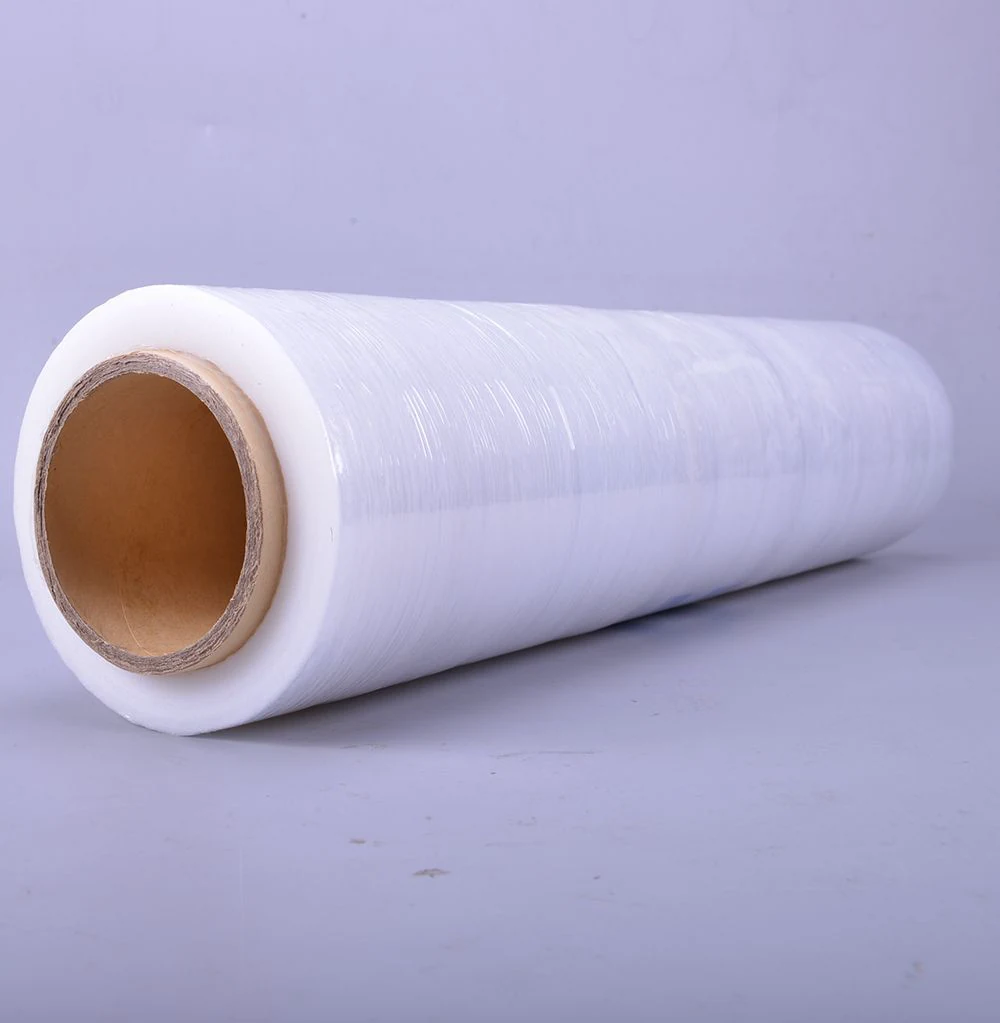
In a warehouse wrapping 50 pallets a day, 25 days a month (1,250 pallets), a saving of 237-291 g per pallet equals 296-364 kg of film a month. Every VND 10,000 difference in film price per kg corresponds to about VND 3-3.6 million a month; multiply by the price on your invoice to get the real amount.
The model’s level is higher than the 30-50% manufacturers usually publish, because the model assumes the same load holding. Two independent studies do not agree on whether more stretch holds the load more securely: a Cal Poly thesis (2012) found no correlation between pre-stretch percentage and load containment in ISTA 3E testing, while the Warsaw University of Technology group (2025) recorded a linear relationship between the number of turns, pre-stretch level, and stabilizing force. So if you need one figure for budget planning, use 30-50% and then replace it with the real weighed figure after a few weeks of trial runs. Remember too that only a machine with pre-stretch can save film this way.
Time and labor
Commercial sources show hand wrapping at about 3-5 minutes per pallet and a semi-automatic machine at about 1-2 minutes. The figures on ICD product pages match the machine side: ICD-X0MS states 30 pallets per hour (2 minutes per pallet), ICD-T1650FM states 20-40 pallets per hour, and the automatic ICD-T1650FZ states 30-50 pallets per hour.
The difference is 3.3 to 10 hours a day, meaning one person at the machine wraps 200 pallets in about 6.7 hours instead of needing one to two extra hand wrappers. In a small warehouse, the figure is more modest. Under Decree 293/2025/ND-CP, the Region I minimum hourly wage from 1 January 2026 is VND 25,500; a warehouse of 50 pallets a day saving 2 minutes per pallet saves about 41.7 hours a month, about VND 1.06 million at the minimum rate. The labor part is only truly large when output reaches hundreds of pallets a day.
There is one more benefit that is hard to convert to money but real: WorkSafe Victoria (Australia) classes hand pallet wrapping as work with a risk of musculoskeletal disorders and names an automatic or semi-automatic wrapper as the preferred solution.
Damaged goods and claims: the hardest benefit to measure
Some articles on benefits state a 60-80% reduction in damaged goods, but cite no source, and ICD Vietnam also found no public statistic that could serve as a general figure. The reason is easy to see: damage has many causes (stacking, inner packaging, transport conditions) and only part of it is from loose wrapping or open corners.
There are two indirect grounds. A 2021 study by the Warsaw University of Technology group, tested under the EUMOS 40509 and 40511 standards, concluded that choosing the right film and wrapping pattern raises the stabilizing force of the load and reduces the risk of damage, while also reducing film use. The right recipe matters more than whether you wrap by hand or machine; a machine helps that recipe repeat each time, and that is the real benefit.
Benefits by type of warehouse
The same machine, but different kinds of warehouse gain in different places. The four situations below show which quantity to look at.
Continuous-dispatch distribution and logistics warehouses
The most important quantity is minutes per pallet. At 200 pallets a day, the 3.3-10 hours a day difference calculated above is enough for one machine operator to replace a hand-wrapping team. The ICD-T1650F specification on its product page is a 1650 mm turntable, 2,000 kg load, 0-12 rpm speed, and it suggests warehouses wrapping 50-150 pallets a day.

Food and beverage
Bottled, canned, and bagged goods that are heavy and stacked high, so the quantities to watch are holding force and base turns. A film wrap on the outside helps limit dust and water splash during storage and handling, but does not replace packaging that touches food directly. A US wrapper maker recommends a base holding force about 10-30% higher than the body to bind the load to the pallet; a machine with preset base turns and pull force makes it easy to keep this ratio.
Electronics and equipment
Goods that dent easily and are sensitive to impact need tension lowered, not raised: too high a holding force can damage the goods themselves. The ICD-T1650F on its product page has 3 adjustable film tension levels. For high-value equipment, consider adding a cushioning layer (for example bubble wrap) before wrapping PE film on the outside, and use corner protectors for edges that dent easily.
Factories, wrapping at the end of the line
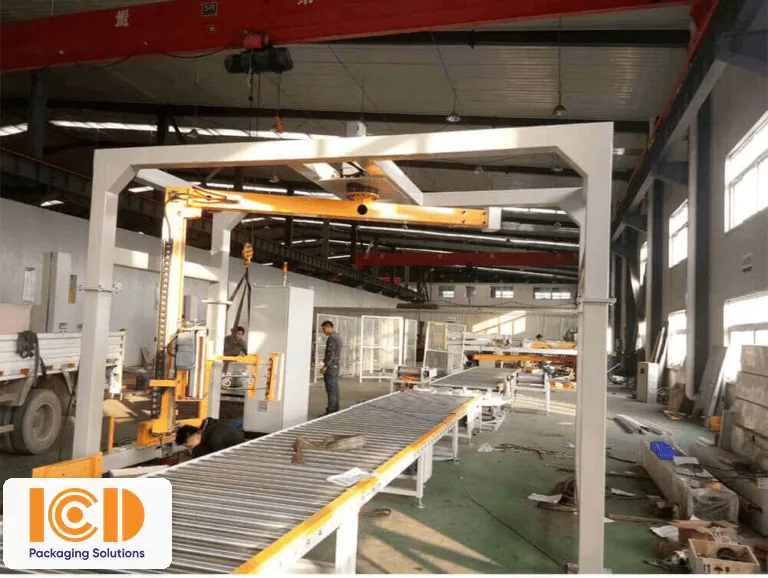
The quantity to look at is rhythm: the wrapper must keep up with the line so it does not become a bottleneck. On the product pages, the automatic ICD-T1650FZ states 30-50 pallets per hour with a film carriage stretching 250%; the ICD-T1800FZ combines a conveyor with a photo sensor measuring load height; the ICD R1800FZ-PL is a rotating-arm machine mounted on a conveyor, for large, heavy pallets that stay still.
Machine types and ICD models by scale
Per the product page, the ICD-T1650F is the most common semi-automatic line at ICD Vietnam. The table below sets the machine types against the specifications stated on the product pages; prices are “contact for a quote”, and for reference prices see the 2026 stretch wrapping machine price guide.
| Machine type | Model ICD | Specifications on the product page |
|---|---|---|
| Semi-automatic turntable | ICD-T1650F, ICD-Y1650F, ICD-X0MS | T1650F: 2,000 kg load, 0-12 rpm. Y1650F: 1,500 kg load, 0-10 rpm, 4 wheels. X0MS: 1,500 kg load, 30 pallets/hour |
| Semi-automatic M type | ICD-T1650FM | 1,000 kg load, 20-40 pallets/hour, hand pallet truck pushes straight into the M-shaped slot |
| Automatic, end of line | ICD-T1650FZ, ICD-T1800FZ | T1650FZ: 30-50 pallets/hour, film carriage stretching 250%. T1800FZ: combined with a conveyor, photo sensor measuring height |
| Heavy pallets or those that should not rotate | ICD R1800FZ-PL, Robot S7 Robopac, Masterplat Plus ICD-TP3 | Pallet stays still, an arm or robot travels around; the Masterplat Plus stretches up to 300% |
Detailed selection also depends on pallet size, load height, and actual weight. See the whole range of ICD pallet stretch wrapping machines to match specifications to your warehouse’s needs.
Frequently asked questions
How much film cost does a PE stretch wrapper save?
Manufacturers usually publish 30-50%. ICD Vietnam’s calculation model for a sample pallet of 1000 x 1200 x 1500 mm with 23 micron film gives 56% when the machine stretches 150% and 73% at 300% stretch, assuming the same load holding. The machine must have pre-stretch; weigh a film roll over 10 pallets to get the real figure.
How does a PE stretch wrapper speed up packing?
Hand wrapping takes about 3-5 minutes per pallet per commercial sources, a semi-automatic machine about 1-2 minutes. On ICD product pages, the ICD-X0MS states 30 pallets/hour, the ICD-T1650FM 20-40 pallets/hour, and the automatic ICD-T1650FZ 30-50 pallets/hour.
Are the benefits of a stretch wrapper the same in every kind of warehouse?
No. Continuous-dispatch warehouses gain most in time, factories in keeping up with the line, and easily dented or impact-sensitive goods in being able to adjust the pull force. So measure the three quantities in your own warehouse: grams of film, minutes per pallet, and pallets returned or damaged.
Does a stretch wrapper reduce damaged goods?
It can, but there is no general figure. The Warsaw University of Technology group’s study shows that choosing the right film and wrapping pattern reduces the risk of damage; a machine helps repeat that recipe. To know the reduction for your own warehouse, count pallets returned or damaged for three months before and after changing how you wrap.
Contact ICD Vietnam
ICD Vietnam advises on choosing a wrapper by your warehouse’s output and goods. Send your needs through the quote request or call directly:
- Northern Vietnam (Hanoi warehouse): 3rd Floor, Thang Long A1 Building, Bau Hamlet, Thien Loc Commune, Hanoi - 0983 797 186 | 090 345 9186
- Southern Vietnam workshop: 551/212 Le Van Khuong Street, Tan Thoi Hiep Ward, District 12, Ho Chi Minh City - 098 6784 186
- Email: sales@icdvietnam.com.vn | Zalo: Chat Zalo
References
- Tkaczyk S. et al., Study of the Stability of Palletized Cargo by Dynamic Test Method, Sensors, 2021
- Tkaczyk S. et al., Pilot Study of Stretch Film for Securing Palletized Loads, Sensors, 2025
- Cal Poly, thesis on pre-stretch and pallet load containment in ISTA 3E testing, 2012
- WorkSafe Victoria, Stretch wrapping pallets
- Decree 293/2025/ND-CP on the minimum wage (effective 1 January 2026)
- Film saving of 30-50%, hand wrapping time of 3-5 minutes and machine 1-2 minutes, and the recommended base holding force 10-30% higher: documents from wrapper distributors and makers (2017-2025), commercial sources, no link.
- Specifications of turntable load, speed, output, and stretch ratio on ICD Vietnam product pages, accessed October 2026; the film weight model and the labor hours chart are ICD Vietnam’s calculations, with assumptions stated in the guide.