
Table of Contents
- How is a single-drum spill pallet different from an ordinary pallet?
- Dimensions and specifications of a single-drum spill pallet
- Is a 40 - 45 litre sump enough for one 200-litre drum?
- How much does a full drum weigh, and can a one-drum pallet carry it?
- When to choose a 1-drum pallet and when a 2-drum or 4-drum one?
- Where is a 1-drum pallet usually placed in a plant?
- How to place a drum on a 1-drum pallet safely
- Material and chemical resistance to check
- Cleaning and emptying the tray
- Frequently asked questions
- How many litres does a single-drum spill pallet hold?
- What size is a single-drum spill pallet?
- Does a single-drum spill pallet meet the 110% level of QCVN 05A?
- Can a single-drum pallet carry a heavy chemical drum?
- Can one drum be placed on a 2-drum spill pallet?
- Can a single-drum spill pallet be used outdoors?
- How should the liquid in the tray be handled?
- Contact ICD Vietnam
- References
Reviewed and updated by ICD - Week 44/2026
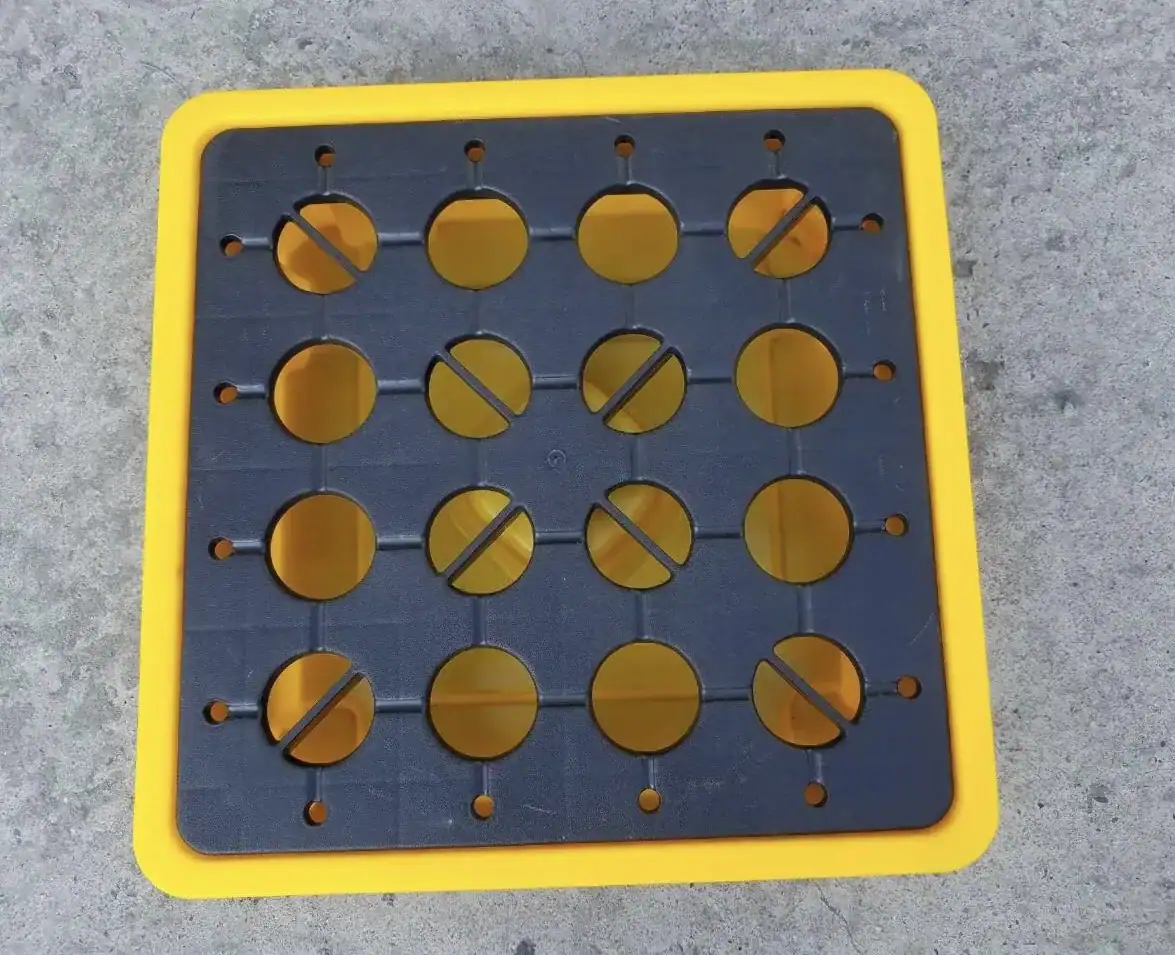
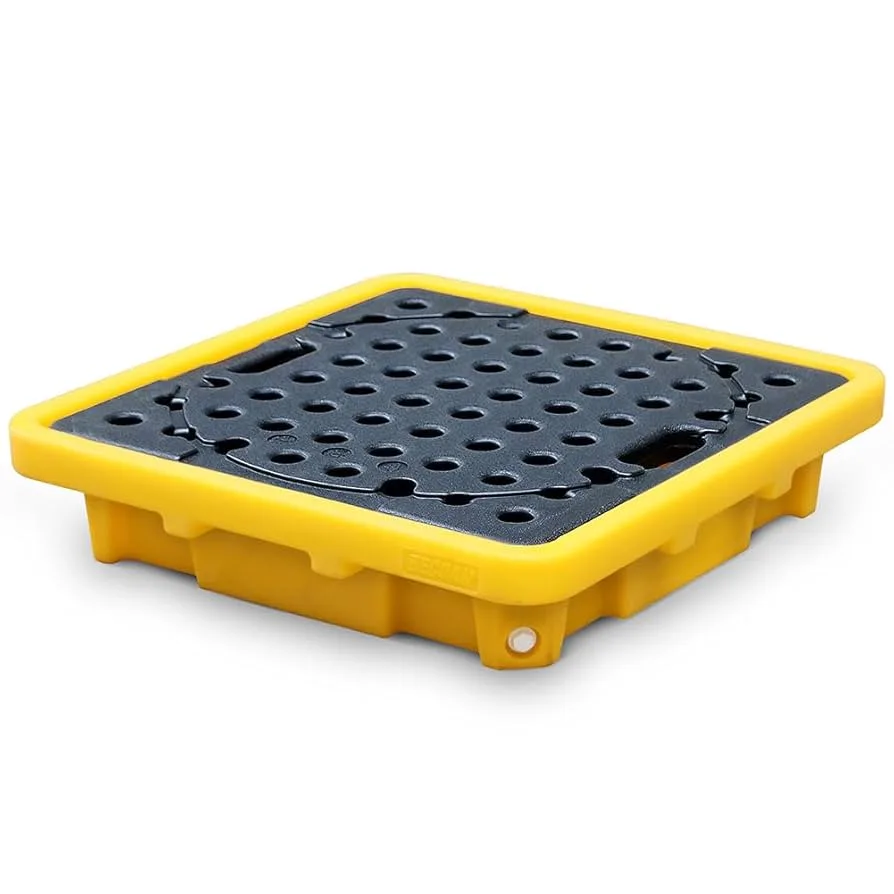
A single-drum spill pallet is an HDPE tray with a grated deck that holds exactly one 200-litre drum, with a sump underneath to catch leaking liquid. Common models on the market measure about 680 x 680 mm or 720 x 720 mm, stand 150 - 160 mm tall, hold 40 - 45 litres in the sump and carry a dynamic load of around 300 kg.
The 40 - 45 litre figure is the detail many buyers miss: it is only about 21% of the drum’s volume, so a one-drum pallet catches drips and moderate leaks, but it cannot hold a whole drum if the drum splits. This article focuses on the one-drum type: the specifications worth reading, when to choose it over a 2-drum or 4-drum pallet, realistic load limits for different liquids, how to place the drum, and how to empty the sump safely.
How is a single-drum spill pallet different from an ordinary pallet?
An ordinary pallet only carries goods for a forklift, while a spill pallet adds a sealed, one-piece sump that retains liquid leaking from the drum. If an oil or chemical drum on an ordinary pallet leaks at the bung or through a punctured base, the liquid runs straight onto the floor and spreads into walkways or drains. On a plastic spill containment pallet, the leak passes through the grated deck into the sump and stays separated from the drum base until it is pumped out. The floor and forklift are protected from chemical attack, and workers do not slip on an oily floor.
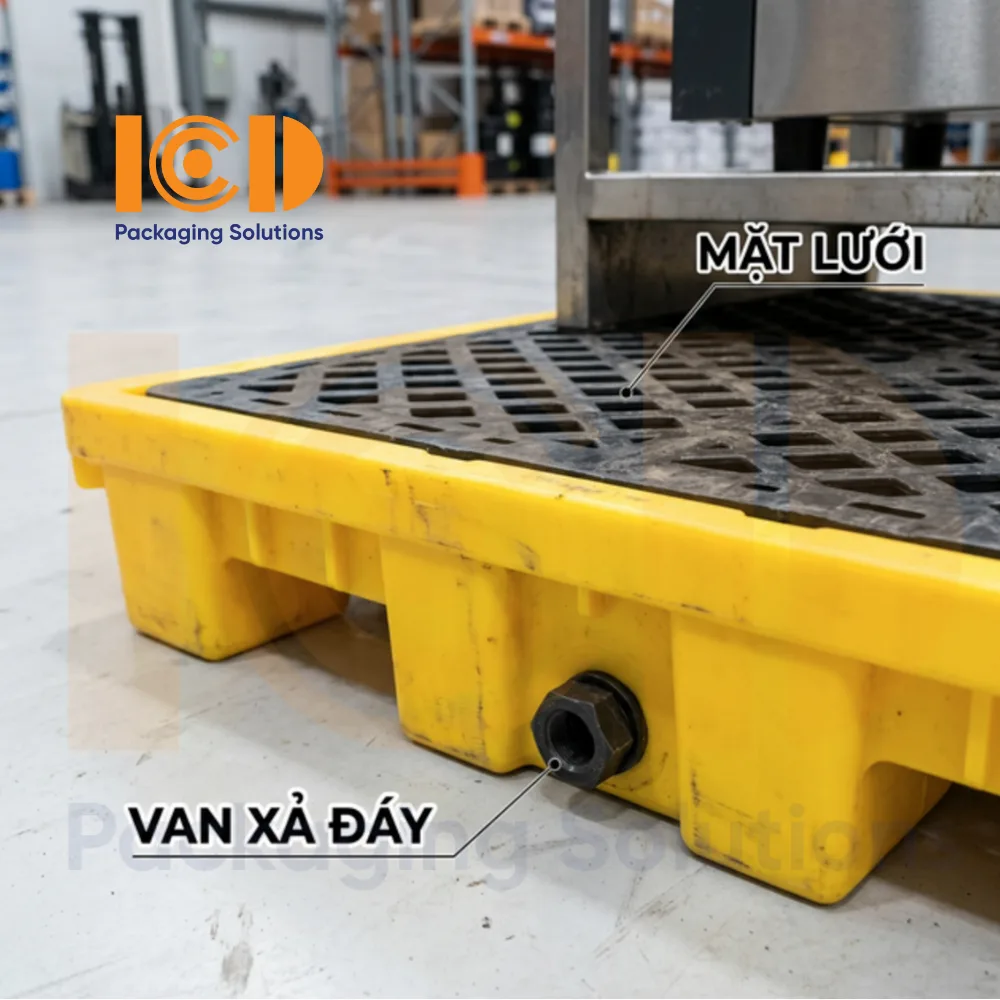
A single-drum spill pallet has three parts. The sump tray is moulded in one piece from HDPE, with no joints and therefore no seams to leak. The grated deck that carries the drum is usually removable for cleaning, with holes or slots large enough for liquid to drain through. Some models also have a drain valve at the base or side of the tray, so the collected liquid can be drawn off without lifting the drum away.
Dimensions and specifications of a single-drum spill pallet
A one-drum pallet has a square deck that fits a 200-litre drum, whose diameter is about 57 - 58 cm, with a few centimetres of clearance on each side so the drum does not touch the rim. The table below shows the ranges manufacturers commonly publish for the low-wall type. When buying, check each line against the datasheet of the exact model you plan to order.
| Specification | Common range (low-wall single-drum type) | Why it matters |
|---|---|---|
| Deck size | 680 x 680 mm or 720 x 720 mm | A 200-litre drum, about 57 - 58 cm in diameter, must sit fully inside the deck |
| Height | 150 - 160 mm | Determines sump volume and the height the drum must be lifted |
| Sump capacity | 40 - 45 litres | Only about 21% of a 200-litre drum |
| Dynamic load | About 300 kg | Limit when lifting or moving the pallet with a drum on it |
| Static load | 600 - 700 kg | Limit when the pallet stays in a fixed position on the floor |
| Pallet weight | About 8 kg | One person can lift it when it is empty |
| Material | Virgin HDPE | Resists most dilute acids, alkalis and oils at normal temperature |
ICD Vietnam’s spill pallet range currently includes 2-drum and 4-drum models, with no dedicated single-drum model. When a customer needs a place for one drum, we advise based on the warehouse’s containment requirement: some sites only need a small drip tray, while others need more capacity and place one drum on a 2-drum pallet to get a sump twice as large at the same height.
Is a 40 - 45 litre sump enough for one 200-litre drum?
No, not if the site must contain the entire drum when it fails. Each regulation sets a different level, and for a single drum the requirement is always far above 40 - 45 litres:
- Regulation 40 CFR 264.175 of the US Environmental Protection Agency (EPA) requires a containment system equal to 10% of the total volume or the largest container, whichever is greater, which means 200 litres for one drum.
- The 2001 oil storage regulations in England require a drum drip tray to hold at least 25% of the total drum capacity, which means 50 litres.
- QCVN 05A:2020/BCT, Amendment 1:2024, requires stores of corrosive and toxic liquid chemicals to have a collection system of at least 110% of the capacity of the largest container, which means 220 litres.
For a tray with a 680 x 680 mm base to hold 220 litres on its own, the walls would have to be about 48 cm deep (0.22 m³ divided by 0.46 m² of base, before subtracting wall thickness). Nobody makes a pallet that deep, because the drum would be hard to load and the centre of gravity far too high. In practice, chemical stores use a one-drum pallet as a point-of-use layer for small leaks, while the 110% containment is provided by the bund, kerbs, channels and sump of the whole area. For the details of each regulation and how to calculate for a multi-drum store, see spill containment pallet dimensions by regulation.
How much does a full drum weigh, and can a one-drum pallet carry it?
The weight of a full drum is 200 litres multiplied by the liquid’s density, plus the drum itself. A drum of lubricating oil with a density of 0.85 - 0.9 holds about 170 - 180 kg of liquid; a drum of water holds about 200 kg; a steel drum adds roughly 20 kg. These figures all stay below the dynamic load of about 300 kg of a common one-drum pallet.
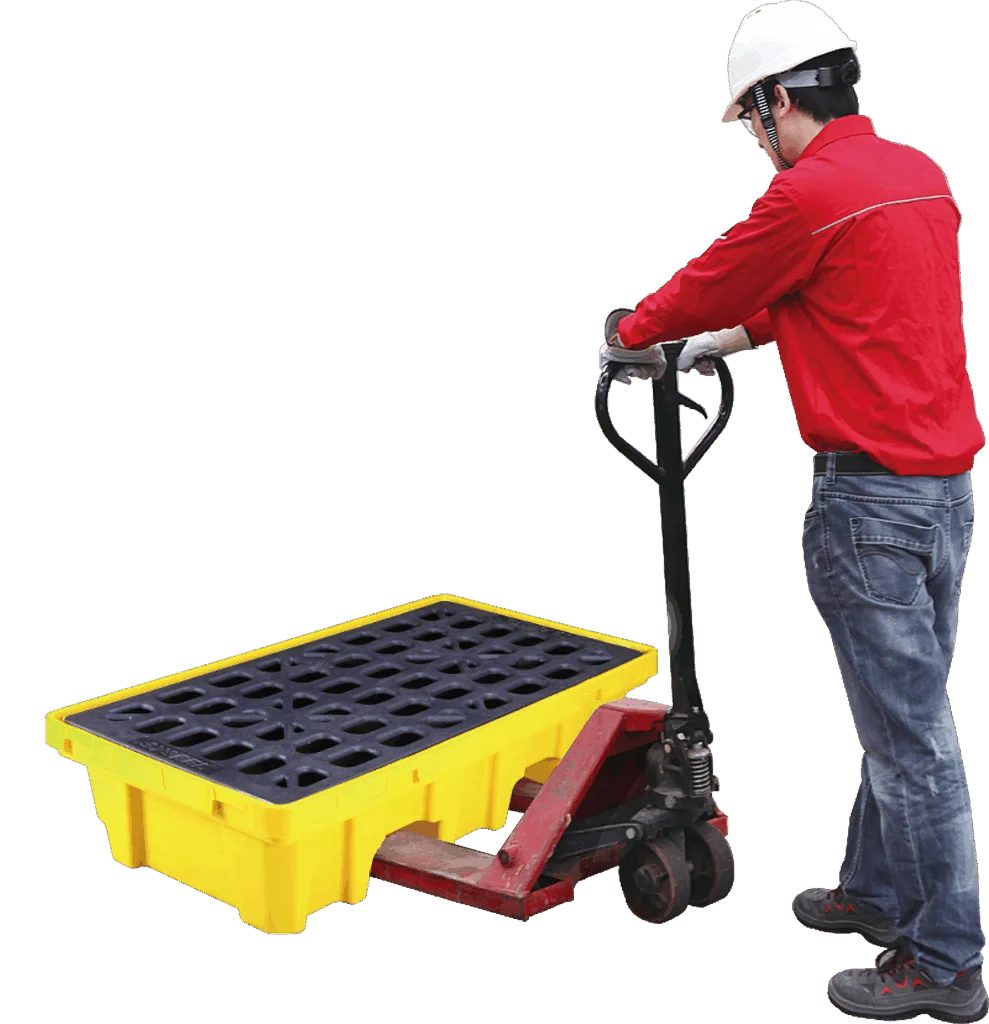
Heavy chemicals are a different case. A 50% caustic soda solution has a density of about 1.52, so 200 litres already weighs about 304 kg before the drum, which exceeds the 300 kg dynamic load. Such a drum can stay in place on the pallet because the static load is 600 - 700 kg, but you should not lift the pallet and full drum together with a hand pallet truck to move it. Before choosing, take the density from the chemical’s safety data sheet (SDS), multiply by 200, and compare the result with the dynamic load of the pallet model.
When to choose a 1-drum pallet and when a 2-drum or 4-drum one?
Choose a 1-drum pallet when there is a single drum at one location: a filling or decanting point beside a machine, an oil drum feeding one machine, or a chemical drum that must stay apart because it is incompatible with others. When two or more drums of the same kind sit together, a 2-drum or 4-drum pallet saves floor space and gives a larger sump.
| Type | Size (mm) | Static / dynamic load | Best for |
|---|---|---|---|
| 1 drum, low wall (common on the market) | 680 x 680 or 720 x 720, height 150 - 160 | 600 - 700 kg / about 300 kg | Filling and decanting points; drums that must be kept apart |
| 2 drums, low wall, ICD Vietnam | 1300 x 660 x 150 | 2,000 kg / 1,000 kg | Two drums of the same kind, easy drum loading |
| 2 drums, high wall, ICD Vietnam | 1300 x 660 x 300 | 1,000 kg / 500 kg | A deeper sump for two drums |
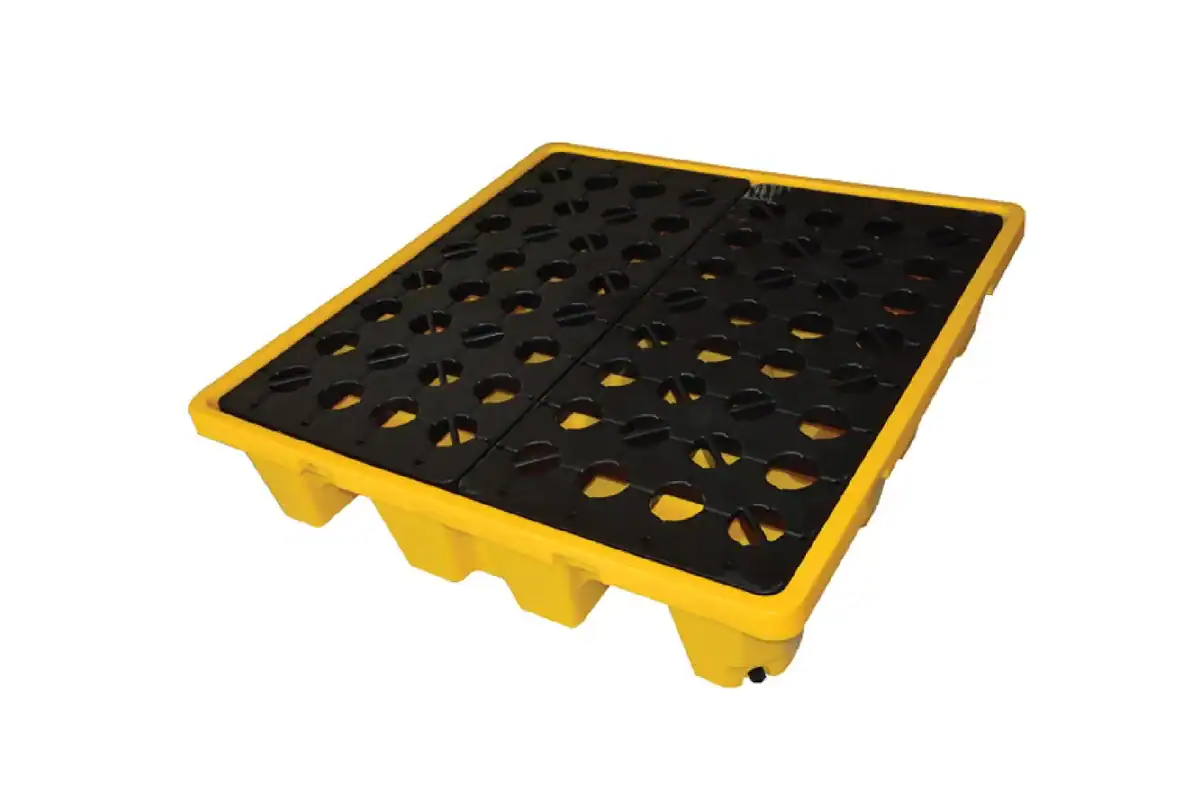
| 4 drums, ICD Vietnam | 1300 x 1300 x 300, 150-litre sump | 2,000 kg / 1,000 kg | Areas holding many drums, moved with a hand pallet truck |
A note on incompatible chemicals: QCVN 05A requires the collection system to keep spilled chemicals away from other chemicals they can react with. Putting an acid and an alkali on the same 4-drum pallet sends both into one sump if they leak. In that case, several separate 1-drum pallets are the better choice than one large pallet.
Where is a 1-drum pallet usually placed in a plant?
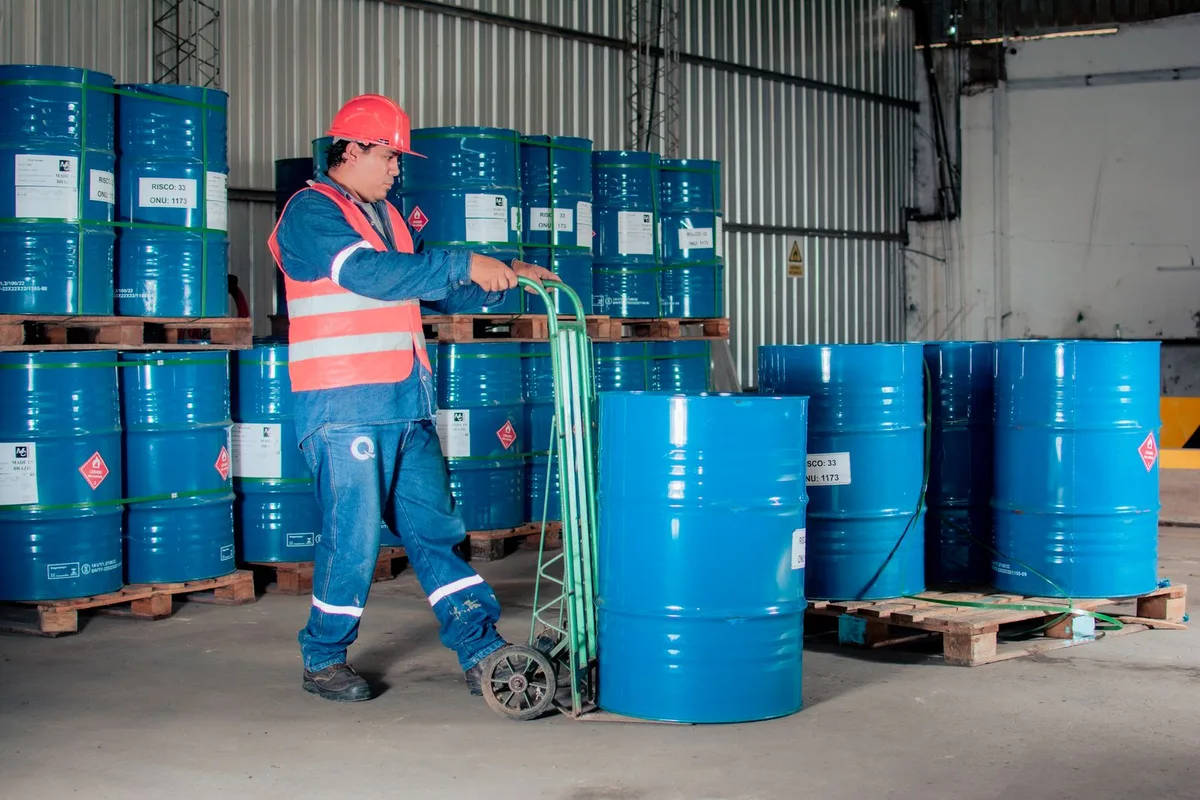
A 1-drum pallet goes where there is only one drum and the drum is opened daily, which is where small leaks happen most. In a machine shop, that is the cutting oil or hydraulic oil drum beside a CNC machine or press. At a wastewater plant, it is the caustic soda, acid or flocculant drum feeding a dosing pump. In a printing or paint shop, it is the ink or solvent drum beside the mixing area.
What these places have in common is that the drum stands close to machines and people, and the floor usually has no containment kerb like the main warehouse. A small tray under the drum keeps the floor around the machine dry, reduces slipping and limits how much chemical soaks into the concrete. By contrast, in a central store holding dozens of drums, 2-drum and 4-drum pallets inside a bunded area make more sense than many scattered 1-drum pallets.
How to place a drum on a 1-drum pallet safely
A full 200-litre drum weighs 190 - 320 kg, so loading the drum onto the tray is when accidents happen and the grated deck is most likely to be damaged. We recommend these steps, in this order:
- Put the pallet in its permanent position on a flat floor before the drum goes on.
- Use a drum trolley or drum clamp; never roll a full drum over the tray rim.
- Lower the drum into the middle of the deck so the drum base does not touch the tray wall.
- Check that the deck lies flat and is not warped after the drum is placed.
- When pouring or decanting, hold the funnel or spout right above the deck so drips fall into the sump.
A low-wall pallet of 150 - 160 mm has an advantage at this step: the lifting height is only like a kerb, so a drum trolley manages it easily. That is also why the 1-drum type is almost always low-wall, even though it limits the sump volume.
Material and chemical resistance to check
Single-drum spill pallets are usually made of virgin HDPE, which resists oil, water and most dilute acids and alkalis at normal temperature. HDPE does not resist everything: concentrated sulphuric acid, some chlorinated solvents and strong oxidisers can make the plastic swell, turn brittle or crack over time. For a specific chemical, ask the manufacturer for a chemical resistance chart; tests such as ASTM D543 are a way to assess how plastic withstands chemicals. You can also read more about the decree on hazardous waste.
If the pallet will stand outdoors, HDPE without a UV stabiliser fades and gradually turns brittle in the sun, so choose only models the manufacturer clearly states are UV-resistant. When comparing suppliers, you can also ask about the manufacturer’s management system certificates such as ISO 9001 or ISO 14001; these certify the factory’s processes and do not replace the specification sheet and chemical resistance chart of the product itself.
Cleaning and emptying the tray
A 40 - 45 litre sump fills faster than you might expect, especially outdoors where it also collects rainwater. Check the tray weekly or after every pouring or decanting job, and pump liquid out as soon as you see any. A tray half full of rainwater has only about 20 litres left for a real leak.
Liquid collected in the tray, whether rainwater mixed with oil or chemicals, is waste that must be collected and treated under hazardous waste rules, not poured into a drain or storm channel. To clean, remove the deck, pump out all liquid, wipe the sump dry and only then put the drum back; on pallets with a drain valve, check the valve seal so it does not leak by itself.
Frequently asked questions
How many litres does a single-drum spill pallet hold?
A common low-wall single-drum model, 150 - 160 mm high, has a sump of about 40 - 45 litres, roughly 21% of the volume of a 200-litre drum. This is the level of a small-leak drip tray, not full-drum containment.
What size is a single-drum spill pallet?
The common type has a deck of about 680 x 680 mm or 720 x 720 mm and a height of 150 - 160 mm, enough for a 200-litre drum, about 57 - 58 cm in diameter, to sit fully on the deck.
Does a single-drum spill pallet meet the 110% level of QCVN 05A?
No. The 110% level for one 200-litre drum is 220 litres, while the sump of a single-drum pallet holds only about 40 - 45 litres. A store of corrosive or toxic liquid chemicals needs additional bunds, channels or a collection sump to reach this level.
Can a single-drum pallet carry a heavy chemical drum?
In a fixed position, usually yes, because the common static load is 600 - 700 kg. For moving it, check the dynamic load of about 300 kg: a drum of 50% caustic soda already holds about 304 kg of liquid, which exceeds this level.
Can one drum be placed on a 2-drum spill pallet?
Yes. A 2-drum pallet has a sump twice as large at the same height, so it collects more, in exchange for taking up more floor space.
Can a single-drum spill pallet be used outdoors?
Yes, if the manufacturer states the material is UV-resistant. Outdoors, rainwater gradually takes up sump capacity, so the tray needs to be checked and emptied more often.
How should the liquid in the tray be handled?
Pump it out, store it in a sealed container and treat it as hazardous waste under the regulations. Do not pour liquid from the tray into a drain or storm channel, even when most of it is rainwater.
Contact ICD Vietnam
If you need help choosing a spill pallet by number of drums, type of chemical and the containment requirement of your site, contact ICD Vietnam for advice on a suitable model and a quote.
ICD Vietnam Industrial Manufacturing Co., Ltd
Northern Vietnam: 3rd Floor, Thang Long A1 Building, Bau Hamlet, Thien Loc Commune, Hanoi - 0983 797 186 / 090 345 9186 / 090 5859 186
Southern Vietnam: 551/212 Le Van Khuong, Tan Thoi Hiep Ward, District 12, Ho Chi Minh City - 098 6784 186
Email: sales@icdvietnam.com.vn
Zalo: Chat with ICD Vietnam on Zalo
References
- Containment capacity requirement: EPA, 40 CFR 264.175 Containment, eCFR.
- 25% drum drip tray: The Control of Pollution (Oil Storage) (England) Regulations 2001, legislation.gov.uk.
- 110% collection system and collection of incompatible chemicals: QCVN 05A:2020/BCT, Vietnamese Government web portal, and Circular 19/2024/TT-BCT issuing Amendment 1:2024.
- Chemical resistance test for plastics: ASTM D543.
- Environmental management system: ISO 14001:2015.
- Specifications of 2-drum and 4-drum spill pallets: ICD Vietnam product catalogue, checked on 15 October 2026.