
Table of Contents
Reviewed and updated by ICD - Week 43/2026
Short answer: PA plastic (polyamide) is a rigid material (nylon wheel tread 70 to 80 Shore D), while polyurethane (PU) is an elastic material (tread 92 Shore A or softer). Wheels: PA for heavy loads on hard, flat floors; PU for floors that scratch easily and where a quiet ride matters. Compressed air tubing: PA takes about 2 times the pressure of PU tubing of the same size, while PU bends more easily. Seals: choose PU, because PA is too rigid to seal tightly.
PA and PU are often placed side by side because both are used for wheels, air hose and machine parts. The root difference is that PU belongs to the elastomer group, while PA is a rigid crystalline plastic. This article compares them for the three applications that buyers of warehouse and factory supplies meet most often, using figures from wheel and air-tubing manufacturers and BASF datasheets; where something is only an inference, it is marked as such.
PA and PU differ in the nature of the material
PA6 and PA66 are semi-crystalline plastics: tensile modulus is about 3,100 MPa when dry (BASF Ultramid B3K), melting at 220 °C for PA6 and 260 °C for PA66, but water absorption of 2.6 to 3.4% at equilibrium drops the modulus to about 1,000 MPa. Most of the properties of PA are in the introduction to PA plastic, so here only the points needed for comparison with PU are kept.
PU is not a single type. Caster City divides it into three families: polyester (strong in tension, wear resistant, good oil resistance, but hydrolyses in hot humid conditions), polyether PPG (good water resistance, lower mechanical properties) and polyether PTMEG (mechanical properties close to polyester, good water resistance, higher price). The letters “PU” on a wheel price list therefore say little; ask about the polyol base.
| Criterion | PA6, PA66 (nylon) | PU (polyurethane) |
|---|---|---|
| Wheel tread hardness | 70 to 80 Shore D (Blickle) | 92 Shore A, soft version 75 Shore A (Blickle) |
| Floor pressure (wheels) | about 40 N/mm² | about 8 N/mm² (92A), 3.5 N/mm² (75A) |
| Water absorption | 2.6 to 3.4% at equilibrium, dimensions change | polyester hydrolyses when hot and humid; polyether resists water |
| Rebound (Bashore) | not stated in the source | 35 to 40% polyester, 45 to 50% PTMEG (Caster City) |
| As compressed air tubing (4 mm) | maximum 1.0 MPa, minimum bend 13 mm (SMC) | maximum 0.5 MPa, minimum bend 10 mm (SMC) |
| Air tubing temperature range (ISO 11619) | -20 to 80 °C | -20 to 60 °C |
Industrial castor wheels: hard or soft
A nylon tread is hard, so floor pressure is high, but it rolls easily and does not deform under load. Blickle gives the average floor pressure of nylon as about 40 N/mm² (cast nylon 60), of PU 92 Shore A about 8 N/mm² and of PU 75 Shore A about 3.5 N/mm². That means nylon presses on the floor about 5 times harder than PU 92A; a thick concrete floor can take it, while a thin epoxy floor or polished tile is safer with PU. Bulldog Castors gives nylon an operating range of -30 to +80 °C.
PU wins on ride comfort and noise, because the elastic tread absorbs shock. Caster City also states the cost of softness: going from 95 down to 80 Shore A can reduce the real dynamic load by about 25 to 40%, while increasing rolling resistance and permanent deformation (creep). That is why soft PU wheels left under a heavy truck standing in one place are easily flattened locally at the contact point, and wheels for very heavy loads often use PU of 60 to 65 Shore D rather than an 80A grade.
A simple rule: heavy load, flat concrete floor and a need for easy rolling, PA; a floor that scratches easily or a requirement for quiet running, PU 92A or harder, and polyether where it is wet; a very heavy load with floor protection needed, hard PU of 60 to 65 Shore D. The common claim that PA wheels are “always more durable outdoors” has no source that could be found: outdoors it is decided by whether the resin is UV stabilised (the BASF K grade) and by the polyol base of the PU, not by PA or PU alone.
Compressed air tubing: PA takes pressure, PU bends easily
SMC data for tubing of the same 4 mm outside diameter: nylon 12 tubing takes a maximum pressure of 1.0 MPa with a minimum bend radius of 13 mm; polyurethane tubing takes 0.5 MPa with a bend radius of 10 mm. The AutomationDirect table gives results in the same direction: 4 mm nylon tubing works at 350 psi at 21 °C and PU tubing of the same size at 200 psi at 24 °C; at 65.6 °C nylon still has 160 psi and PU only 85 psi. Nylon loses less pressure rating with temperature than PU.
| 4 mm tubing | Nylon (SMC, AutomationDirect) | PU (SMC, AutomationDirect) |
|---|---|---|
| Maximum pressure at room temperature | 1.0 MPa; 350 psi | 0.5 MPa; 200 psi |
| Working pressure at 65.6 °C | 160 psi | 85 psi |
| Minimum bend radius | 13 mm | 10 mm |
| Standard temperature range ISO 11619 | -20 to 80 °C | -20 to 60 °C |
On temperature, KR West gives the working range of nylon tubing as -40 to 93 °C, PU as -40 to 74 °C and polyethylene as -73 to 79.5 °C. They rank PU as the softest, polyethylene as moderately soft and nylon as the least soft. This answers the claim in many articles that “PE tubing is much stiffer than PU”: the source shows PE is softer than nylon.
ISO 11619 also states a condition that is often overlooked: PU is polyester-based or polyether-based, and when water is present above 40 °C a hydrolysis-resistant PU must be specified with the supplier. So PU tubing is not “absolutely moisture proof” as some articles say; it resists moisture well when the polyol base is right.
In summary for tubing: for fixed main lines, high pressure or near a heat source, choose nylon; for lines running to a manipulator or robot, places that bend a lot and low pressure, choose PU. When you need both (a lot of tight bending and still above 1 MPa) you need specialised copolyamide tubing, of the kind that some manufacturers publish documents on, but this article does not have enough independent data to assess it.
Gaskets and seals: PU, not PA
For seals the need is elasticity to press tight into the groove. Boedeker lists hydraulic seals among the typical uses of polyester PU (cut resistance, tear resistance, wear resistance, oil resistance), while PA is not among the materials used for elastic seals. The reason is an inference from hardness: PA is in the range of several thousand MPa and does not deform to fit the groove the way elastic PU does. PA is still usable for sliding parts, bushings and gears, where rigidity and wear resistance are needed.
The claim “PU stops 100% of leaks” is advertising, not a specification. Sealing depends on the groove, pressure, oil or gas, temperature and polyol base. With oil, polyester is better; with hot water, polyether.
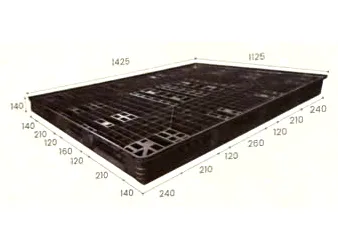
If you are choosing warehouse supplies rather than machine parts, explore ICD Vietnam’s plastic pallet lines by load capacity and rack type.
Frequently asked questions
How do PA and PU plastic differ?
PA is a rigid semi-crystalline plastic (wheel nylon 70 to 80 Shore D). PU is an elastic material (tread 92 Shore A or softer), with several families such as polyester and polyether.
When should you choose PA wheels rather than PU?
When the load is heavy, the concrete floor is flat and hard, and easy rolling is needed. Nylon presses on the floor at about 40 N/mm², about 5 times PU 92 Shore A according to Blickle.
When should you choose PU wheels?
When the floor scratches easily (thin epoxy, polished tile) and quiet, smooth running is needed. For wet places or outdoors, choose polyether-based PU.
Is PA or PU better for compressed air tubing?
PA takes higher pressure (4 mm tubing: 1.0 MPa versus 0.5 MPa for PU, according to SMC) and holds pressure better when hot. PU bends more easily (10 mm bend radius versus 13 mm).
Can PU tubing withstand water?
Yes, if the polyol base is right: ISO 11619 requires a hydrolysis-resistant PU to be specified when water is present above 40 °C.
Should seals be made of PA or PU?
PU. The elasticity of PU lets it seal tightly; PA is rigid and so suits sliding or supporting parts, not elastic seals.
Contact ICD Vietnam
ICD Vietnam Industrial Manufacturing Co., Ltd.
North: 3rd Floor, Thang Long A1 Building, Bau Hamlet, Thien Loc Commune, Hanoi, 0983 797 186 / 090 345 9186 / 090 5859 186
South: 551/212 Le Van Khuong Street, Tan Thoi Hiep Ward, District 12, Ho Chi Minh City, 098 6784 186
Email: sales@icdvietnam.com.vn
Zalo: Chat on Zalo now
References
- Blickle, Info box wheel and castor series (tread hardness: nylon 70 Shore D, cast nylon 80 Shore D, PU 92 Shore A; average floor pressure nylon 40, PU 92 Shore A 8 N/mm2) - blickle.com
- Bulldog Castors, Engineering Polymers: Material Properties of Polymeric Caster Wheels (nylon 80 to 90 Shore D, -30 to +80 °C, nylon 6 and 66 both used for wheels and wheel cores) - bulldogcastors.co.uk
- Caster City, The Science of Polyurethane Caster Wheels (polyester, polyether PPG, PTMEG; hardness, hydrolysis, rebound) - castercity.com
- Boedeker Plastics, Polyurethane Technical Guide (polyether for forklift wheels, polyester for hydraulic seals) - boedeker.com
- SMC, nylon tubing T0425 and polyurethane tubing TU0425, 4 mm outside diameter (maximum pressure 1.0 and 0.5 MPa, minimum bend radius 13 and 10 mm) - smcpneumatics.com
- AutomationDirect, Nylon Pneumatic Tubing (working pressure by temperature table for nylon and polyurethane tubing) - automationdirect.com
- KR West, Nycoil tubing catalog (comparison of polyethylene, nylon, polyurethane: temperature, pressure, softness) - krwest.com
- ISO 11619:2024, Pneumatic fluid power - Polyurethane and polyamide tubings (PU used at -20 to 60 °C, PA at -20 to 80 °C; PU polyester-based or polyether-based; above 40 °C with water a hydrolysis-resistant PU is needed) - iteh.ai (sample)
- BASF, Ultramid B3K (PA6) Product Information, 09/2026: density 1,130 kg/m3, melting point 220 °C, saturation moisture absorption 9 to 10%, equilibrium at 23 °C/50% RH 2.6 to 3.4%, HDT A 60 °C, drying 80 °C for 4 hours - download.basf.com
- BASF, Ultramid (PA) brochure, section Behavior on exposure to weather (K grade is weather resistant, carbon black gives the best effect) - basf.com